
Civita di Matera: Old Town Between the Sassi
Walk Matera's Civita, the historic ridge between Sasso Barisano and Sasso Caveoso, with cathedral views, free panoramas and traffic-zone tips.
On this page
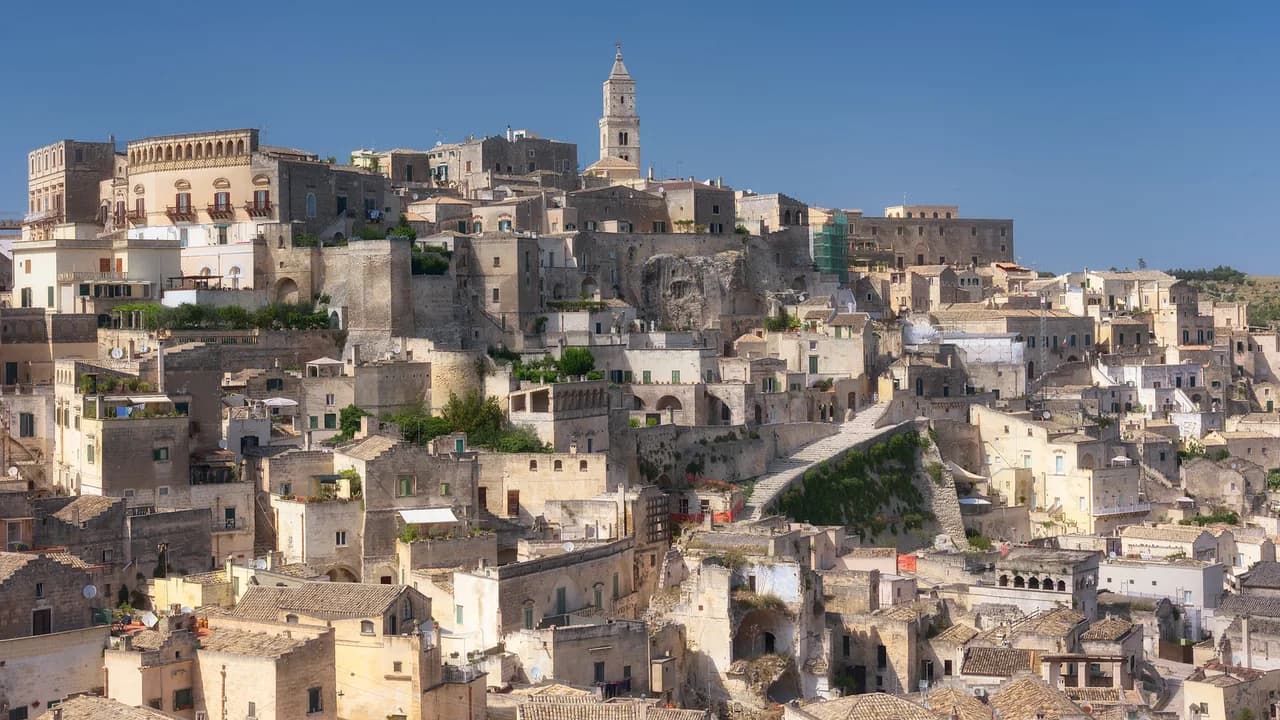
Matera's old town is not one uniform cave district but a set of quarters stacked on a limestone ridge above the Gravina ravine. At the highest point sits the Civita, the historic core where the cathedral commands the skyline between the two better-known sassi. Treating it as the hinge of a walk, rather than a separate village to tick off, makes the layout far easier to read.
The two districts below it are the Sasso Barisano to the north, busier with hotels and restaurants, and the Sasso Caveoso to the south, the zone most often photographed. Guidebook writers note there is no hard line between them, so you will drift from one to the other without noticing. The Civita is simply the ridge that separates and connects them.
As editorial advice rather than official guidance, allow half a day to walk up from the modern city, explore the cathedral piazza, follow the ridge and descend into one sasso. Add a second night if you want the paid cave interiors as well, because each one takes time even when the entry is modest.
Where the Civita Sits in Matera's Layout
Matera lies in Basilicata, in a remote corner of southern Italy, and the old quarters are carved into the soft tufa on the edge of a ravine. The Civita occupies the high ground on the ridge between the two sassi, which is why the cathedral was built there and why its bell tower is visible from viewpoints across the city. It is a position, not a walled enclave, so expect to arrive on foot through ordinary lanes.
Approaching from the modern town, most visitors reach the old quarters via the main square, Piazza Vittorio Veneto, and the viewpoints beside it. From there the streets climb toward the cathedral through a dense press of stone houses, courtyards and staircases. Understanding that uphill direction is the single most useful orientation tool before you set off.
Reading the Two Sassi Before You Climb
The Sasso Barisano is usually the first district you enter when walking down from the modern city. It holds a concentration of hotels, shops and restaurants, so it feels busier and more commercial than its neighbour. Its lanes are still narrow and steep, but they open frequently onto terraces with views across to the other side of the ridge.
The Sasso Caveoso, on the southern flank, is where many of the classic photographs are made: rows of stone facades and cave dwellings climbing the hillside. It also contains the uninhabited caves on the edge of the quarter, which give a rawer sense of how the sassi looked before restoration. Walking between the two, you cross the Civita without any formal boundary marker.
A short historical note helps the walk make sense. Matera was described as a national shame in the mid-twentieth century, when families lived in caves without running water, sewage or electricity, and thousands were rehoused in the modern city from the 1950s. UNESCO recognition followed in 1993, and the quarters once abandoned became hotels, museums and restaurants.
Arrival and Access: Traffic Zones and Leaving the Car Outside
If you drive, do not follow an online pin into the old town. The historic quarters are a limited traffic zone restricted to residents and guests of hotels inside it, and drivers can be fined simply for passing through. Travellers have reported exactly that mistake after trusting a car park location found online, so park outside the zone and continue on foot. Further visitor details appear in Sassi Di Matera: The Ultimate Guide For A Day Trip - The Marvelous Travelers.
Arriving by bus or train brings you to the modern city, generally within a walk of the old quarters, and the final stretch is uphill on stone. Pack light if you are staying inside the sassi, because you will likely carry bags up staircases where vehicles cannot go. Ask your accommodation in advance about luggage help or parking arrangements. For wider planning, see Sassi di Matera Visitor Guide.
A Walking Route from Piazza Vittorio Veneto to the Cathedral
Begin on Piazza Vittorio Veneto, the square that marks the edge of the modern grid, and pass through the Tre Archi to the belvedere named after Luigi Guerricchio. From there, follow lanes uphill toward the cathedral, letting the bell tower guide you. The route is short in distance but relentless in gradient, so pace yourself and pause at each terrace.
If you prefer a plotted line rather than improvising, a self-guided walk through the Sassi can sequence the viewpoints, the cathedral and the descent into one district without doubling back. Either way, the pleasure of the Civita is in the detours: a courtyard with flower pots, a sudden arch framing the ravine, a staircase that ends at a private door.
The Cathedral as the Focal Point of the Civita
Matera's cathedral, dedicated to Maria Santissima della Bruna and Sant'Eustachio, was built in the thirteenth century on the highest ridge of the old city. Its Romanesque exterior is restrained apart from a fine rose window, while the interior was decorated centuries later with gilding, ceiling frescoes and an elaborate carved nativity. That contrast between plain stone outside and ornament within is the reason to step past the doorway. For wider planning, see Cattedrale di Matera Visitor Guide.
The piazza in front of the cathedral sits at the top of the Civita, and the views from it are among the best in the city even if you never go inside. Entry to the interior is charged, unlike the outdoor viewpoints, so treat it as a separate decision from the walk itself. Current admission and any restrictions are published by the site and tourism offices rather than fixed in guidebooks.
Some travellers report that the bell tower is not open to climb, and the cathedral's height already does the work of a tower. Check locally before planning around any tower access. Photography rules inside churches vary, so look for signage at each entrance.
Palazzi and Lanes You Pass Without Entering
The Civita's noble palazzi line the streets around the cathedral, their stone facades often giving little away from outside. Most are private or in mixed use, so admire the doorways, balconies and carved lintels as part of the walk rather than expecting a house museum. No reliable public source confirms regular opening for these buildings, so plan the Civita around its streets and churches.
The lanes themselves are the attraction: steep, uneven and often shaded, they thread between houses whose roofs serve as streets for the level above. This is ordinary residential Matera, so keep voices low near doorways and give way on stairs. A slower pace reveals more than a rushed circuit of the main sights; for more corners like these, see the hidden gems in Matera.
Free Viewpoints Along the Ridge
The Belvedere dei Tre Archi, beside Piazza Vittorio Veneto, looks over the dense packing of the city and the cathedral beyond. It has two levels, and the lower one is often empty when the upper terrace is crowded. Light is harsh in the middle of the day, so early morning or late afternoon suits photography better.
Piazzetta Pascoli, next to Palazzo Lanfranchi, gives a different angle: the sassi on one side and the hillside churches and valley on the other. Both viewpoints are free and open, which makes them a sensible way to structure a walk when your budget is focused on one or two paid interiors. For wider planning, see Cattedrale di Matera Visitor Guide.
On the far side of the ravine, the Parco della Murgia Materana offers the classic panorama back toward the city, with rock churches cut into the opposite slope. Reaching it means a rocky descent and climb; the trail is steep in places and best walked in cooler hours with water and decent shoes.
Cave Churches and Cave Houses: Separate Ticketed Interiors
Below the Civita, several rock churches contain frescoes worth the detour. Santa Maria di Idris is the most dramatic from outside, perched on a rocky spur, while Santa Lucia alle Malve and San Pietro Barisano hold older paintings inside. Each is a separate ticketed interior, and combined tickets exist in various forms, so confirm what a ticket covers before buying.
Cave houses tell the domestic side of the story. The Casa Grotta di Vico Solitario reconstructs a furnished family dwelling in Sasso Caveoso, close to the rock church of Santa Maria di Idris. Quieter alternatives exist in Sasso Barisano, and each takes only a short time to visit, which makes them easy to slot around the Civita walk.
Underground, the Palombaro Lungo cistern beneath Piazza Vittorio Veneto is a vast rainwater store that was rediscovered during works on the square. It offers shade and a striking change of scale on a hot day. Admission is charged separately from the churches, so decide in advance which interiors matter most to you.
How Long to Allow and How the Civita Fits a Visit
Matera is compact and walkable, and a day gives a good sense of the sassi, but staying at least two nights lets you see the city lit up after dark and eat without rushing. The Civita itself occupies a morning or an afternoon at an unhurried pace. Overnight guests also catch the quieter hours once day trippers have left.
Many visitors come on a day trip from Puglia, which is workable but leaves little room for the climb, the cathedral and a cave interior in comfort. If your time is tight, choose one district to descend into and keep the Civita ridge as the spine of the walk. For wider planning, see Matera one-day itinerary.
Practical Tips: Footwear, Heat and Water
Comfortable shoes are essential, because the old quarters are explored on foot over uneven stone, steep staircases and slippery steps. In summer the heat inside the sassi is intense and shade is scarce, so carry water and avoid the middle of the day for the longest climbs.
Pack as lightly as possible if you are staying inside the sassi, since cars cannot reach most addresses and luggage must be carried up stairs. A small backpack makes the arrival far easier. Tell your host your arrival time so they can advise on the nearest practical drop-off point. For wider planning, see Best time to visit Matera and avoiding crowds.
Where to Eat and Rest Around the Civita
The lanes around the Civita and both sassi hold plenty of places to pause, from casual slices of pizza to seated restaurants in cave settings. Local cooking leans on vegetables, orecchiette and pureed fava beans with chicory, with good bread throughout. Reserve ahead in high season if you want a specific table with a view.
For a break from the sun, the underground cistern and the cave interiors double as cool refuges, while terraces near the viewpoints serve drinks with panoramas. Prices vary widely by setting, so check menus before sitting down. A gelato near Piazzetta Pascoli is a low-cost way to regroup before the next climb.
Plan Your Visit
The Civita rewards a simple plan: arrive from Piazza Vittorio Veneto, climb slowly to the cathedral, and let the free viewpoints frame the two sassi below. Decide in advance which paid interiors you want, then build the walk around them rather than trying to see everything.
Check current opening times, admission and any restoration closures directly with the cathedral and individual sites before travelling, since published details change. For the wider context, the hidden gems in Matera and the main Matera Attractions hub help you balance the famous sights with quieter corners.
Frequently Asked Questions
What is the Civita in Matera and where is it?
The Civita is the historic high ground on the ridge between Sasso Barisano and Sasso Caveoso, crowned by the cathedral. It is part of the old city rather than a separate village, and you reach it on foot through the lanes of either sasso.
Can you drive or park in the Sassi and Civita?
No, the historic quarters are a limited traffic zone restricted to residents and hotel guests staying inside it, and entering can bring a fine. Leave your car outside the zone and walk in, or use buses and taxis to the edge of the old town.
Is Matera Cathedral free to enter?
The piazza and the views outside cost nothing, but entry to the cathedral interior is charged. Rates and any reduced tickets change, so confirm the current admission at the entrance or through the tourism office.
How much time should you allow for the Civita and the Sassi?
As editorial advice, allow half a day for the Civita ridge and one sasso at a relaxed pace, and two nights in the city if you also want cave interiors. This is a suggestion, not official guidance.
Which Matera viewpoints are free?
The Belvedere dei Tre Archi by Piazza Vittorio Veneto and Piazzetta Pascoli next to Palazzo Lanfranchi are both free and open. The Murgia Timone belvedere across the ravine is also free but requires a rocky walk with steep sections.
Sources
Continue exploring
More guides you'll find useful





