
Rock Churches of the Murgia Materana: A Visitor Guide
Plan a visit to the rock-hewn churches of the Murgia Materana park: which sites sit in town, which need a guide, and how to build a realistic route.
On this page
The rupestrian churches are the thread that ties Matera's cave districts to the limestone plateau across the Gravina gorge. Planning a visit is less about ticking off a list than about understanding three different access models: town complexes managed together, park churches visible through grilles or opened by guides, and one crypt that only accepts reserved visits. Getting that distinction right is what turns a vague walk into a coherent day.
The first concrete thing to lock in is the park's visitor centre. The Centro di Educazione Ambientale at Jazzo Gattini publishes seasonal daily hours, from 9:30 to 16:30 between November and March and 9:30 to 18:30 from April to October. Treat those times as the operator's published schedule and reconfirm before travelling, since seasonal hours shift. For wider planning, see Cripta del Peccato Originale Visitor Guide.
Two Worlds: Churches in the Sassi and Churches on the Plateau
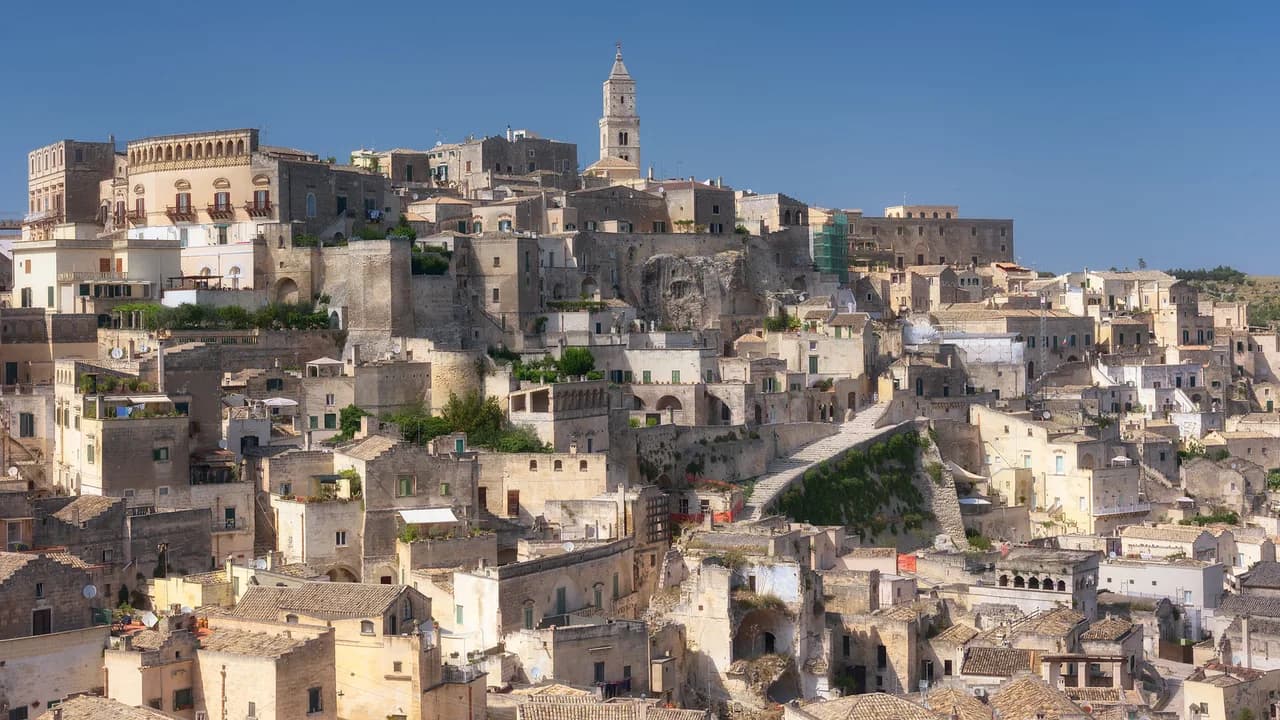
Inside Matera, several rock churches sit within the Sassi themselves, which means you can fold them into a city walk between viewpoints and stairways. Out on the Murgia, the churches are scattered across open limestone country where distances, heat and path conditions shape the day far more than opening times do.
That split matters because the planning logic differs. A town church is a twenty-minute stop you add to a neighbourhood wander; a park church may require a trailhead, a guide with keys, or a decision to accept an exterior view through a protective grille. Decide which experience you want before you map a route.
The park itself stretches from Matera toward Montescaglioso, with the Gravina di Matera as its most dramatic feature. The Matera park authority describes its remit as protecting the rupestrian churches and the archaeological landscape around them, which is why so much of the plateau is about walking between sites rather than touring a single building.
The In-Town Complexes: San Pietro Barisano, Santa Lucia alle Malve and Madonna dell'Idris
Three cave complexes in the city are the most accessible introduction. San Pietro Barisano is recognisable by its built façade and bell tower above the Sasso Barisano, and inside it preserves the rock-cut benches once used in funerary practice. Santa Lucia alle Malve clings to the edge above the Gravina and housed Matera's first Benedictine female community.
Madonna dell'Idris crowns the Montirone spur and connects to the crypt of San Giovanni in Monterrone, whose frescoes are the reason many visitors linger. Together these sites show how the same soft calcarenite that gave Matera its cave dwellings also produced churches, cisterns and hermitages over many centuries.
A travel account reports that these in-town complexes are managed as a group by a local cooperative, which is useful context when you plan entry: ask about combined access where you buy your ticket rather than assuming one ticket covers everything. Photography inside is restricted, so check the rules at the entrance before you raise a camera.
Pairing these interiors with the street-level story of the Sassi works well as a half day, and a broader attractions overview helps you sequence them with the city's other sights. Check current entry arrangements on site, since the operator sets them.
The Murgia Timone Cluster: Five Churches Worth Choosing Between
Across the gorge, the Murgia Timone area holds a dense group of rock churches. San Falcione, also recorded as San Canione, is attributed to Italo-Greek monastic communities and retains fresco fragments on its central pillar, while San Vito alla Murgia looks out over the Sassi from a dramatic position and served as a film location for Pasolini.
Sant'Agnese has a simple rectangular chamber and a remarkable water system, including a cistern fed by a groove cut to channel rainwater from the plain above. Madonna delle Tre Porte lost part of its entrance to collapse, leaving two visible naves with frescoes spanning several centuries. Madonna delle Croci is architecturally notable for a single nave divided by a broad transverse arch, with a Byzantine-style Madonna and archangels.
You do not need to see all five. Choose by interest: frescoes at Madonna delle Croci and Madonna delle Tre Porte, architecture and setting at San Vito, early monastic history at San Falcione. That selection keeps a walk to a sensible length and leaves room for the prehistoric village and viewpoints nearby.
San Nicola all'Amendola and the Far Edges of the Park
San Nicola alla Murgia dell'Amendola sits within the remains of a Bronze Age farming settlement and was originally shaped like a Greek cross; its façade has collapsed, but the carved arches and apses remain legible. It is a longer reach than the Murgia Timone cluster, so treat it as part of a wider park excursion rather than a quick add-on.
The park's geography explains the time cost: a limestone plateau cut by deep ravines, with the Gravina di Matera as the largest. Distances on a map look modest but translate into slow walking over uneven ground, which is why a single far-flung church can consume half a day.
For orientation before committing to a route, the park authority's own pages list trails, visitor centres and points of interest. Use them to confirm which sites are currently reachable and whether any section is closed, since conditions on the ground change.
Free Paths, Locked Doors and Grilles: What You Can See Independently
Access to the park's paths is free, and several rock churches, including Sant'Agnese, Madonna delle Tre Porte and Madonna delle Croci, can be viewed through protective grilles. That arrangement lets you see interiors partially without entering, and it exists to protect fragile frescoes from damage and humidity.
The interiors at Murgia Timone are locked, and authorized guides carry the keys. This is the central trade-off of the park: independence and no cost on the paths, versus interpretation and actual entry with a guide. If seeing frescoes up close matters to you, build the day around a guided walk rather than hoping a door will be open.
Matera's tourist scene makes arranging a guide straightforward once you are in the city, and many visitors simply ask at their accommodation. Whatever you arrange, confirm the meeting point and what is included before you set out, because not every tour enters the same churches. For wider planning, see Sassi di Matera Visitor Guide.
The Cripta del Peccato Originale: A Reserved Visit to Slot In
The Cripta del Peccato Originale is a Benedictine rock complex whose frescoes earned it a reputation as the Sistine Chapel of rupestrian art. It is visitable only by reservation, so it cannot be improvised into a walking day; book it first, then build the rest of your itinerary around the confirmed slot.
The dedicated operator publishes the booking procedure, current arrangements and any conditions of visit, so check there rather than relying on secondhand summaries. Keep the confirmed time flexible in your plan, since a fixed reservation can reshuffle the rest of the day.
A Realistic Walking Plan: The Belvedere Circuit from the CEA
The most practical anchor for a first park visit is the guided belvedere walk from the CEA, a circular route of just over two hours along the slope of the Gravina opposite the Sassi. It takes in caves and rock churches, and the terrain is described as not particularly difficult, so it suits walkers who are not seasoned hikers but who want interpretation.
The route finishes back at the centre, where a tasting of local produce is offered. The visitor centre also shows a short film about the park and sells a printed map of the area for a nominal sum, which is worth having if you plan to add an independent walk afterwards.
Plan the walk for the cooler end of the day. The slopes opposite the Sassi are exposed, and the plateau offers little shade, so a late-afternoon start is more comfortable than midday in summer and gives you the classic view of the city lit from the west.
If you want a longer stay on the plateau, the CEA site also lists a campervan park and campsite at Masseria Radogna, plus a cafeteria with local specialities, which turns the centre into a base rather than just a trailhead.
No-Car Festive Weekends at Murgia Timone
On certain festive weekends the Murgia Timone belvedere area cannot be reached by car, from 9:00 to 19:00. The CEA lists Easter Monday, 25 April, 1 May, 2 June, 1, 2 and 3 July, the second weekend of July and the first Sunday of October as affected dates, so check the current list before driving out.
On those weekends a bus service connects central Matera with the park, running from 11:00 to 17:00 at roughly half-hour intervals from Piazza San Pietro Caveoso, the FAL station at Villalongo and the cemetery car park in the Pantano district. Treat the timetable as the operator's published arrangement and reconfirm it for your date rather than relying on it indefinitely.
If your visit coincides with one of these weekends, the restriction actually simplifies things: leave the car and take the bus, then walk the belvedere paths from the drop-off. If you are travelling independently on other days, there is a parking area and panoramic viewpoint on the murgia about 1.5 km from the CEA.
Kit, Terrain and When to Hand Over to a Guide
Wear shoes with rubber soles. The paths above the ravine are walkable with care, but expect loose stones and gravel, uneven steps and exposed stretches, and the footpaths inside the ravine are comparable to mountain paths, so they are unsuitable for anyone prone to vertigo.
Carry water and sun protection regardless of season, because the plateau offers little cover. A wide-brimmed hat and a wind layer cover both the midday sun and the breeze that picks up on the exposed slopes above the gorge.
Hand over to a guide when your priority is interiors, frescoes or the monastic story, and stay independent when you mainly want landscape and a viewpoint. That framing keeps you from booking a tour you do not need, or arriving at a locked door you cannot open.
Common Mistakes to Avoid
Do not assume a shared ticket or shared access across a cluster. In-town complexes are managed collectively as reported, while park churches vary between grilled views, locked interiors and reservation-only sites, so verify each one separately.
Do not leave the Cripta del Peccato Originale to the last minute. It requires a reservation, and a same-day attempt can easily fail in busy periods, so fix that booking before you arrange anything else in the park.
Do not underestimate the sun or the ground underfoot. A short map distance across the plateau can take far longer than expected, and returning along exposed slopes in the heat is the most common way a pleasant walk turns into a slog.
If you are also visiting the city's religious architecture, note that Matera Cathedral sits in the Civita between the two Sassi, which makes it a natural continuation of an in-town rock church morning.
Plan Your Visit
Build your day around access rather than a checklist: town complexes first if you want frescoes without a guide, a guided belvedere circuit if you want park interiors and context, and a pre-booked crypt visit if rupestrian painting is the point of the trip. Confirm the CEA's seasonal hours and any festive-weekend car restriction before you go.
Two practical checks at the end of planning: the park authority for trails and site status, and the CEA for current tours and timings. With those pinned down, the Murgia rewards a slower pace than most Matera itineraries allow.
Frequently Asked Questions
Are the rock churches of the Murgia Materana free to visit?
Access to the park's paths is free, and some churches can be viewed through protective grilles without charge. Interiors that are locked, including those at Murgia Timone, require an authorized guide with keys. Entry arrangements for the in-town complexes and for the Cripta del Peccato Originale are set separately, so check with each operator rather than assuming one rule covers all.
Can you visit the rupestrian churches without a guide?
Partly. You can walk the plateau paths independently and see several churches through grilles, including Sant'Agnese, Madonna delle Tre Porte and Madonna delle Croci. The locked interiors at Murgia Timone need a guide, and the Cripta del Peccato Originale requires a reservation. If seeing frescoes up close matters, plan around a guided walk.
How long does the belvedere walk from the CEA take?
The guided belvedere circuit is a circular walk of just over two hours, following the slope of the Gravina opposite the Sassi and taking in caves and rock churches. The terrain is described as not particularly difficult. Confirm current departure times and availability with the centre before you build your day around it.
Which rock churches are inside Matera and which are in the park?
San Pietro Barisano, Santa Lucia alle Malve, and Madonna dell'Idris with the San Giovanni in Monterrone crypt sit within the city and are managed together. San Falcione, San Vito alla Murgia, Sant'Agnese, Madonna delle Tre Porte, Madonna delle Croci and San Nicola alla Murgia dell'Amendola are out in the park, with the first five clustering at Murgia Timone.
Do you need to book the Cripta del Peccato Originale?
Yes. It is visitable only by reservation. The dedicated operator publishes the booking procedure and conditions, so arrange it before finalising other plans. Because the slot is fixed, keep the rest of your itinerary flexible enough to fit around it.
How do you reach the Murgia Timone belvedere on no-car weekends?
On listed festive weekends the belvedere area cannot be reached by car between 9:00 and 19:00. A bus service then connects central Matera with the park from 11:00 to 17:00 at roughly half-hour intervals, departing from Piazza San Pietro Caveoso, the FAL station at Villalongo and the Pantano cemetery car park. Reconfirm the arrangement for your date.
What should you wear for walking the Murgia paths?
Shoes with rubber soles are advised. Expect loose stones, gravel, uneven steps and exposed stretches, and note that footpaths inside the ravine resemble mountain paths and are unsuitable for anyone with vertigo. Carry water and sun protection, since shade is scarce on the plateau.
Sources
Continue exploring
More guides you'll find useful





