
Porta Napoli Lecce Visitor Guide: Gateway to the Old Town
Porta Napoli in Lecce: what this Renaissance triumphal arch is, how to use it as an orientation point, the short walk onward, and practical tips for visiting.
On this page
Porta Napoli is the grandest of Lecce's old city gates and the most natural place to begin a walk through the historic centre. It is an outdoor monument you approach on foot, framed by trees and set on a small square in the northwestern corner of the old town. Treat it as a starting point rather than a destination and the rest of Lecce unfolds in a sensible order.
This guide covers what the arch is, why its restrained Renaissance style stands apart from the Baroque streets beyond, what lies within a short stroll, and how to arrive without a car. It also explains the trade-offs, from church dress codes to the restricted traffic zone that makes driving into the centre more trouble than it is worth.
What Porta Napoli Actually Is
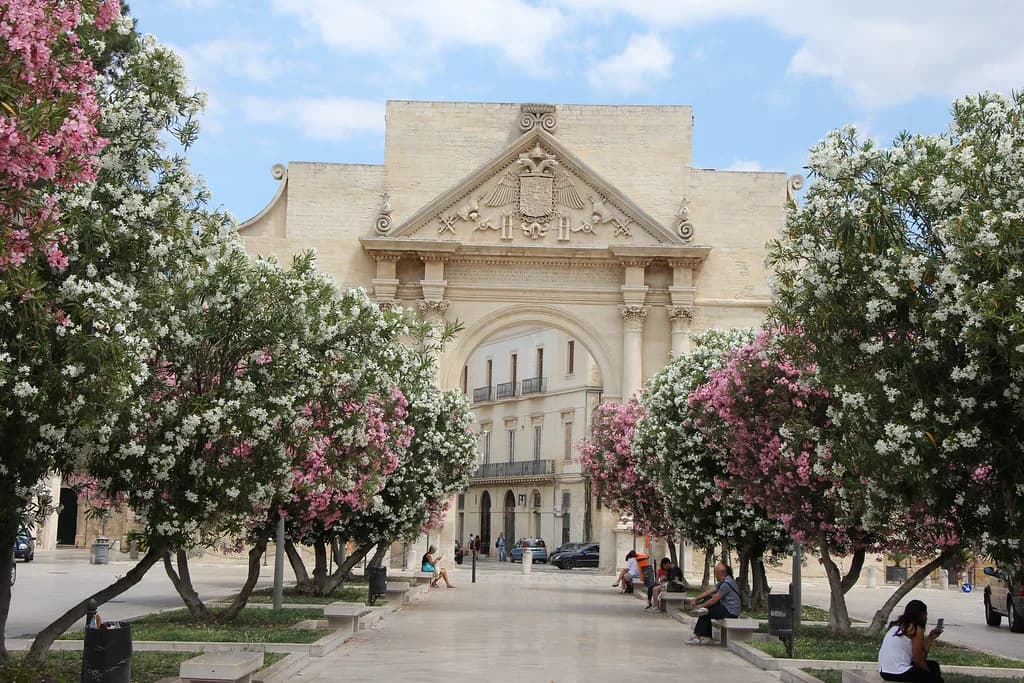
Porta Napoli is a triumphal arch that served as the ceremonial entrance to Lecce for arrivals from the direction of Naples. It is built from the pale local limestone that gives the city its warm honey tone in low light, and it stands on Piazzetta Arco di Trionfo in the northwestern part of the old town. Because it is part of the street fabric rather than a museum, you walk up to it, look, and pass through. The practical guidance on visiting the arch notes that it has no ticket office or information desk of its own, so plan your stop around the walk rather than around a queue.
The gate is described as open to the public at any hour and free to approach, but because it is an outdoor monument rather than a managed site, treat access as a matter of ordinary street conditions. If you are building a day around it, check the city's own pages for any local notice affecting the square, and otherwise assume a walk-up visit. That is what makes it a useful orientation point: nothing to book, nothing to schedule.
Why It Works as an Orientation Point
The value of the arch is geographic. Pass through it and you enter a compact labyrinth of lanes where the main sights sit close together, so the gate gives you a fixed landmark to return to if the streets confuse you. From the arch, the Basilica of Santa Croce, the Roman Theatre and Piazza del Duomo all lie within a short walk through the old town, which means you can plan a loop rather than a series of separate trips.
Lecce's historic centre is small enough to cover on foot, and most of the important sites sit inside it, so an arch at the edge is a sensible anchor for a half-day walk. If you would rather follow a defined route than improvise, a self-guided walk Lecce Baroque itinerary through the centre can begin near this end of town and finish around Piazza del Duomo. Use the gate as your start, not your finish, and the light on the limestone improves as the afternoon goes on.
What You Actually See: Renaissance Stone Against a Baroque City
The detail worth pausing for is stylistic. Lecce is famous for its florid Baroque facades carved from soft local limestone, yet Porta Napoli is described as a restrained Renaissance design, which makes it read as a deliberate contrast to the ornamented streets beyond. Look for the imperial coat of arms on the gate, a reminder that this was a statement of civic status as much as a practical opening in the walls.
Because the arch is carved from the same stone as the churches and palaces inside the centre, it also introduces the material that defines the city before you reach the famous facades. The stone is soft enough that 17th- and 18th-century craftsmen could carve dense sculptural detail directly into building fronts, which is why Santa Croce's surface looks almost overworked. Seeing the plainer gate first makes that explosion of carving land harder.
The Gateway in Context: A Short Walk to the Main Sights
Walk through the arch and you are heading toward the Basilica of Santa Croce, the most celebrated example of Lecce Baroque, whose facade took generations to complete. Continue and you reach Piazza del Duomo, an enclosed square ringed by churches and palaces, with the cathedral's tall bell tower rising above it. Both are close enough to reach on foot from the gate without planning transport in between.
The Roman amphitheatre sits in Piazza Sant'Oronzo at the heart of the old town, partly excavated and partly hidden beneath the modern street level. Part of the structure can be seen from above at street level, while going inside depends on arrangements made locally, so check before assuming you can walk down into it. The Anfiteatro Romano Lecce visitor guide covers what is visible and how to approach it.
If you want one more gate for comparison, Porta Rudiae is the oldest of Lecce's three historic entrances and sits within walking distance of the others, so the gates can be strung together on a single stroll. The Porta Rudiae Lecce visitor guide explains how it differs from the more imposing arch at the northwestern edge.
Arriving: On Foot, by Bus, by Taxi or by Car
Most visitors reach the arch on foot from elsewhere in the centre, since it borders the pedestrian old town and is easy to fold into a walking route. If you are coming from Lecce's central railway station, it is a short walk rather than a journey, and the station itself is a regional hub served by national and high-speed trains from cities such as Rome, Bologna and Bari. That rail connection makes a car-free day in Lecce realistic.
Local buses run through the centre and taxis are available, though hailing apps are less common here than in larger Italian cities. If you arrive by air, Brindisi's Salento airport is the closest gateway to Lecce and Bari's airport offers more flight choice further north, with buses, trains or a hired car covering the onward leg. Check current connections before you commit to a late arrival.
Driving into the centre is the option to think hardest about. Lecce's historic core has extensive limited traffic zones and parking is tight, so a car is better used for exploring the wider Salento peninsula than for reaching a gate you can walk to. Leave the car outside the restricted area and finish on foot.
How Long to Allow at the Arch
As a suggested rule of thumb, allow fifteen to thirty minutes for the gate itself: enough time to look at the coat of arms, take a few photographs and get your bearings on the square. Stretch it to around an hour if you want to examine the carving and wander the lanes immediately either side before committing to a route. These are planning suggestions rather than any official timing.
The calculation changes if the arch is your entry point for a full old-town walk, in which case the gate is a short stop within a much longer morning or afternoon. For a city break, two or three days is a comfortable allowance for Lecce itself, with a shorter stop if you are touring the wider Salento.
Either Side of the Arch: Lanes, Cafes and Courtyards
On the city side, the arch opens into the tangle of lanes that makes up the old town, where you will pass craft workshops, small trattorias and quiet courtyards between the headline sights. This is the part of Lecce best done slowly, without a checklist, letting the streets carry you from the gate toward Piazza del Duomo.
One detour that rewards the curious is the Museo Faggiano, a private house where renovation work uncovered archaeological layers stretching back roughly 2,500 years, from ancient tombs to Roman cisterns and medieval passages. It turns an ordinary-looking building into a vertical history of the city, and it sits within the same walkable core as the gate.
Beyond the arch, the wider province rewards a slower plan: the Baroque villages and coastal stretches of the Salento peninsula are why many people base themselves in Lecce for longer than a city break. Keep the gate as the point where your urban day begins and the countryside day ends.
Practical Tips for the Walk
Lecce's churches enforce a dress code, so cover shoulders and knees if you intend to step inside Santa Croce or the cathedral after passing the arch; a light layer in your bag solves it. Many shops and some businesses still close for a midday riposo, so plan browsing for the morning or late afternoon and keep the middle of the day for shaded walking.
Comfortable shoes matter here because the old town is paved and best covered slowly, and summer heat in July and August is intense enough to reshape a walking plan. Carry water and shift the longest stretches to early or late in the day.
If your interests run to underground layers, early Christian remains or the city's older quarters, the hidden gems side of Lecce rewards a second walk beyond the obvious route, and the attractions hub for Lecce Attractions helps you choose which sights justify a ticket and which are simply streets to wander.
Pairing the Arch With the Rest of Lecce
From the gate, a natural full-day route continues to the Castle of Charles V, the fortress built on earlier fortifications that now hosts exhibitions and events, before heading to Piazza del Duomo and then Piazza Sant'Oronzo. Check locally for what is currently showing and for opening arrangements at the castle.
Finish the loop by comparing the gates, since Porta Rudiae and Porta San Biagio both mark entries to the same compact centre and can be visited on foot in the same stroll. The Porta Rudiae Lecce visitor guide is useful if you want the older gate's story before you set out.
Plan Your Visit
Porta Napoli is not an attraction that demands its own slot in the itinerary; it is the frame around the day. Arrive on foot, spend a short while with the arch and its coat of arms, then let the lanes pull you toward Santa Croce, the Roman Theatre and Piazza del Duomo.
Check current transport, church access and any city notices before you travel, leave the car outside the restricted zone, and give the old town more time than you think it needs. The gate is free to approach and always part of the street, which is why it works so well as a starting point. For related planning, see Porta Rudiae, Lecce.
Frequently Asked Questions
What is Porta Napoli in Lecce?
It is a triumphal arch and one of the historic gates into Lecce's old town, standing on Piazzetta Arco di Trionfo in the northwestern corner of the centre. Built in a restrained Renaissance style from local limestone, it was the ceremonial entrance for arrivals from the direction of Naples and now serves as a natural starting point for a walk through the Baroque streets.
Is Porta Napoli free to visit?
The arch is an outdoor monument rather than a ticketed site, so there is no admission charge and no ticket office. You walk up to it and pass through. Because it is part of the street rather than a managed attraction, check the city's own pages for any local notice affecting the square before a special trip.
How long should you spend at Porta Napoli?
Plan on fifteen to thirty minutes to look at the arch, note the imperial coat of arms and get your bearings on the square. Allow around an hour if you also want to explore the lanes immediately either side. These are suggestions for planning, not an official visiting time.
Which landmarks are within walking distance of Porta Napoli?
The Basilica of Santa Croce, the Roman Theatre, Piazza del Duomo and the Castle of Charles V sit within the compact old town, reachable on foot from the gate. The partly excavated Roman amphitheatre is in Piazza Sant'Oronzo at the heart of the centre. Because the centre is small, these can be combined into a single walking loop rather than separate trips.
How do you reach Porta Napoli without a car?
It is a short walk from elsewhere in the centre and from Lecce's central station, which is well connected by national and high-speed trains. Local buses cross the centre and taxis are available, though ride-hailing apps are less common here. From Brindisi's Salento airport, onward buses, trains or a hired car cover the final leg.
Can you drive to Porta Napoli, and what about parking and ZTL restrictions?
Driving into the historic centre is the least convenient option. Lecce has extensive limited traffic zones and parking pressure in the old town, so it is better to park outside the restricted area and walk in. A car is more useful for day trips around the Salento peninsula than for reaching the gate itself.
How many days do you need in Lecce?
Two or three days suits a city break, giving time for the Baroque churches, the Roman remains, the museums and a slow evening in the old town. If Lecce is one stop on a wider Salento tour, a shorter stay works, but keeping at least one night lets you see the centre after dark.
What should you cover in one day in Lecce?
Start at Porta Napoli, walk to the Basilica of Santa Croce, continue to Piazza del Duomo and the cathedral, then reach Piazza Sant'Oronzo for the amphitheatre. Add the Castle of Charles V if exhibitions are open. Take a midday break during the hottest hours and finish with an evening stroll through the lanes.
Sources
Continue exploring
More guides you'll find useful





