
Porta Rudiae Lecce Visitor Guide: Walking Into the Old Town
Use Porta Rudiae as a walking gateway into Lecce's old town, with parking and traffic-zone cautions, a route from the station and nearby stops.
On this page
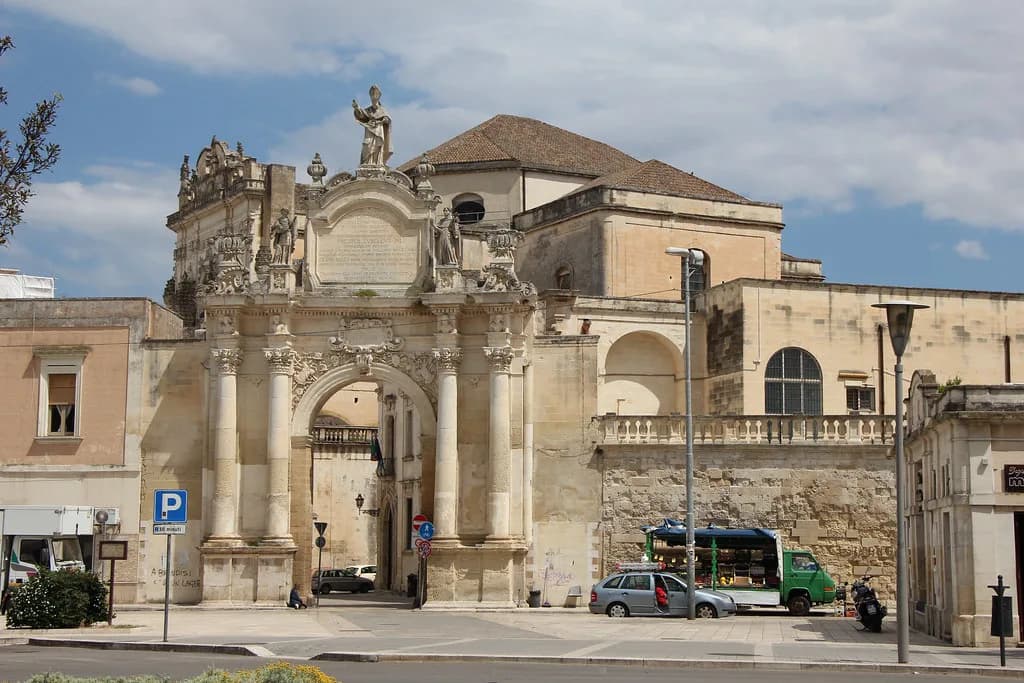
Porta Rudiae works best as an orientation point rather than a destination. It is one of the historic gates into Lecce's walled centre, and treating it that way changes your planning: you do not need a ticket or a time slot, you need to know which side of the walls to leave the car and which street to follow once you step through. This guide builds a short walk around the gate, then adds the modest market outside it and a separate archaeological outing further out.
The gate also helps you understand how Lecce is stitched together. The old town sits inside a ring of gates and boulevards, and each gate leads to a different slice of the centre. Use our broader Lecce Attractions collection to see how Porta Rudiae fits alongside the city's better-known monuments before you commit to a route. A few minutes of map reading here saves a lot of doubling back later.
Where Porta Rudiae Sits in Lecce
Porta Rudiae stands on Viale Università, the avenue that traces the edge of the historic centre. A local guesthouse describes it as the third of the city's entrances, reached by continuing along Viale Università past the Obelisco and Porta Napoli until the gate appears on your left. That sequence is useful: if you can find Porta Napoli, you are only a few minutes' walk from Porta Rudiae.
The gate once pointed toward the ancient city of Rudiae, which is where its name comes from, according to the same accommodation guide. Beyond that naming detail, published material says little about the gate's sculpture or construction history, so do not arrive expecting panels that explain every carved figure. Come for the setting, the framed view into the centre and the convenience of the position, and read the architecture as part of the wider Baroque streetscape you are about to enter.
Because the gate is free to walk through and has no published visiting restrictions of its own, it suits an unstructured arrival. Check the city council's site before you travel for any roadworks or temporary changes affecting the streets around the centre, since local traffic arrangements can shift. If you want a monument that rewards a scheduled stop, plan that separately and keep the gate as the hinge between the two.
Arriving by Car: Park Outside and Walk In
Driving to the gate is easy; driving through it is the part worth thinking about. One Lecce guesthouse directs drivers arriving from the Brindisi road to follow Viale Università until Porta Rudiae, then turn around so the gate is on their right, where a parking area sits about 30 metres beyond it. The instruction is written for that property's guests, but the logic holds for any driver: leave the car outside the walls and cover the centre on foot. Treat the parking details as guidance to confirm rather than a guaranteed current arrangement.
The same source lists that car park at 60 cents per hour during its charged periods, with free parking at night, between 2 and 4 pm, and on Sundays and bank holidays. Those figures are the guesthouse's own account and are not presented here as city-wide rates, so check the signs at the machine or ask your accommodation before relying on them. Payment methods and machine operation are not covered by the source at all.
The practical takeaway is simple. Arrive with coins or a card, photograph the ticket on your dashboard, and budget a short walk rather than a hunt for a space inside the centre. Parking outside also means you can leave when you like without negotiating narrow streets in the dark.
The Traffic Zone: What the Camera Hours Mean
Lecce's historic centre is a limited traffic zone, and the guesthouse guidance warns that cameras operate from 9 pm to 6 am on weekdays and all day on Sundays and bank holidays. It advises avoiding a drive into the old town after 10 pm and simply walking from the property. These hours come from one accommodation's instructions, so confirm the current rules with the city before you rely on them.
The point is not the exact schedule but the habit: assume cameras are watching the entrances and that a gate is not a free pass. If your hotel lies inside the walls, ask whether they register your plate or whether you should park outside regardless. A single question at booking is cheaper than contesting a penalty after you get home.
Walking In From the Station
On foot, the route from Lecce's train station is short and mostly straight. The guesthouse directions send you down Viale Oronzo Quarta for about 250 metres, left along Viale Gallipoli for roughly 400 metres, then right onto Via Università, where Porta Rudiae appears after about 50 metres on the right. Distances are approximate and come from that source, so allow extra time with luggage.
This approach has a useful side effect: you see the gate as an edge, with ordinary city life on one side and the dense centre on the other, rather than meeting it as a monument in a square. Walking also avoids the parking question entirely. If you are staying near the station, the gate makes a sensible first orientation walk on the day you arrive.
Orienting Yourself Past the Gate
Once through the gate, the street layout is straightforward enough to navigate without a guide. The same directions describe stepping inside onto the main corso, then taking the first left after about 30 metres onto Via Antonio Galateo. That turn is a good mental marker: the corso carries the flow of visitors, while the side streets off it feel calmer and are easier to wander.
From here the centre's main sights are within easy walking distance, though each has its own visiting arrangements worth reading before you go. Our Basilica di Santa Croce Lecce visitor guide covers the church whose ornate facade is the image most people carry home, and it makes a natural second stop on the same walk. Keep the gate behind you as the anchor for your return.
If you prefer to drift rather than tick off monuments, use the side streets to link the gate with the centre's quieter corners. Our guide to hidden gems in Lecce suggests alternatives when the headline sights are crowded, including the Museo Faggiano, where a family's excavation revealed layers beneath an ordinary house.
Wherever you walk, remember that the centre is compact and the gate is close to everything. That makes a loop easy: enter at Porta Rudiae, cross the old town, and leave by another gate so the return walk is a different street.
The Market Just Outside the Gate
Just outside Porta Rudiae is a small market that a century of trading has made part of the neighbourhood's routine. Descriptions of it mention fresh produce, friendly stallholders, spit-roasted chicken, cured meats and cheeses, along with a pastry shop and café known for pasticciotti and savoury rustici. It is a short stop, not a half-day outing, and that is part of its appeal: you can browse, buy something for later and be back on your way.
One listing gives morning and, on several days, late-afternoon opening periods, but those times come from a third-party travel page rather than the market itself. Treat them as a rough indication and check on arrival or with your accommodation before making a special trip. The same listing advises bringing cash, since some vendors may not accept cards.
The market's value to a visitor is context rather than spectacle. You see what a Lecce food shop looks like when it is serving the neighbourhood, and you get a sense of the produce and breads of Salento before you sit down to a restaurant meal. Go early if you want the fullest stalls, and keep your expectations modest in size.
Why the Gate Is Worth a Detour on Foot
Porta Rudiae earns its place in a walking plan because it does two jobs at once. It marks the boundary of the old town, giving you a clear starting point and a clear place to return to, and it sits close enough to the market and the station that you pass it naturally. That makes it more useful than a monument you have to seek out.
A short detour is worthwhile if you are already walking the ring of gates or heading to or from the station. It is less compelling if your time in Lecce is very limited and you have not yet seen the centre's main squares. In that case, enter the old town by the nearest gate to your first sight and save Porta Rudiae for a later wander.
For a fuller day, the Anfiteatro Romano Lecce visitor guide explains the Roman remains in the heart of the centre, which pair well with a walk that starts at the gate. Build the plan around one or two anchors and let the streets between them fill the rest of your time.
The Rudiae Archaeological Park: A Separate Trip
The ancient site that gave the gate its name lies outside the centre at Via A. Mazzotta, and it deserves its own plan rather than a spur-of-the-moment extension of a city walk. A spring 2026 programme there combined guided visits, digital reconstructions, a Roman re-enactment and a sign-language-interpreted tour, with free admission and booking by phone. Those dates have passed, so do not treat them as a current schedule or a standing free-ticket policy.
What the site offers is a longer story than the gate: a Messapian settlement later absorbed into the Roman world, with archaeological layers and an amphitheatre, and a link to the Latin poet Ennius. Check current opening arrangements, any admission charge and whether booking is needed before you set out, since none of that is fixed by an old programme page. The city's official site is the place to start for confirmed local information.
If you go, plan transport rather than assuming you can walk it between other stops. The park sits away from the historic centre, so treat it as a half-day with travel at either end, and carry the phone number or a booked confirmation with you.
What to Check Before You Go
The gate itself needs no preparation, but the practicalities around it do change. Confirm the current traffic-zone rules with the city or your accommodation, check the signs at any car park rather than relying on a published tariff, and look up the market's hours locally rather than trusting a listing. None of this takes long, and each check removes a small risk from the day.
Leave the rest flexible. The pleasure of this corner of Lecce is that it works as an unplanned start to a walk: step through the gate, follow the corso, take a side street when something looks interesting, and let the market supply a snack. Build your day around one booked activity at most, and keep the gate as the easy fixed point you return to.
Plan Your Visit
Porta Rudiae is best treated as the beginning of a Lecce walk rather than an item on a checklist. Park outside the walls, note the traffic-camera hours, walk in from the station if you can, and let the gate lead you to the corso and the side streets beyond it.
Add the small market outside for provisions, keep the archaeological park for a separate outing with confirmed details, and read up on the Basilica di Santa Croce Lecce and the city's other sights before you set out. A little preparation on traffic and parking is all this corner of Lecce really asks of you.
Frequently Asked Questions
Is Porta Rudiae free to see?
Yes. The gate is an entrance to the historic centre rather than a ticketed monument, so walking through it costs nothing. There are no published opening hours for the gate itself, but nearby sites such as churches and museums set their own admission arrangements, which you should check separately before visiting.
Can you drive through Porta Rudiae?
You can drive up to it, but the historic centre behind it is a limited traffic zone with cameras. One local guesthouse warns that cameras operate from 9 pm to 6 am on weekdays and all day on Sundays and bank holidays, though you should confirm current rules with the city. The simplest approach is to park outside the walls and walk in.
Where do you park near Porta Rudiae?
A guesthouse near the gate describes a parking area about 30 metres beyond Porta Rudiae, with hourly charges during set daytime periods and free parking at night, between 2 and 4 pm, and on Sundays and bank holidays. Those figures come from that property's guidance, so check the signs and machine on arrival before paying.
How long do you need at Porta Rudiae?
The gate itself takes only a few minutes to walk through and look back at. Most visitors should give it a small part of a longer old-town walk, perhaps with a stop at the market outside. Allow more time only if you are using it as the start of a route that continues deep into the centre.
What is there to do near Porta Rudiae in Lecce?
The market outside the gate is the closest draw, with produce, cheeses, cooked food and a pastry shop. Inside the walls, the main corso and the centre's Baroque churches are a short walk away, including the Basilica di Santa Croce. The Rudiae Archaeological Park lies further out and needs its own transport and planning.
Is the Porta Rudiae market open every day?
A third-party listing shows morning hours daily plus later afternoon hours on several days, with shorter Sunday hours, but that is not an official market schedule. Check locally or ask your accommodation before making a special trip, and bring cash since some vendors may not accept cards.
Sources
Continue exploring
More guides you'll find useful





