Piazza De Ferrari & Teatro Carlo Felice: Genoa Orientation Guide
Use Piazza De Ferrari as your compass in central Genoa: the 1936 fountain, the Teatro Carlo Felice frontage, Palazzo Ducale and the ways into the caruggi.
On this page
Piazza De Ferrari is the kind of square you cross without noticing the first time and use as a landmark for the rest of the trip. It sits in the centre of Genoa, named after the 19th-century financier Raffaele De Ferrari, and lines up a cluster of frontages that range from neoclassical theatre to early-20th-century palazzi. Treating the square as an orientation tool rather than a photo stop makes the rest of the historic centre easier to read.
The most useful first move is to walk the edges of the square and match the buildings to the map. The 1936 bronze fountain by Giuseppe Crosa di Vergagni anchors the centre, while the Teatro Carlo Felice and the Ligustica Academy of Fine Arts sit on the theatre side and the Palazzo Ducale opens off the square's eastern edge. The 1936 date and Crosa di Vergagni's authorship are confirmed by a local hotel's description of the square; treat later alterations as something to check on site rather than assume.
Why Piazza De Ferrari works as a first orientation point in Genoa
Central Genoa folds around a tight historic core, and Piazza De Ferrari is one of the few open spaces where you can see several landmark buildings at once. The square's edges point toward different parts of the city: the caruggi old town lies to one side, Via XX Settembre runs off toward the shopping streets on another, and the theatre and palace frontages give you fixed reference points. Standing at the fountain and turning once tells you which way each of those pulls.
The square is also a natural place to start or end a walk because the buildings themselves are recognisable. The Ligustica Academy of Fine Arts, the Palazzo Ducale and the theatre side give you three distinct visual anchors, while the fountain provides a central point to return to if the side streets confuse you. Use the fountain as a meeting point and the building frontages as your bearings, rather than relying on a single exit.
Reading the square: the 1936 fountain by Giuseppe Crosa di Vergagni and the polygonal basins
The fountain in the centre of the square was designed by Genoese architect Giuseppe Crosa di Vergagni in 1936 and is described as a symbol of the city. Its centre is a bronze basin supported by six pillars, set inside a polygonal basin whose masks pour water into a second circular basin, itself surrounded by a third circular basin. That layered structure is the detail worth noticing: from a distance the fountain reads as a single jet, but up close you can see the stacked bowls and the masks that feed them.
Because the fountain is in the open square, it is one of the few places where you can stop and get your bearings without committing to a ticket or a queue. The official tourism site does not publish access rules or closing times for the square itself, so treat the fountain as an exterior landmark and check the city's event listings if you want to know whether anything is scheduled around it.
Teatro Carlo Felice: the neoclassical design, wartime destruction and the 1991 rebuild
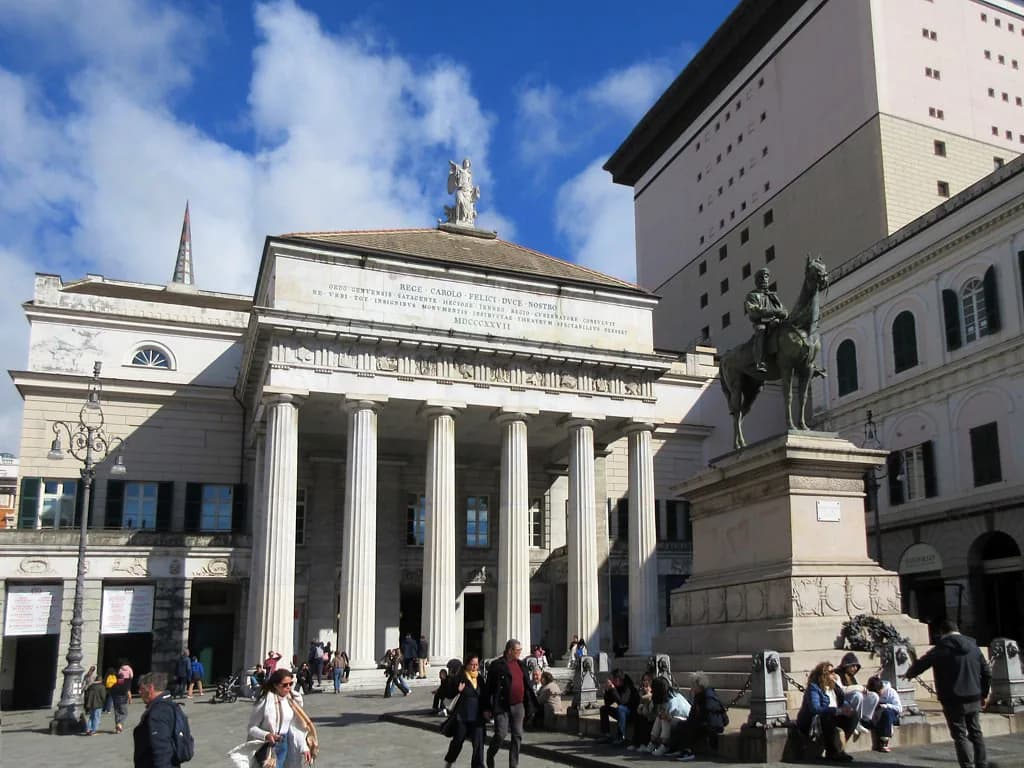
The Teatro Carlo Felice is the most prominent neoclassical frontage on the square, designed by Carlo Barabino in the early 19th century. Its history explains why the building may not look like a single uninterrupted 19th-century structure: it was destroyed during the Second World War and rebuilt in 1991. Knowing that two-part story helps you read the theatre correctly, because the visible fabric mixes the original design intent with a late-20th-century reconstruction.
For an orientation visit, the theatre is best approached as an exterior landmark first. The sources consulted here do not list current box-office hours, performance schedules or tour availability; if you want to see inside or attend a performance, check the theatre's own published information rather than assuming the frontage is open. The city's tourism site lists events and cultural listings and is a reasonable starting point for what is on during your dates.
Around the edges: Palazzo Ducale, Palazzo della Regione Liguria, the Ligustica Academy and the former stock exchange
The buildings around the square give it a legible architectural ring. The Palazzo Ducale was built in the 14th century as the residence of the doges and later served as a court, prison and barracks before being restored in 1992; it now hosts art and cultural exhibitions. The Palazzo della Regione Liguria, built in 1912 and acquired by the region in 1970, is another major frontage, and the Ligustica Academy of Fine Arts, founded in 1751, faces the Palazzo Ducale across the square.
The former stock exchange building, designed by Dario Carbone and completed in 1912, adds an Art Nouveau note to the ring and now houses the Chamber of Commerce. None of this means the interiors are open on the same terms: the fountain, the theatre facade and the palace exteriors are seen from the square, but the Palazzo Ducale's exhibitions and the academy's collections are separate interiors. Plan on the square as free public ground and treat each interior as its own visit with its own access rules.
The architecture mix that makes the square legible: neoclassical frontages opposite eclectic palazzi
One of the practical pleasures of Piazza De Ferrari is that you can see the architectural layers without moving far. On the theatre side, the neoclassical frontages of the Teatro Carlo Felice and the Ligustica Academy of Fine Arts, both associated with Carlo Barabino, give a coherent early-19th-century character. Opposite, a group of grand palazzi shows a more eclectic style, so a single turn of the head covers roughly a century of Genoese building fashion.
That contrast is useful for orientation because it tells you which side of the square you are on before you check a map. If you are facing the columned theatre front, you are looking at the Barabino side; if you are looking at heavily decorated facades from the turn of the 20th century, you are on the opposite edge. For a wider walk through Genoa's layered architecture, the city's attraction guides and the hidden gems in Genoa round out what the square only hints at.
Getting your bearings on foot: how the square opens toward the caruggi old town and toward Via XX Settembre
Piazza De Ferrari sits at a junction of two very different walking experiences. On one side, the square opens toward the caruggi, the narrow alley network of the historic centre, where the streets tighten and the light drops. On the other, Via XX Settembre runs toward the shopping streets, named in descriptions of the square as one of the main routes lined with shops, boutiques and cafes. Choosing which exit to take is the simplest way to decide what kind of afternoon you want.
The square is also a natural junction for public transport and for the metro, although the official city sources do not publish station names, line numbers or journey times for this guide. Rather than guess, use the Genoa getting around guide for the city's transport logic and confirm current routes on the operator's own information before you travel. For a slower start, the old town walking route picks up from the square's caruggi edge and keeps the navigation simple.
Budgeting time: a self-set loop of the square's exteriors versus adding interior visits nearby
A loop of the square's exteriors is a short, self-set walk rather than a fixed itinerary, so the honest advice is to decide in advance how many interiors you want to add. The fountain, the theatre facade, the Palazzo Ducale exterior and the surrounding palazzi can all be read from the pavement without booking anything. If you add the Palazzo Ducale's exhibitions or another nearby museum, budget a separate block of time and check that venue's own access details rather than assuming the square's public status carries inside.
For travellers who want one substantial interior stop rather than several, the city's museum offerings extend well beyond the square. The Mercato Orientale Genova visitor guide is a good complement for a food-focused morning, and the Acquario di Genova visitor guide suits a family afternoon by the port. Pairing the square with one of those keeps the day manageable instead of turning Piazza De Ferrari into a list of fronts to tick off.
Practical planning: how to check theatre and palace access before you go
The biggest planning risk is assuming the square's landmarks operate on one schedule. The sources consulted here describe the architecture and history but do not confirm current opening hours, ticket prices, performance calendars or booking rules for the Teatro Carlo Felice, the Palazzo Ducale or the Ligustica Academy. Check the theatre's own published information for performances and tours, and treat palace exhibition details as something to confirm with the venue before you rely on a specific opening.
The tourism site carries event listings and practical visitor information for the city, including cultural events that may affect how busy the square or nearby venues are. The city portal covers civic notices and city services rather than ticketing, so use it for what is happening in the city and use the individual venue's own page for access to that venue. Do not assume that a single ticket covers the fountain, the palace and the theatre; they are distinct sites and should be planned as such.
Plan Your Visit
Piazza De Ferrari repays a deliberate ten-minute stop rather than a hurried crossing. Walk the perimeter once, note which way the caruggi and Via XX Settembre pull, and use the fountain as your fixed point for the rest of the day. If you want to go inside the theatre or the Palazzo Ducale, treat that as a separate visit and confirm the current details through official channels before you go.
For the rest of the city, the attraction hub ties together the main sites while the hidden gems in Genoa guide points toward quieter corners once you have your bearings. The square itself is free ground, so the only real budget decision is how many paid interiors you add.
Frequently Asked Questions
Who designed the fountain in Piazza De Ferrari and when was it built?
The fountain was designed by Genoese architect Giuseppe Crosa di Vergagni and dates from 1936, according to published descriptions of the square. Its centre is a bronze basin supported by six pillars, set inside a polygonal basin with masks feeding a second circular basin, which is itself surrounded by a third circular basin. It is an outdoor landmark in the square rather than a ticketed interior.
Is Teatro Carlo Felice the original 19th-century building?
It was designed by Carlo Barabino in the early 19th century, but it was destroyed during the Second World War and rebuilt in 1991. The frontage you see therefore combines the original neoclassical design intent with a late-20th-century reconstruction. The sources consulted here do not give current opening times or tour availability, so check the theatre's own information before planning an interior visit.
Do Palazzo Ducale, the fountain and the theatre share one ticket?
No. The fountain sits in the open square and the theatre and palace are separate buildings with their own access arrangements. The Palazzo Ducale's exhibitions are distinct interiors, and the theatre operates as a performance venue. Plan on the square as public ground and check each venue's own access details rather than looking for a combined ticket.
How does Piazza De Ferrari connect to Genoa's old town?
The square opens toward the caruggi, the narrow alley network of the historic centre, on one side and toward Via XX Settembre on another. Choosing which exit to take is the simplest way to pick your walk: the caruggi side pulls you into the dense old town, while Via XX Settembre heads toward the shopping streets. The sources consulted here do not verify specific metro station names or journey times, so confirm transport details independently.
What should I look at first if I only have a short stop at the square?
Start at the fountain to get your position, then look for the neoclassical theatre front and the surrounding palazzi, which sit opposite each other. That single turn covers the square's main architectural contrast. If you want to add the Palazzo Ducale's exhibitions or the Ligustica Academy, treat those as separate stops and check each venue's current opening details beforehand.
Where can I check current visiting details for the theatre and nearby palaces?
Check the official tourism site for event listings and practical visitor information, and the city's portal for civic notices and services. For venue-specific opening hours, ticket prices and performance calendars, use the venue's own published information. The sources consulted here describe the history and architecture but do not confirm current hours, prices or booking rules.
Sources
Continue exploring
More guides you'll find useful