
Piazza del Ferrarese, Bari: Gateway to Bari Vecchia
Use Piazza del Ferrarese to orient yourself between Bari Vecchia and the Murat district, then plan an evening drink, a passeggiata or a one-day walking route.
On this page
Most visitors treat Piazza del Ferrarese as a photo stop on the way into the old town, then hurry on. That wastes a genuinely useful square. One local guide describes Piazza Ferrarese as the entrance point you reach after a walk down Via Sparano from the station, with the old port and the lungomare on one side and the lanes of Bari Vecchia on the other. Sit for ten minutes and you can fix your bearings for the whole day.
It is also free. This is an open public square rather than a monument with a ticket window, so you can pass through at any hour your itinerary allows and spend nothing. The paid interiors of Bari — the castle museum, the cathedral's underground collection, the Basilica's crypt — are all a few minutes away, which makes the piazza a sensible place to decide what you are actually willing to pay for.
This guide treats the square as an orientation tool and a starting point rather than a destination in itself. You will find how to reach it on foot, what you are looking at, how its atmosphere shifts between afternoon and evening, and where it fits in a one-day route that runs from the castle through the pasta street to the waterfront.
Where Piazza del Ferrarese Sits in Bari
The square occupies the seam between two very different cities. To the north and east lies Bari Vecchia, the old town on its triangular peninsula between the old port and the modern harbour, a district of narrow lanes that follows no grid. To the south and west begins the Murat district, the 19th-century grid of straight streets, shops and theatres laid out beyond the medieval walls.
That position is what makes the piazza legible. An orientation guide to the old town describes Piazza Ferrarese as the point where a walk down Via Sparano delivers you to the historic quarter, with the sea on one side and the lanes on the other. Treat it the same way: arrive, look at the water, look at the alleys, then choose a direction.
The old port, Porto Vecchio, lies immediately alongside, and the city's great seafront promenade, Lungomare Nazario Sauro, starts its run from this end of the waterfront. Between the two you have a natural walking axis that takes in fishing boats, the evening passeggiata and the long line of Liberty-style buildings along the shore.
For a wider survey of what surrounds the square, including the castle, the cathedral and the smaller churches tucked into the lanes, the city's attraction pages are the place to start. They also help you judge which paid interiors are worth your time on a short visit.
Arriving on Foot from Bari Centrale
The most straightforward approach is on foot from the station, down the shopping street Via Sparano through the Murat district until the grid gives way to the square and the old town beyond. One local guide puts that walk at around twenty minutes, which is a reasonable planning figure for anyone carrying little.
If you are arriving by cruise or ferry, the terminal sits close to the old town, and the same guide describes the old town as a short walk from the port gates. That makes the square a natural first stop after disembarking.
The choice that matters most is luggage. Cobbled lanes, stepped passages and crowded evening squares make wheeled cases miserable, so if you are arriving with bags, go to your accommodation first and come back unencumbered. Let the piazza be an evening stop rather than your first.
What You Are Actually Looking At
The square itself is an open expanse of pale limestone paving, bordered by bars and restaurants and opening directly onto the water. It is named for merchants from Ferrara who traded here in the 17th century, and today it functions as the social front room of the old town rather than a monument with a single focal point.
Look down as well as up. Part of the ancient Roman road known as the Via Traiana, which once carried traffic from Rome towards Brindisi, is preserved beneath glass in the paving, an archaeological window that ties the square to two thousand years of road history. It is easy to walk over without noticing, so slow down and scan the ground.
Beside the square stands the Teatro Margherita, the Art Nouveau theatre raised on stilts over the sea between 1912 and 1914 to sidestep a ban on new theatres on public land. Land reclamation in the 1920s left it on dry ground, and after decades as theatre and cinema it reopened as a contemporary art venue, so what you can see inside depends on the current exhibition rather than a fixed collection.
That combination — open paving, a buried Roman road and a theatre that appears to float — is why the square rewards a few minutes of attention rather than a quick snapshot. For the building's history and what is showing, the dedicated Teatro Margherita guide sets out the practical visiting details.
Free to Enter, and What That Changes
Piazza del Ferrarese is a public square, so there is no admission charge, no ticket queue and no opening time to plan around. That makes it an unusually useful element in a city where several major sights are ticketed, and it means you can treat the square as a fixed point whenever a plan slips.
Free access does not extend to everything nearby. Bari's Norman-Swabian castle, for example, has charged admission for its museum and interior; Italy's official tourism site describes it as the landmark building beside the old town, commissioned by Frederick II in the 13th century on what remained of a Norman fortification and now home to a museum and the city's cultural centre.
The same principle applies to churches. The Basilica di San Nicola houses the relics of Saint Nicholas and does not charge for entry, but its main church and its crypt keep separate hours, so check both spaces rather than assuming one visit covers everything.
Plan the square as the free element in a day that otherwise includes one or two paid interiors. For the basilica's crypt and main church in detail, the Basilica di San Nicola guide is the practical companion; for a broader sense of which surrounding sights charge and which do not, start from the city's hidden corners.
Daytime and Evening: Two Different Squares
By day the piazza is a pause rather than a party. It is a place to sit, order something cold and watch the city pass, and one visitor guide describes it as quieter in daylight, better for a relaxed stop than for atmosphere. Use that window to read the map, decide which lanes to take and plan your route through the old town.
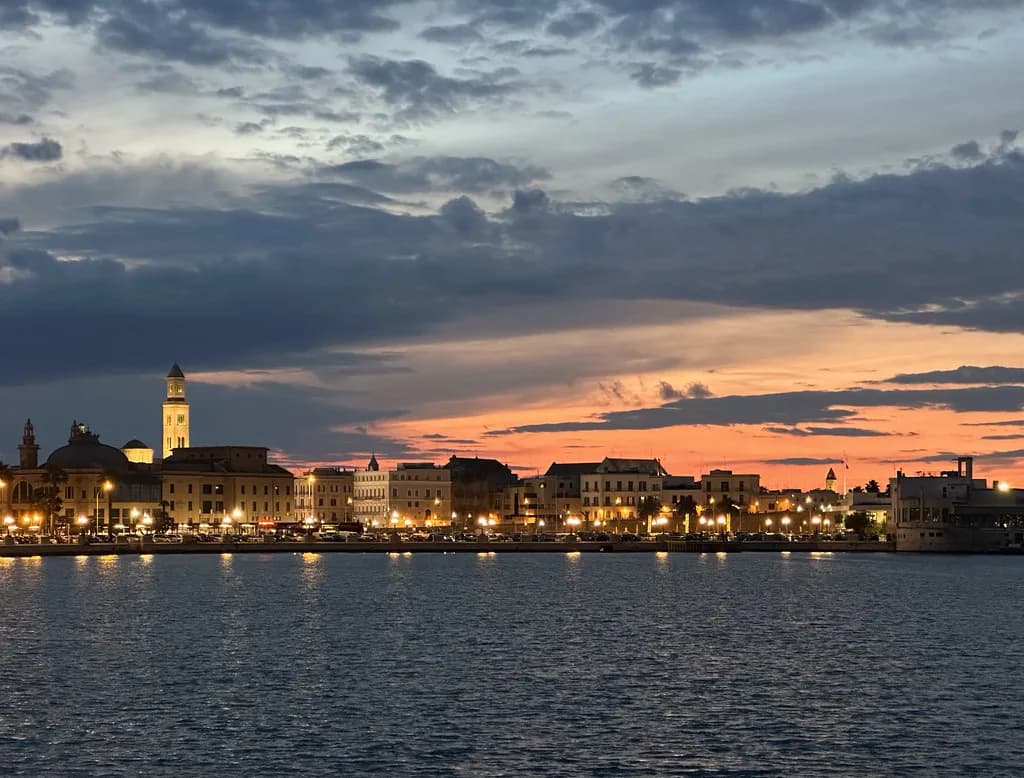
In the evening it changes character. The bars and restaurants that line the square put their tables out, and the square becomes part of the evening walk that Bari does well. Another guide describes the seafront promenade filling from around 7pm with the passeggiata, the unhurried social stroll along the shore.
The practical lesson is to visit twice if you can. Come in the morning to orient yourself and see the paving and the Roman road in decent light, then return in the evening for a drink and the walk. If you only pass through once, the evening version shows you how Bari actually uses its own city.
If evening crowds are not your preference, the shopping streets of the Murat district immediately south of the square offer a calmer frame for the same visit. For wider planning, see A Slow Guide to Bari's Murat Neighbourhood.
Building a One-Day Route Around the Square
Start at the castle in the morning, then cross to the pasta street near it, where women roll and sell orecchiette at their doorsteps. One local guide notes that late morning is prime time and that by afternoon they have often sold out, so a later arrival risks finding empty trays.
From there, walk to the Basilica di San Nicola and the cathedral, then move through the lanes to Piazza Mercantile, the medieval market square many residents treat as the heart of the old town. Piazza del Ferrarese comes next, at the point where the lanes release you onto the waterfront.
Finish on the seafront. Walk the wall path along Via Venezia, which gives you the Adriatic on one side and glimpses into old town life on the other, then continue past the Fortino di Sant'Antonio and out along the lungomare as the light goes. This costs nothing and uses the square's position as a hinge rather than a stop.
If you would rather see the cathedral's mosaics and underground remains in the same circuit, slot that visit between the basilica and the market square. The Bari Cathedral San Sabino visitor guide sets out what the interior and the crypt collection contain, which helps you decide how much time to give it.
Eating and Drinking Around the Square
Treat the square as an evening address rather than a lunch stop. Daytime eating in Bari is better done a few lanes away: focaccia barese is a morning food, thick, soft and topped with cherry tomatoes pressed into the dough, and one guide notes the best bakeries sell out by noon, so plan an early purchase.
Panzerotti, the small fried half-moon pastries filled with tomato and mozzarella, are the other great street snack, best eaten hot from the fryer. Buy one, keep walking, and save the sit-down meal for later, when the square's tables are out and the passeggiata is underway. For the full range of Bari snacks, the street food guide is the practical reference.
For the evening, the bars and restaurants around the square are convenient rather than definitive. Menus and prices change, so read what is posted at the door before you sit down, and if a table on the square is full, the lanes behind it hold plenty of alternatives. No venue recommendation here should be read as current advice on price or hours.
Practical Trade-Offs: Walking, Driving and Luggage
Walk. The square, the old town and the waterfront form one continuous pedestrian experience, and driving into this area creates problems rather than solving them. Bari Vecchia is a pedestrian zone, and one local source warns of fines and frustrated residents for anyone who tries to drive the lanes.
If you arrive with a car, park outside the centre and continue on foot. The same source describes park-and-ride lots on the city's outskirts with a shuttle into the centre, but schemes and charges are exactly the kind of detail that changes, so confirm current arrangements with the city before you set off.
Luggage is the other trade-off. With a case, head straight for your accommodation and leave sightseeing until you have dropped it. If you are staying in the old town itself, choose somewhere you can reach without dragging bags across cobbles and up steps.
Common Mistakes to Avoid
The first mistake is ticking the square off like a sight. It has no queue and no single artefact to photograph, so its value lies in using it: fixing your position, choosing a direction, and returning later when it is busy.
The second is missing the wall walk. The elevated path along the old town's seaward edge, with views over the water and down into the lanes, is the best free thing near the square and is regularly walked straight past by visitors heading for the port.
The third is confusing the two ports. Porto Vecchio, with its small fishing boats, is a working harbour rather than the terminal for ferries and cruise ships, and a walk along it gives you an honest look at the city's maritime life before the bars open.
The fourth is failing to look beyond the obvious. The old town rewards unplanned wandering, and its smaller churches, votive shrines and quiet courtyards are part of why people come back to Bari rather than passing through. For wider planning, see Hidden Gems in Bari.
Pairing the Square with Nearby Sights and a Short Day Trip
The square works best inside a cluster of free or low-cost stops. The basilica is free to enter, the wall walk and old port cost nothing, and the lanes themselves are the attraction. Add one paid interior — the castle museum or the cathedral's underground collection — and you have a full day without overspending.
For a half-day trip, Polignano a Mare is the easiest add-on, with a clifftop old town above a cove and rail connections from Bari. Check current timetables yourself rather than relying on any journey time quoted in a blog, and treat day trips as suggestions you fit around the weather.
To set the wider plan, the Bari Attractions hub collects the city's core sights and their visitor essentials in one place. Use it to sequence the piazza, the castle and the basilica sensibly, then leave gaps for the wandering that the old town does best.
Plan Your Visit
Piazza del Ferrarese is not the reason to come to Bari, but it is the reason you will not get lost on the way to the reasons. Arrive on foot from the station, use the square to read the city, then follow the lanes to the basilica, the market square and the water.
Give it two passes: a quick daytime orientation and an evening return for the passeggiata. That is the honest way to see how Bari uses its own waterfront, and it costs nothing beyond whatever you choose to drink.
Before travelling, confirm current hours, prices and transport arrangements with the city and the individual sites, since none of those stay fixed for the long term. The city's own channels are the reliable source.
Frequently Asked Questions
Is Piazza del Ferrarese free to visit?
Yes. It is an open public square with no ticket window and no admission charge, so you can walk through or sit at any point in your day. The bars and restaurants around it sell food and drink, and nearby sights such as the castle museum and the cathedral's underground collection are separately ticketed.
How long should you spend at Piazza del Ferrarese?
Most people need only fifteen to thirty minutes to look at the paving, find the Roman road preserved under glass and take in the Teatro Margherita beside the square. Plan a return in the evening if you want the busier aperitivo atmosphere, which is a different experience from a daytime pass.
What is the difference between Piazza del Ferrarese and Piazza Mercantile?
Piazza del Ferrarese is the square at the seam between the old town, the Murat district and the waterfront, so it works as an orientation point and an evening bar address. Piazza Mercantile lies deeper inside Bari Vecchia and was the city's commercial heart, generally read as the historic centre of old town life.
When is Piazza del Ferrarese busiest?
The square is livelier in the evening, when the bars and restaurants put out tables and the passeggiata begins along the seafront. Daytime is quieter and better suited to sitting with a coffee or getting your bearings before entering the old town lanes.
Can you walk from Bari Centrale to Piazza del Ferrarese?
Yes. The route runs down Via Sparano through the Murat district to the edge of the old town. One local guide puts the walk at about twenty minutes; with luggage, consider going to your accommodation first, since the old town lanes are cobbled and often stepped.
Can you drive or park at Piazza del Ferrarese?
Driving into the old town is a bad idea: Bari Vecchia is a pedestrian zone, and a local source warns of fines and frustrated residents. Park outside the centre and walk in. Confirm current parking and any restricted-traffic arrangements with the city before you travel, since these details change.
Sources
- Bari Italy: Travel Guide to Puglia's Capital - Beautiful Puglia
- Bari Vecchia (Old Town): Local Guide to Bari’s Historic Heart - Veloservice
- Bari: Things to do & Places to visit - Italia.it
- Official event website
- 17 Unexpected Things To Do In Bari, Italy - The Globetrotting Teacher
- Teatro Margherita: Bari's Theatre Built Over the Sea - Bari, Italy | Ciceru - Travel Stories & Adventure Guides
Continue exploring
More guides you'll find useful





