
Teatro Margherita Bari: The Theatre Built Over the Sea
How Bari's Teatro Margherita was built on stilts over the Adriatic, why it now stands on dry land, and what to expect from its contemporary art galleries today.
On this page
Teatro Margherita is the pale building on Bari's seafront that looks as though it should be standing in water. It very nearly was: the theatre was raised on stilts over the Adriatic between 1912 and 1914, largely to get around a restriction on building new theatres on public land. The building reopened in December 2018 as a contemporary art venue known as Bari Arte Contemporanea, or BAC, and it now hosts temporary exhibitions rather than stage shows. For a wider look at the city, see our Bari attractions hub.
Plan on roughly 45 to 90 minutes inside, depending on how thoroughly you read the exhibition and how long you linger on the surviving foyer decoration; that is a suggestion, not an official duration. The building sits on Piazza IV Novembre, a short walk from the Old Town and the waterfront promenade, so it slots easily into a half day that also takes in the sea wall and the Lungomare. Check the official event website before travelling, because the exhibition calendar and visitor arrangements change from season to season.
A Landmark on Bari's Waterfront
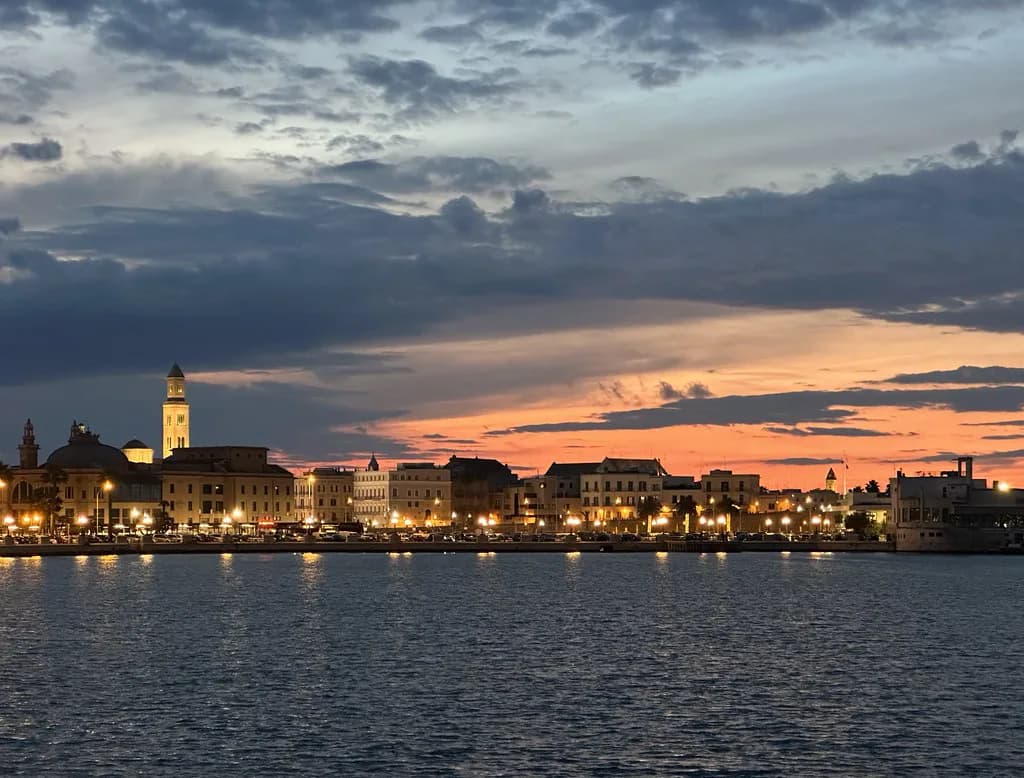
The theatre sits on the seafront at Piazza IV Novembre, between the old harbour and the grid of the modern city. Its Liberty-style facade, with a dome and a pair of towers framing the entrance, makes it one of the most photographed buildings on this stretch of coast. The address is worth noting because the entrance is not on the promenade side, and first-time visitors often walk past looking for a theatre marquee that no longer exists.
Because it is embedded in the city rather than isolated, the theatre works best as one stop on a walking loop rather than a destination in itself. The lanes of Bari Vecchia, the old town, begin a few minutes inland, and the seafront continues west along the Lungomare. If you want to build a fuller day around this stretch, our Bari Attractions hub maps the sights that fit naturally together.
A Theatre on Stilts: The Legal Workaround
The story starts with a fire. A wooden predecessor, the Varieta Margherita, burned down in 1911, and the city wanted a replacement. But a municipal arrangement with the powerful Petruzzelli family barred new theatres on public land, so the architects simply moved the site offshore and built on piles over the sea. The design was by Francesco De Giglio with engineering by Luigi Santarella, and it became one of Bari's first reinforced concrete buildings.
Construction ran from 1912 to 1914, and the theatre officially opened on 22 August 1914. Understanding this piece of civic one-upmanship changes how you look at the building: the maritime setting was a legal manoeuvre, not a romantic gesture. Look for the surviving decorative work in the foyer, including stucco and murals made by the Colonna family for that 1914 opening.
Why It No Longer Stands Over Water
Land reclamation along the waterfront in the 1920s filled in the area around the piles, so the theatre that was designed as an island now sits on dry ground. Visitors who arrive expecting water lapping at the foundations are usually surprised to find a solid piazza instead. The building kept its position but lost its moat, which is why the nautical nickname persists even though the reality changed a century ago.
That history matters for planning: there is no boat, bridge or pier approach to arrange. You simply walk up to the entrance from the street, and the seafront views are had from the pavement rather than from a gangway. It also means the building is fully part of the urban fabric, which is why it pairs so neatly with the rest of the old waterfront.
A Short Century of Uses
In its early decades the theatre hosted variety shows, opera and concerts, and it also screened films. During the Second World War, in 1943, Allied forces occupied it and renamed it the Garrison Theatre, using it as a logistics base and an entertainment venue for soldiers. It was damaged by bombing and by a ship explosion in the harbour in 1945, and in 1946 it was converted into a cinema, a role it kept until it closed in 1979.
The long abandonment that followed is part of why the interior looks as it does today, stripped of its seating and adapted rather than restored to its original auditorium form. Restoration work began in 2009, and the building reopened to the public in December 2018. Knowing this sequence helps you read the space: you are standing in a rescued shell, not a working playhouse.
What to Expect Inside
Set your expectations for a gallery, not a theatre. The raked seating is gone and the floor is flat, with modular spaces used for temporary exhibitions of Italian and international artists. The grandeur survives in the shell: look up for decorated ceilings and look around the foyer for the period stucco and murals. A visitor writing in April 2024 described faded ceiling decoration in one gallery, partly hidden behind exhibition panels, so the architecture and the art compete for your attention.
Because the programme is temporary, what you see depends entirely on when you go. Past exhibitions have drawn on big names in art and photography, and the venue has hosted shows associated with Van Gogh and Banksy at different times. Treat any specific exhibition you have read about as history until the official calendar confirms it is still running.
Tickets, Prices and What to Confirm
Ticket prices and concession rules are set by whoever is running the current exhibition, so they are not fixed facts you can rely on from a guide written in advance. The safest approach is to check the official site for the show you plan to see, and to ask at the ticket desk about reduced rates for students, families or older visitors before paying. Do not budget from old figures.
For context only: in April 2024, one visitor reported paying a senior rate of 7.50 euros against a standard price of 10 euros, and noted that no ID was requested. That is a single past observation from a past edition of the exhibition programme, not a current tariff, and it says nothing about what the venue charges now. Treat it as evidence that concessions have existed, and verify everything at the source.
Opening Hours and the Monday Question
Many Italian galleries close on Mondays, so it is tempting to assume this one does too. No dependable weekly pattern is published for Teatro Margherita, and the official site is the only place that carries the venue's own scheduling. A visitor in April 2024 reported the gallery open one Monday afternoon, but that single past visit proves nothing about the Mondays on your own trip. Check the official calendar for the days you will be in Bari rather than planning around a guess.
The same applies to seasonal schedules and to gaps between exhibitions. If the theatre is a priority for your trip, build in a backup plan nearby, such as the cathedral or the basilica, so a closed door does not derail the day. Our Bari Cathedral San Sabino visitor guide covers one close alternative worth holding in reserve.
Fitting the Theatre Into a Bari Itinerary
The theatre sits at the seam between the old town and the newer city, which makes it a natural hinge for a walking day. Start in Bari Vecchia among the narrow lanes, walk out to the sea wall and the theatre, then continue west along the waterfront. If you want more overlooked corners on that route, our guide to hidden gems in Bari adds stops that most short visits skip.
The theatre also makes an easy anchor for the evening passeggiata, since the seafront in front of it fills up as the light drops. For the broader context of this part of town, including where to eat and wander after the gallery, see A Slow Guide to Bari's Murat Neighbourhood just inland. Budget-conscious travellers can pair a paid exhibition with the free pleasures of the waterfront, collected in our guide to free things to do in Bari.
Practical Notes Before You Go
The venue is a contemporary art space in a historic shell, and sources do not describe it as an officially designated museum, so do not expect the services of a large civic museum. There is no published information here about step-free access, bag rules or security screening, so travellers with specific needs should contact the venue directly before visiting. Summer in Italy lists the address as Piazza IV Novembre.
Note the date of any account you read, including the ones behind this guide, and weigh how old it is. Building works, exhibition changes and administrative reorganisations all alter what a visit feels like, and Bari's waterfront has been in flux for years. The official event website is the only place that can tell you what is actually on when you arrive.
Plan Your Visit
Teatro Margherita rewards visitors who arrive knowing what it is: a rescued 1914 theatre, built over the sea to dodge a monopoly, now a flat-floored contemporary art venue with fragments of its original elegance intact. Give it an hour, look up at the ceilings, and treat the exhibition as a bonus rather than the main event.
Before you go, confirm the current exhibition and opening days on the official site, and check ticket prices at the desk rather than in any guide. Then build the rest of the day around the old town and the seafront, which is where this building makes the most sense.
Frequently Asked Questions
Why was Teatro Margherita built over the sea?
A municipal arrangement with the Petruzzelli family barred new theatres on public land, so after the wooden Varieta Margherita burned down in 1911 the replacement was built on stilts over the water. Construction ran from 1912 to 1914 under architect Francesco De Giglio and engineer Luigi Santarella, and the theatre opened on 22 August 1914.
Is Teatro Margherita still on the water?
No. Land reclamation along the waterfront in the 1920s filled in the area around the pilings, so the building now stands on solid ground beside the seafront rather than surrounded by the sea. You reach it on foot from Piazza IV Novembre, not by bridge or boat.
What is Teatro Margherita used for today?
Since reopening in December 2018 it has operated as a contemporary art venue known as Bari Arte Contemporanea, or BAC, hosting temporary exhibitions in modular gallery spaces. The raked seating has been removed and the floor is flat, so it is a converted building rather than a working theatre auditorium.
Sources
Continue exploring
More guides you'll find useful





