
Bari Cathedral of San Sabino: Visitor Guide & What to See
Plan a visit to Bari's Romanesque Cathedral of San Sabino: what to see inside, the underground museum, the Exultet manuscript, and how it differs from San Nicola.
On this page
Bari's cathedral, the Cattedrale di San Sabino, sits in the old town on Piazza dell'Odegitria, close enough to the Basilica di San Nicola and the seafront that it fits naturally into a walk through the city's historic centre. Most visitors reach it on foot; treat it as one stop in a morning rather than a separate excursion.
The first thing to understand is that the complex has several parts: the church itself, a crypt, an underground archaeological area known as the Museo del Succorpo, and the Diocesan Museum with the Exultet manuscript. This guide treats them as separate stops, because planning as if a single admission covers everything is the most common way to run short of time or money.
Where the Cathedral Sits in Bari Vecchia
The cathedral stands on Piazza dell'Odegitria in the heart of the old town, the tangle of lanes usually called Bari Vecchia. From the Basilica di San Nicola it is a short walk, and from the seafront promenade and the Teatro Margherita it is only a few minutes further. That makes it easy to slot into a route that also takes in Piazza Mercantile and the old port.
Because the streets are narrow and ungridded, a map app helps on the first approach; look for the campanile rather than the facade. If you are building a fuller day, our Bari Attractions hub lists the other sights within easy walking distance, so you can decide what else deserves your time.
Bari's Cathedral, but Not Its Most Famous Church
San Sabino is technically Bari's most important church, yet its fame is overshadowed by the Basilica di San Nicola nearby, which draws the pilgrimage traffic. Knowing this helps you allocate time honestly: the cathedral rewards attention to detail rather than a quick photo stop, but it is rarely the reason people come to Bari.
The present building is a Romanesque structure from the 12th and 13th centuries, raised on the site of an earlier Byzantine cathedral destroyed in the 12th century. It was consecrated in 1292, and its design echoes the Basilica di San Nicola. Those dates come from third-party descriptions of the building's history, so treat them as background rather than fixed points to check on site.
Reading the Exterior Before You Go In
Start with the facade, divided into three sections that mirror the three naves inside. The central section carries a rose window framed by a semicircular cornice with carved figures, and the portals below incorporate elements from earlier doors. Walk around the left flank to see the deep arcades and reconstructed galleries.
On the right flank, a cylindrical structure called the Trulla once served as a baptistery and is now a sacristy. Behind the church, three pairs of blind arches and another rose window close the composition, while the bell tower rises to nearly 69 metres with tiers of windows. Reading these features first makes the interior easier to follow.
Inside the Church
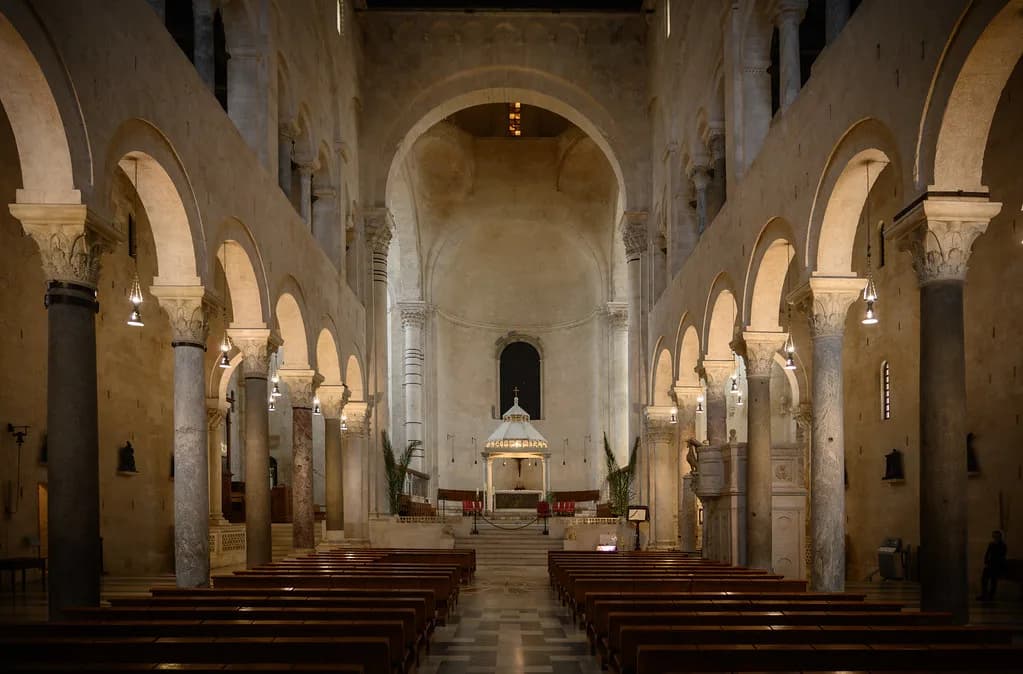
The interior is deliberately austere: three naves separated by slender columns, likely reused from the earlier Byzantine building, with plain walls punctuated by arcades. If you expected gold and Baroque decoration, this is why. An 18th-century remodelling was largely stripped away in a 1950s restoration that returned the space to its Romanesque character.
Look for the raised transept with its carved stone screens, the Romanesque lions flanking the steps to the altar, and the ciborium by Alfano da Termoli dated 1233, reconstructed from original pieces. The dome above the presbytery sits on an octagonal drum with windows, which is what gives the crossing its light. In the central nave floor, remnants of polychrome marble include a rose pattern echoing the facade window.
Below Ground: Crypt and Archaeological Area
Beneath the church, the crypt was remodelled in the 18th century and is supported by rows of columns; it houses the Byzantine icon of the Virgin Odegitria, one of Bari's patron figures. The cathedral is also associated by tradition with the relics of Saint Sabinus, its namesake, though that is a devotional claim rather than something the diocese publishes as visitor information.
The Museo del Succorpo is the subterranean collection where excavations revealed remnants of an early Christian basilica and Roman ruins beneath the cathedral. Lonely Planet names this underground museum as the highlight of a visit, which is a useful signal if you must choose between the church alone and the church plus the excavations.
Access to these lower spaces has not always matched the church's own opening, and travellers have reported finding the cathedral doors shut when they expected them open. Check with the diocese before you travel rather than relying on a guidebook printed months earlier, and have a fallback such as the Basilica di San Nicola or the waterfront.
The Exultet and the Diocesan Museum
Next to the cathedral, the Diocesan Museum holds the Exultet, a Byzantine-influenced illuminated parchment that predates 1050. Its images are inverted relative to the text so that the congregation could see the illustrations while the deacon read the Easter proclamation from the ambo. That design detail is the reason the manuscript is worth a deliberate stop rather than a glance.
A guided tour of the cathedral complex offered by one tour operator includes the Museum of the Exultet along with the crypt and the underground archaeological area, plus a historic-centre map. Treat the schedule you find as that operator's programme, not as the cathedral's own timetable, and confirm before booking.
Free Church or Ticketed Spaces: Planning Time and Budget
Do not assume a single admission covers the church, the crypt, the archaeological area and the Diocesan Museum. They are managed as separate elements, and some published tour prices bundle several of them while others do not. Decide in advance which interiors matter to you, then confirm current terms with the diocese rather than budgeting from an old trip report or a blog figure.
Allow roughly 30 to 45 minutes for the church alone as a suggested planning figure, and add time if you want the crypt, the Museo del Succorpo and the Exultet museum. That is our estimate, not an official duration. If you are short of time, the underground archaeology and the illuminated manuscript are the two elements you cannot see elsewhere in the city.
Guided or Self-Guided
The operator tour of the cathedral complex runs a little over an hour and covers the church, crypt, archaeological area and Exultet museum with a licensed guide speaking Italian. That suits travellers who want the layers beneath the building explained in sequence; self-guided visitors can read the same spaces but will miss the framing.
The operator notes that tourist visits inside churches are suspended during liturgical services, with access reserved for worshippers, and that schedules can shift for organisational or weather reasons. Arrive at the meeting point at least ten minutes early if you book. Self-guided visitors face the same service rule, so plan around Mass times rather than assuming the doors are always open.
Etiquette, Dress and Timing
This is an active place of worship, not a museum with a turnstile. Dress modestly, keep voices low, and step aside if a service begins. Photography during liturgy is inappropriate; if you are unsure whether a given area permits it, ask or simply refrain.
For practical timing, aim for a weekday morning when you can also reach the crypt and museum without rushing, and avoid published service times. Because no official schedule appears in the sources here, confirm opening hours and any closures with the Archdiocese of Bari-Bitonto before you set out.
San Sabino vs the Basilica di San Nicola
With one morning in Bari, the Basilica di San Nicola usually wins on grounds of fame: it holds the relics of Saint Nicholas and is shared by Catholic and Orthodox pilgrims. San Sabino is the city's cathedral, but it takes second place in visitor attention. A reasonable split is a quick look at San Nicola and a slower, more detailed stop at the cathedral.
If you care about archaeology and manuscripts, do the reverse: prioritise the crypt, the Museo del Succorpo and the Exultet, and give San Nicola a shorter pass. Either way, plan both in the same walk, since they sit minutes apart in the old town.
Pairing the Cathedral With the Rest of Bari Vecchia
From the cathedral, walk to Piazza Mercantile, the square that has served as the city's commercial heart since the 14th century and remains a natural pause for a coffee or a gelato. Continue to the old port to watch fishermen land the catch, then loop back past the Castello Normanno-Svevo, whose exterior ramparts can be walked without a ticket.
If you still have appetite for archaeology, the Museo Archeologico di Santa Scolastica sits in a former monastery on the old town's coastal edge and holds finds spanning the region's prehistory to the medieval period. Check its current hours before going, since opening days have varied.
For corners that fall outside the headline sights, our hidden gems in Bari guide is a sensible next read. It helps you spend the afternoon beyond the cathedral without retracing the same three streets.
Plan Your Visit
Bari's cathedral is best approached as a layered site: exterior, church, crypt, archaeology and manuscript, each with its own status and access. Go with a plan for which parts you want, verify current hours and admission directly with the Archdiocese of Bari-Bitonto, and leave room for the possibility that a service or closure changes your sequence.
Built into a walk through Bari Vecchia, the cathedral takes on more meaning than it does in isolation. Pair it with San Nicola, Piazza Mercantile and the seafront, and the old town's layering of Byzantine, Romanesque and modern becomes legible in a single morning.
Frequently Asked Questions
Is entry to Bari Cathedral free?
The sources available here do not confirm current admission terms for the church itself, so avoid assuming a free-entry policy. The crypt, the Museo del Succorpo archaeological area and the Diocesan Museum with the Exultet are separate elements that may be ticketed, and some guided tours bundle them. Confirm the current position with the Archdiocese of Bari-Bitonto before you travel.
What can you see in the crypt and underground museum of San Sabino?
The crypt is an 18th-century remodelling supported by rows of columns and houses the Byzantine icon of the Virgin Odegitria. Beneath the cathedral, the Museo del Succorpo displays excavations that revealed remnants of an early Christian basilica and Roman ruins. Both are the parts of the complex most worth planning extra time for.
How long should you allow for a visit to Bari Cathedral?
As a rough planning suggestion, allow 30 to 45 minutes for the church alone, and add time for the crypt, the archaeological area and the Exultet museum. This is our estimate rather than an official duration. A guided tour of the full complex offered by one operator runs a little over an hour.
Is the Cathedral of San Sabino or the Basilica di San Nicola more important?
San Sabino is technically Bari's most important church, but the Basilica di San Nicola draws more visitors because of its association with Saint Nicholas and its shared use by Catholic and Orthodox pilgrims. With limited time, many travellers prioritise San Nicola and treat the cathedral as a slower, more detailed second stop.
Can you visit during religious services?
No, tourist visits inside churches are suspended during liturgical services, and access is reserved for worshippers. Schedules can also change for organisational or weather reasons. Plan around published Mass times and confirm with the diocese rather than relying on an old guidebook.
Do you need a guided tour to see the cathedral complex?
You do not need one to enter the church, but a licensed guide adds context to the crypt, the archaeology and the Exultet manuscript. One operator offers a tour of the complex in Italian lasting just over an hour. For independent travellers, reading about the layers before you arrive is the practical alternative.
What is the Exultet and where is it kept?
The Exultet is an illuminated parchment predating 1050, created for the Easter liturgy, with images inverted relative to the text so the congregation could see them while the deacon read. It is kept in the Diocesan Museum adjacent to the cathedral. Check current display and access arrangements with the diocese before planning around it.
Sources
Continue exploring
More guides you'll find useful





