Basilica di San Nicola Bari: A Practical Visitor Guide
Plan a visit to Bari's Basilica di San Nicola: the crypt and relics, Romanesque interiors, free entry, a separate treasury, and respectful etiquette.
On this page
The Basilica di San Nicola is the building most travellers associate with Bari, and with good reason: it holds the relics of Nicholas of Myra, the fourth-century bishop whose generosity fed the later Santa Claus legend. It sits in the Città Vecchia, a short walk from the port and roughly a quarter-hour on foot from Bari Centrale station, according to the basilica's own site. This guide separates what is free from what is separately ticketed, explains why the crypt can pause access during services, and suggests visit lengths as suggestions rather than official timings.
Why the Basilica Matters: Nicholas of Myra and the 1087 Translation
Nicholas served as bishop of Myra, in present-day Turkey, and died in the fourth century; the stories attached to him include rescuing sailors and providing dowries anonymously. In 1087, sailors and merchants from Bari brought his relics back from Myra, an episode remembered as the translation, and construction of a basilica to house them followed soon after. That act explains why a Puglian port city, rather than a Lycian town, became the saint's most famous shrine.
Because Nicholas is venerated by both Catholics and Orthodox Christians, the basilica functions as a meeting point between the two traditions, with liturgies and iconography reflecting that crossroads. The liturgical feast falls on 6 December, and the city also marks the translation of the relics at other points in the year. If your trip coincides with a major celebration, expect heavier pilgrim traffic and possible restrictions around worship spaces rather than a quiet museum-like visit.
Where It Sits in Bari Vecchia
The basilica stands in the old town, five minutes from the maritime port and about fifteen minutes from the railway station by the basilica's own description, which makes it easy to fold into a walking day rather than a taxi trip. Address listings vary between Largo Abate Elia 13 and Piazza San Nicola 13 depending on the source, so navigate to the piazza in front of the church and you will find the entrance.
A sensible route arrives through the lanes of Bari Vecchia on foot, spends time in the church, then continues to the seafront at Lungomare Nazario Sauro or back through Piazza Mercantile. If you want more context for the surrounding streets before you go, our hidden gems in Bari guide covers the corners of the old town that reward a slower walk.
Allow time for the approach itself: the old town's alleys are narrow, signage is modest, and the piazza in front of the facade is the natural orientation point. Our Bari Vecchia neighbourhood guide is useful if you want to plan the surrounding streets rather than treat the basilica as an isolated stop.
The Exterior and Its Romanesque Character
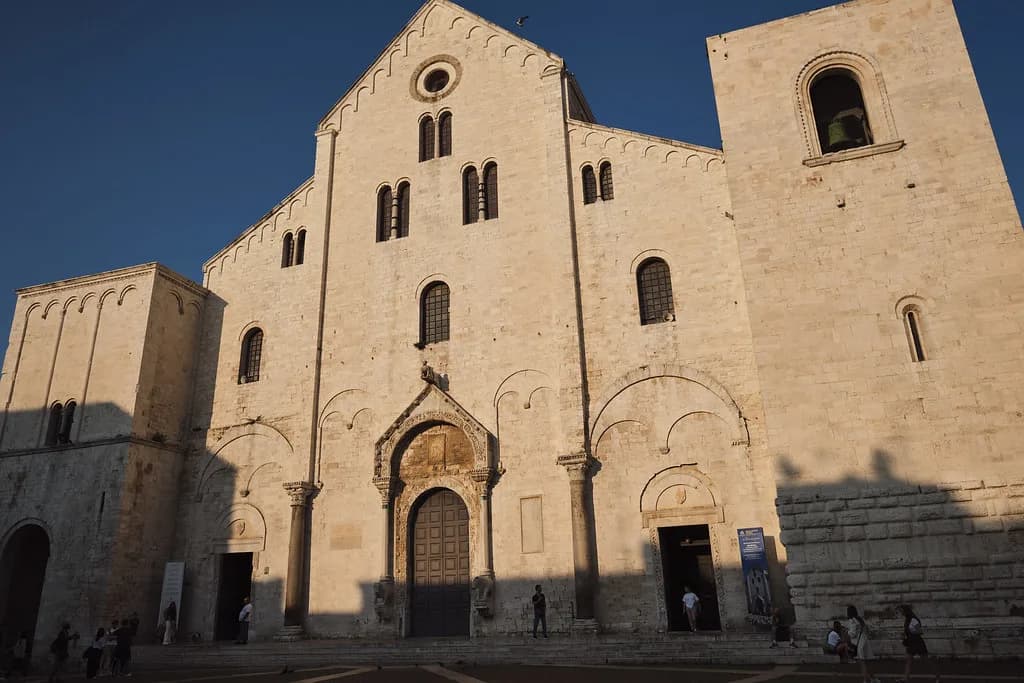
The facade reads as severe, massive Romanesque work in local limestone, with the solid, sober look associated with Norman-era architecture in southern Italy. What is easy to miss is that the church was not raised on empty ground: it was built over the area of the residence of the catepan, the Byzantine governor of southern Italy between 968 and 1071, and it reuses substantial material from that earlier building. Knowing this changes how you look at the masonry, which mixes new construction with salvaged stone.
Walk the length of the piazza before going in, because the building's weight and proportions register best from a distance, and the side and rear views show how the church sits among ordinary old-town houses. The portico area has been the subject of restoration and refunctionalisation work noted in the basilica's published news, so parts of the exterior surroundings may be affected by works when you visit. Check the facade at street level first, then look up.
Inside the Upper Basilica: What to Look For
The interior follows a three-aisled basilica plan with a broad transept, and the central nave, choir and side chapels repay slow looking rather than a quick circuit. Look for the layering that accumulates in a church this old: medieval fabric, traces of older frescoes, Byzantine-influenced iconography and later Baroque retouching sit close together. Third-party guides describe this mixture as one of the pleasures of the space, though which frescoes and chapels are visible can change with restoration.
Photography is generally tolerated without flash, but treat that as common courtesy rather than a published rule, and follow any signage or instructions from staff on the day. If a chapel is being used for prayer, step back rather than working around worshippers. If you want a second Romanesque church to compare, the Bari Cathedral San Sabino visitor guide covers the other great church of the old town, a short walk away.
The Crypt and the Relics
The relics rest in the crypt beneath the choir, reached by descending into a low, narrow space that carries the weight of the visit for many people. Third-party guides note that the crypt is generally open during the same hours as the basilica but may close or slow access during services, and they advise confirming timings with the basilica rather than assuming a fixed window. Treat a closed crypt door as a sign of liturgy in progress, not a snub.
Inside, keep voices low, avoid touching the shrine, and follow staff directions; the space is physically tight, so travellers with mobility limitations or a dislike of crowds should ask about access before committing to the descent. Because the crypt is a working worship space rather than a display room, behaviour matters more here than anywhere else in the building. Visitor reviews frequently single out the crypt as the emotional centre of a visit, which is a fair expectation to carry in.
If seeing the relics is the purpose of your trip, build slack into the day so a paused access window does not derail the rest of your plans, and check the basilica's own site for liturgy-related notices before travelling. The basilica publishes its liturgical life and celebration schedules there, which is a more reliable guide than any third-party summary.
Free Entry vs Paid Extras
Entry to the basilica itself is free for visitors and worshippers, according to a third-party visitor guide, and that covers the nave, transept and, when open, the crypt. The Museo del Tesoro di San Nicola, which displays liturgical objects, manuscripts and secondary relics across several levels, is described as a separate small museum that may require a ticket, with the same guide quoting an indicative range of three to five euros. Treat that figure as indicative and unverified rather than as current official admission.
Guided tours are a third separate layer: the basilica offers bookable guided visits, and commercial operators sell their own formats, including a short crypt-focused walk and a longer option that pairs the church with the treasury. Availability, language and price depend on the operator and the season, so book only through a channel you can verify and read the inclusions carefully. A guided tour of the basilica and crypt is a convenient way to structure a first visit if you want commentary rather than self-guided looking. Further visitor details appear in Bari: Basilica of Saint Nicholas Guided Tour.
The practical consequence is that you can see the church and its relics without spending anything, and decide on the day whether the treasury or a guide is worth the extra cost. Do not assume one ticket covers everything in the complex, because the basilica, the museum collection and tours are administered and priced separately.
Hours and Services: Verify Before You Go
Third-party sources quote indicative public hours of roughly 7:00 to 12:00 and 16:00 to 19:30 Monday to Saturday, with a slightly later Sunday morning close around 12:30, but these are not confirmed official hours and can shift around liturgical events. The basilica's own website is the authority for the current schedule and for Mass and confession times, and it is the page to check in the days before you travel.
Because the church hosts regular liturgies, weddings and celebrations, opening windows can be interrupted or shortened at short notice, and the crypt in particular can pause access. The basilica publishes its celebration schedule, confession times and booking routes for guided visits and Masses on its own site, so a single check there settles most practical questions.
How Long to Allow
For a short stop that covers the facade, the nave and a look at the side chapels, allow roughly thirty to forty-five minutes; that is a suggestion for pacing, not an official figure. If you want to descend to the crypt, sit with the relics for a while and read the interior slowly, plan on an hour or a little more.
Adding the treasury museum pushes the visit toward two hours, and a guided format sold by operators typically runs from about seventy-five minutes for the crypt-focused version to around two and a half hours when the museum and a tasting are included. Those durations come from the operator's own description and should be checked against the current listing rather than treated as fixed.
A realistic half-day pairs the basilica with a walk through the old town and the seafront, which suits the building's location better than a rushed dash from the station. If you want a structured route, our self-guided walking route through Bari can slot the basilica into a larger circuit.
Etiquette and Dress
This is an active place of worship, so dress with shoulders and knees covered, keep voices down and switch off camera sounds and flash. Third-party guides give this as practical advice rather than published policy, but it matches what any working church expects of visitors. If a liturgy is underway, sit or stand at the back rather than moving through the nave as a sightseer.
Photography without flash is generally tolerated, but follow signage and staff instructions on the day, and never photograph people at prayer. In the crypt, the narrow space and the presence of worshippers make restraint more important than getting the shot.
When to Go: Morning Light, Evening Facades and Feast Days
Early morning, between roughly 7:00 and 9:30, is recommended by a third-party guide for softer light, fewer crowds and the atmosphere of morning services, though any timing depends on the day's liturgy. Evening is the better time for the facade itself, when the piazza and the illuminated stone make the building legible from outside rather than from within.
Feast days and major celebrations, especially around 6 December and the translation commemorations, bring pilgrims from Italy and Eastern Europe and can restrict movement through the church and crypt. If your dates are fixed to a festival, plan around the services rather than against them, and check the basilica's own calendar for what is happening.
Practical Planning Before You Travel
Carry a little cash for small offerings and for the treasury if you decide to go in, since a ticket window is not the place to discover your card is the only option. Confirm current hours, any restoration works and celebration times on the basilica's site in the days before your visit, because published news there flags building works and schedule changes.
If you need a specific arrangement, such as a group visit, a Mass intention or an accessibility question, contact the basilica directly through the channels listed on its own pages rather than relying on a third-party summary. Keep your expectations modest about what any single source, including this one, can confirm about a living institution's daily operations.
Nearby Pairing to Extend the Outing
Once you leave the basilica, the old town continues to reward walking: the lanes behind the church lead back toward Piazza Mercantile, and the seafront at Lungomare Nazario Sauro gives a wide view back over the Adriatic. Pairing the church with the cathedral and a short archaeological stop gives the day more shape than a single visit can.
The Museo Archeologico di Santa Scolastica Bari is a reasonable addition for travellers interested in the layers beneath the city's religious architecture. If you are building a wider itinerary, the Bari attractions hub lists the sights worth slotting around the basilica.
Accessibility and Physical Constraints
The crypt is a narrow, enclosed space reached by descending, which makes it a genuine constraint for some visitors, and crowding can make the descent uncomfortable even for those without mobility issues. Published sources do not confirm the full details of step counts, lift access or wheelchair suitability, so contact the basilica directly if these matter to your visit.
Crowding around the shrine and in the nave can make it hard to pause, and the narrow lanes outside add to the effect. A quieter approach is to arrive early in the day and treat any restricted stretch as a prompt to spend longer in the upper church.
Plan Your Visit
The Basilica di San Nicola rewards a visit that treats it as a place of worship first and a monument second: free to enter, with the relics in the crypt as the heart of the experience and the treasury as an optional extra. Confirm the current schedule and any building work on the basilica's own site before travelling, since hours and access can change around liturgies. Build in a little slack, dress respectfully and leave time to walk the old town.
Frequently Asked Questions
Is entry to the Basilica di San Nicola in Bari free?
Yes. Entry to the basilica itself is free for visitors and worshippers according to third-party visitor information, and that covers the nave, transept and, when open, the crypt. The treasury museum collection is described as a separate ticketed stop, and guided tours are sold separately, so do not assume one ticket covers the whole complex. Confirm current arrangements on the basilica's own website before you travel.
What are the opening hours of the Basilica di San Nicola?
Third-party guides quote indicative hours of roughly 7:00 to 12:00 and 16:00 to 19:30 Monday to Saturday, with a slightly later Sunday morning close around 12:30. These are not confirmed official hours and can shift around liturgies, weddings and celebrations. Check the basilica's own site in the days before your visit for the current schedule and for Mass and confession times.
Can you see the relics of Saint Nicholas, and where are they kept?
The relics rest in the crypt beneath the choir, reached by descending into a low, narrow space. The crypt is generally accessible during basilica hours but can close or slow access while services are underway. Because it is a working worship space, keep voices low, avoid touching the shrine and follow staff directions. If seeing the relics is the purpose of your trip, build some slack into the day.
How long should you allow for a visit to the basilica?
As a suggestion rather than an official figure, allow around thirty to forty-five minutes for the facade, nave and side chapels. Add time for the crypt, and plan on roughly an hour or a little more if you want to sit with the relics and read the interior slowly. The treasury museum pushes a visit toward two hours, and guided formats run from about seventy-five minutes upward depending on what is included.
What should you wear when visiting the basilica?
Dress as you would for any working church: shoulders and knees covered, and no beachwear. Keep voices low, switch off camera sounds and flash, and avoid photographing people at prayer. Third-party guides present this as practical advice rather than published policy, but it matches what the setting expects. During liturgies, stay toward the back rather than moving through the nave.
Is the treasury museum included in the basilica visit?
No. The basilica is free to enter, while the Museo del Tesoro di San Nicola is described as a separate museum collection that may require its own ticket. A third-party guide quotes an indicative three-to-five-euro range, but that figure is unverified and should not be treated as current official admission. Check the price at the door or on the basilica's website.
What should you see near the basilica in Bari?
The old town lanes around the church lead back toward Piazza Mercantile, and the seafront at Lungomare Nazario Sauro offers a wide view back over the water. The cathedral, Bari Cathedral of San Sabino, is a short walk away and gives a second Romanesque comparison. The archaeological museum at Santa Scolastica is another option for travellers interested in the city's deeper layers.
Sources
Continue exploring
More guides you'll find useful