
Lungomare Nazario Sauro Bari: Waterfront Walk Guide
Plan a free stroll along Bari's Lungomare Nazario Sauro, with old port views, sunset timing, nearby piazzas and a route on to Pane e Pomodoro beach.
On this page
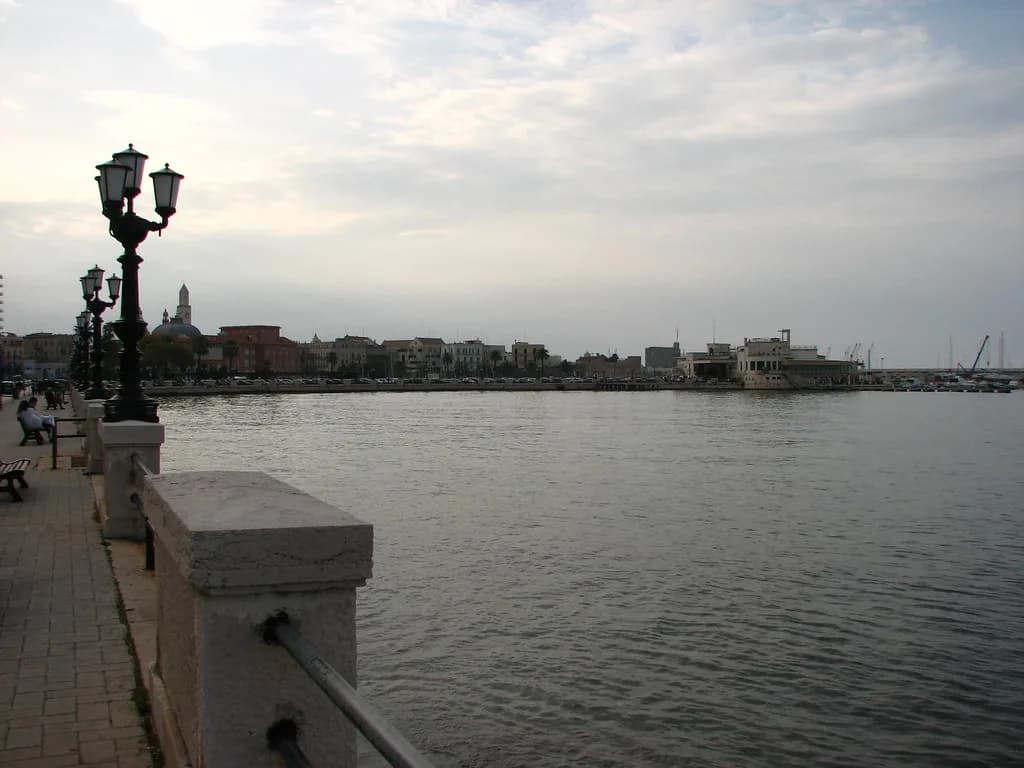
Bari's Lungomare Nazario Sauro is the simplest free thing to do in the city, and that is exactly why it works. You get an open view of the Adriatic, the working life of the old port, and a steady stream of Baresi doing what people in port cities have always done: walking, talking and watching the water. No ticket, no queue, no opening hours to plan around.
What the walk delivers is atmosphere rather than spectacle. It is not a resort strip and not a dramatic cliff path; it is an urban promenade with benches, sea air and a city wrapped around it. The interesting part is the chain of things it connects: the fishing boats of the old port, the old-town edge around Piazza del Ferrarese, the ornate theatre on the water, and eventually the public beach at Pane e Pomodoro.
Where the Promenade Runs and How to Join It
The seafront walk in Bari is usually described as running between Piazza Armando Diaz and the city beach, with plenty of benches along the way. That positioning matters when you plan: one end sits close to the old-town edge and the port, while the other stretches toward the public sand of Pane e Pomodoro. Treat those as your two anchors rather than hunting for a formal trailhead, because there is no marked route or official starting gate.
Reaching the waterfront on foot is straightforward from Bari Vecchia. The old town spills out near Piazza del Ferrarese, which sits right on the boundary of the historic quarter and close to both the Porto Vecchio and the lungomare, making it a natural place to begin or end a walk. From there you are already facing the water, so the only decision is which direction to take.
Do not confuse the promenade with Bari's separate Lungomare Imperatore Augusto, which is often quoted at around nine kilometres in length. The naming along Bari's coast shifts from stretch to stretch, so quotes of distance or landmarks on online reviews may refer to a different segment. Use the sea on your right or left as your guide rather than a figure you read somewhere.
Walk It One Way: Old Port to the Beach
The most satisfying logic is a one-way stroll rather than an out-and-back. Start at the old-port and Teatro Margherita end, where the fishing boats and the waterfront theatre give you an immediate sense of place, then keep the sea beside you as the city loosens into its beach edge. You finish at Pane e Pomodoro, where a swim or a sit-down closes the loop without retracing your steps.
The return is where a little planning helps. Bari is a compact city and the promenade sits within walking distance of the old town, so many visitors simply walk back through the streets rather than the seafront, which turns the outing into a loop through Bari Vecchia. If you would rather not walk twice, decide before you set off whether you will take a bus, taxi or a slow wander back.
The flat ground is a quiet advantage. There is no climbing, and the bench-lined promenade invites pauses, which makes it one of the easier urban walks in Puglia for anyone travelling at a slow pace or with tired legs after a morning in the old town.
What You Actually See Along the Way
The Porto Vecchio is the first real sight, and it is a working one. Fishermen still bring their catch ashore here, and the blue boats moored along the old harbour are the image most visitors carry home; note that this is not the terminal for the big cruise ships or the ferries to Greece, Montenegro and Albania, which dock elsewhere.
Teatro Margherita gives the seafront its most photographed silhouette. The theatre opened in August 1914 after a fire destroyed its wooden predecessor, built on stilts over the water to sidestep a municipal agreement that blocked new theatres on public land; land reclamation in the 1920s filled in the shoreline, so it now stands on dry ground, and since December 2018 it has operated as a contemporary art venue. Visitor details: Museum Teatro Margherita, Tourist Attraction in Puglia, Italy.
Look inland and the Castello Svevo di Bari, also called the Norman-Swabian Castle, appears from the seafront. The twelfth-century fortress changed hands repeatedly among Normans, Swabians, Angevins and Aragonese, and today it houses exhibitions; whether the interior collection and the surrounding ramparts are free or ticketed is a detail to confirm on the castle's own page before you rely on it. Related guide: Norman-Swabian Castle in Bari.
The sea itself is the constant. Bari's waterfront photographs show a broad open view where residents pause for a selfie or simply sit facing the Adriatic, and the appeal is that ordinary, unforced pleasure of a coastal city using its own edge.
Sunset, Evening or Early Morning?
Sunset and the evening are the classic window, when the light softens and the promenade fills with people. Local reviewers consistently point to sunset as the moment the seafront comes into its own, with streetlights coming on and residents gathering along the water; that is also when the bars and restaurants around Piazza del Ferrarese get busy.
Morning offers a different city. The old port is livelier in the earlier part of the day, when the catch comes in and the fish trade is at its most active, so walkers who want to see Bari working rather than relaxing should reverse the timing. The trade-off is that you lose the evening atmosphere that draws most visitors to the promenade.
Spring and autumn are the gentlest seasons in Puglia, when crowds thin and the weather still cooperates; early June or late September suits anyone who wants warmth without the peak-summer press. High summer along an exposed waterfront means sun and heat, so carry water and use the shade when you find it.
How Long to Allow
As an editorial suggestion rather than anything official, budget about forty-five minutes for a short seafront stroll with pauses, and roughly ninety minutes to two hours for the full walk from the old-port end through to Pane e Pomodoro with a stop on the sand. Add time if you detour inland to the piazzas or stop for focaccia.
Anyone with only half a day can still do justice to the seafront. The old town and its main sights sit close enough that a walk along the water, a glance at the castle exterior and a coffee in a piazza make a coherent few hours without rushing; travellers who want museums and church interiors should plan a full day.
Stopping Points Just Inland
Piazza del Ferrarese is the natural first detour, a square lined with bars and cafés that is quiet by day and lively at night. It also marks where the old town begins, so you can step off the seafront and be among narrow streets within a minute or two.
Piazza Mercantile has been the commercial heart of Bari since the fourteenth century and remains a place for people-watching, eating and evening events, with the Palazzo del Sedile and its clock tower giving the square its shape. Both piazzas are free public space, so they cost you nothing but time.
Just inland, Arco Basso, often called the orecchiette street, is where local women shape pasta by hand at tables in the open. It is a working tradition rather than a performance, so buy a bag of pasta if you stop to photograph, and remember these are private doorsteps rather than a visitor attraction.
Food and Drink Along the Route
Focaccia barese is the snack to seek out near the waterfront: a thicker bake than the Ligurian version, topped with cherry tomatoes and olives and finished with plenty of olive oil. Bakeries in the old town sell it by the slice, which makes it an easy, informal stop before or after the walk.
At the Porto Vecchio, seafood is street food rather than restaurant food. Fishermen bring their catch ashore and some of it is eaten on the spot, sushi-style, with sea urchins, mussels and octopus among the usual offerings; go earlier in the day if you want the widest choice. This is not a setting for anyone squeamish about raw shellfish.
For everything else, the old town supplies panzerotti, gelato and sit-down trattorias within a short walk of the promenade. Specific cafés change hands and adjust hours, so rather than relying on any list, check Google Maps for current opening times on the day and simply pick whichever terrace looks busy with local families.
Ending at Pane e Pomodoro Beach
Pane e Pomodoro is Bari's own public beach, reachable on foot along the lungomare, roughly a half-hour walk from the edge of the old town depending on where you start. It is a functional city beach with a café, showers and changing rooms, not a resort; umbrellas and towels are not provided, so bring your own if you plan to stay.
Set expectations sensibly. Bari's beach is convenient rather than glamorous, and travellers chasing the classic Puglia coastline should look to the Gargano, the Tremiti islands, or towns such as Polignano a Mare and Monopoli for a dedicated beach day. Treat Pane e Pomodoro as a place to cool off at the end of a city walk.
Pairing the Walk With Bari's Free and Low-Cost Sights
Bari's free sightseeing clusters tightly around the waterfront. The Basilica di San Nicola in Bari, which holds the relics of Saint Nicholas in its crypt and is shared by Catholic and Orthodox worshippers, sits a short walk inland, as does the Romanesque Bari Cathedral with its white limestone exterior; both are churches, so check current visiting hours before you go and dress appropriately. The Basilica di San Nicola Bari visitor guide covers the crypt and the practicalities separately.
Be careful about assuming one ticket covers everything. Bari's churches, castle interiors and museums are separate operations with their own entry rules, so the free outdoor walk and the ramparts outside the castle are distinct from paid museum visits; anyone planning a museum morning should check official pages for current hours and prices rather than trusting older blog figures.
Suggested Half-Day and Full-Day Combinations
A relaxed half day might run: old port in the mid-morning, a slow walk along the seafront past Teatro Margherita with a look at the castle exterior, then focaccia in the old town and a coffee in Piazza Mercantile. That covers the waterfront's highlights without a single ticket.
With a full day, add a morning in Bari Vecchia with a church interior, a museum or the castle collection, then save the promenade for late afternoon and sunset so the light works in your favour. Slower travellers based in Bari for a few nights can then dedicate another day entirely to a coastal day trip by train to Monopoli or Polignano a Mare.
If you have already walked the seafront and want more of the city's overlooked corners, the hidden gems in Bari include quieter streets and small sights beyond the headline churches. The official city website is the place to check for temporary closures, events and notices that might affect a waterfront visit.
Practical Notes Before You Set Out
The walk is flat and exposed. There is little natural shade along the open seafront, so a hat, sunscreen and a refillable water bottle make a real difference in warmer months; the fountain in Piazza Mercantile is a handy place to top up as you pass through the old town.
Think about footwear and timing rather than gear. This is a city pavement walk, not a hike, so ordinary shoes suffice, but late-afternoon sun on an unshaded promenade can be draining, and the benches are there for a reason.
Finally, accept the promenade for what it is: a pleasing urban edge rather than a grand scenic set piece. Some visitors find it pleasant but not a reason to visit Bari on its own, and pairing it with the old town, the port and a meal is what makes the outing worthwhile. Further visitor details appear in Teatro Margherita, Bari – Joel's Journeys & Jaunts.
Plan Your Waterfront Stroll
Walk the Lungomare Nazario Sauro in one direction, from the fishing boats and Teatro Margherita toward Pane e Pomodoro, and you get the best of Bari's free sightseeing in a couple of hours. Keep expectations calibrated: the pleasure here is the sea air, the city's working port and the easy company of people doing the same thing.
Before you go, check the city website for any events or closures along the seafront, and verify opening times for any church or museum you want to enter, since those are separate from the walk itself. Then simply choose your hour, morning for the port or evening for the light, and let the promenade do the rest.
Frequently Asked Questions
Is the Lungomare Nazario Sauro walk free?
Yes. The promenade is public space with no entry fee, and the benches, sea views and old port are all open to anyone. Nearby churches, the castle museum and art venues are separate sites with their own entry rules, so a free walk does not mean free access to those interiors. Check each site's own page before you plan a visit indoors.
How long does it take to walk Bari's waterfront promenade?
There is no official length to work from, so treat any figure with caution. As a rough editorial suggestion, allow around forty-five minutes for a short seafront stroll and ninety minutes to two hours to walk from the old-port end to Pane e Pomodoro with pauses. Add time for detours into the old town.
Is the promenade better at sunset or in the morning?
Sunset is the classic choice, when the light softens, the streetlights come on and residents gather along the water, and it suits anyone combining the walk with dinner. Morning is better for the old port, when the fishing boats land their catch and the harbour is at its most active. Choose according to whether you want atmosphere or working port life.
Does the promenade lead to a beach in Bari?
Yes, the lungomare continues toward Pane e Pomodoro, Bari's public city beach, which has a café, showers and changing rooms. It is a functional local beach rather than a resort, and umbrellas and towels are not provided, so bring your own. For a dedicated beach day, look to Polignano a Mare, Monopoli or the wider Puglia coast.
Is Bari's waterfront walk worth doing if you only have half a day?
It fits easily into half a day, especially paired with the old town. A short route might include the old port, a walk past Teatro Margherita, a look at the castle exterior, focaccia in Bari Vecchia and a coffee in one of the piazzas. Anyone wanting church interiors or museum collections should allow a full day.
Where do you start the Lungomare Nazario Sauro walk?
Most visitors join the seafront near Piazza del Ferrarese, at the edge of the old town and close to both the Porto Vecchio and the promenade. From there, head toward the beach so the walk runs one way rather than doubling back. There is no official trailhead or marked route, so use the coastline as your guide.
What should you watch out for when walking the promenade?
The main things are sun and exposure. The seafront is flat but largely unshaded, so carry water and wear a hat in warmer months, and use the benches when you need a pause. Nights are lively around Piazza del Ferrarese, and the old-town streets just inland are uneven underfoot in places.
Sources
- Bari's Nazario Sauro waterfront
- 17 Unexpected Things To Do In Bari, Italy - The Globetrotting Teacher
- 17 Fun Things to do in Bari, Italy - Adventurous Kate
- Bari, Italy: The Hidden Gem of the Adriatic | Designer Travel
- Visit Castello Svevo Di Bari in Bari | Live the World
- Piazza Mercantile, Bari: address and opening hours | ZonzoFox
- Teatro Margherita: Bari's Theatre Built Over the Sea - Bari, Italy | Ciceru - Travel Stories & Adventure Guides
- Museum Teatro Margherita, Tourist Attraction in Puglia, Italy
- Teatro Margherita, Bari – Joel's Journeys & Jaunts
- Official event website
- Lungomare Nazario Sauro - Puglia, Italy
- Lungomare Imperatore Augusto - All You SHOULD Know ...
Continue exploring
More guides you'll find useful





