Free Things to Do in Palermo: Markets, Squares and Views
Plan a low-cost day in Palermo with free markets, baroque squares, fountains and waterfront walks, plus clear notes on which churches and palaces charge entry.
On this page
Palermo is a city where the cheapest day can also be the fullest: open-air markets, baroque intersections and a seafront park cost nothing to wander, and the historic centre is compact enough to cover on foot. The pattern to learn early is free street versus paid interior, because much of what makes the city famous is visible from outside before any ticket window appears.
Palermo is the capital of Sicily and, according to one long-form guide, home to roughly 650,000 people, which explains why its markets feel like working neighbourhood infrastructure rather than visitor attractions. Treat those markets as a free morning activity, then decide whether one ticketed interior is worth your budget for the day.
Why Palermo Suits a Low-Cost Day
Very little of Palermo's appeal is gated. The street grid of the historic centre, the outdoor food markets, the fountains and the waterfront are public space, and the city's UNESCO listing covers a route of monuments rather than one walled site, as Visit Sicily explains in its description of the Arab-Norman itinerary. That distinction matters: a street can be heritage-listed while the building on it still sells admission.
Plan a day around what you can see without paying, and let paid interiors be deliberate choices rather than accidents. If you want a wider menu of overlooked corners before you go, the Yondli guide to hidden gems in Palermo is a sensible starting point for less-obvious stops.
The Markets: Free to Enter, Different in Character
Palermo's outdoor markets cost nothing to walk through, and each has a distinct personality, so pick according to the time of day rather than trying to tick off all three. Ballarò is the largest and most intense, a working market where locals shop and traders call out prices; Capo is smaller, food-led and best in the morning when stalls are fully stocked; Vucciria is the one most likely to disappoint anyone expecting a classic daytime food market.
That last point deserves emphasis. Travel writing on La Vucciria is blunt about the gap between reputation and reality: by day it is a scattering of stalls and bric-a-brac, and its real energy arrives in the evening when bars and street-food counters take over the lanes around Piazza Caracciolo. If you want the market spectacle, go to Ballarò or Capo; if you want cheap evening street life, Vucciria is the free option.
Bring small change, because the pleasure of a market is buying a piece of fruit or a snack on impulse and the stalls are not set up for cards. One Palermo food guide advises exactly that: standard street food varies wildly from cart to cart, so buy small, taste, and go back to the vendor you liked. None of this requires a ticket.
Quattro Canti and the Four Historic Quarters
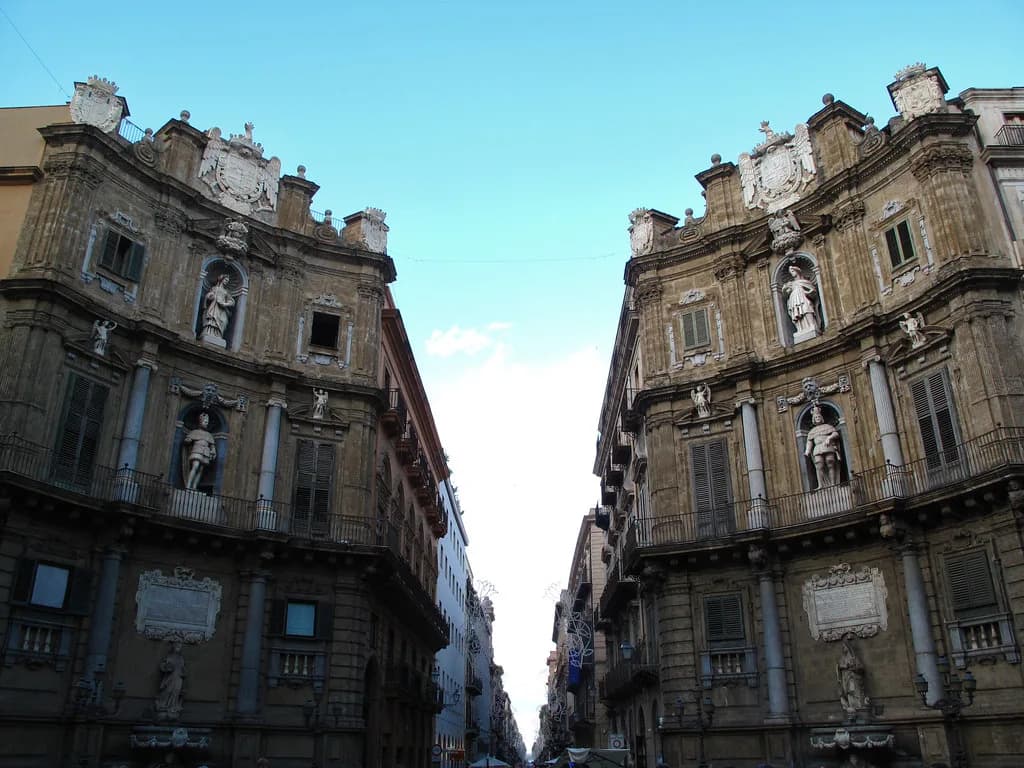
Quattro Canti, the baroque intersection at Corso Vittorio Emanuele and Via Maqueda, is the best free orientation point in the city. Its four curved corners were built in the early seventeenth century under Spanish rule, and each facade carries a statue of a Spanish king, a patron saint and a fountain representing one of the four seasons. From the same spot you can read the division of the historic centre into four traditional quarters: La Loggia, Kalsa, Albergheria and Capo, sometimes called Seralcadio.
Standing there costs nothing and tells you where you are in relation to everything else, which is why it belongs early in a free day rather than at the end. If you plan to spend more time in the southern quarter, an Albergheria neighbourhood guide helps you link the market streets with the nearby churches.
Fontana Pretoria and Piazza della Vergogna
Fontana Pretoria is the city's most spectacular free fountain, and its history is as good as its appearance. It was made in Florence and brought to Palermo in the 1570s in hundreds of pieces, a logistical feat that a Palermo things-to-do guide describes in detail. The square around it was nicknamed Piazza della Vergogna, the square of shame, because of the nude figures on the fountain.
You can see the whole thing from the pavement, so there is no reason to treat it as a stop with an entrance. Combine it with Quattro Canti a few minutes away and you have a free architectural circuit that takes under an hour. For a broader list of sights grouped by area and type, the Palermo Attractions hub is a useful cross-check.
Walk the Cassaro Spine from Porta Felice to Porta Nuova
Via Vittorio Emanuele, the old Cassaro, runs almost straight from the sea at Porta Felice to Porta Nuova near the cathedral and royal palace, and walking it is the cheapest way to see how Palermo fits together. Along the way you pass Quattro Canti and a run of churches, palaces and small side streets worth detouring into. Treat it as your first-day orientation rather than a checklist, and let side alleys pull you away.
If you would rather follow a fixed route than improvise, a self-guided historic centre walk does the same job with a sequence already worked out. Otherwise, start at the sea end in the morning, break for market food, and finish near the cathedral before the light goes.
San Giovanni degli Eremiti: Exterior Versus Interior
San Giovanni degli Eremiti is one of the most photogenic stops in the city, and most of what you will remember is the outside: five red domes above a garden of citrus, agave and climbing plants. Visit Sicily notes that the church, now deconsecrated, was founded in 1142 and forms part of the Arab-Norman UNESCO route, with a garden that is as much a reason to come as the building itself. The domes and the setting are the free postcard; access to the church and its cloister is managed separately and should be confirmed on site or via official sources.
Sacred Destinations describes the same building as sitting on the site of a mosque and notes the late Norman cloister with its Moorish cistern nearby. That helps set expectations: this is a small complex, not a sprawling museum, and the walk past it through the Albergheria street grid is part of the value. If you are weighing it against other paid interiors, see it first from the outside and decide.
Palermo Cathedral and the Free-Versus-Paid Question
Palermo Cathedral is a genuinely difficult site to describe in free-or-paid terms, because the building is both a working place of worship and a monument with separately managed areas such as roof access and treasury-type add-ons. Rather than assume that entry is entirely free or entirely ticketed, check at the door and on official sources for what is included on the day you visit. The exterior, with its patchwork of Norman, Gothic, Catalan and Baroque layers, costs nothing to admire from the piazza.
That patchwork is the point. A city guide to Palermo describes the cathedral as a composite of Muslim, Byzantine, Jewish, Latin, Lombard and French influences, with a zodiac on its floor, which is rare in Italian cathedrals. Read the facade before you decide whether the interior is worth your one paid stop.
Palazzo Abatellis: The Deliberate Splurge
Palazzo Abatellis, home of the Regional Gallery of Sicily in the Kalsa quarter, is the paid stop this guide would defend rather than the one it would skip. Klat magazine explains that the museum opened in 1954 and is now regarded as a landmark of twentieth-century museology, with Carlo Scarpa's installation creating a dialogue between a Catalan Gothic building and the works inside. The centrepiece is the monumental Triumph of Death fresco, displayed in the former chapel, alongside Antonello da Messina's Virgin Annunciate.
Budget time and money for this one rather than trying to squeeze it in between free sights. Set aside roughly two to three hours for a considered visit, an explicitly suggested duration rather than an official figure, and check current admission and hours with the museum before you go. If you only pay for one interior in Palermo, this is the strongest case for doing so.
Kalsa, Santa Maria dello Spasimo and the Roofless Church
The Kalsa quarter, running down toward the sea from the historic centre, is one of the oldest parts of Palermo and is noticeably less crowded than the shopping streets around Quattro Canti. Santa Maria dello Spasimo, a church ruin open to the sky and used as a cultural venue, is the area's most distinctive stop, and it is described in senior-travel writing as a less-visited site where concerts and exhibitions are sometimes staged. Events vary by season, so check locally rather than planning a day around a specific performance.
Beyond Spasimo, the quarter rewards plain walking: the street life around the food stalls and simple seafood restaurants is the attraction, not any single ticket. For more corners like this, the guide to hidden gems in Palermo places lesser-known stops alongside the obvious ones.
Waterfront Downtime: Foro Italico and Mondello
Foro Italico is a broad waterfront park along the sea, useful when you want to stop spending and sit down. The same source describes it as a large public space with sea views, benches and shaded grass, which makes it a good afternoon reset between ticketed stops. It costs nothing to walk the promenade, and it is the kind of place where a free day genuinely feels like a day off.
Mondello, within the city limits, combines a sandy beach with a village walk, and it is free to wander even outside swimming season. One Palermo guide notes that Sicilians treat the proper beach season as roughly mid-June to mid-September, with shoulder-season visits far calmer and still pleasant for walking. Expect heavy summer crowds and plan around them rather than fighting them.
Understanding the UNESCO Listing Without a Ticket
The Arab-Norman Palermo listing, which also takes in the cathedrals of Cefalù and Monreale, is a route of monuments rather than a single walled attraction, as Visit Sicily sets out. That is why a public street can be part of a World Heritage site while the building beside it still sells admission. Once you understand the distinction, the free-or-paid question stops being confusing and becomes a matter of choosing which interiors deserve your money.
La Zisa is a good example: the palace, begun under William I in the mid-twelfth century as a pleasure retreat, is a UNESCO-listed Arab-Norman building whose interior access is ticketed. Check current conditions and details with the site before you go, and enjoy the exterior and surrounding streets regardless. Nigel and Sue Adventures includes La Zisa among Palermo's sights, which is a useful prompt to slot it into a western walking day.
Budget Tactics That Actually Work
The single most useful rule is one paid interior per day, with everything else outdoors. That keeps the budget predictable and stops you from paying for three similar museums on the same afternoon. Tours bundle visits for convenience, but a half-day excursion that includes Monreale and San Giovanni degli Eremiti, like the one listed by Expedia, shows how quickly a paid itinerary replaces free walking.
Eat at market stalls and small bakeries rather than sit-down lunches in the tourist core, and carry small notes for spontaneous buys. Palermo's street food is unfussy and rooted in working-class cooking, which is why it remains budget-friendly. If you want to plan around crowds and heat rather than pay for timed slots, check the best time to visit and avoiding crowds before you fix dates.
A Free Day and a Paid Day Compared
A free day in Palermo looks like this: Ballarò or Capo in the morning, Quattro Canti and Fontana Pretoria on foot, a walk down the Cassaro toward the sea, an afternoon at Foro Italico, and Vucciria in the evening. A paid day keeps the same skeleton but adds one interior, usually Palazzo Abatellis or the cathedral's ticketed areas, and slows down elsewhere. The two days feel different, and alternating them keeps the budget and the energy in balance.
Plan Your Free Palermo Day
Palermo rewards the traveller who walks first and pays second. The markets, squares, fountains and waterfront give you a full day for nothing, and the ticketed interiors are easy to add once you know which one you actually want. Keep small change, check current opening and access details with official sources, and treat the city's streets as the main event.
If you are building a longer stay, pair this guide with day trips from Palermo to see how far a cheap base can stretch, and confirm any seasonal or event-related changes before you commit.
Frequently Asked Questions
What can you do for free in Palermo?
The strongest free options are the outdoor markets, the baroque squares around Quattro Canti, Fontana Pretoria, the Via Vittorio Emanuele spine, Foro Italico and a walk around Mondello. Most of the city's appeal is in public space, so a full day costs nothing beyond food and transport.
Are Palermo's street markets free to visit?
Yes, walking through Ballarò, Capo and Vucciria costs nothing; you pay only for what you buy. They differ in character: Ballarò is the largest and most intense, Capo is food-led and best in the morning, and Vucciria is more of an evening street-life spot than a daytime market.
Is Palermo Cathedral free to enter?
It is not a clear free-or-paid site, because the working church and separately managed areas such as roof access and treasury-type add-ons may be handled differently. Check at the entrance and on official sources on the day, and enjoy the exterior piazza regardless.
Is San Giovanni degli Eremiti free?
The building is famous for its five red domes and garden setting, which you can see from outside. Access to the church interior and cloister is managed separately, so confirm current access and conditions on site or via official sources before you plan around it.
Which Palermo sights are worth paying for?
Palazzo Abatellis, home of the Regional Gallery of Sicily, is the strongest case for spending, thanks to the Triumph of Death fresco, Antonello da Messina's Virgin Annunciate and Carlo Scarpa's installation. Check current admission before you go, and treat it as your one paid interior of the day.
Is La Vucciria market free, and is it worth visiting?
It is free to walk through, but set expectations: by day it is a scattering of stalls and bric-a-brac rather than a classic food market, and its energy arrives in the evening. If you want a traditional market experience, go to Ballarò or Capo instead.
Sources
Continue exploring
More guides you'll find useful