Vicenza Viewpoints: Monte Berico Terrace and City High Points
A practical guide to Vicenza viewpoints, from the Monte Berico sanctuary terrace to the Palladian rooflines you read from the street below.
On this page
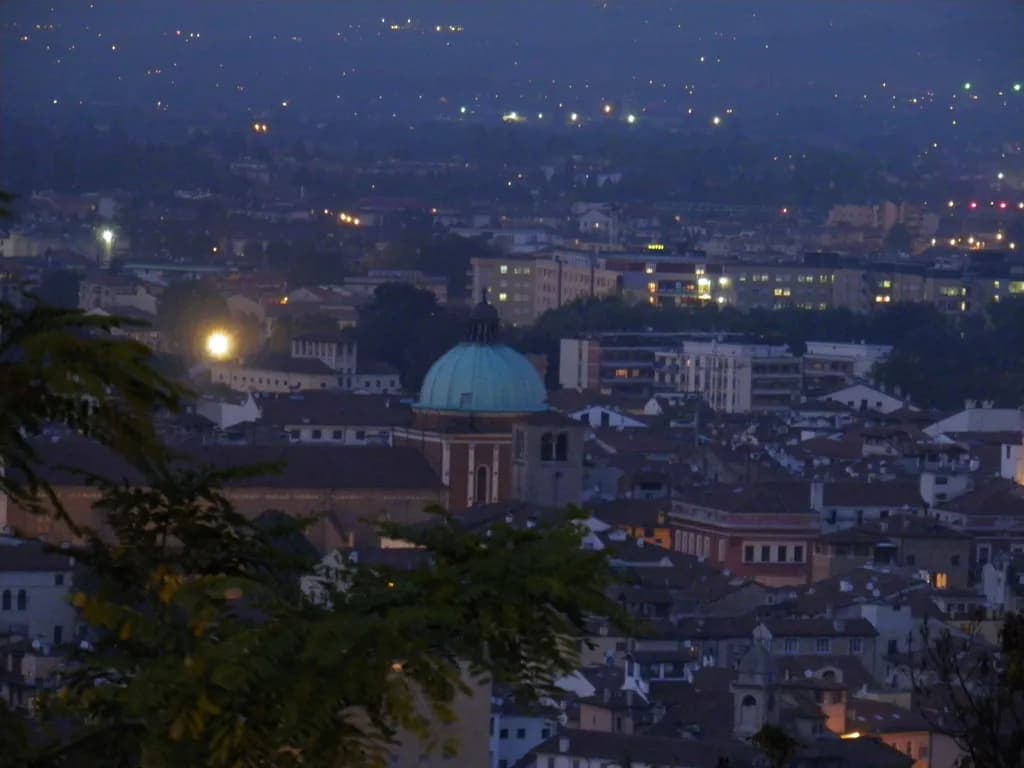
Vicenza is a city that rewards looking up rather than looking out. Its historic centre is a dense weave of towers, domes and long rooflines, and the views that matter most are often framed by architecture rather than opened by altitude. The one classic overlook is Monte Berico, the hilltop Marian sanctuary that stands above the city and lets you see the whole shape of it at once.
The rest of the pleasure is horizontal. From Piazza dei Signori you read the Basilica Palladiana's loggia and the tower beside it; from the edge of Palazzo Chiericati you look across the Retrone towards the Berici hills. Treating those as viewpoints, not just monuments, changes how you walk the centre and keeps a viewpoint day from becoming a checklist of similar panoramas.
Why Vicenza rewards looking up: a low skyline of towers, domes and Palladian rooflines
Unlike a city built around a single dome or river bend, Vicenza spreads its visual interest across many small vertical moments: a tower over a square, a colonnade lifted on a podium, a villa set on a rise just outside the walls. That means the best strategy is not to hunt for one perfect panorama but to collect several partial ones. A rooftop line seen from the hill explains the street plan; a street-level view explains the buildings you saw from above.
The city's identity is inseparable from Andrea Palladio, the sixteenth-century architect whose town palaces, churches and villas shaped the historic centre and its UNESCO listing. His work is urban rather than purely scenic, which is why so many of the best views are slices of street: a loggia seen end-on, a palazzo corner against a slope of hills. Walking with that in mind is what makes a Vicenza viewpoint day feel different from a generic city overlook.
Monte Berico: the hilltop Marian sanctuary and its terrace as the classic city overlook
Monte Berico is the one place in Vicenza where you get the city as a whole rather than in fragments. The sanctuary of Santa Maria di Monte Berico sits on the hill above town, a Marian shrine whose basilica and forecourt look back down over the rooftops towards the plain. Because it is a working place of worship as well as a landmark, the visit works best when you treat the view as a pause within a church visit rather than a separate attraction.
The building itself rewards a slower look before you turn around. The sanctuary's own site describes it as a place where faith, art and hospitality meet, with frescoes and sculpture inside and a sacred art museum alongside. That combination — a devotional interior, a small museum, and an outdoor terrace view — is what makes Monte Berico the natural first stop of any viewpoint itinerary in Vicenza.
Plan the hill as a half-day rather than a quick photo stop. Our own suggestion is to allow a leisurely two to three hours for the sanctuary, the surrounding grounds and a walk back down into the centre; that is editorial advice, not an official figure. The sanctuary publishes its liturgical and cultural programme separately, and it is worth reading that page before you go so a service or event does not catch you mid-visit.
Practicalities for the Monte Berico visit: sanctuary versus museum, free church versus paid collections
The most useful distinction to hold on to is between the sanctuary as a place of worship and the museum operated alongside it. The basilica and its immediate surroundings function as a shrine that pilgrims and visitors enter as part of the church's daily life; the sacred art museum is a separate, curated collection. Do not assume one entrance or one arrangement covers both, and check the sanctuary's own pages for current visiting arrangements rather than relying on third-party listings.
The sanctuary site publishes opening times and a calendar of liturgical and cultural events, and those pages are the right place to confirm current hours before travelling, since seasonal Mass schedules shift between summer and winter time. Third-party travel listings reproduce hours that may be out of date, so treat them as a hint rather than a source of truth. If you are travelling specifically for the terrace view, check the calendar on the day before and again on the morning.
Some practical points are genuinely unclear from available sources, and it is honest to say so. Detailed rules on accessibility, bag checks or access to any terrace area are not set out in the material we could verify, so if any of that matters to you, contact the sanctuary directly using the details published on its contact page. That call or email is worth more than any assumption about how the hilltop is managed on a busy feast day.
The historic centre from above: what the Basilica Palladiana and Piazza dei Signori frame
In the centre, viewpoint hunting turns into architecture-watching. Piazza dei Signori holds the Basilica Palladiana, Palladio's remodelling of the medieval town hall with its two-storey loggia of arches, and the tall tower beside it. What you get here is not a panorama but a framed slice of the city: the square's floor, the loggia's rhythm and the skyline above the arcade all read together as one composed view.
The Basilica is not just a facade to photograph from the outside. The civic museums network, which manages the building, also operates a jewellery museum within the Basilica Palladiana, so the ground under the loggia is a city collection rather than simply a passageway. If you want a proper Basilica Palladiana Vicenza guide rather than a glance from the square, plan it as its own stop and check the museum pages for what is currently on show.
Palladio's edges: Palazzo Chiericati and the view across the Retrone and the Berici hills
Palazzo Chiericati is the central Palladian landmark that most repays being looked at from a slight distance. It was designed by Palladio for a private patron and completed after his death, raised on a podium with a colonnaded portico running the full ground floor and loggias confined to the side wings at the piano nobile. Standing back across the street lets you see the podium, the columns and the roof line as one composition rather than as a facade you walk past.
The building now houses the city's Museo Civico, whose collections run from Venetian painting of the fourteenth century to later work, and the palace's own ceilings — including a firmament room with constellation symbols — are part of the reason to step inside. If the exterior is your viewpoint, the interior is the explanation of it. Check the civic museums site for which rooms are open, since parts of the collection have been subject to works.
From this edge of the centre the view opens towards the Retrone and the Berici hills beyond the rooftops, which is a different composition from the hilltop one: closer, more layered, with the villa belt visible as a green ridge. It is a good place to end a central walk because it hands you the landscape you will spend the next day exploring.
Villa La Rotonda's hill setting: how a building becomes a viewpoint without a formal terrace
Villa La Rotonda, properly Villa Almerico Capra, is the villa just outside the city that Palladio designed on a hilltop, begun in the 1560s and completed later by others. Its four-sided symmetry was conceived so the building could be seen from every direction and so its occupants could look out in a full circle. That makes it a viewpoint by design, even though it has no viewing terrace in the public-attraction sense.
The tourism consortium that lists Vicenza's villas gives the villa's address and contact details alongside a long roll of other Palladian and later villas in the province, which is useful if you plan to link several in one day. Villa visits vary in how much of the interior is open, so check the villa's own site for visiting arrangements before you set out rather than assuming a fixed pattern.
For view purposes, the honest assessment is that La Rotonda's payoff is the setting and the approach, not a designated panorama point. If you want a wide view of the city, Monte Berico is the better target; if you want to understand how a Palladian building sits in a landscape, this is the more instructive stop, and the two complement rather than duplicate each other.
Indoor context for your vista: the civic museum network and Palladio Museum explained separately
Two separate organisations are easy to confuse. The Musei Civici di Vicenza runs the city museums and monuments — Palazzo Chiericati, the Naturalistic Archaeological Museum, the Risorgimento and Resistance Museum, Palazzo Thiene, the Teatro Olimpico, the Basilica Palladiana and Santa Corona. The Palladio Museum is a different institution, run by the international centre for Palladian studies, and it has its own programme of exhibitions and visits.
Combined cards do exist for the city network: the Vicenza consortium describes a Gold Card covering eleven sites and a Silver Card covering four, valid for a set number of days from issue and sold at several museum ticket desks. Crucially, that is a city-network card and does not extend to the Monte Berico sanctuary museum, which sits outside it. Read the scope carefully before buying, and confirm current prices and validity on the official pages rather than in older listings.
Note too that the civic museums are closed on Mondays according to the consortium's visitor information. That single fact reshapes a viewpoint itinerary: build a Monday around the sanctuary, the streets and the squares, and save the interiors for another day.
Slow-view strategy: pair one high point with one street-level walk and avoid viewpoint fatigue
The most common mistake in a city of this size is trying to collect every elevated view in a single day. In practice, one hilltop visit plus one unhurried street walk gives you more than three rushed panoramas, because the second half of the day explains what you saw in the first. Our suggestion is a morning on Monte Berico followed by an afternoon in the centre, with the walk back downhill built in as part of the experience rather than a transfer to be endured.
Pair the hill with a Palladian route through the centre so the architecture you noticed from above reappears at eye level. A Palladian architecture walk through Corso Palladio and its side streets does exactly that, moving between the Basilica, the palazzi and the Teatro Olimpico without pretending any of them is a secret. The point is sequence and attention, not novelty.
Season matters more than it might seem for a viewpoint day, because haze and heat both flatten long views. The consortium recommends Vicenza's climate as most comfortable in spring and early autumn for exploring the city's sites and outdoor routes; check the best time to visit Vicenza before fixing dates, and keep a flexible morning for the hill in case the weather turns.
Plan Your Vicenza Viewpoint Day
Build the day around Monte Berico first, using the sanctuary's own site to confirm current visiting arrangements, and treat the museum there as a separate stop from the church. Then walk back down and read the centre at street level, letting Piazza dei Signori and Palazzo Chiericati supply the framed views that the hilltop view sets up.
Confirm the practical details — museum closures, card scope, villa visiting arrangements — on the official pages before you travel, since timetables and access change. The city council's site is the reliable starting point for events and city notices, and it will tell you if anything unusual is happening in the squares during your stay.
Frequently Asked Questions
Where do you get the best view over Vicenza?
Monte Berico is the classic overlook: the hilltop sanctuary of Santa Maria di Monte Berico stands above the city and gives you the whole shape of the centre and the plain beyond in one look. In the historic centre, the views are architectural rather than panoramic — Piazza dei Signori with the Basilica Palladiana, and the edge of Palazzo Chiericati looking towards the Berici hills. Treat them as complementary rather than competing.
Is the Monte Berico sanctuary free to visit?
The sanctuary is a working church and its grounds are entered as part of visiting the shrine; the sacred art museum alongside it is a separate collection. Confirm current visiting arrangements and any charges on the sanctuary's own site before travelling, and do not assume a city museum card covers it.
Do I need a ticket to see the view from Monte Berico?
The view from the hilltop is tied to visiting the sanctuary rather than to a separate viewing platform, so the practical question is the sanctuary's visiting arrangements, not a viewpoint ticket. Check the sanctuary's published hours and event calendar, especially around feast days, and contact them directly if you have specific access questions, since those rules are not documented in publicly available material.
How does Villa La Rotonda compare with Monte Berico as a viewpoint?
Villa La Rotonda is a hilltop villa designed for a full-circle view from the building itself, so its interest lies in how the architecture frames the landscape rather than in a public panorama terrace. Monte Berico gives you the city; La Rotonda gives you Palladio's relationship to the hills. Visiting both on different days is better than trying to rush them together.
How much time should I allow for a viewpoint day in Vicenza?
As an editorial suggestion, allow a leisurely morning for Monte Berico — the sanctuary, the grounds and the walk down — and an afternoon for a slow central walk. That is our planning advice, not an official duration, and it should flex around services, museum closures and weather.
Is Vicenza worth visiting for architecture alone?
Yes, if you are interested in how a Renaissance architect reshaped a working city. Vicenza's centre holds town palaces, a remodelled basilica, churches and a theatre by Palladio, plus later buildings by his followers, many still in everyday use. The viewpoint angle simply gives you a way to read that architecture from two heights instead of one.
Sources
- Città di Vicenza
- Palladio Museum
- Vicenza, Palladio and the villas - Consorzio Turistico Vicenzaè
- Musei Civici di Vicenza
- Palazzo Chiericati a Vicenza: cosa fare e vedere - Italia.it
- Home - Santuario Santa Maria di Monte Berico
- Santuario della Madonna di Monte Berico Map - Church - Vicenza, Veneto, Italy
Continue exploring
More guides you'll find useful