Vicenza Self-Guided Walk: Piazza dei Signori to the Olimpico
A step-by-step self-guided walk through central Vicenza, linking Piazza dei Signori, Corso Palladio and the Teatro Olimpico, with timing and side trips.
On this page
Vicenza rewards walking more than almost any other city of its size in the Veneto, because most of its famous buildings sit directly on ordinary streets rather than behind gates. Palladio's palaces are still used as banks, shops and offices, so a self-guided walk here is as much about facades and street corners as about museum interiors.
This route links Piazza dei Signori, Corso Palladio and the Teatro Olimpico in a single continuous stretch, with two optional extensions for anyone with more time. Treat the timing as an editorial suggestion rather than an official itinerary, and check opening days and ticket terms with the operators before you commit a day to it.
Why Vicenza Suits a Self-Guided Walk
The historic centre is compact and essentially flat, and the main sights sit within a short stroll of each other, which makes a do-it-yourself route easy to hold in your head. A published walking tour sold through Marriott's activities platform squeezes Corso Palladio, the Duomo, Piazza dei Signori, the Basilica Palladiana, Contra Porti, the Teatro Olimpico and Palazzo Chiericati into about 90 minutes, which gives a useful sense of how tightly the core sights cluster.
What makes the city distinctive is that Palladio's work is embedded in daily life rather than isolated in a museum district. A long-running account of a Palladian walk notes that his palaces now house bank headquarters, shopping arcades and even a discount store, so you spend much of the walk looking up at loggias and porticoes above shopfronts.
If you want to go further than this single route, the broader hidden gems in Vicenza guide covers quieter corners and overlooked buildings that do not fit neatly into a first walk. Read it before you decide how much time to give the centre.
Before You Set Off: Free, Ticketed and Worth Confirming
Sort the stops into three groups before you leave your hotel. The piazza, the basilica loggias seen from outside, Corso Palladio and the church exteriors cost nothing to look at; the Teatro Olimpico, Palazzo Chiericati, Santa Corona and the basilica terrace are ticketed in some form; and the two villas outside town are run separately from everything else.
The town's main civic sights are sold through a common museum network rather than as one all-inclusive pass. The tourism consortium describes a Gold Card covering 11 sites over 12 days and a Silver Card covering four sites over eight days, with cards sold at the Teatro Olimpico tourist office and at several museums, and it advises checking updated opening times for 2026. Terms and prices change, so confirm the current structure at the ticket desk or on the civic museums site before choosing.
The same consortium states that the Civic Museums close on Monday, which is worth building into your plan as a working assumption rather than a guarantee. If your only full day is a Monday, lean on the free street-level walk and confirm any ticketed interior separately.
Stop 1: Piazza dei Signori and the Basilica Palladiana Loggias
Start in Piazza dei Signori, the square that has long served as the economic and social centre of the city. The Basilica Palladiana wraps one side of it, a medieval town hall reclad by Palladio in two tiers of white marble loggias; it is not a church despite the name, and standing in the square to study it costs nothing.
The rooftop terrace above the loggias is a separate ticketed visit, and it is sometimes priced higher when a major exhibition fills the building, so ask at the entrance rather than assuming a fixed charge. Beside the basilica, the slim Torre Bissara gives you a vertical marker for the rest of the walk.
Give the square and its edges a relaxed quarter of an hour, more if there is a market or an exhibition on. This is also the natural place to buy a coffee before the street walk begins.
Stop 2: Corso Palladio as an Open-Air Architecture Walk
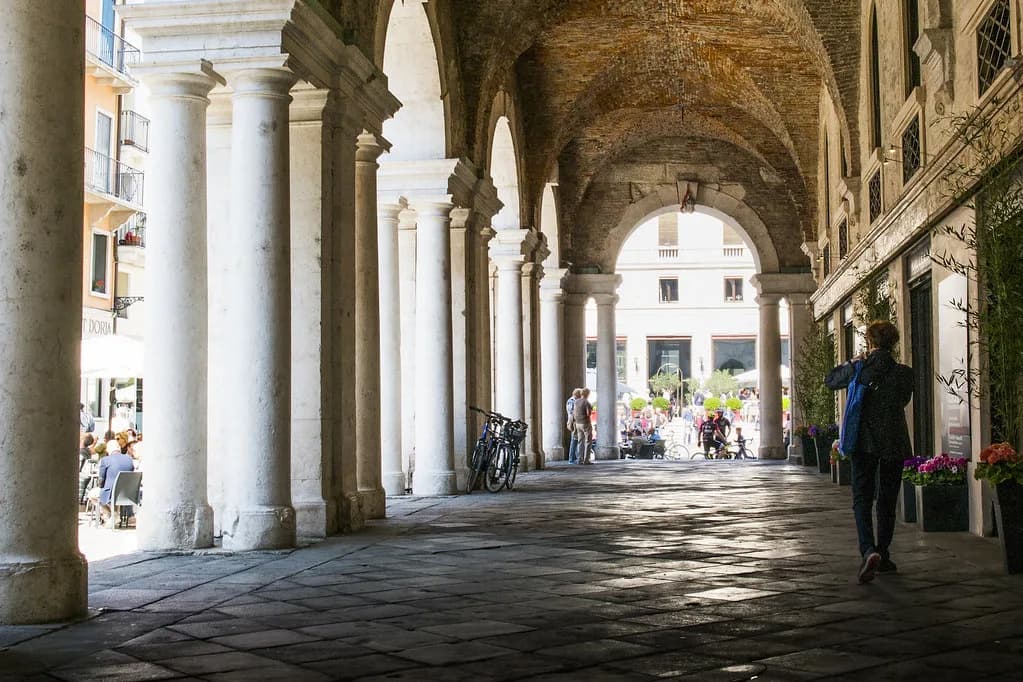
From the piazza, walk the length of Corso Palladio, the straight spine of the old town, looking up rather than into windows. Palladio and his followers lined it with palaces, and the pleasure of the street is in spotting porticoes, column rhythms and cornices above the shopfronts at eye level.
Contra Porti, just off the main axis, concentrates several of the grander palaces within a few minutes of walking, which makes it a worthwhile short detour. If architecture is your main reason for visiting, the dedicated Vicenza Palladian architecture walk goes deeper into the sequence of buildings and how to read them.
Allow roughly half an hour of unhurried strolling, pausing where a facade catches your eye. There is no need to enter every building; several are working offices and shops, and the street itself is the exhibit.
Stop 3: Teatro Olimpico and Palazzo Chiericati
The Teatro Olimpico is the stop most visitors remember. Palladio designed it in 1580 for the Accademia Olimpica, the cultural group he belonged to, and did not live to see it finished; his son oversaw the works and handed the theatre to the city in 1583. The wooden stage set of receding streets, built by Vincenzo Scamozzi for the opening performance, still creates its forced perspective on a shallow stage.
Across the same small square, Palazzo Chiericati holds the city's art collections in a Palladio design raised on a colonnaded podium. The Veneto paintings run from the fourteenth to the eighteenth century, with the frescoed ceiling rooms as much of the draw as the pictures; italia.it describes the astrological and mythological ceiling cycles in some detail.
Pairing the two is efficient because they sit minutes apart, and both belong to the civic network that the cards cover. Check the current room closures and exhibition arrangements on the civic museums site before promising yourself a particular painting.
For a wider menu of individual sights, from the basilica to the villas, the Vicenza Attractions hub bundles the visitor guides in one place.
Stop 4: Santa Corona and Its Altarpieces
Santa Corona, a short step off Corso Palladio, holds two altarpieces that would headline most cities: Giovanni Bellini's Baptism of Christ and Veronese's Adoration of the Magi. It is now a ticketed civic site rather than an open parish church, and it appears on both Vicenza Cards, so the entry decision depends on whether you are already carrying one.
The church also carries the Valmarana Chapel, a reminder that Palladio's patronage network ran through these family churches as well as the town palaces. Half an hour is enough for the two paintings and a look at the interior.
Optional Extension A: Up to Monte Berico
If you still have energy, climb or ride up to the Santuario di Monte Berico, the hilltop sanctuary that looks back over the rooftops. The basilica is a working place of worship, so visiting pauses during services; the sanctuary's own site publishes Mass times and notes that schedules shift between summer and winter.
The covered portico climbing the hillside is a scenic approach on foot, and a local bus runs up from the centre if you would rather save your legs. The sanctuary also holds a museum of sacred art, which is a separate decision from simply admiring the view from the terrace.
Allow an hour to ninety minutes for the climb, the church and the panorama, and check service times so you are not walking in mid-Mass.
Optional Extension B: Villa Rotonda and Villa Valmarana ai Nani
The two famous villas south of the centre are privately run and sit on neither Vicenza Card, so treat them as a separate outing rather than an extra stop on the civic ticket. Villa Capra Valmarana, known as La Rotonda, is listed by the tourism consortium with its own address and telephone contact on Via della Rotonda, and Villa Valmarana ai Nani appears separately on Via dei Nani.
Opening days and interior access vary by season, so contact the villas directly rather than relying on a guidebook. Budget an afternoon if you want to see both interiors, since the walk out from the centre and back eats into the time you have.
A weekend visit is the safer bet if seeing the inside of a villa matters to you, because weekday access is more restricted for some of these houses. Confirm before you build the day around it.
Suggested Duration and a Morning-to-Evening Shape
As an editorial suggestion, not an official route, allow about four hours for the central walk with two ticketed interiors, and a full day if you add Monte Berico or one of the villas. Start at Piazza dei Signori in the morning, walk Corso Palladio before the lunch trade fills the cafes, and book the theatre and gallery for the middle of the day.
Break for lunch near the piazza or along the corso, then take Santa Corona in the early afternoon when the streets are busiest and a cool church interior is welcome. Finish with an aperitivo back in the squares, which is when the light on the basilica marble is at its best.
If you would rather hand the logistics to someone else, the greeter service in Vicenza offers a free walk with a resident volunteer, in groups of no more than six and with no tipping expected, arranged in advance through the request form. That is a different experience from a paid guided tour and works well for first-time visitors.
Practical Pacing and Practical Checks
The railway station sits a short walk south of the centre, so you can start and finish the route on foot without a bus ticket. If you are arriving by train from elsewhere in the Veneto, leave the station, walk up towards the piazza, and begin the route in the order above.
Guided English-language walks have historically run on set days of the week through the local tourism consortium, but that page is old and should not be treated as a current schedule. Check the consortium's news and events pages if you want to join a group rather than walk alone.
For the umbrella of the city's notices, events and civic information, the Comune di Vicenza site is the starting point, and it is where you find out whether a square is closed for a festival or a museum is running a special exhibition.
If your schedule is tight, the one day in Vicenza itinerary compresses the same stops into a shorter loop, whereas the two days in Vicenza itinerary spreads them out with the villas included.
Plan Your Visit
The heart of this walk is short enough to do in an afternoon, but the decisions around it are what make the day work: which interiors you pay for, which you save, and whether you add a hilltop or a villa. Book nothing on reflex, confirm the museum and villa terms before you travel, and let the free street-level architecture carry the rest.
For broader timing questions, from spring weather to how busy the centre gets, the best time to visit Vicenza guide covers the seasons alongside this route.
Frequently Asked Questions
How long does a self-guided walk around central Vicenza take?
As an editorial suggestion, allow about four hours for the central route with two ticketed interiors, and a full day if you add Monte Berico or one of the Palladian villas. The core sights are close together, so the walking time is modest; the time goes on the interiors and on lingering in the squares.
Is the Teatro Olimpico included in the Vicenza museum cards?
The Teatro Olimpico appears among the sites covered by the Vicenza Gold and Silver Cards in the tourism consortium's description of the civic museum network. Card terms and prices are revised periodically, so confirm the current inclusions at the ticket desk or on the official civic museums site before you buy.
Can you visit Villa Rotonda without a car from the centre?
Yes, it is reachable on foot from the historic centre, though it sits on a hill outside the core. The villa is privately run and not part of the civic museum cards, so check opening days and interior access with the operator directly before setting out, since they vary by season.
Which Vicenza sights are free to see from outside?
Piazza dei Signori, the Basilica Palladiana loggias viewed from the square, Corso Palladio and the church exteriors cost nothing to look at. The basilica rooftop terrace, the Teatro Olimpico, Palazzo Chiericati and Santa Corona are ticketed in some form, so budget accordingly.
Is Vicenza walkable from the train station?
Yes, the station sits just south of the historic centre, and the main sights along Corso Palladio are a short walk from it. That makes the route easy to do without local transport, though the climb to Monte Berico is easier with the bus or the covered portico.
Sources
- Città di Vicenza
- Vicenza Greeters: Free walking tour - mini group
- Things to Do in Vicenza: A Palladio Day Trip Guide
- Vicenza Uncovered: Walking Tour of the City’s Iconic Landmarks
- GUIDED WALKING TOURS - Saturday & Monday - Consorzio Turistico Vicenzaè
- A Palladian Walk through Vicenza – Travel Blog | TravelGumbo
- Vicenza, Palladio and the villas - Consorzio Turistico Vicenzaè
- Musei Civici di Vicenza
- Palazzo Chiericati a Vicenza: cosa fare e vedere - Italia.it
- Home - Santuario Santa Maria di Monte Berico
Continue exploring
More guides you'll find useful