Vicenza Rainy Day: Indoor Museums, Churches and a Dry Route
Plan a wet day in Vicenza around a covered theatre, palace galleries and churches, with ticket-scope notes and a compact route that keeps you dry.
On this page
Vicenza suits wet weather better than most small Italian cities, because its headline sights cluster in a compact centre where the longest walk between two interiors is measured in minutes rather than kilometres. You can move between a covered Renaissance theatre, a palace gallery and a Gothic church without committing to a long exposed stretch. The catch is not the rain but the ticket logic, which decides how much you see and what you spend.
The figures quoted here come from a 2026 guide to the city and are reported rather than guaranteed, so treat them as planning estimates and confirm current admission on the operator's own pages before you travel. The same applies to opening days, which matter enormously if the private villas are on your list. Get those two things right and a rainy day in Vicenza needs very little improvisation.
Why Vicenza Works Well in the Rain
Andrea Palladio rebuilt much of this city in the sixteenth century, and the result is a dense grid of palazzi, a theatre and a basilica that sit almost shoulder to shoulder. That density is what makes a wet day manageable: you are never far from the next doorway. If you want to understand how the architecture fits together before you start walking, the background in this guide to the hidden gems in Vicenza is a useful primer.
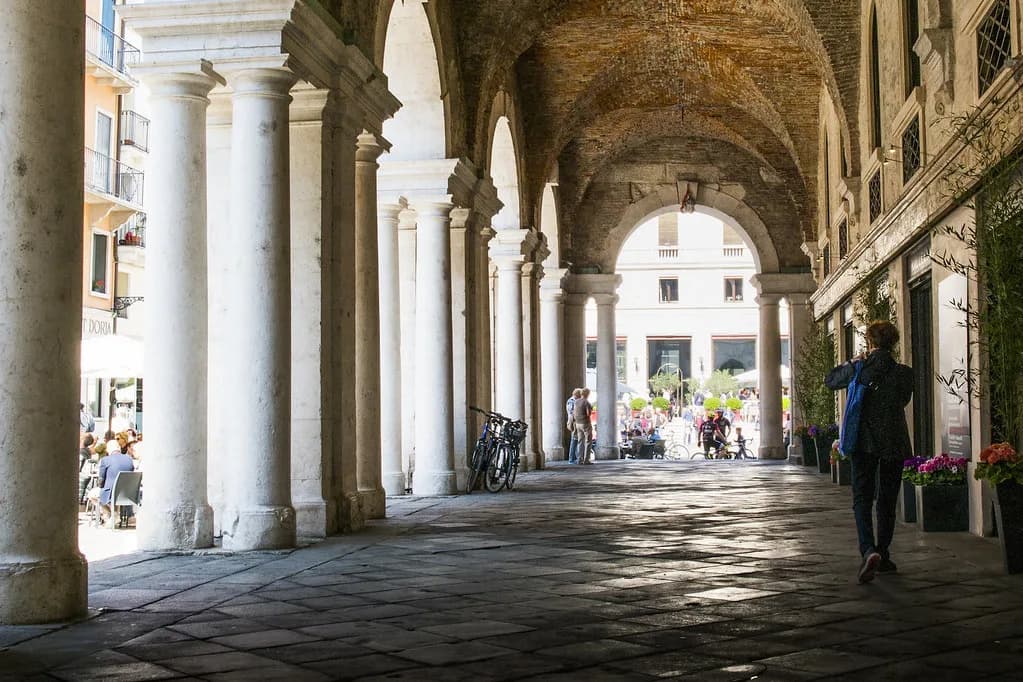
The centre is flat and small enough to cross on foot in around a quarter of an hour, so a shower costs you a short dash rather than a ruined afternoon. Porticoes and the loggias around the main square give you places to pause without buying anything. Plan two or three indoor anchors and let the gaps between them flex with the weather.
One practical habit helps: check the forecast the evening before and decide then whether the private villas outside the centre stay in the plan. Those villas involve a walk beyond the old town, which is fine in drizzle and miserable in a downpour. Everything inside the centre can be reordered on the day without losing much time.
The Two Real Decisions: Tickets and Villa Dates
Almost nothing in Vicenza requires advance booking, which is why a rainy day here stays low-stress. The decisions that actually shape your visit are which civic museum ticket you buy and whether the privately owned villas fit your dates. Sort both out before you leave your hotel and the rest is walking.
The Musei Civici di Vicenza runs the main civic sites as one network, and its site lists the venues individually: the Teatro Olimpico, Palazzo Chiericati, the Basilica Palladiana, Santa Corona, the natural history and archaeology museum, the Risorgimento museum and the Palazzo Thiene galleries among them. Checking that list is worthwhile because it tells you exactly which places fall inside the card system.
If you are weighing how a wet day fits into a wider trip, the sight-by-sight guides in the Vicenza Attractions hub let you compare venues before committing to a route. That is more reliable than deciding at the first ticket window with rain running down your neck.
Ticket Scope Explained: Singles, SILVER and GOLD
According to the 2026 guide, a single Teatro Olimpico ticket is reported at twelve euros and Palazzo Chiericati at eight, while the SILVER card is reported at sixteen euros for any four of the eleven network sites over eight days. The GOLD card is reported at twenty-two euros for all eleven sites over twelve days. Those are reported figures from a third-party guide, not a booking quote, so verify them at the ticket desk or on the operator site.
The arithmetic is simple enough to do in your head: two headline interiors bought separately already exceed the SILVER card, which then leaves two more sites in hand. That makes SILVER the sensible buy for most wet-day visitors doing the theatre, the gallery and one or two churches. GOLD only makes sense if you intend to work through five or more civic sites, which is a lot for one rainy day.
Do not assume one ticket opens every door in the network. The cards come with a defined scope and a validity window, and individual sites sell their own admission too. Ask at the first desk what your card covers and for how many days, then keep the receipt with you.
Start Indoors at the Teatro Olimpico
The Teatro Olimpico is the strongest possible opening move on a wet morning: it is entirely covered, it is unlike anything else in Italy and it takes under an hour. Palladio designed it in 1580, the year he died, and his pupil Vincenzo Scamozzi finished the work. What stops people in their tracks is the wooden stage set of the streets of Thebes, built for the opening performance in 1585 and still in place, using forced perspective to fake long avenues on a shallow stage.
Individual visitors buy at the box office and walk in, according to the 2026 guide, so there is no timed slot to chase and no need to build your morning around a reservation. Check the current opening days before you go, since civic sites commonly close one day a week. Arriving early also means fewer people in front of the stage set when you want to look at it properly.
Budget around forty-five minutes for the theatre itself. If you are travelling with someone who tires of architecture, this is the room that wins them over, so put it first rather than saving it for the end of a damp afternoon.
Cross the Square to Palazzo Chiericati
Palazzo Chiericati sits a couple of minutes from the theatre across the same square, which makes it the natural second stop and a genuinely dry transfer. The palace is an early Palladio design with a long colonnaded front, and it now holds the city's civic art gallery, the Pinacoteca, with Veneto paintings and frescoed ceilings across several rooms. Our Museo Civico Palazzo Chiericati Vicenza guide covers what to prioritise inside if your time is short.
Give the gallery forty-five minutes to an hour. The building rewards as much attention as the collection, so look up at the ceilings as well as at the walls. Pairing the theatre and the palace in one stretch is the most efficient indoor hour and a half in the city.
If you want a third indoor collection on the same theme, Palazzo Leoni Montanari in Vicenza is a separate visit with its own admission rather than part of this civic cluster, so treat it as a substitute or an addition rather than a free extra.
Piazza dei Signori and the Basilica Palladiana
Piazza dei Signori is Vicenza's living room, and the Basilica Palladiana wraps one side of it with two tiers of white marble loggias. Despite the name it is not a church but the medieval town hall that Palladio reclad early in his career, and the commission made his reputation. Standing in the square and looking up costs nothing, and the loggias give you shelter while you do it.
The rooftop terrace is a separate ticketed visit, reported at around six euros normally and closer to fifteen when a major exhibition occupies the building. The slim Torre Bissara beside it is the tallest structure in the old town. On a wet day the terrace is the part to skip, since the point of it is the view.
Use the square as your pivot rather than a destination. It sits between the theatre end of town and the shops along Corso Palladio, so it works naturally as a sheltering pause between two indoor visits when the rain sets in.
Santa Corona for Two Altarpieces
Santa Corona is a Gothic church a short step off Corso Palladio, and it holds two works that would headline most city collections: Giovanni Bellini's Baptism of Christ and Paolo Veronese's Adoration of the Magi. For two paintings of that quality, half an hour is well spent, and the church interior keeps you out of the weather.
This is not a free parish church to wander into. The 2026 guide describes it as a ticketed civic site, reported at roughly three to four euros, and it appears on both the SILVER and GOLD cards. That distinction matters when you are doing card arithmetic: Santa Corona counts as one of your four SILVER stops.
If you have already bought a card, this is the obvious place to spend one of its allowances. If you are buying singles, decide here whether the paintings justify the small extra outlay, because the answer will tell you whether a card was the right call.
Lunch and Shelter: Using the Loggias and Squares
Rain changes where you eat rather than when. The squares around Piazza dei Signori do their eating and evening spritz trade, and the arcaded streets give you covered approaches to most of them. Book nothing, walk until you find a room that looks warm, and treat lunch as part of the shelter strategy rather than an interruption to it.
A sensible wet-day shape is two indoor sights in the morning, a long lunch, then one or two more in the afternoon. That rhythm keeps you from doing all the walking in one soaking stretch. It also means you can drop a stop without feeling you have wasted the day.
The Villa Problem on a Rainy Day
The two famous villas are privately owned and sit outside the civic card system entirely, so you pay separately at each gate. Villa Rotonda, Palladio's symmetrical domed villa with four identical temple fronts, is the one most visitors want to see inside. The catch is its calendar: the 2026 guide reports it open Friday to Sunday from April to October, weekends only in March and November, and closed otherwise. Check the villa's own site before you build a day around it.
Villa Valmarana ai Nani, a few minutes further along the same walled lane, holds fresco cycles by Giambattista Tiepolo and his son Giandomenico and keeps friendlier hours through the season. If bad weather has already cost you the Rotonda, this is the better substitute and the stronger interior in any case.
On a genuinely wet day, think hard about whether the villas earn the walk. The Rotonda's pleasure is partly its setting on a low hill with views in every direction, and grey rain removes most of that. Save it for a brighter visit and spend the wet hours in the centre instead.
A Wet-Day Walking Order
Start at the Teatro Olimpico when it opens, then cross to Palazzo Chiericati while the morning is still quiet. Walk the length of Corso Palladio under the arcades toward Piazza dei Signori, pause in the loggias, and take lunch near the square. In the afternoon, visit Santa Corona for the Bellini and the Veronese, then add one more civic site if your card still has room. If you would rather follow a structured sequence of Palladian sights, this Palladian architecture walk sets out the buildings in a logical order.
Keep the order flexible rather than clock-driven. The centre is small enough that you can swap the afternoon stops without losing more than a few minutes. The fixed points are opening days, not times.
A Wetter-Weather Fallback
If the rain is heavy enough to make even short crossings unpleasant, cut the villa idea entirely and reduce the day to the theatre, the gallery and one church. Add a long lunch and a second gallery, and you still have a full day indoors. That version also costs less, since you stay within the civic network and skip the separate villa admission.
If you want to stretch your legs between showers, a self-guided walk through the centre can be trimmed to the arcaded streets, which keep you mostly covered. Treat it as a filler between indoor stops rather than the main event on a wet day.
What We Would Do Differently
The most common mistake is buying two single tickets for the theatre and the gallery. On the reported 2026 figures, the SILVER card costs less than those two singles and adds two more stops, so the singles only make sense if you genuinely intend to see one thing and leave.
The second mistake is turning up at Villa Rotonda on a weekday. Its opening pattern is narrow for much of the year, and a closed gate means an awkward walk back into town in the rain. Confirm the days on the villa's own site and build the trip around them, not the other way round.
The third is assuming the card covers the villas, or that Santa Corona is free. Neither is true: the villas are private and separately ticketed, and Santa Corona is a paid civic site. Knowing that before you arrive keeps the day's budget honest.
Plan Your Visit
A rainy day in Vicenza comes down to a short list: decide your ticket, confirm the villa days, and anchor the day on the covered theatre and the palace gallery. The compact centre does the rest, and the loggias give you somewhere to stand when a shower passes over.
Treat every price and opening day in this plan as reported rather than fixed, and check the Musei Civici di Vicenza site and the individual villa sites shortly before you go. That five-minute check is the difference between a smooth wet day and a closed door.
Frequently Asked Questions
What can you do indoors in Vicenza on a rainy day?
The reliable indoor anchors are the Teatro Olimpico, Palazzo Chiericati with its civic gallery, and the church of Santa Corona with its Bellini and Veronese altarpieces. All three sit within a short walk of each other in the centre, and the loggias around Piazza dei Signori give you shelter between them. The Basilica Palladiana's covered loggias are free to walk, while its rooftop terrace is a separate ticketed visit and of limited value in rain.
Do you need to book the Teatro Olimpico in advance?
According to a 2026 city guide, individual visitors buy at the box office and walk in, with no timed slot or reservation. That makes it an easy first stop on a wet morning. Opening days do vary by season, so check the current schedule on the Musei Civici di Vicenza site before you go rather than relying on a guidebook.
Is the Vicenza Card worth it for one wet day?
On the reported 2026 figures, the SILVER card costs less than two single tickets to the theatre and the gallery, and it adds two more stops within its validity window. For most wet-day visitors doing three or four civic sights, it is the better buy. Confirm the current scope and validity at the ticket desk, since the card covers a defined set of sites rather than every museum in the city.
Are Villa Rotonda and Villa Valmarana ai Nani included in the civic museum card?
No. Both villas are privately owned and sit outside the civic network, so you pay separately at each gate. Plan for two separate admissions if you intend to see both interiors, and check each villa's own site for current prices and opening days before you travel.
Which days is Villa Rotonda open?
A 2026 guide reports it open Friday to Sunday from April to October, weekends only in March and November, and closed otherwise. Because the pattern is narrow for much of the year, confirm the current days on the villa's official site before planning a visit, especially if you are travelling midweek.
Is Santa Corona free to enter?
No. It is a ticketed civic site rather than a free parish church, and it is covered by the SILVER and GOLD cards. A 2026 guide reports admission at roughly three to four euros for a single ticket. Check the current price at the door or on the Musei Civici di Vicenza site.
Sources
Continue exploring
More guides you'll find useful