Vicenza Palladian Architecture Walk: A Slow Route
A self-guided Palladian architecture walk through central Vicenza: Piazza dei Signori, Corso Palladio palaces and the Teatro Olimpico, with practical planning notes.
On this page
Vicenza is widely called the city of Palladio, and the label holds up on foot: Andrea Palladio's palaces, public buildings and theatre sit close together in the historic centre. This route follows his work from civic commissions to his final, unfinished project, starting in the main square, moving along the main street, and ending inside the theatre. A suggested shape for the day is a morning for the square and Corso Palladio and an afternoon for one or two interiors before the theatre; that is a pacing idea, not an official duration.
Expect a clear split between exteriors and interiors. Many facades can be read from the street at no cost, while the theatre, the palace museums and some churches are separate spaces with their own conditions. The practical work of this walk is deciding in advance which interiors justify your time and money, and treating the rest as facade study.
Why This Route Differs From a General Orientation Stroll
A general city walk in Vicenza tends to cover the same streets at a gentler pace, mixing in cafes, side lanes and viewpoints. This one is narrower on purpose: it stops only where Palladio built or reworked something, and it asks you to compare what he inherited with what he added. That focus makes the order matter, because the square, the street and the theatre each teach a different lesson about how he handled a site.
The city was inscribed on the UNESCO World Heritage list in 1994, and that listing covers the urban fabric rather than a single monument. Treat the ensemble as the exhibit: the way the Basilica, the palazzi along Corso Palladio and the theatre sit inside a working town is the point, not a checklist of plaques. Further visitor details appear in The architecture of Andrea Palladio at Vicenza, Italy (2021).
The same buildings appear on Vallotto's classic itinerary, which begins in Piazza dei Signori and notes the Basilica's double loggia added around an older government building, before moving along Corso Palladio to Palazzo Chiericati, Palazzo Barbaran da Porto and finally the Olympic Theatre. Use that order as the spine of your day and add your own pauses rather than inventing a different sequence.
Before You Go: Tickets, Interiors and Dress Code
Decide which interiors you want before you leave your room. The Teatro Olimpico, the Palladio Museum inside Palazzo Barbaran da Porto, and the Musei Civici collections at Palazzo Chiericati are separate attractions with separate arrangements, and nothing in the published material suggests one ticket covers all of them. Check each venue's own page for current admission and any booking requirement on the day you plan to visit.
For city-level practicalities, the Comune di Vicenza website is the most reliable starting point: it lists municipal services, contacts, news and event pages, and links to the Teatro Olimpico's own site. Use it to confirm that nothing unusual is happening in the centre on your dates, then go to the individual venue pages for visiting terms.
Churches deserve a moment of planning too. A tour operator's advice for this itinerary asks guests to avoid shorts and sleeveless tops, with knee-length skirts and short sleeves acceptable, which is a sensible default for any visit to Santa Corona and other active churches. Carry a light layer in summer so you can cover up without leaving the route.
Stop 1: Piazza dei Signori, Read as One Comparative Stop
Start where the city's power was displayed. The Piazza dei Signori holds two Palladio interventions facing each other at a short distance: the Basilica, his renovation of the older Palazzo della Ragione, and the later Loggia del Capitaniato on the north-east side of the square. Standing between them, you can compare a long, layered facade with a compact, sculptural one in a single sweep.
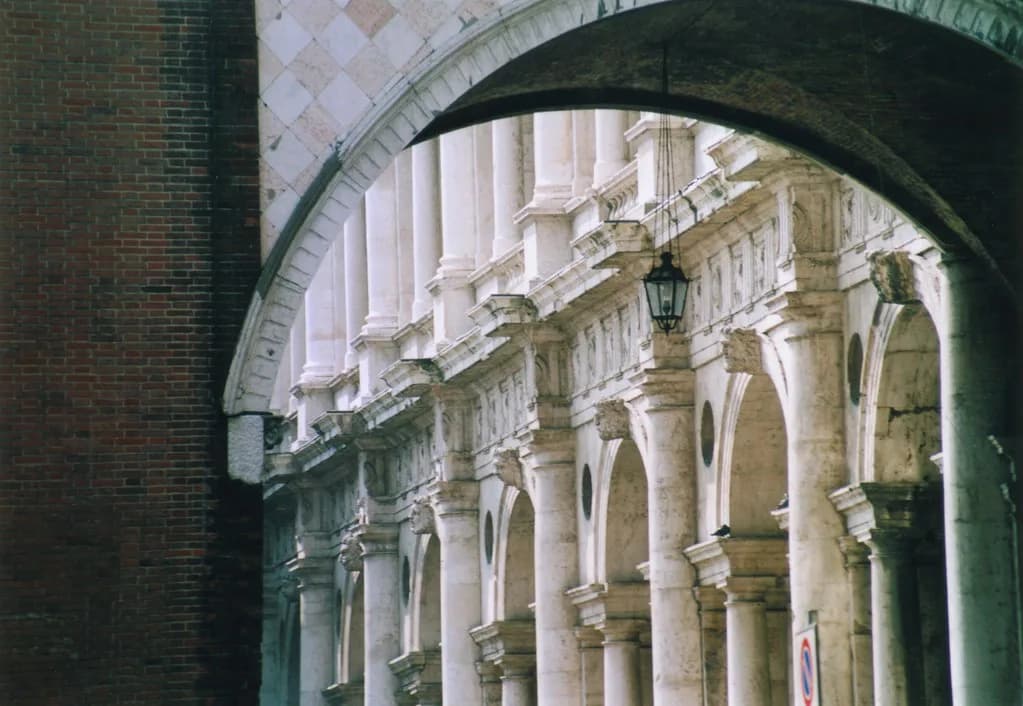
The Basilica began as a fourteenth-century government seat and was reworked by Palladio, who wrapped it in a double loggia and the building took the name it carries today. Look at how the arcade repeats around the structure and how the upper level relates to the lower one. That rhythm, more than any single ornament, is the reason the building is studied.
The Loggia del Capitaniato, designed in 1571 and 1572, presents a heavier, more assertive front with half-columns and a projecting entablature. Because it stands so close to the Basilica, the square lets you see how Palladio changed register between a civic arcade and a display facade. Keep this contrast in mind; it makes the later palaces on Corso Palladio easier to read.
Stop 2: Corso Palladio as an Architecture Sequence
Corso Palladio is the city's main street and also its densest run of Renaissance townhouses, built for prominent Vicentine families. Walk it looking upward rather than into shop windows: the interest is in how each facade sets its columns, cornices and window rhythm against its neighbours. A slow first block teaches you more than a fast pass along the whole street.
If you only have half a day, this is the stretch to compress rather than skip. Choose two or three facades to study properly and let the rest go by, saving your attention for Palazzo Chiericati and Palazzo Barbaran da Porto, where you will want to stop and go inside. The street is free to walk, so it costs nothing to return later if you run short of time.
Stop 3: Palazzo Chiericati and Its Museum Role
Palazzo Chiericati was commissioned by Girolamo Chiericati from Palladio in 1550, and its facade logic rewards a few minutes from the street before you decide whether to enter. The building now houses the city's civic collections, so a visit is a museum visit as much as an architecture visit; check the museum's own page for what is currently on show and how admission is handled.
The trade-off here is time against variety. If your interest is the buildings themselves, the street view of Chiericati plus one interior elsewhere may serve you better than touring every collection. If you travel for art, allocate a proper block here and cut something later in the day rather than rushing the theatre.
Stop 4: Palazzo Barbaran da Porto and the Palladio Museum
Palazzo Barbaran da Porto was designed by Palladio between 1569 and 1571 for Montano Barbaran, and its two tiers of Ionic and Corinthian columns with stucco relief give the street one of its richest fronts. The building now hosts the Palladio Museum and the International Centre of Study Andrea Palladio, so plan it as a dedicated interior stop rather than a quick doorway.
Set aside enough time to read the displays rather than walking straight through, and confirm current opening arrangements on the museum's own channels before you build your day around it. If it is closed on your dates, the facade still repays the detour, and you can move the saved time to the theatre.
Short Detour: Santa Corona and Two Paintings
A few steps off the main street, the church of Santa Corona was founded by the Dominicans in the thirteenth century and holds two works worth the interruption: Veronese's Adoration of the Shepherds and Giovanni Bellini's Baptism of Christ. The stop splits the walk neatly between the palaces and the theatre, giving your feet a rest indoors before the final leg.
Treat this as an active place of worship rather than a gallery: dress modestly, keep your voice down, and check locally whether there is any charge or restriction for visitors on the day. A short visit of a few focused minutes is usually enough, and it keeps the day's energy for the theatre.
Stop 5: Teatro Olimpico, Saved for Last
The Teatro Olimpico is Palladio's final work, begun in 1580 and completed after his death by Vincenzo Scamozzi following the original plan, and it is still in use. Its famous feature is not the seating but the stage: a permanent set of receding streets built with forced perspective to represent Thebes for the opening production of Oedipus the King in 1585.
Walking to the back of the auditorium and looking along the three passages is the moment most visitors remember, so give yourself time to stand there instead of photographing from the entrance and leaving. Performances still take place, which means the theatre can be closed to casual visitors at certain times; check the official theatre page for the date you plan to be in Vicenza.
There is a strong case for seeing the exteriors of the square and street in the morning and reserving the theatre for later, when your attention is still fresh but your feet are not. This is a suggested pacing choice, not an official schedule; adjust it to your own energy and to whatever time slot the venue gives you.
How Much Time to Allow, and How to Split the Day
A realistic suggestion for this focused route is a morning for the square and Corso Palladio, a pause for lunch, and an afternoon for Palazzo Barbaran da Porto, Santa Corona and the Teatro Olimpico. That is a suggested shape rather than an official duration, and it assumes you enter only two or three interiors. If you add the civic museum, plan a full day.
For a half day, keep the free sequence and pick one paid interior. The square, the street facades and the church exterior require no ticket, while the theatre and the palace museums each need their own arrangement, so one interior plus a good look at everything else is a coherent visit rather than a compromised one.
Whatever you choose, leave slack. A building that pulls you in will cost twenty minutes you did not budget, and the theatre is not a place to arrive breathless with a train to catch.
Common Mistakes to Avoid
The first is assuming a single pass covers the Palladian sites. The Basilica, the Loggia, the palaces and the theatre are distinct places with distinct arrangements, and any combined offer should be confirmed at the source rather than assumed. Check each venue separately and keep the numbers straight before you commit.
The second is racing Corso Palladio to reach the theatre early. The street is the connective tissue of the walk, and the comparison between its facades and the square is what makes the theatre legible. The third is treating Santa Corona as a filler stop when it holds two significant paintings and offers a natural break.
Finally, do not save the theatre for a moment when you are too tired to look properly. The interior is the one place on this route where the experience depends on standing still.
Extending Beyond the Centre: The Villas
Palladio's villas sit outside the historic centre, and the two usually paired with a Vicenza visit are Villa Capra, known as La Rotonda, and Villa Valmarana ai Nani with its Tiepolo frescoes. Both belong on a separate outing: they involve leaving the city streets and, in the case of La Rotonda, checking whether the villa is receiving visitors on your dates.
Do not try to fold them into a half-day city walk. The UNESCO listing includes the villas as well as the city, so they are worth their own slot, but the centre already gives you a full day of Palladian architecture without them. Plan the villas for a second visit or a dedicated afternoon.
Where This Walk Fits in a Longer Vicenza Trip
Use this route as your architectural anchor and build the rest of the trip around it. For the quieter corners, courtyards and less obvious pleasures of the city, the hidden gems in Vicenza guide covers ground this walk deliberately leaves out. Between the two, you get both the famous sequence and the texture around it.
If you prefer a broader orientation first, take a self-guided walk through the centre before this one, then come back to the Palladian buildings with the map already in your head. The Vicenza Attractions hub collects guides to the individual sights, including the Basilica Palladiana, so you can prepare each stop before you arrive.
Plan Your Palladian Day
Book or check the theatre and the Palladio Museum first, because those are the stops most likely to shape your day. Then treat the square and Corso Palladio as free, flexible time that can expand or shrink around them, and keep Santa Corona as the pause in between.
The city rewards attention more than speed: two interiors studied properly beat five doorways photographed in a hurry. Walk the route in the order that makes the architecture argue, verify current visiting terms at the source, and you will leave with a clearer idea of why Vicenza is called Palladio's city.
Frequently Asked Questions
Is this Vicenza Palladian architecture walk self-guided or guided?
This is a self-guided route you follow at your own pace, using the square, the main street and the theatre as its sequence. Guided options exist in Vicenza, including private tours that cover the same buildings, but availability, duration and cost should be confirmed directly with the operator rather than assumed.
Which Palladian sites in Vicenza need a ticket and which can be seen from outside?
Piazza dei Signori, the facades along Corso Palladio and the exterior of Santa Corona can be seen from public streets without a ticket. The Teatro Olimpico and the palace museums, including the Palladio Museum in Palazzo Barbaran da Porto and the civic collections at Palazzo Chiericati, are separate attractions; check each venue's own page for current admission and any booking requirement.
How long does a Palladian architecture walk in central Vicenza take?
Allow roughly a morning for Piazza dei Signori and Corso Palladio and an afternoon for one or two interiors plus the theatre. That is a suggested pacing plan rather than an official duration. If you enter several museums, give the walk a full day, and always leave slack so the theatre is not rushed at the end.
Sources
Continue exploring
More guides you'll find useful