Vicenza Neighborhoods Guide: Where to Stay and Eat
A practical guide to Vicenza's neighbourhoods, comparing the historic centre, Borgo Berga, San Pietro and the station area for where to stay and eat.
On this page
Vicenza rewards travellers who choose a base deliberately. The historic centre holds most of the sights clustered around Palladio's palaces, while Borgo Berga and the western quarter offer quieter streets on the edge of that stage. Around the station, the appeal is practical: you arrive, drop your bag, and walk into the city.
This guide treats neighbourhoods as decisions rather than decoration. For each area, ask what you want from your evenings and how much time you want to spend walking to the next church, palace or plate of bigoli. Sourced practicalities, such as the Monday closure of the civic museums, then help you assign the right day to the right quarter.
Quick orientation: a compact centre and the areas around it
Vicenza sits in the Veneto between Venice and Verona, and its historic centre is shaped by Andrea Palladio's Renaissance buildings, museums, gardens and viewpoints. That concentration makes the centre a natural base if architecture is your priority, because you can step out of your door and be at Piazza dei Signori within minutes.
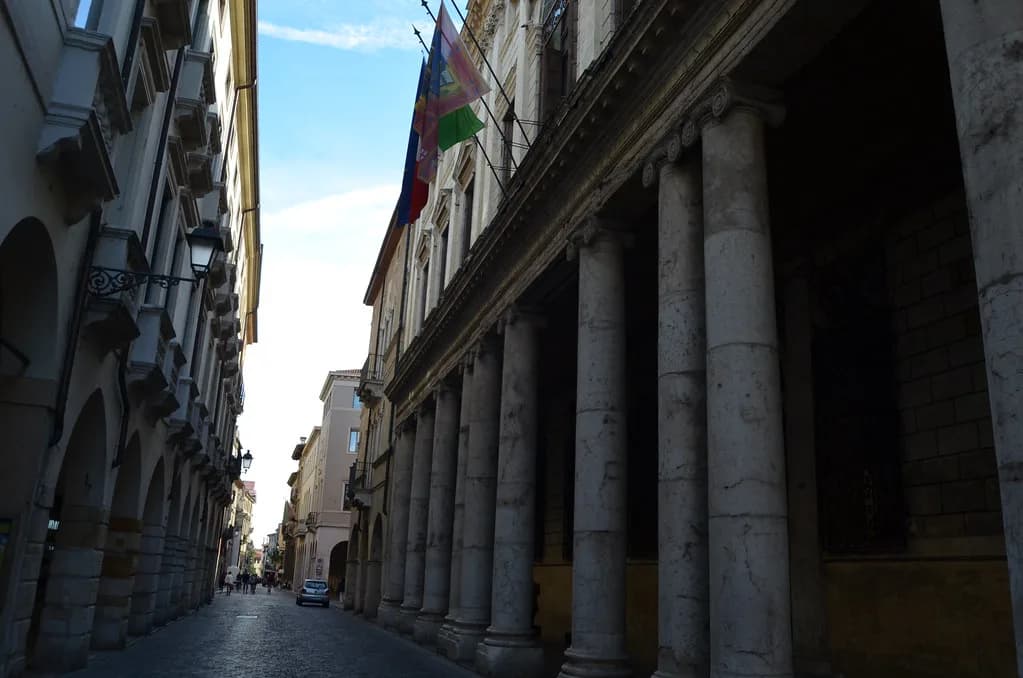
Beyond the main spine of Corso Palladio, the city changes character. Borgo Berga, at the foot of the Berici hills, is described as an area of small Renaissance and Baroque churches along cycle lanes. The western quarter, reached by stepping off Corso Palladio, holds palaces by Palladio and his pupil Scamozzi, a loggia tucked into the Salvi gardens and the Diocesan Museum.
The station area is the fourth option, and it is best understood as a transport base rather than a stage set. Vicenza's historic core is where the architectural character lives; the station side is where you sleep before an early train or after a late arrival. Decide which of those two needs matters more, and the choice usually makes itself.
Historic centre: Palladio's city as a base
The centre's headline set piece is Piazza dei Signori, where the Basilica Palladiana stands opposite Palazzo del Capitaniato. Palladio wrapped the earlier Gothic Palazzo della Ragione in marble loggias rather than demolishing it, and the contrast between Gothic upper storeys and Renaissance arches is what gives the square its character. The loggia includes one of the earliest examples of the Palladian window, a detail worth pausing for before you move on.
Corso Palladio links the cathedral end to Piazza Matteotti, passing palaces and the Teatro Olimpico. The theatre began construction in 1580, the year Palladio died, and was inaugurated in 1585; its surviving trompe-l'oeil scenery creates an illusion of depth that still surprises visitors. Staying in the centre means you can see it early or late, when the streets are calmer.
At the end of Corso Palladio, Palazzo Chiericati was designed by Palladio in 1550 and has housed Vicenza's civic museum since 1855, with paintings from the late twelfth through the seventeenth centuries. The palace is one of the city's UNESCO-listed monuments, and its portico and upper loggias make it a rewarding stop even if you only walk the exterior. For a broader choice of palaces, churches and villas, the hidden gems in Vicenza are often found just off the main route rather than on it.
Historic centre practicalities: cards, closures and pace
The centre's paid interiors take time, so decide in advance which ones you actually want to enter. The tourism consortium notes that the Vicenza Gold Card is valid for 12 days from issue and covers 11 sites, while the Silver Card is valid for 8 days and covers 4 sites chosen from the museum network. Both are sold at the tourist office next to the Teatro Olimpico and at several museums including Palazzo Leoni Montanari and the Basilica Palladiana; prices have applied since 13 January 2025, so check the current tariff before you buy.
One fixed planning constraint is the Monday closure of the civic museums. That reshapes which day you give to the centre, particularly if Palazzo Chiericati and the natural history and archaeology collections are priorities. Seasonal opening times change, so confirm the current schedule before setting out rather than relying on a stale listing.
Ground-level enjoyment of the centre is largely free: the piazzas, the loggias and the streets are public space, and the architecture does not require a ticket. Budget your paid visits for the interiors you care about most, and treat the rest as walking. A self-guided walk through the centre can pace those visits so you are not trying to see everything in one afternoon.
Borgo Berga and the southern edge: quieter streets and the Monte Berico climb
Borgo Berga sits at the foot of the Berici hills and is described as an area of small Renaissance and Baroque churches along cycle lanes. It is not a district of headline monuments, which is exactly why it suits travellers who want to sleep away from the busiest streets while remaining within walking distance of the centre.
The southern edge's main draw is the Arco delle Scalette, the ceremonial arch attributed to Palladio with a design dating to around 1575 and built in 1595. From there, a stairway climbs to the Sanctuary of the Madonna di Monte Berico, a complex combining a fourteenth-century Gothic church with a Baroque basilica. At the top, Piazzale della Vittoria has a broad terrace with views across Vicenza and the Vicentine Prealps.
The climb is a walk, not a transfer, so wear shoes that handle steps and carry water in warm months. After descending, you can continue toward Villa Valmarana ai Nani and La Rotonda, both outside the centre. Villa Valmarana, decorated by Giambattista Tiepolo and his son Giandomenico, publishes opening hours that vary by day; check the official page before travelling, since the times shown are subject to seasonal change.
San Pietro and the western quarter: palaces, loggias and a slower walking day
The western quarter is the centre's quieter counterpart: step off Corso Palladio and you find palaces by Palladio and Scamozzi, the Bishop's Palace museum and a Palladian loggia hidden in the Salvi gardens. The Loggia Valmarana, probably built in 1591 by a student of Palladio, sits among greenery near the walls of Piazza Castello. The gardens were inaugurated in 1592, closed to the public soon afterwards and reopened in 1909, and they remain a compact public space with statues and two Palladian-style loggias.
The Diocesan Museum occupies the Palazzo Vescovile, the historic Bishop's Palace overlooking Piazza del Duomo, a short walk from the cathedral. Its present appearance mainly reflects nineteenth-century and post-war renovations, and the museum traces the artistic and cultural history of the local Church. That makes the western quarter a natural fit for a slower day, when you want fewer headlines and more looking.
Palazzo Leoni Montanari, a late Baroque palace on Contrà San Corona dating from 1678, now houses the Gallerie d'Italia, combining eighteenth-century Venetian painting with a collection of ancient Russian icons. It is a ticketed interior, so pair it with one other paid site rather than trying to chain three museums in a row. A Palladian architecture walk is a useful way to keep the day focused on buildings rather than on tickets.
Around the station: arrival logistics and day-trip logic
The station area earns its place as a base when your trip is short or your itinerary includes day trips. Vicenza is an easy hour by frequent trains from Verona and Venice, which makes a station-side hotel practical if you plan to leave the city on one of your days. The trade-off is that you sleep in a transport district rather than among the palaces, and you will walk further to reach Piazza dei Signori.
For a two-night stay centred on Vicenza itself, the historic centre is the stronger choice because it puts the architecture at your doorstep. For a one-night stopover before an early departure, the station side wins on convenience. Neither is wrong; they answer different questions, and the mistake is booking the station area and then resenting the walk every evening.
Arrival logistics beyond the railway are best confirmed directly. The city's official tourism portal publishes maps, brochures and current information, and the official municipal site carries news and event updates. Check there for current details rather than relying on generic transfer advice, since services and timetables change.
Where to eat: how to think about each area
Evidence for named restaurants by neighbourhood is thin, so treat this as a framework rather than a booking list. In the historic centre, eating near Piazza dei Signori means paying for position and atmosphere; the reward is that you can walk home past the Basilica Palladiana after dinner. Look at menus posted outside and compare a couple of streets off the square before committing.
In Borgo Berga and the western quarter, the streets are quieter and the restaurants more likely to serve a neighbourhood rather than a view. That usually means simpler cooking and less pressure to turn tables. For local dishes, look for baccalà alla Vicentina, salted cod cooked with onions and milk, and bigoli, the thick pasta served with duck or anchovy sauce.
Around the station, the priority is speed and reliability rather than atmosphere, which suits a late arrival or an early departure. Wherever you eat, confirm current opening days directly with the business, since restaurant hours are not covered by the sources here and change with the season. A short walk off the main drag is usually the best way to find a table without a queue.
Where to stay: matching neighbourhood to trip style
Choose the historic centre if this is your first visit and architecture is the reason you came. You will pay for the location, but you gain the ability to see the Basilica Palladiana and the Teatro Olimpico before the day-trippers arrive. Check whether your property is inside the pedestrian core, because that affects how you arrive with luggage.
Choose Borgo Berga or the western quarter if you want quiet evenings and do not mind a short walk into the centre. These areas suit longer stays and travellers who prefer a residential rhythm. Confirm directly with the property what is nearby for breakfast and whether the walk into the centre is flat, since the hills begin close to Borgo Berga.
Choose the station area for short stays, early trains or day trips to Venice and Verona. It is a functional base, not a scenic one, and that is the honest trade-off. Whatever you choose, verify check-in arrangements and current availability with the property rather than relying on a listing that may be out of date.
A suggested two-day split so each area gets its own rhythm
Day one belongs to the historic centre, starting at Piazza dei Signori and the Basilica Palladiana, then walking Corso Palladio to the Teatro Olimpico and Palazzo Chiericati. Keep the day's paid interiors to two at most, and check the Monday closure before assigning this day. Finish with an evening stroll back through the piazzas, when the light softens the marble loggias.
Day two shifts to the edges: the Salvi gardens and the Diocesan Museum in the western quarter, or the Arco delle Scalette and the Monte Berico climb on the southern side. These are different walks with different energies, so pick one rather than trying to combine them. The two days in Vicenza itinerary sets out a fuller version of this split if you want more structure.
The spring and autumn months are generally the most comfortable for walking, so check the best time to visit Vicenza before fixing your dates. Whenever you come, leave room for an unscheduled hour in a loggia or a garden; that is where the city's quieter pleasures live.
Plan Your Visit
Vicenza's neighbourhoods are less about boundaries than about rhythm. The centre gives you Palladio at close range, the edges give you quiet streets and hillside walks, and the station gives you connections. Pick the one that matches how you want to spend your evenings, then verify the practical details before you book.
Two checks save the most frustration: the Monday closure of the civic museums, and the current validity and price of the Vicenza cards. Both are published by the tourism consortium, and both change what a two-day visit can realistically cover. Sort those first, and the rest of the planning falls into place.
Frequently Asked Questions
Is Vicenza worth visiting?
Yes, particularly if you care about architecture. The historic centre holds Palladio's Basilica Palladiana, the Teatro Olimpico and Palazzo Chiericati, along with museums, gardens and the Monte Berico sanctuary above the city. It is a compact UNESCO-listed city that rewards walking rather than rushing.
Which part of Vicenza should I stay in for a short trip?
For a short trip focused on the city itself, the historic centre puts the main sights within walking distance. If your priority is an early train or a day trip to Venice or Verona, the station area is more practical. Neither is better in the abstract; they suit different itineraries.
How do you get up to Monte Berico from the centre?
The traditional route is on foot from the Arco delle Scalette, the ceremonial arch attributed to Palladio, where a stairway climbs to the sanctuary. The walk is entirely pedestrian, so allow time and wear suitable shoes. Confirm current access and sanctuary opening times before you set out, since schedules change seasonally.
Do you need a car to explore Vicenza?
No, the historic centre is best explored on foot, and the station area connects you to the wider Veneto. A car is useful only if you plan to visit villas scattered across the province, where public transport is less convenient. For a city-focused visit, leave the car behind.
What should I know about museum tickets in Vicenza?
The tourism consortium publishes two combined cards: the Vicenza Gold Card, valid for 12 days and covering 11 sites, and the Silver Card, valid for 8 days and covering 4 chosen sites. Prices have applied since January 2025, so check the current tariff at the tourist office before buying. Civic museums close on Mondays.
Where can I eat in Vicenza's neighbourhoods?
Specific restaurant recommendations by neighbourhood are not reliable in a guide, because openings change. Use the piazzas and main streets for atmosphere and step a street or two away for better value. Confirm opening days directly with the restaurant before you go.
Sources
- Vicenza, Italy: Travel Guide
- What to See in Vicenza, Italy: Free Audio Guide
- Maps, brochures and publications - Consorzio Turistico Vicenzaè
- Palazzo Chiericati a Vicenza: cosa fare e vedere - Italia.it
- Villa Valmarana ai Nani - Italia.it
- Vicenza, Palladio and the villas - Consorzio Turistico Vicenzaè
- Santuario della Madonna di Monte Berico, Vicenza, Italy - Reviews, Ratings, Tips and Why You Should Go – Wanderlog
- A Palladian Walk through Vicenza – Travel Blog | TravelGumbo
- Città di Vicenza
Continue exploring
More guides you'll find useful