Parma in One Day: A Walkable Itinerary for Art and Food
Plan one day in Parma with a walkable route through Piazza Duomo, the Pilotta and Santa Maria della Steccata, separating free churches from paid interiors.
On this page
Parma rewards a single day because the sights worth seeing sit within a short walk of each other. The cathedral, the baptistery, the Pilotta complex and two Correggio fresco cycles can all be reached on foot, and the train station lies roughly a 15 to 20 minute walk from the historic centre. The real decision is not transport but sequence: how to order a morning of frescoes so it does not flatten into a blur of domes.
This itinerary is built around that ordering. It places the smaller Correggio dome at San Giovanni Evangelista before the famous one in the cathedral, groups the free churches apart from the paid interiors, and treats the Pilotta as a place to choose two collections rather than attempt four. Timing throughout is an editorial suggestion, not an official schedule, and every price or opening time should be re-checked with the operator before you travel.
Why Parma Works as a One-Day City
Parma is compact where it matters for a short stay: the monuments cluster around Piazza Duomo, Piazza Garibaldi and the river, and walking links them. The train station sits about a 15 to 20 minute walk from the centre, so you can arrive, drop a bag and be at the cathedral without touching public transport. That geography makes a genuine one-day visit possible rather than a hurried checklist.
The trade-off is art-first versus food-first. Parma is a UNESCO Creative City of Gastronomy and the home of Parmigiano Reggiano and Prosciutto di Parma, and a long production tour can swallow half a day outside the centre. If food is the point, choose one shorter tasting in the city rather than a five-hour dairy and ham run, and keep the afternoon for the Pilotta. If art is the point, keep lunch simple and spend the saved hours with Correggio.
Weather shapes the plan more than many visitors expect. The Emilia-Romagna climate is mild for much of the year, and March through October is the most comfortable window for a walking day, according to one traveller account. Summer afternoons can be hot enough to make the air-conditioned Pilotta galleries welcome, while winter fog and occasional snow argue for a tighter loop around Piazza Duomo.
Start at Piazza Duomo: Free Cathedral, Ticketed Baptistery
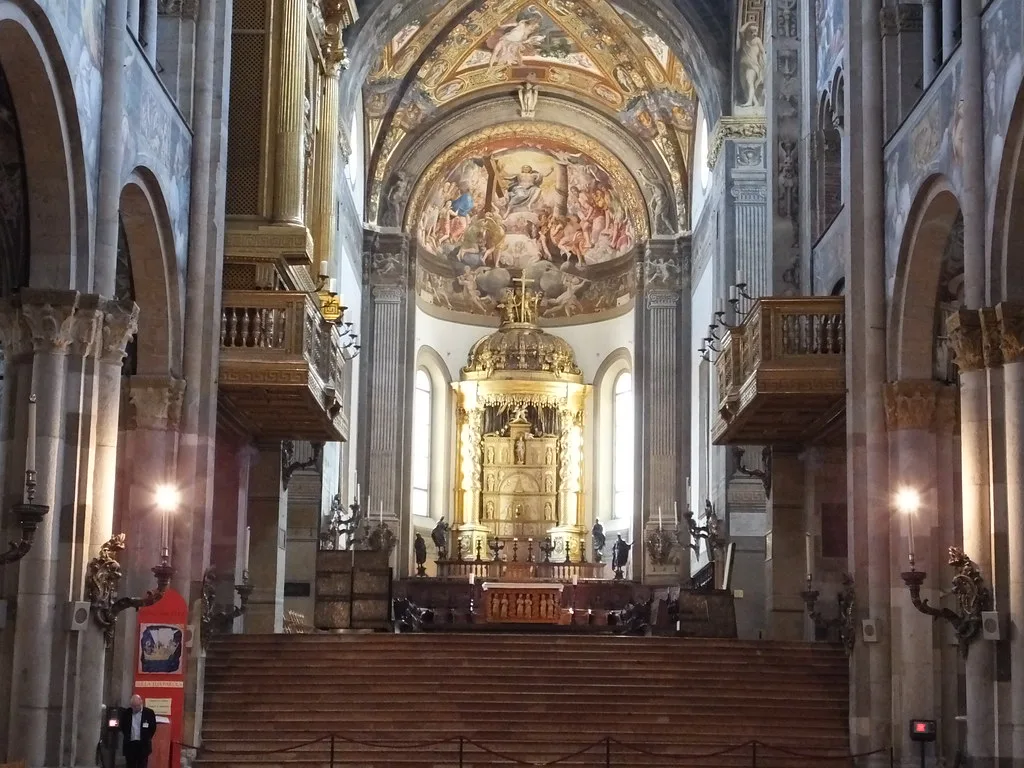
Begin at Piazza Duomo, where the cathedral, the octagonal baptistery and the bishop's palace stand together. Entry to the cathedral itself is free. The interior pairs Benedetto Antelami's Deposition relief of 1178 with Correggio's Assumption frescoed inside the crossing dome, and the contrast between carved stone and painted air tells Parma's art story in one building. Further visitor details appear in The Cathedral of Parma: Between Romanesque and Renaissance | Vivere in Italien.
The baptistery is the separate, paid visit. Built of pink Verona marble from 1196 and signed by Antelami, it shifts from Romanesque to Gothic as it rises, and its interior is covered in frescoes almost to the vault. Ticket scope matters: the Piazza Duomo operators sell visiting passes, and the baptistery is normally grouped with the Diocesan Museum rather than sold as a church donation. Confirm what is included before you queue.
The cathedral keeps its own rhythm, with visits suspended during services and a midday pause. One traveller account describes the cathedral as free with hours of roughly 7.45am to 12pm and 3pm to 7.20pm, and a shorter Sunday morning, but those are blog-reported and can change with the liturgical calendar. Check the Piazza Duomo operators' published visiting hours before building the morning around them.
San Giovanni Evangelista: See the Smaller Dome First
Two minutes behind the cathedral stands San Giovanni Evangelista, and walking past it is the most common mistake in a one-day Parma visit. Correggio painted the Vision of St John on Patmos in its dome in the early 1520s, a few years before he began the cathedral's Assumption. It is smaller and quieter, and it is where he worked out the foreshortening that the cathedral dome later pushes to its limit.
The church is free to enter and needs about forty minutes, longer if the cloisters are open. Look for Correggio's St John in the lunette at the end of the nave, often missed by people who come only for the dome, and the frescoes by Parmigianino in the chapels of the left aisle, painted when he was in his late teens. Two painters of European importance in one modest church is a concentration Parma does not advertise loudly.
The Benedictine pharmacy at the end of one cloister, the Spezieria di San Giovanni, survives with its shelving, majolica jars and mortars in place and is among the oldest preserved pharmacy interiors in Italy. Access to the cloisters and pharmacy is managed separately from the church, with varying hours and possible charges. Ask inside on the day rather than assuming the church entry covers it.
This is also literary ground. Petrarch lived in Parma for about a decade from 1341 on the street now named for him, and the bell tower of San Giovanni, at 75 metres the tallest in the city, is visible from the lanes behind the cathedral. Walking from Petrarch's plaque to the church takes only minutes and gives the morning a second thread beyond art history.
Palazzo della Pilotta: Pick Two Rooms, Not Four
The Pilotta is not one museum but an unfinished Farnese palace holding several collections under a single roof: the Galleria Nazionale, the archaeological museum, the Palatina Library and the Teatro Farnese. One ticket is usually reported to cover several of these, but verify current scope at the entrance rather than assume every room is included. Trying to see it all in a one-day itinerary is the surest way to remember none of it.
The Teatro Farnese is the reason many visitors come. Built by Giovanni Battista Aleotti in 1618, a vast wooden theatre with tiered seating, it was largely destroyed by Allied bombing in 1944 and rebuilt from its own fragments, reopening in 1962. Allow twenty to thirty minutes for it and treat it as part of the Pilotta visit rather than a separate stop.
For a pick-two plan, pair the theatre with the Galleria Nazionale, where the paintings give the Correggio morning a wider context. Traveller accounts put a combined ticket for the complex at around 16 euros with Monday closure, but that is blog-reported and not an official tariff. Check the current price and opening days on the Pilotta's own channels before you go.
Steccata, Teatro Regio and a Free Pairing
Santa Maria della Steccata sits opposite the Teatro Regio, which makes them a natural five-minute pairing. The basilica is free to visit and holds frescoes that reward a slow look, with a dome visible from Piazza Garibaldi nearby. Because it is a working church, a midday break is normal; one account gives roughly 7.30am to 12pm and 3pm to 6.30pm, but confirm on arrival.
The Teatro Regio is Parma's opera house, inaugurated in 1829 and seating more than 1,400. Its exterior is sober, almost plain, and the decoration inside is the attraction. Short guided tours are generally bookable rather than walk-in, so reserve ahead if opera architecture is a priority for your day.
Piazza Garibaldi is the natural pause between the two. Built on the crossing of the Roman streets, it holds the Palazzo del Governatore and its clock tower, cafes and terraces, and it is where Parma gathers for the evening passeggiata. Stop for a coffee here rather than pushing straight on, because the next stretch to the river is longer than it looks.
Lunch and the Food Decision
Parma's local cooking is built on what the surrounding countryside makes: Parmigiano Reggiano, Prosciutto di Parma, tortelli and crescentine. A sit-down trattoria will take an hour or more, which is fine if you have accepted a slower day. If you want both a proper lunch and the Pilotta in the afternoon, eat earlier than Italian habit suggests and keep dessert for a gelato during the walk.
If you would rather taste than sit, shorter city food tours of two to three and a half hours exist and can fit around sightseeing, while the five-hour dairy and ham tours consume half the day. Choose based on what you are willing to cut. A long tour means dropping the Pilotta or the Camera di San Paolo, not squeezing both in.
The Parmigiano Reggiano Museum and the Parma Ham Museum are both outside the historic centre, so they work better as a second-day excursion than as a stop between churches. If cheese and ham are the reason for your visit, plan the day around a production tour and let the monuments wait.
Piazzale della Pace and Parco Ducale: Room to Breathe
Piazzale della Pace gives you the best angle for photographing the Pilotta's long facade, and it costs nothing to stand there. Cross the Verdi bridge afterwards into the Parco Ducale, a sixteenth-century green space reshaped in the eighteenth and still used by residents for a daytime break. Both stops are short and both prevent the day turning into a monument marathon.
The park's opening hours shift with the season, roughly 7am to 8pm from November to March and 6am to midnight in the longer days according to one traveller's account. Treat those as indicative only, since municipal park hours change. The Ducal Palace inside the park is generally admired from outside, so do not plan an interior visit.
Camera di San Paolo and the Oltretorrente Extension
If your legs and timing hold, the Camera di San Paolo is the best optional addition. This frescoed room in the former monastery of St Paul carries Correggio's early sixteenth-century work and is a paid visit, so it belongs in the budget rather than the free-church column. One account puts entry at 8 euros, but check current opening times and price directly before committing an hour.
Across the river, the Oltretorrente has the medieval tower houses and porticoes that Parma's centre lacks, along with the Franciscan church of the Annunziata, known locally as the Duomo of the neighbourhood. It is a genuine change of texture after the polished squares, and it is where you can see the older, more layered city behind the monuments. Related guide: San Francesco del Prato, Parma: Visitor Guide.
The Museo Glauco Lombardi is another quiet option, especially on a wet afternoon. It holds the collection of Glauco Lombardi, devoted to Parma under the Bourbons and Marie-Louise, and is housed in the Palazzo di Riserva on Strada Garibaldi. It is a step away from the main route but rewards anyone interested in the ducal period rather than the Renaissance.
What to Cut When You Have Half a Day
With half a day, build around Piazza Duomo and San Giovanni Evangelista and let everything else go. The cathedral is free, the smaller Correggio dome is free, and the two together tell the story you came for. Add the baptistery exterior without entering, and you have seen the square's architecture in about ninety minutes.
Skip the Pilotta complex entirely rather than rushing one gallery, and save the Teatro Regio tour and the Camera di San Paolo for a second visit. If your half-day falls on a Monday, remember that the Pilotta is widely reported closed, though you should confirm with the museum itself. The churches, meanwhile, keep their own midday pauses, so a 12pm arrival can find doors shut.
How to Get Around Without Gambling on Schedules
Parma's centre is small enough that walking covers everything in this itinerary. Public buses exist and accept a contactless card tapped on board in one traveller's account, but for a single day you are unlikely to need them. Wear shoes for cobbles and reserve your energy for the two climbs onto the cathedral and Pilotta floors.
If you are arriving by train from Bologna or Milan, the station is a short walk from the centre, but do not build the day around exact train times you have not checked. Schedules and fares change, and this guide deliberately avoids quoting them. Look up current services on the operator's site the week you travel.
For events, temporary exhibitions and civic notices, the city's own website is the safest source, and it flags current activities rather than a static list. Check it the day before you go if anything in the plan depends on a specific museum being open.
Rain Plan and the Monday Trap
The two most common ways a Parma day collapses are Monday closures and midday church breaks. Museum closure days vary by institution, so confirm each one individually rather than assuming a city-wide rule. Churches that close around noon reopen in the mid-afternoon, which means a 1pm cathedral visit can fail where a 9am one succeeds.
If it rains, the Pilotta complex is the obvious shelter, and the Museo Glauco Lombardi and the Camera di San Paolo are small enough to fill a wet hour. The park and Piazzale della Pace are the first things to drop. Keep the churches for the gap between showers and the museum for the downpour.
Plan Your Visit
Parma rewards the visitor who chooses deliberately. See San Giovanni's dome before the cathedral's, keep the free churches separate from the paid interiors in your head, and treat the Pilotta as two collections rather than four. That is the difference between a day that hangs together and a day that becomes a sequence of domes.
Confirm hours and ticket scope with the operators before you travel, especially at Piazza Duomo and the Pilotta, and leave one flexible hour in the plan for the pharmacy, a longer lunch or a wrong turn. Parma's compact centre means the detours are part of the day, not a failure of it.
Frequently Asked Questions
Is one day in Parma enough?
One day covers Piazza Duomo, San Giovanni Evangelista, the Pilotta and the Steccata at a comfortable pace if you start in the morning and do not attempt every collection. It is not enough for a Parmigiano Reggiano and Parma ham production tour outside the centre as well, so choose art or food as your focus.
What can you see in Parma for free in one day?
The cathedral, the church of San Giovanni Evangelista and the basilica of Santa Maria della Steccata are free to enter, and the square and Parco Ducale cost nothing. The baptistery, the Diocesan Museum, the Pilotta complex and the Camera di San Paolo are ticketed interiors. Confirm current scope with each operator.
Do you need to book the baptistery or the Pilotta in advance?
The Piazza Duomo operators sell visiting passes and offer online booking, so checking their site ahead is sensible for the baptistery and Diocesan Museum. For the Pilotta, confirm current opening days and whether a single ticket still covers the collections you want to see before you rely on a walk-in.
Should you do a food tour or sightsee on a one-day Parma trip?
A shorter city tasting of two to three hours can fit around sightseeing, while five-hour production tours consume half the day and are best paired with fewer monuments. Parma's museums and churches cluster tightly, so a long tour effectively replaces the Pilotta rather than adding to it.
What is closed on Mondays in Parma?
The Pilotta complex is widely reported closed on Mondays, but museum closure days differ by institution and should be confirmed individually. Churches keep their own midday breaks rather than full Monday closures. Check each site's own listing before you set the day's route.
Where should you eat during a day in Parma?
Look for trattorias serving tortelli, crescentine, Parmigiano Reggiano and Prosciutto di Parma around Piazza Garibaldi and the centre's side streets. Book ahead if you want a proper sit-down lunch, or eat earlier than Italian habit so the afternoon remains free for the Pilotta.
How do you get from Parma train station to the historic centre?
The station is roughly a 15 to 20 minute walk from the centre, so the day can start on foot. Buses exist and accept contactless tapping on board. Check current train services with the operator rather than relying on any quoted timetable or fare.
Sources
- Homepage - Comune di Parma
- How to spend one day in Parma (map included) - A Ticket to Take Off
- San Giovanni Evangelista, Parma: Correggio's Other Dome
- Literary itinerary in Parma and surrounding areas | Visit Emilia
- The Glauco Lombardi Museum - napoleon.org
- Piazza Duomo Parma - Cathedral, Baptistery, Bishop's palace
- The Cathedral of Parma: Between Romanesque and Renaissance | Vivere in Italien
- Piazza del Duomo | Parma, Italy | Attractions - Lonely Planet
- Discover Parma | Visit to the city and its masterpieces | Artemilia
Continue exploring
More guides you'll find useful