Hidden Gems in Modena: Quiet Corners Worth Your Time
Go beyond Ferrari and balsamic in Modena with a modernist cemetery, a quiet art gallery, a working market, producer visits and a hands-on leather workshop.
On this page
Modena rewards travelers who slow down. The historic center is compact and mostly crossed on foot, and driving inside the city is restricted in many areas by a limited traffic zone, so arriving without a car removes a planning problem rather than creating one. That makes the city unusually well suited to wandering between one small sight and the next.
Why Modena Suits Slow, Unhurried Exploring
Most people arrive in Modena for one headline reason, whether that is balsamic vinegar, Ferrari or the Romanesque cathedral. The good news is that the center is tiny enough that the headline stops and the quieter ones sit within a short walk of each other. Taste Bologna notes that most attractions in the historic center are minutes apart on foot and that driving inside the city is limited in many areas by a restricted traffic zone.
Getting there is straightforward by rail. The closest major airport is Bologna Guglielmo Marconi, about 40 km away, and from Bologna Centrale the city is roughly 35 minutes by local train, with direct connections also reported from Milan, Florence and Verona. Once you are in, local buses or a rented bike cover longer hops, but the pleasure is in the alleys between them.
As a rough suggestion rather than an official figure, allow one to two days if you want to combine one museum, the cathedral square and a food stop without rushing. Add a second day if a tasting or workshop is on your list. Trying to compress the famous sights and the quieter ones into a single half-day usually means seeing neither properly.
How to Approach the Lesser-Known Side
Treat the center as a loop rather than a checklist. Start at Piazza Grande, drift outward toward the market, and let the narrow streets pull you toward whatever looks interesting. The sources describe Modena as flat and walkable, with frequent stops for coffee or gelato built naturally into the day.
Timing matters more than most guides admit. Early autumn, roughly September to November, is presented as a pleasant window with harvest activity and fewer crowds, while summer brings warmth along with heavier tourism. If your priority is calm rather than atmosphere, aim for the shoulder seasons.
Underrated Architecture: San Cataldo Cemetery
The San Cataldo Cemetery is the kind of place many visitors skip on principle, and that is precisely why it makes a good counterweight to the food and motor attractions. Designed in the 1970s by Aldo Rossi, it is a modernist composition of geometric forms, pastel walls and arcades, treated by architectural travelers as a landmark rather than a burial ground alone. The city-level Taste Bologna guide singles it out as a major site, but it rarely features in short itineraries.
Go with the expectation of quiet reflection and a slow walk, not a visitor experience with facilities. Because it is an active cemetery, check locally or with the city before planning a visit around it, and behave accordingly once inside. It is a genuinely different kind of Modena stop, and that is the point.
Quiet Cultural Stops Beyond the Big Names
The Galleria Estense holds the art collection assembled by the Este dukes, including Renaissance paintings, Baroque sculpture and musical instruments. Travelers describe it as an intimate museum where you may have a room largely to yourself, which makes it an excellent indoor pause on a hot or wet afternoon. Confirm current opening days and any separate ticket with the museum before you build a day around it.
For a different sort of quiet, the Biblioteca Estense Universitaria appears among the city's recommended smaller attractions. It suits readers and history-minded travelers who want an hour away from crowds rather than another queue. Verify access conditions directly, since library reading rooms often have their own rules.
Local Food Corners: Mercato Albinelli
Mercato Albinelli has been operating since 1931 and functions as a working market rather than a sight. Stalls carry fresh produce, handmade pasta, wheels of Parmigiano Reggiano, cured meats and jars of traditional balsamic, and the building smells of coffee, bread and cheese. Go hungry and without a fixed shopping list.
Look for what is in season and ask vendors what they would take home rather than what tourists usually buy. A small counter selling warm tigelle with salumi is a better introduction to the region than a sit-down menu. Market hours vary by day and season, so check them before making it your first stop of the morning.
Smaller Producers Worth Seeking Out
Two producer-level stops appear in local recommendations: 4 Madonne Caseificio dell'Emilia, a dairy, and Acetaia Villa San Donnino, a vinegar house. These offer a closer look at how Parmigiano Reggiano and traditional balsamic are actually made than any shop counter can. They sit outside the tightest tourist circuit, which is part of their appeal.
Neither visit can be improvised reliably. Production schedules, tour availability and tasting formats are set by each operator, so contact them directly to confirm hours, whether booking is needed and what the visit includes. A dairy is usually best seen in the morning, but confirm that with the producer rather than assuming it. Further visitor details appear in THE 5 BEST Hidden Gems in Modena (2026).
The Artisan Angle: Leather and Hands-On Making
Modena still has small workshops, and one of the more memorable experiences is a leather session at Vacchetta Grassa, where craftspeople demonstrate cutting, stitching and finishing by hand. Visitors can make a belt, wallet or small accessory, which changes the pace of a trip from consuming to making. It is a good choice for travelers who have had their fill of museums.
Because workshop capacity is limited and schedules change, ask the atelier in advance about session times, languages and what materials are included. Do not assume walk-ins are possible on the day you happen to pass by. Booking a session also gives shape to a morning that might otherwise drift.
Beyond the Motor-Valley Headliners
Car enthusiasts tend to assume every Ferrari-related stop is one site. It is not. The Museo Enzo Ferrari sits in Modena itself, in a building that combines a modern pavilion with the restored workshop once used by Enzo's father, and it tells the founder's personal story. The main Ferrari museum is in Maranello, a separate location and a separate outing.
If you have already done that circuit, the Panini Motor Museum is a lower-key alternative focused on a different collection of vehicles. It appears among the city's smaller recommended attractions rather than the headline listings, so check its current access arrangements before you go. It rewards people who care about the machines more than the branding.
Piazza Grande, the Duomo and the Ghirlandina: What Is Free
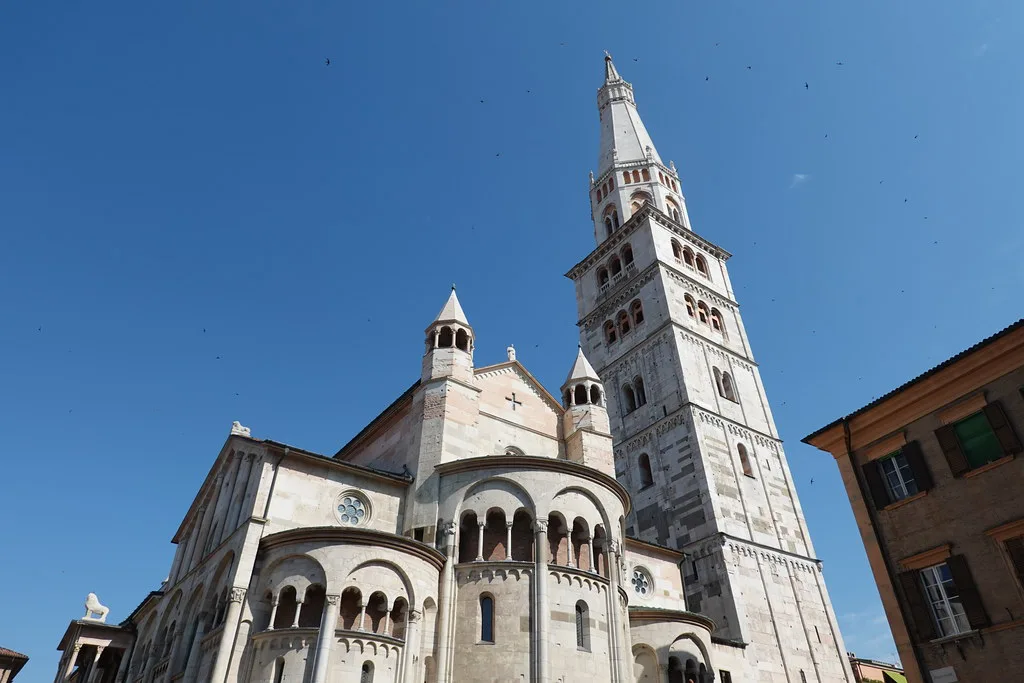
The square, the cathedral exterior and the streets around them form a UNESCO-listed ensemble that you can walk through without spending anything. Modena Cathedral was begun in 1099 and its facade is a gallery of stone carvings; the Ghirlandina rises 86 meters beside it and is visible from much of the center. Seeing the outside costs nothing and takes as long as you like.
Interiors and the tower climb are a different matter. Treat the cathedral, any tower access and the museums as separate, individually ticketed or individually regulated experiences rather than assuming one ticket covers the ensemble. Check current arrangements with each site, since these are exactly the details that change.
Climbing the Ghirlandina involves narrow, winding stairs and a tight squeeze in places, and the reward is a view over terracotta rooftops and, on clear days, the Apennines. If stairs are not for you, the view of the tower from the square is the trade-off, and it is still worth the stop.
Day Trip Sense: Castelvetro and Lambrusco Country
About 20 minutes from the city, Castelvetro di Modena is a hilltop medieval village surrounded by vineyards producing Lambrusco Grasparossa. The streets are cobbled, balconies are full of flowers and the views look out over wine country. It works well as an optional half-day rather than a checklist item.
Pair a tasting with local cured meats and cheese, and arrange transport or a driver if you plan to drink. Seasonal village events exist but their dates change each year, so confirm with local tourism information rather than planning around a schedule you found online. Keep Modena as your base and treat the village as an excursion.
The Crowded Version and the Quiet Version
The honest trade-off is that Modena's biggest draws come with the crowds they deserve. The Ferrari museum, the vinegar tastings and the cathedral all attract people for good reason, and skipping them entirely to chase quiet corners is a false economy. What you can do is sequence them: one headline sight in the morning, a market lunch, then a quieter gallery, cemetery or workshop in the afternoon.
That rhythm takes advantage of when the city empties out rather than fighting it. Visitors who make time for the slower stops often describe Modena as more rewarding than expected, precisely because it is quieter than Italy's major destinations. If you want more of that feeling, our guides to the hidden gems in Florence and hidden gems in Venice apply the same approach to larger cities.
Practical Tips for a Slower Visit
Skip the rental car if you are staying in the center. The restricted traffic zone, compact layout and flat streets make walking the default and bikes or local buses the fallback for longer hops. Park outside the restricted area if you are driving in, and walk from there.
Build flexibility into each day rather than a strict timetable. Opening arrangements for museums, the tower and producer visits vary, and the sources here do not provide current hours, so confirm each one with the operator before you set out. A plan with two fixed points and plenty of gaps handles this best.
For a fuller picture of what to see beyond this shortlist, browse the Modena Attractions guides, which cover the cathedral, the tower, the museums and the markets in more depth. Use them to book the headline experiences and keep this list for the in-between hours.
Which Travelers Get the Most From Modena
Modena suits travelers who would rather see four things well than eight things quickly. If you like markets, modernist architecture, small workshops and the occasional museum room to yourself, the city's softer side will carry your trip. If you want a checklist of must-see sights, it still works, but plan around the crowds rather than in spite of them.
The formula is simple: one planned anchor each morning, a food stop at midday, and a quiet corner in the afternoon. That is enough to see the city's famous sights and still notice everything in between. Verify the specifics with each site, then leave room for the unplanned detour. For related planning, see Getting Around and Arriving in Modena: A Practical Guide.
Frequently Asked Questions
What are the hidden gems in Modena?
The strongest lesser-known stops are San Cataldo Cemetery by Aldo Rossi, the Galleria Estense, the Biblioteca Estense Universitaria, the Panini Motor Museum and the artisan leather workshop at Vacchetta Grassa. Producer visits such as a local dairy and a vinegar house also work well as calmer alternatives to headline tours. Confirm hours and access with each place before planning around it.
Is Modena worth visiting for a day?
Yes, if you accept a short visit as a taster rather than a full survey. One day comfortably covers Piazza Grande, the cathedral exterior and a walk through Mercato Albinelli, plus one museum if you move deliberately. Adding a tasting or a workshop needs more time, so consider a second day.
What can you see in Modena in one day?
Start with Piazza Grande and the cathedral exterior, then browse Mercato Albinelli before lunch. Use the afternoon for one indoor sight, such as the Galleria Estense or the Enzo Ferrari Museum, and finish with a slow evening in the square. Treat this as a suggested shape, not an official itinerary.
Sources
Continue exploring
More guides you'll find useful