Matera Viewpoints Guide: Best Belvederes and Best Light
Compare Matera's best viewpoints, from Piazza Pascoli and Tre Archi to Murgia Timone, with access notes, light-timing tips and honest trade-offs for each.
On this page
Choosing a viewpoint in Matera is really a decision about light and access. The same terrace can be flat at midday and extraordinary half an hour before sunrise, and the walk between two spots that look close on a map may involve a steep flight of stone stairs. This guide treats each belvedere as a specific shot with its own trade-offs rather than ranking them.
The viewpoints below fall into three groups: belvederes on the city side facing the Sassi, terraces inside the Sassi looking across or back, and the far rim of the Gravina ravine in the Murgia Materana park. One photographer who has visited repeatedly recommends two nights as a minimum for shooting here, three to work without rushing, precisely so you get two sunrises and two blue hours.
How Matera's Geography Shapes Every View
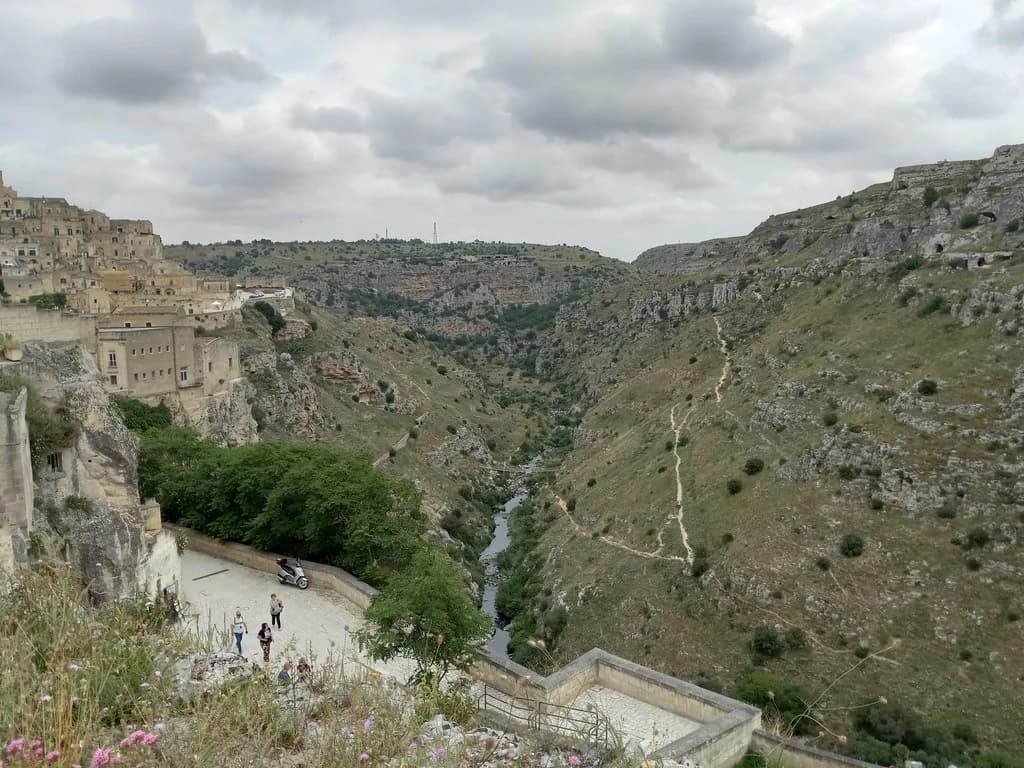
Matera sits on the edge of a limestone plateau split by the Gravina river gorge. The Sassi cave districts climb the slope on the town side, while the opposite rim belongs to the Parco Archeologico Storico Naturale delle Chiese Rupestri del Materano, the park protecting the ravine and its rock-cut churches. That means every viewpoint is essentially a choice of which side of the gorge you stand on and which direction you look.
From the city side you look into the stacked houses of Sasso Barisano and Sasso Caveoso, usually with the Cathedral on the ridge between them. From the far rim you look back at the whole town and see how small and how layered it is. Knowing this before you arrive saves you from trekking across the ravine for a shot you could have taken from Piazza Vittorio Veneto.
Within the Sassi themselves, orientation matters more than elevation. Some terraces face the Cathedral, others face the ravine or the Murgia. Plan each outing around the direction of the light you want rather than simply ticking off the highest balcony, and the sequence of a day falls into place.
City-Side Belvederes: Tre Archi and Piazza Pascoli
Belvedere Luigi Guerricchio, known as Tre Archi, sits beside Piazza Vittorio Veneto and the city theatre, reached through a small portico of three round arches. It is the easiest viewpoint to reach on foot from the modern centre if you are staying near the Sassi, and it gives a striking view of the Cathedral rising over the town. Because it is so central, it is also the spot most likely to have company at popular hours.
Belvedere Piazzetta Pascoli lies in the south-west of the old town and opens a wide panorama over the Sassi, stretching from the Cathedral to the rock church of Santa Maria di Idris on the right. A travel photographer rates it his favourite location in the city and suggests arriving around half an hour before sunrise, when the streetlights are still on. It works well with a wide lens, with a zoom for pulling details out of the packed rooftops.
Between the two, Tre Archi suits orientation and an early-morning sky over the Cathedral, while Pascoli gives the broader sweep of both Sassi. If you have only one sunrise, Pascoli gives more to work with; if you are staying near Piazza Vittorio Veneto and want a quick first look, Tre Archi is the simpler start. Neither carries an entry charge or a booking system as far as the sources show.
The Sassi-Side Terraces: San Pietro Barisano and Sant'Agostino
The small terrace above Chiesa di San Pietro Barisano looks toward the Cathedral with the church's own bell tower in the foreground. One photographer describes it as offering among the best sunset views in town and advises arriving thirty to sixty minutes ahead of sunset. He also notes that the bell tower's illumination comes on later than the streetlights, so patience or a tripod and time-lapse may be needed to catch both lit.
The square in front of the Convento di Sant'Agostino, a short walk away, takes in more of the Sassi to the right of the Cathedral and rewards a wider lens. Just below it, reached by the stairs between Via D'Addozio and Vico Sant'Agostino, a low stone balustrade offers a cleaner composition where a tree does not block the winding road around the Cathedral hill. That lower spot is better suited to sunrise than sunset according to the same photographer.
These three positions are close together but not interchangeable: the Barisano terrace compresses the Cathedral and its bell tower, Sant'Agostino opens the sweep of rooftops, and Vico Sant'Agostino frames the road and the tree line differently. If the light is not cooperating at one, walking two minutes to the next is usually more productive than waiting. Because they sit inside the Sassi, expect stairs and uneven stone underfoot.
Rione Casalnuovo and the Streetlight Problem
Rione Casalnuovo lies a short walk south of Piazza Pascoli and offers a north-facing view, so the time of day matters less than at the east- or west-facing terraces. One photographer found it workable for both sunset and blue hour but not dramatically better at either. The advantage is distance from the busiest viewpoints; the disadvantage is fewer obvious foreground anchors.
The practical difficulty here is artificial light. In his account, streetlights beside the terrace switched on after he set up and over-brightened the stone balustrade in the foreground, forcing a heavy crop. If you are shooting here, frame to exclude the nearest lamps or expose for them before they come on, and check where they fall in the composition rather than discovering it in editing.
Across the Ravine: Murgia Timone and the Cave Frame
Belvedere Murgia Timone sits on the far side of the gorge, directly across from Matera, and belongs to the protected park landscape of the Murgia Materana. There are two ways to reach it: walk from Piazza Santa Lucia alla Civita, descend to the Torrente Gravina, cross the Ponte Tibetano suspension bridge and climb the other side, or drive around the gorge. The walking route takes roughly three quarters of an hour including stops, in the account of one photographer who did it.
The same photographer found the official belvedere a little too high, taking in too much of the modern town behind the Sassi, and preferred climbing down to one of the caves below it for a natural frame around the old districts. Treat these as two different shots rather than one destination, and allow time to find a spot rather than assuming a single fixed place to stand.
The trade-offs are real. Walking in means no vehicle, but the descent and climb involve rough ground and the suspension bridge, and the sources offer no safety or accessibility guarantee. Driving means a route around the gorge and the practical questions of parking and restricted traffic in town, about which the park authority does not publish visitor guidance on its site. Check locally before setting out, especially with a tripod and a heavy bag.
Cathedral and Palombaro Lungo: Interiors, Not Viewpoints
Matera Cathedral, the Basilica Cattedrale di Matera Maria Santissima della Bruna, is worth a separate visit, but it is an interior rather than a belvedere. One photographer reports finding it open in two blocks through the day with a modest entrance fee at the time of his visit; treat those figures as his experience rather than current information. Check the cathedral's own notices or the tourist office for present hours and admission before you build a day around it.
Palombaro Lungo, the city's largest underground cistern, is a similar case: a ticketed interior a few steps from Tre Archi, with low light and a small entry charge in the same photographer's report. It takes only about fifteen minutes to see and pairs naturally with the Tre Archi belvedere above it. Neither belongs on a list of viewpoints, and neither should be assumed to share a ticket with anything else.
Streets, Alleys and Details for Flat Light
When the sky is grey or the sun is high, stop chasing panoramas and work the streets instead. The narrow stone lanes of the Sassi offer doors, arches, textures and cats in doorways that photograph well in soft, even light, and the walking itself is the point. A self-guided walk through the Sassi is a sensible frame for this kind of wandering, since it keeps you moving without a fixed itinerary.
This is also the mode that suits a day when you have overslept or the weather has turned. More than one viewpoint photographer treats the middle of the day as rest time and saves energy for the evening, and the detail hours are what make that rest affordable. Look for the quieter corners of Sasso Barisano and Sasso Caveoso rather than the signed main routes.
A Two-Day Plan Built Around the Light
Arrive in the afternoon, walk the Sassi as the light drops and scout your positions for the next morning. Shoot blue hour from Belvedere Piazzetta Pascoli, then eat late. Day one: up before sunrise for the Sassi from the main viewpoints, return for a rest, explore the rock churches or the Cathedral interior late in the morning, then head to a different blue-hour position such as San Pietro Barisano or Sant'Agostino.
Day two: use the morning for a drive or hike to Murgia Timone or the caves below it, then come back for a final blue-hour shoot from Piazza San Pietro Caveoso or Rione Casalnuovo. A third day, if you have it, is for the parts of the Sassi you have not covered and for detail shots. The Matera Attractions hub has individual guides if you want to slot in a specific sight.
The logic is simple: two sunrises and two blue hours, with the flat middle of each day left for interiors, rest and walking. You will not need to rush between spots or compromise on a single morning when the weather fails, and you will have seen the town change colour at least four times.
Mistakes Worth Avoiding
Arriving late for blue hour is the commonest error, and it is fatal to a shot: the sky loses its colour quickly after sunrise and before the lamps switch on. One photographer notes Matera's streetlights go off about thirty minutes before sunrise, so if you want both artificial and natural light you need to be in position well before that. Treat this as his observation rather than an official timetable.
Overpacking is the second mistake, because the Sassi involve constant stairs and narrow passages. A smaller bag with one wide and one longer lens will serve you better than a full pack, and stepping out of a doorway or archway to let someone pass costs nothing. Whether a tripod is welcome varies by site and by time; ask before setting one up in a busy passage or in an interior.
Plan Your Visit
Treat Matera's viewpoints as a set of lighting decisions: Pascoli and Tre Archi for the wide early shot, the San Pietro Barisano and Sant'Agostino terraces for the layered blue hour, Rione Casalnuovo for a quieter angle with a streetlight caveat, and Murgia Timone for the far side of the ravine. Add the streets for flat light and the Cathedral and Palombaro Lungo as paid interiors on a separate plan.
Before you go, confirm any hours, tickets and access arrangements yourself: the viewpoints carry no published schedule in the sources here, and the park's own pages are the place to check for the protected ravine. If you want more context on what else to see, browse the Matera attractions collection or the free things to do in Matera piece.
Frequently Asked Questions
What are the best viewpoints in Matera?
The most useful set is Belvedere Luigi Guerricchio (Tre Archi) beside Piazza Vittorio Veneto, Belvedere Piazzetta Pascoli in the south-west of the old town, the terraces at Chiesa di San Pietro Barisano and the Convento di Sant'Agostino, Rione Casalnuovo, and Belvedere Murgia Timone across the ravine. Each gives a different composition; pick based on the direction of light you want rather than ranking them.
Which Matera viewpoint is best at sunrise versus sunset?
Photographers who shoot here tend to favour Piazzetta Pascoli and the lower Vico Sant'Agostino spot for sunrise, and the terrace above San Pietro Barisano for sunset. These are opinions from personal visits, not official guidance. Check the sky and the position of the sun on the day and be in place half an hour early for blue hour.
Is Belvedere Murgia Timone worth the walk across the ravine?
It depends what you want. One photographer prefers the caves below the belvedere, which frame the Sassi more tightly, and found the belvedere itself a bit too high. Walking in via the Ponte Tibetano takes roughly three quarters of an hour including stops in his account, or you can drive around. Check conditions and your own footing before committing.
How many days do you need in Matera to catch the good light?
Two nights is a sensible minimum for photographers, giving you two sunrises and two blue hours with a full day between. Three nights lets you slow down and explore interiors, rock churches and quieter alleys without rushing. This is a suggested pace, not an official recommendation.
Is Matera Cathedral or Palombaro Lungo a viewpoint?
No. Both are paid interiors, separate from the outdoor belvederes. One photographer reported a small entrance fee and split opening hours at the Cathedral and a short visit to the underground cistern Palombaro Lungo, but those are his experiences at the time of his visit. Confirm current details with the sites directly.
What should you pack for photographing Matera's viewpoints?
A wide lens for the Sassi panoramas and a longer one for details, plus a small bag you can carry up and down the stone stairs. A tripod helps at blue hour but ask before setting one up in busy passages or interiors. Pack light, and carry water in summer, when midday heat is significant.
Sources
Continue exploring
More guides you'll find useful