
Matera Sassi Guide: Caveoso, Barisano or Civita?
Choosing where to stay in Matera: compare Sasso Caveoso, Sasso Barisano and the Civita with sourced notes on atmosphere, orientation, steps and GPS trouble.
On this page
Matera's old quarter is usually sold as a single block of cave houses, but the UNESCO-listed Sassi break into two rock amphitheatres, Sasso Barisano and Sasso Caveoso, with the Civita district sitting above them. Each has a different building stock and a different feel, which matters when you are deciding where to sleep and how much stair climbing to accept.
This guide separates the three districts, flags the terrain honestly and keeps ticketed interiors distinct from the lanes and squares you can walk for nothing. It closes with food clusters and a short history so the neighbourhood you pick makes sense in context.
Why the Sassi are three districts, not one neighbourhood
Treating the Sassi as one place leads to vague advice and disappointing bookings. The two amphitheatres are carved out of the same rock but developed differently, and the Civita occupies the high ground between them. Knowing which district your accommodation sits in tells you more about your daily routine than any star rating.
This matters most for anyone with knee trouble, heavy luggage or limited time. A room described loosely as being in the Sassi could mean a level-ish lane off a main square or a flight of worn steps below street level. Ask the property which district it sits in and whether the approach involves stairs.
Orientation in brief: two rock amphitheatres plus the Civita above them
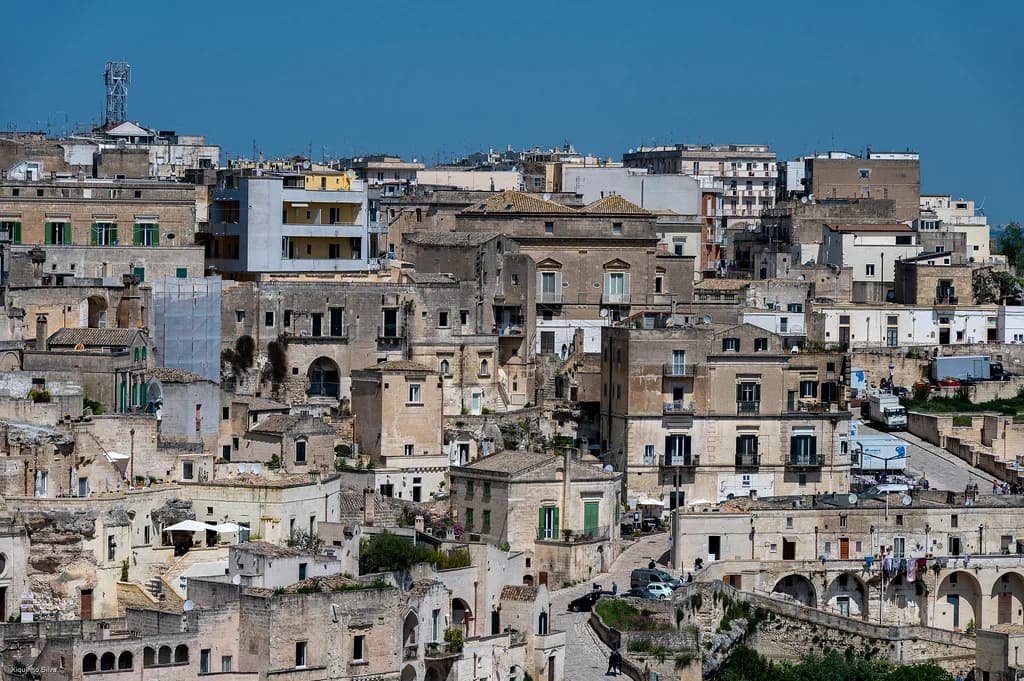
The Sassi form two amphitheatres hewn from the rock. Sasso Barisano lies to the north-west, while Sasso Caveoso sits to the south, and the Civita looks out over the panorama of both with the oldest inhabited group of buildings clustered around the cathedral. That simple three-part map is enough to read most addresses in the old city, as the Puglia Guys set out in their Matera orientation notes.
Piazza Vittorio Veneto, on the plain above, is a practical anchor because it sits near the station and parking areas, though it is not the only sensible start. Piazza San Pietro Caveoso below offers a second natural base if you are already staying down among the caves. For a wider set of sights, the Matera Attractions hub collects the individual guides worth planning around.
Sasso Barisano: palaces and traditional houses in the north-west
Sasso Barisano contains mainly palaces and traditional houses, which gives it a more built-up, masonry character than its southern counterpart. If your mental image of Matera is stone facades and doorways rather than bare cave walls, this is the district that comes closest. It also sits on the north-west side, so it works well with an approach from Piazza Vittorio Veneto.
For travellers hunting the quieter, less obvious corners of the city beyond the headline viewpoints, the hidden gems in Matera guide is the natural next read.
Sasso Caveoso: the cave-dwelling district to the south
Sasso Caveoso is mostly made up of cave-dwellings, and that is exactly why many visitors want to stay there. The streets hold churches and small piazzas, including the Chiesa di San Pietro Caveoso, and the district has its own evening life around Piazza San Pietro Caveoso. As a base it trades polish for atmosphere.
The Sassi di Matera visitor guide sets out what this district offers in more detail, including the rock-hewn church of Santa Maria de Idris cut into the hillside. Read it before you commit to a cave room, so you know whether the atmosphere you are booking matches the reality of the terrain.
Civita: the oldest inhabited cluster around the Duomo and the viewpoints
The Civita overlooks the panorama of the Sassi and contains the oldest inhabited group of buildings, arranged around the Cattedrale di Matera. Walking up to Piazza Duomo is part of the experience, and the climb steepens as you approach the cathedral through the lanes below. The reward is a central position between the two amphitheatres and the evening light over the rooftops.
Because the Civita sits above the two Sassi, it suits travellers who want the panorama and quick access to both districts rather than a deep cave immersion. It also means stairs in almost every direction, so treat it as the choice for walkers who do not mind them.
Steps, uneven surfaces and unreliable GPS: practical route planning
The Sassi are stair-heavy, and the steps can be unkind to your knees, especially when you are carrying bags or walking late in the day. Streets are steep and uneven in places, which is why comfortable shoes and water belong on any packing list. Travellers with accessibility requirements should ask specific questions about the route to their accommodation rather than rely on general descriptions.
Navigation is the other trap. In the multi-level alleys, GPS commonly struggles, and a wrong turn can send you on a longer, unexpected walk even when you are heading for the same street. The practical fix is to orient yourself by the main squares and the vertical layering, then accept some meandering as part of the visit. These terrain and navigation warnings come from the Puglia Guys guide to Matera, even though Matera itself lies in Basilicata rather than Puglia.
A suggested route through all three districts
As a structure for a first orientation walk, start at Piazza Vittorio Veneto and climb gently toward Piazza Duomo, continuing down to Piazza San Pietro Caveoso and then up to Piazzetta Pascoli before returning to the main square. This simple loop touches Barisano, the Civita and Caveoso in one continuous line. If you would rather follow a more detailed plan, our own Matera self-guided walk through the Sassi lays it out step by step.
Allow roughly two to three hours for a route of this kind, and treat that figure as this guide's suggestion rather than an official timing. The Puglia Guys suggest a similar duration for their own self-guided route, so it is a reasonable planning baseline for the district circuit described here. Add time if you stop at the viewpoints or pause in the squares.
If Matera is one stop on a longer southern Italy trip, a three-day itinerary lets you spread the districts across different days instead of cramming the climb into one afternoon. A two-day itinerary suits anyone with only a weekend and a single full walking day.
Churches and rock-hewn heritage: free ground versus ticketed interiors
The lanes, stairways and piazzas of the Sassi are public ground you can wander without a ticket, and that is how most visitors experience the districts. Individually ticketed interiors are a separate matter. No single Sassi pass is published as covering every cave dwelling or rock church, so treat each interior as its own visit and check its own current arrangements before you go.
Rock-hewn churches are scattered across the districts, and a few are built into the hillsides you pass on the walking route. Casa Noha, a multimedia exhibition in a cave dwelling, is one example of an interior that is its own visit rather than part of a general neighbourhood ticket. Confirm current arrangements directly with each site.
Rough Guides notes that visiting the Cripta del Peccato Originale, south of the city, requires booking by phone and that tours run for around an hour. Treat that as the constraint the source states and confirm the details with the site before travelling.
Where to sleep: atmosphere versus accessibility trade-offs in each district
Accommodation inside the Sassi is atmospheric rather than secret. Many newer bed-and-breakfasts and some handsome hotels have opened in the cave districts, which Rough Guides describes as the most evocative places to stay, while noting that modern fittings would be unrecognisable to former residents. Booking a week or so ahead is recommended there, since rooms can be scarce outside Maratea in Basilicata.
Choose Sasso Caveoso if you want to sleep among cave-dwellings and accept stairs; choose Sasso Barisano if you prefer houses and palaces and a north-western approach from the main square. The Civita suits travellers who prioritise the cathedral, the panorama and a central position over a cave interior. None of these is inherently better, and the right answer depends on how much climbing you want each day and how much luggage you are moving.
Food and drink clusters: Piazza Vittorio Veneto, Piazza San Pietro Caveoso and Via Buozzi
Eating out clusters in three convenient zones. Cafés and bars gather around Piazza San Pietro Caveoso and along Via Buozzi in the Sassi, while Piazza Vittorio Veneto and Piazza Sedile serve the Piano, the newer town above. Staying in one of the districts puts at least one of these clusters within a short walk of your door.
Traditional Materan cooking is dominated by meat dishes despite the proximity of the sea. For a broader choice of restaurants and food-focused experiences across the city, the Materaturismo site lists guided itineraries that include gastronomic stops alongside the classic Sassi routes. It is a useful cross-check when you want something more structured than a walk-up table.
A short historical frame: 1950s relocation, 1993 UNESCO listing, 2019 Capital of Culture
The Sassi you walk through today are the product of an abrupt break. In the 1950s around twenty thousand residents were relocated from the cave dwellings to modern housing, and Carlo Levi's 1945 memoir Christ Stopped at Eboli had already brought international attention to the poverty there. The area was later cleaned up and repopulated with homes, hotels, restaurants and workshops.
In 1993 the city and its grotto-filled outskirts were declared a UNESCO World Heritage Site, and Matera went on to hold the European Capital of Culture title in 2019. That trajectory explains why the districts now hold both restored cave interiors and modern hospitality in the same lanes. It also explains why the Sassi read as lived-in and atmospheric rather than as a preserved open-air museum.
Reading Matera responsibly: what 'cave dwelling' does and does not mean today
A cave room today is not a reconstruction of the poverty that emptied the Sassi. The restored dwellings are fitted with modern plumbing and furniture, and many are hotels or guesthouses rather than family homes. Book with that in mind: you are choosing atmosphere and history, not hardship.
Not every cave dwelling is visitable or included in a single ticket, and some are private residences or businesses. Treat your accommodation as the one interior you have booked, and confirm any others individually. For the city's wider sights, the Matera visitor guides cover individual attractions one by one, and the city's tourism operator, Materaturismo, publishes the guided visits it runs.
Plan Your Visit
Decide first how much stair climbing is acceptable, then choose between Sasso Caveoso's cave-dwellings, Sasso Barisano's palaces and houses, or the Civita's cathedral-side cluster. Book accommodation early if you want to sleep inside the Sassi, and ask the property directly about the approach and any steps.
Build one orientation walk that touches all three districts, check access for any interior you want to enter, and keep the loops flexible enough for a wrong turn in the lanes. That approach gets you the atmosphere without the guesswork.
Frequently Asked Questions
What is the difference between Sasso Caveoso and Sasso Barisano?
Sasso Barisano, in the north-west, contains mainly palaces and traditional houses. Sasso Caveoso, to the south, is mostly made up of cave-dwellings and holds a cluster of cafés and bars around Piazza San Pietro Caveoso. Choose Barisano for masonry streets and a straightforward approach from the central square, and Caveoso if you want to sleep among the caves.
Where is the Civita in Matera and what is it known for?
The Civita overlooks the panorama of the two Sassi and contains the oldest inhabited group of buildings, arranged around the Cattedrale di Matera. It sits above the two cave districts, so it is the place to head for the cathedral, the views and a position between the two amphitheatres.
Is it hard to walk around the Sassi of Matera?
The districts are stair-heavy and the streets can be steep and uneven, and the steps can be unkind to the knees. GPS also struggles in the multi-level alleys, so a wrong turn may lengthen your walk. Wear comfortable shoes, carry water and allow some meandering, especially when moving with luggage.
Should you stay inside the Sassi or in the newer town?
Staying inside the Sassi is atmospheric, and many bed-and-breakfasts and small hotels have opened in the cave districts. The newer town above offers a flatter base and easier access from the main square. The trade-off is daily climbing versus convenience, so pick according to your energy and mobility across the trip.
How long does a self-guided walk through the Sassi take?
Our suggested route through Barisano, the Civita and Caveoso takes roughly two to three hours, depending on stops. That duration is this guide's planning suggestion, not an official itinerary. Add extra time for viewpoints, cafes and any detours caused by the winding lanes.
Do you need tickets to visit the cave dwellings and rock churches?
The lanes, squares and stairways are public ground that you can walk at no cost. Interiors such as the multimedia exhibition at Casa Noha and individual rock churches are visited separately, and no single Sassi pass covers everything. Check current access arrangements for each site before you go.
Sources
Continue exploring
More guides you'll find useful





