Lecce Market Food Guide: Mercatino Porta Rudiae & Local Eats
Plan a food-focused morning at Lecce's Mercatino Porta Rudiae, see which Salento specialties to look for, and pair the market with the old centre.
On this page
A food market is one of the fastest ways to understand what Lecce actually eats, and the Mercatino Porta Rudiae is the handiest example for a short city break. It sits just outside Porta Rudiae, one of the gates into the historic centre, so it slots naturally into a morning that continues on foot. Come with a loose plan rather than a shopping list: buy a little fruit, try one pastry, then let the old town do the rest.
This guide treats the market as a place to shop, snack and watch rather than a ticketed attraction. Hours and addresses come from third-party listings that can change with the season, so treat every time below as a prompt to verify rather than a promise. Where the city's food culture needs context, that is covered too, from cucina povera to the iced coffee people drink in summer.
Why a Market Morning Belongs in a Lecce Food Itinerary
Lecce is often called the Florence of the South for its Baroque facades, but its daily food culture is more modest and more interesting. A morning at a neighbourhood market shows you the produce, cheeses and cured meats that turn up on restaurant menus later the same day. That makes the market a useful first stop: you learn the vocabulary of the local kitchen before you sit down to eat it.
The Mercatino Porta Rudiae is described as a small, century-old market just outside the gate of the same name, with fresh produce alongside a pastry shop and café known for pasticciotti and savoury rustici. It is not a vast covered hall, so budget a short visit rather than a half day. The reward is a low-key slice of Salento daily life within a few minutes of the Baroque centre.
If you want the wider picture of the city beyond food, the hidden gems in Lecce guide covers the overlooked corners worth folding into the same walk. Read it before you go so you know which detours are worth the time.
What Kind of Market Mercatino Porta Rudiae Is
Expect a compact, practical market rather than a curated food hall. Listings describe fresh fruit and vegetables, quality meats including spit-roasted chickens, typical cured meats and cheeses, and traditional desserts, with friendly traders who keep the place feeling like a community hub. That mix makes it useful for a picnic or a self-catering stay as well as for grazing.
Do not arrive expecting named stalls or a fixed number of vendors; that level of detail is not published reliably and changes with the day. Instead, walk the length of the market once to see what is actually on offer, then go back for the things that looked best. This two-pass approach works far better than deciding from the entrance.
One caution: this is not the same as the Monday weekly market listed on Viale dello Stadio in a general Puglia market guide. Confusing the two will send you to the wrong part of the city, so check which market you are heading for before you leave.
Address and Listed Hours, With a Note to Recheck
Third-party listings give the market an address on Viale dell'Università, 99, just outside Porta Rudiae, with hours that vary by day: mornings from around 6:30 to 14:00 on weekdays, a Sunday window of roughly 7:30 to 13:30, and some late-afternoon reopening on several days. Treat those times as indicative rather than official, because market schedules shift with season, holidays and stallholder routines.
The safest approach is to confirm before you set out, either by asking at your accommodation or by checking a current local listing the day before. If you arrive and the stalls are packing up, the nearby pastry counter and the walk into the centre still make the trip worthwhile.
Note also that the historic centre restricts vehicle traffic, with camera checks in the evenings and on Sundays and public holidays according to one local accommodation guide. If you are driving, park outside the walls and walk in rather than testing the zone.
How to Time a Visit
Market advice for Puglia generally is to go early: the best produce is still there and, in summer, nothing has sat in the heat for hours. A visit in the first part of the morning also leaves the rest of the day free for churches, lunch and a siesta. Arriving close to midday means picking over what remains.
If your priority is the pastry counter rather than the produce, mid-morning is the pleasant compromise, once the market has woken up but before the lunchtime shutdown. The trade-off is smaller choice of fruit and vegetables. Decide which matters more and time the visit accordingly.
For broader guidance on seasons, heat and crowd patterns in the city, see the best time to visit Lecce and avoiding crowds. It helps you judge whether an early market start will be a pleasure or a sweat.
What to Buy and What to Eat First
Start with a pasticciotto, the oval shortcrust pastry filled with vanilla custard that is eaten across Puglia and best served warm. Pair it with a caffè Leccese, the small iced coffee made with almond syrup and espresso, which is the summer drink to know in Lecce. Both are cheap, quick and a better introduction to the city than a full sit-down breakfast.
Then graze: a little fruit for later, a piece of cheese, a few slices of cured meat, and perhaps a rustico if the pastry counter has one. Buying small quantities lets you taste more and keeps your bag light for the walk into the centre. Save the sit-down meal for lunch.
The same source notes that the market's café and pastry shop is known for pasticciotti and savoury rustici, so you can combine shopping and eating in one stop. If you only do one thing at the market, that pastry counter is a good candidate.
Reading the Market Like a Menu
Look at what is piled highest and priced most keenly, because that is usually what is in season and grown nearby. In Puglia the weekly markets are where people buy fruit and vegetables, and the quality is often better than supermarket produce. Use the display as a preview of what restaurants will be cooking that week.
Sellers may ask what you plan to do with what you are buying, whether to fry it, boil it or eat it raw, because they want to hand you the right specimen. Answer honestly and take the advice. It is not nosiness; it is how the market works.
A stroll costs nothing and teaches you the names of local cheeses, cured meats and vegetables, which makes ordering later easier. If you want more free options in the city, the free things to do in Lecce guide is a good companion.
Salento Food Context: Cucina Povera and the Local Classics
Lecce's cooking is rooted in cucina povera, the rural tradition of making satisfying food from inexpensive, seasonal ingredients such as beans, vegetables, grains and locally raised meat. That history explains why humble dishes here taste better than their ingredient list suggests. It also explains why the market's produce is the star rather than imported luxury goods.
On menus, look for orecchiette, the ear-shaped pasta often served with cime di rape, and ciceri e tria, pasta with chickpeas and pieces of fried pasta. Seafood appears too, since the coast is close, including spaghetti alle cozze. Knowing these names before you sit down makes ordering much easier.
A dedicated guide to what to eat in local food covers the full list of pastries, pasta shapes and coffee habits, which is worth reading before the market so you know what to look for.
Puccia, Pizza and Gelato Around the Market
For lunch after the market, a puccia is the practical choice: a soft, round flat roll stuffed with salami, vegetables and cheese. Antica Pucceria Giannone dal 1941 on Via Giuseppe Libertini is one long-standing option for one, and it is a short walk from the centre. For pizza, Ciro Pizzeria on Via Principi di Savoia is singled out for its Neapolitan style and setting on a small square.
For a sweet finish, Baldo Gelato on Via Idomeneo is described as known for the best gelato in the city, while Defriscu on Via Giuseppe Palmieri is another dependable after-dinner stop. Granita, the coarser semi-frozen dessert, is the hot-weather alternative and is served at bars and pasticcerie too.
If you prefer a structured tasting, a hosted street food walk through the Baroque centre visits several selected venues with a local host; the listing shows a per-guest price and specific dates, so check the current page rather than relying on any figure quoted elsewhere. A local restaurant round-up is also useful for planning a longer meal, with the reminder that booking ahead matters at weekends and in high season.
Budget: Cash, Rounding and Buying by the Etto
Apulian markets sell in units worth learning: an etto is 100 grams, a mazzo is a bunch, and a cestino is a basket, so you are not always buying by weight. Ask for a small quantity and expect the seller to nudge it upward to round the price. You are allowed to say no.
Carry cash in small notes, because one listing advises that some market vendors may not accept cards. Set yourself a modest budget for grazing and keep the rest for a proper lunch. Buying fruit and cheese at the market rather than a supermarket is also a cheap way to assemble a picnic, and one food writer notes that groceries in Lecce cost far less than in Canada.
The same writer recommends Supermercato Dok as a reliable local supermarket for bread, olives, pasta and cured meats if you are self-catering. Treat it as a backup to the market, not a substitute for it.
Pairing the Market With Piazza del Duomo and Santa Croce
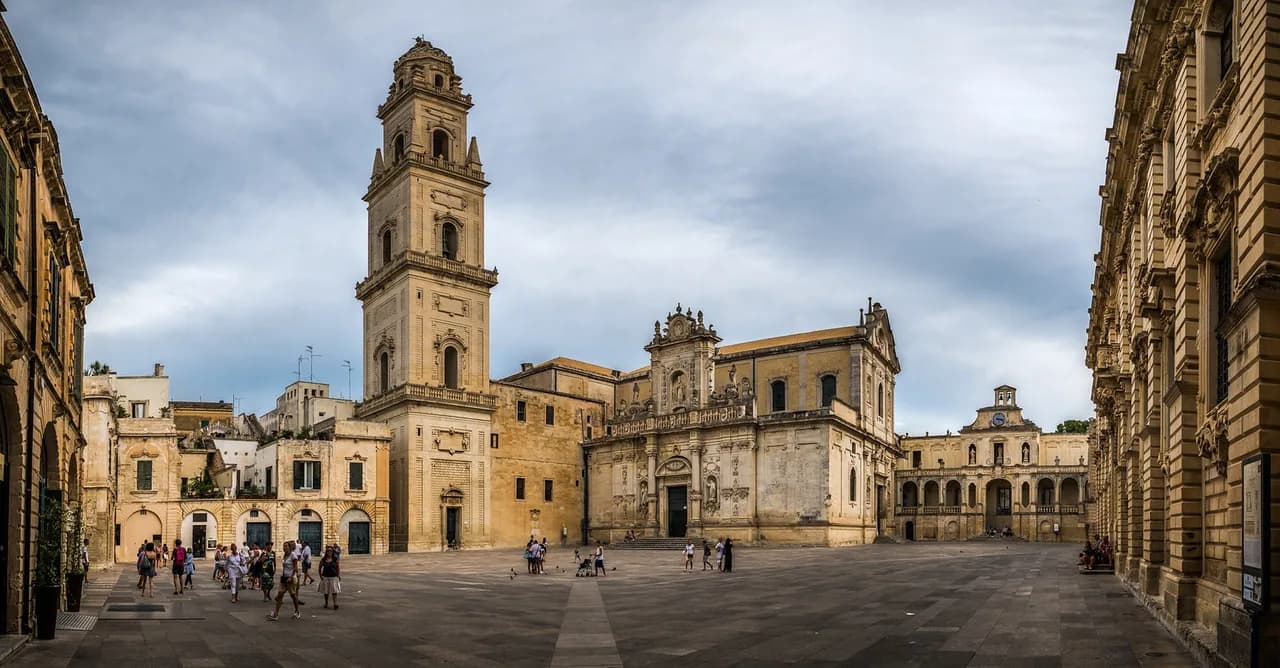
From Porta Rudiae it is an easy walk into the historic centre, where Piazza del Duomo sits enclosed by the cathedral, the bell tower, the bishop's palace and the seminary. The square is one of the most striking in southern Italy and costs nothing to enter. Build the market morning around that axis and you cover food and Baroque in one loop.
Church visiting needs a little planning. A walking guide describes a single LeccEcclesiae ticket covering the Duomo, bell tower, MuDAS, Santa Croce, San Matteo and Santa Chiara, said to be valid for 15 days, with prices and hours to confirm at the ticket office in the Antico Seminario on Piazza del Duomo. Do not assume every church in the city shares that ticket.
San Matteo is worth a deliberate detour for its undulating convex-concave facade, a Roman Baroque gesture unusual in Lecce, and its twelve apostle statues inside. The church was built between 1667 and 1700 on the site of an earlier chapel. It sits on Via dei Perroni, close enough to the market walk to add without much effort.
If you would rather follow a fixed route than improvise, a self-guided walk Lecce Baroque gives you a sequence to follow at your own pace.
Practical Etiquette and Mistakes to Avoid
Do not touch produce unless the stall invites it; some sellers prefer to select for you, while others hand you a bag. Ask if you can taste when you are unsure, and accept a refusal gracefully. A quiet please and thank you in Italian goes a long way.
Skip the temptation to arrive late and expect the full range, and avoid treating the market as a photo set while people are shopping. Dress for walking on cobbles and carry water in summer. If you are combining the market with churches, cover shoulders and knees, as several sources note for places of worship.
For orientation across the city's sights, the Lecce Attractions hub gathers the individual guides in one place.
Plan Your Visit
A market morning works best as a short, early outing: shop lightly, taste a pasticciotto and a caffè Leccese, then walk through Porta Rudiae into the Baroque centre while the light is still good. Confirm the listed hours the day before, carry small notes, and leave room for a proper lunch rather than filling up on samples.
The market is a starting point, not the whole food story. Combine it with a puccia, a plate of orecchiette and a gelato, and you will have covered most of what Lecce does well in a single day.
Frequently Asked Questions
What is sold at Lecce's Mercatino Porta Rudiae?
Listings describe a small market with fresh fruit and vegetables, meats including spit-roasted chicken, typical cured meats and cheeses, and traditional desserts. There is also a pastry shop and café associated with it, known for pasticciotti and savoury rustici. Specific stalls and vendor counts are not reliably published, so see what is there on the day.
What are the listed opening hours for Mercatino Porta Rudiae?
Third-party listings suggest early-morning opening, a midday close around 14:00 on most weekdays, a shorter Sunday window, and some late-afternoon trading on several days. These are not official times, so confirm with your accommodation or a current local listing before travelling, especially on public holidays.
Is there a separate weekly market in Lecce?
Yes. A general Puglia market guide lists a Monday market in Lecce on Viale dello Stadio, which is a different location from the Mercatino Porta Rudiae. Check which one you want before setting out, and reconfirm the day and hours locally, since weekly market schedules can change.
What local foods should you try first in Lecce?
Start with a warm pasticciotto and a caffè Leccese, then try orecchiette with cime di rape or ciceri e tria at lunch. A puccia sandwich and a gelato later in the day round things out. These are the dishes most consistently associated with the city and the wider Salento.
Should you carry cash for Apulian food markets?
One market listing advises that some vendors may not accept cards, so carry small notes as a precaution. Learn the local units too: an etto is 100 grams, while mazzo and cestino mean a bunch and a basket. Sellers may round your order upward, and you are free to decline.
Can you combine a market visit with Lecce's Baroque churches in one morning?
Yes. The market sits just outside Porta Rudiae, within walking distance of Piazza del Duomo and Santa Croce. A walking guide describes a combined LeccEcclesiae ticket covering the main churches, but confirm current prices and opening times at the ticket office in the Antico Seminario before you plan around it.
Sources
- The Best Food in Lecce -
- Lecce Street Food Tour - Eatwith
- 16 Best Restaurants in Lecce, Italy: My Must-Eat Spots
- Weekly Local Markets in Puglia - Explore and Discover
- Piazza del Duomo - Ormina Tours
- Mercatino Porta rudiae, Lecce, Italy - Reviews, Ratings, Tips and Why You Should Go – Wanderlog
- Porta Rudiae
- Baroque Church Walk in Lecce — Historic Route
- Church of San Matteo - LECCECCLESIÆ
Continue exploring
More guides you'll find useful