
Getting Around Genoa: Walking, Buses, Metro and Funiculars
Plan how to move around Genoa on foot, by bus, metro, funicular and lift, and how to reach the centre from the airport and the two main train stations.
On this page
Genoa is a city you experience on foot first, yet one whose steep hills make mechanical transport part of ordinary life. The compact historic centre, the waterfront and the main squares sit close together, but neighbourhoods climb quickly away from the port. Planning a few lifts, funiculars and bus hops in advance saves time and calf muscles.
This guide separates two logistics problems visitors usually meet at once: arriving in the city from the airport or a station, and moving around once you are there. Fares and service details can change, so treat the figures here as a starting point and confirm them with the operator before you travel. The city tourism board publishes a transport overview that covers buses, the metro, funiculars, lifts and the Casella line.
Orientation: the Old Town, the Squares and the Two Stations
Most short visits revolve around a rough triangle: Via San Lorenzo in the medieval centre, Piazza De Ferrari as the main civic square, and Porto Antico on the waterfront. The old town spreads between the two main stations and the sea, which makes it easy to cross on foot but easy to lose your bearings inside. Treat Via San Lorenzo as your reference line when you need to reset your direction.
Genoa has two big stations, Principe to the west near the port and Brignole to the east beyond the shopping streets. Principe puts you close to Via Balbi and the Royal Palace, while Brignole suits Via XX Settembre and the eastern edge of the centre. Choosing the right one for your accommodation removes an unnecessary cross-city transfer on arrival.
The historic core is the largest medieval centre in Europe, a dense web of caruggi that is perfect for wandering but not always quick to navigate. Getting pleasantly lost is part of the experience, provided you leave enough slack in the day. If you have limited time, pick one or two fixed landmarks per walk and let the lanes fill the gaps between them.
Arriving by Plane and Train: Airport Bus and Station Choices
Genoa's Cristoforo Colombo airport sits a short distance west of the centre, and the Volabus is the city bus link designed for arrivals. According to the city tourism board, the Volabus connects the airport with Genova Brignole and Genova Piazza Principe, passing through the city centre. That makes it a useful option if your hotel is near either station rather than on the waterfront.
The same page notes that a journey on the Volabus takes roughly thirty minutes, but schedules and frequencies should be checked with AMT before you rely on a tight connection. If you land late or carry heavy bags, compare the bus with a taxi at the official rank rather than deciding on the plane. Looking up your stop before boarding avoids a long walk at the far end.
Genoa sits on fast rail lines to Milan and Rome, with slower regional trains linking the coastal towns in both directions. Most trains stop at both Principe and Brignole, so your choice depends on where you are sleeping rather than which station the train reaches first. Check your ticket to see which station is listed before you decide where to get off.
Principe is the handier arrival for Via Balbi, the Royal Palace and the western edge of the old town, and it also links to the rack railway that climbs to Granarolo. Brignole works better for Via XX Settembre, Piazza De Ferrari and the eastern lanes. A short metro ride connects the two if you pick the wrong one by mistake.
Some travellers use Genoa as a base for coastal excursions, and Brignole is generally the more convenient departure point for trains heading east toward Santa Margherita Ligure, Portofino's nearest station, and beyond. If your plan mixes city days with coastal outings, a hotel near Brignole can save repeated transfers. Farther-flung ideas are collected in our Genoa day trips guide.
The AMT Network in Plain Terms: Buses, Metro, Funiculars and Lifts
Public transport in Genoa is run by AMT and is unusually varied for a city of its size. The tourism board describes an integrated system that includes more than 140 bus lines, a single underground line with seven stations, two funiculars, ten lifts, a rack railway dating from 1901, a boat link and a narrow-gauge railway toward Casella. In practice you will use the buses, the metro and the odd lift far more than any single attraction.
The metro links the Rivarolo area in the Polcevera Valley with the centre, which is useful mainly for connecting the two main stations and reaching the heart of town. It is not a comprehensive sightseeing network, so do not expect a metro stop at every landmark. Walking plus the occasional metro hop is the realistic pattern.
The two funiculars, Sant'Anna and Zecca-Righi, climb from the centre to the higher parts of the city, and the ten lifts connect streets with hillside viewpoints. These are the answer to Genoa's vertical layout: instead of grinding up a staircase, you rise in a couple of minutes. The city's funicular and rack railway pages are worth a look before you set out for the day.
One local's description of Genoa as a northern city with a southern lifestyle is a good mental note for transport too: shops close for lunch, dinner runs late, and rushing through the caruggi misses the point. Build slack into your day and let the lanes and lifts set the pace. The city rewards a slower rhythm.
Tickets and Passes: What Each One Covers
The city tourism board lists a single ticket at two euros valid for 110 minutes from validation across the urban and provincial network, covering buses, the metro, funiculars and lifts. It also lists an integrated AMT and Trenitalia ticket at two euros twenty for use on the urban railway network as well. Fares change, so confirm the current amounts with AMT or at a ticket office before you buy.
The important detail is scope: the standard single ticket does not cover the Volabus or the Genova-Casella railway. The tourist ticket, listed as MetDaily at ten euros for 24 hours from validation, does include those as well as the Santa Margherita-Portofino line 782. If your day mixes the airport bus with sightseeing, the day ticket can work out better than singles.
Tickets are sold at AMT ticket offices, newsstands, tobacconists and many shops and bars, and tourist tickets are also available at tourist information offices. The AMT Genova app lets you buy some ticket types, but check which ones before you depend on it. Children up to 1.15 metres tall travel free, per the tourism board.
Validate your ticket on boarding where validation is required, since inspectors do check and the fine is not worth the risk. Keep the ticket until the validity window ends in case you are asked to show it. A single well-timed ticket can cover a bus ride, a funicular ascent and a lift descent within the same window.
Walking the Caruggi: Shoes, Slopes and Getting Lost
Walking is the easiest way around central Genoa, where most cultural and historic sights sit within a compact area. The trade-off is terrain: streets are narrow, often go straight uphill, and many are cobbled or stepped. Bring shoes with grip rather than sandals, and expect to cover more vertical ground than the map suggests.
The old town can feel darker and quieter at night than the bright daytime postcard, and some alleys empty out after the shops close. Plan a route back to your accommodation before dark rather than improvising, and stick to busier lanes if you are uncertain. Asking your hotel which streets to use after dark is a simple precaution that many travellers skip.
Beyond the centre, walking alone to hillside neighbourhoods or outlying beaches is impractical, and that is where the bus network earns its keep. Use the buses for the first leg and walk back downhill, which is far kinder on the knees. Many of the city's quieter corners reward this approach, and our hidden gems in Genoa guide points to a few places worth the effort, including the Cimitero Monumentale di Staglieno.
If you want to combine walking with the sights rather than plan transport from scratch, a structured route helps you avoid backtracking. Our Genoa 2 day itinerary groups stops by neighbourhood so you spend less time retracing steps. Even a loose plan makes the caruggi feel less like a maze.
The Genova-Casella Railway: A Heritage Line Running by Bus
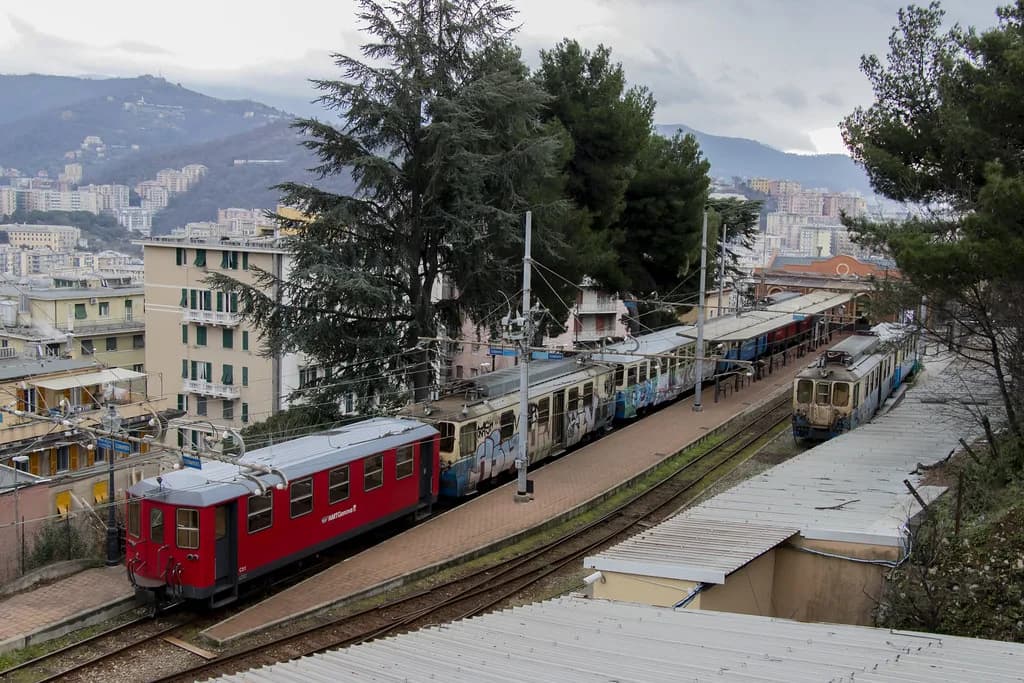
The narrow-gauge Genova-Casella railway is a historic line through the hills behind the city, and it is the sort of trip that appeals to travellers who want scenery rather than another museum. The tourism board currently notes that the service is operating entirely with replacement buses because of line maintenance. Plan accordingly and do not expect a steam-era carriage.
Because the replacement is temporary, confirm the status with AMT before making a special journey, and remember that the standard single ticket does not cover this route. The 24-hour MetDaily ticket does, according to the tourism board. If the bus substitution is still in place when you travel, the scenery on the way to Casella is the point rather than the rolling stock.
When to Choose a Taxi, the Metro or a Lift Instead of Walking
Taxis in Genoa are not something you hail on every corner; the rough guide advice is to look for stands at major junctions such as the aquarium and Piazza De Ferrari. That makes them best for late arrivals, heavy luggage or a direct run to the airport rather than spontaneous hops. Confirm the fare with the driver or the stand before you set off.
The metro is the cleaner choice when you need to cross the city quickly between Principe and Brignole or reach the centre from Rivarolo. It is short and simple rather than comprehensive, so treat it as a connector rather than a touring route. For most sightseeing days, walking and the occasional bus will do the job.
If the weather turns, the covered lanes and a couple of transport hops can rescue a wet afternoon. Our Genoa Rainy Day Plan collects indoor options and sheltered routes for exactly that situation. Keeping one rainy-day alternative ready makes a flexible schedule easier to hold together.
A Slow Day: Linking Walks, Lifts and Views
One satisfying pattern is to walk the old town in the morning, take a funicular or lift up to a viewpoint around midday, and descend on foot through a different neighbourhood. The Zecca-Righi funicular and the Castelletto area lifts both serve this purpose, and the Castelletto viewpoint gives you a panorama over the rooftops. Check which lifts and funiculars are running on the day, since maintenance closures do occur.
For a longer loop, the waterfront at Porto Antico connects easily to the old town and the aquarium area, while the promenade toward Boccadasse and the cliffs at Nervi offer a coastal contrast to stone lanes. Each is reachable by bus or train if you would rather not walk the whole way. The city tourism site keeps an events and highlights page if you want to align a walk with something happening.
Plan Your Visit
The practical rule for Genoa is simple: walk the centre, use the buses and metro to bridge the gaps, and treat lifts and funiculars as everyday transport rather than treats. Buy the ticket that matches your day's scope, and confirm current fares and service status with AMT before you rely on them.
If you want the background on the sights you will pass, start with our Genoa Attractions hub and then build a walk around the neighbourhoods you most want to see. Leave room for an unplanned detour, because the caruggi repay wandering. A little planning goes a long way in a city this vertical.
Frequently Asked Questions
Is Genoa a walkable city?
The historic centre is very walkable and most major sights sit within a compact area, but the city is built on slopes, so expect stairs and steep lanes. Bring comfortable shoes with grip, and use buses, the metro, funiculars or lifts for the hilly neighbourhoods and longer hops.
How do you get from Genoa airport to the city centre?
The Volabus is the AMT service linking Cristoforo Colombo airport with Genova Brignole and Genova Piazza Principe, passing through the centre. The city tourism board notes a journey of roughly thirty minutes, but confirm current schedules and fares with AMT before you travel, and remember the standard single ticket does not cover the Volabus.
Should I arrive at Principe or Brignole station?
Choose based on your accommodation. Principe suits the western old town, Via Balbi and the Royal Palace, while Brignole is handier for Via XX Settembre, Piazza De Ferrari and trains heading east along the coast. Most trains stop at both stations, so check your ticket and pick the one that avoids a cross-city transfer.
Does a single bus ticket cover the funiculars and lifts?
Yes. The city tourism board lists the standard single ticket as valid across the urban network, including buses, the metro, funiculars and lifts, within its validity window. It does not cover the Volabus or the Genova-Casella railway, which the 24-hour tourist ticket does. Confirm current fares with AMT.
Is the Genova-Casella railway running normally?
The tourism board currently states that the line is operating entirely with replacement buses because of maintenance. Check the latest position with AMT before planning a trip, since the arrangement is temporary and this route is not covered by the standard single ticket.
Is it safe to walk in Genoa's old town at night?
Travel guides advise that some old-town lanes are dark and quiet after the shops close. Plan your route back before dark, stick to busier streets if you are unsure, and ask your accommodation which way to go. This is general guidance rather than a set of official rules.
Do you need a car in Genoa?
No. The centre is best explored on foot, the public transport network covers buses, metro, funiculars and lifts, and the old quarter is closed to through traffic. A car is a liability for short city stays rather than an asset.
Where can I buy public transport tickets in Genoa?
Tickets are sold at AMT ticket offices, newsstands, tobacconists and many shops and bars, and tourist tickets are also available at tourist information offices. The AMT Genova app allows some ticket purchases, but check which types before you rely on it.
Sources
Continue exploring
More guides you'll find useful





