Arezzo Antiques Fair Guide: Fair Weekend vs a Normal Day
Plan around Arezzo's monthly Fiera Antiquaria: when it recurs, where the stalls spread, what is sold, and how a fair weekend differs from a normal day.
On this page
Arezzo's antique market, the Fiera Antiquaria, is one of the reasons travellers build a Tuscan weekend around this city rather than passing through it. The Fiera is a street market, so there is nothing to book and no ticket to buy; the planning goes into choosing the right weekend and pacing yourself once you arrive.
The fair is held on the first Sunday of every month plus the preceding Saturday, which means the Saturday sometimes falls in the previous month. The practical detail that shapes the whole trip is this: the market is free to walk through, and the stalls spread from Piazza Grande outward.
What the Fiera Antiquaria Actually Is
The market began in 1968, launched by the Tuscan collector Ivan Bruschi, and is described as the oldest antiques fair in Italy. That history matters less than what it means for a visit: this is a long-running dealers' market, not a craft fair assembled for tourists.
Fondazione Arezzo Intour handles destination promotion for the city and publishes visitor information across museums, events and the historic centre. Use its channels to confirm that a given month's edition is going ahead before you commit to travel dates, because a recurring market can still shift around local circumstances. For wider planning, see Piazza Grande Arezzo.
Because there is no gate, no wristband and no timed slot, your schedule is entirely your own. Treat the fair as a district of the city rather than a venue you enter and leave, and you will plan a calmer weekend.
When the Fair Recurs, and Why the Saturday Moves
The rule to remember is straightforward: the Fiera Antiquaria runs on the first Sunday of the month, with trading also on the preceding Saturday. Everything complicated about the calendar follows from that one sentence.
When the first Sunday lands on the 1st, the Saturday before it falls in the previous month. A September visit where the Sunday is 1 September would therefore mean the Saturday market sits in August, so check both dates against your travel window rather than assuming a two-day event always fits inside one month.
Third-party listings circulate their own date tables each year, but they are not the organiser's diary. Confirm the recurrence on the official city tourism channels and cross-check with the fair's own communications before booking trains or accommodation around a specific weekend.
Where the Stalls Spread
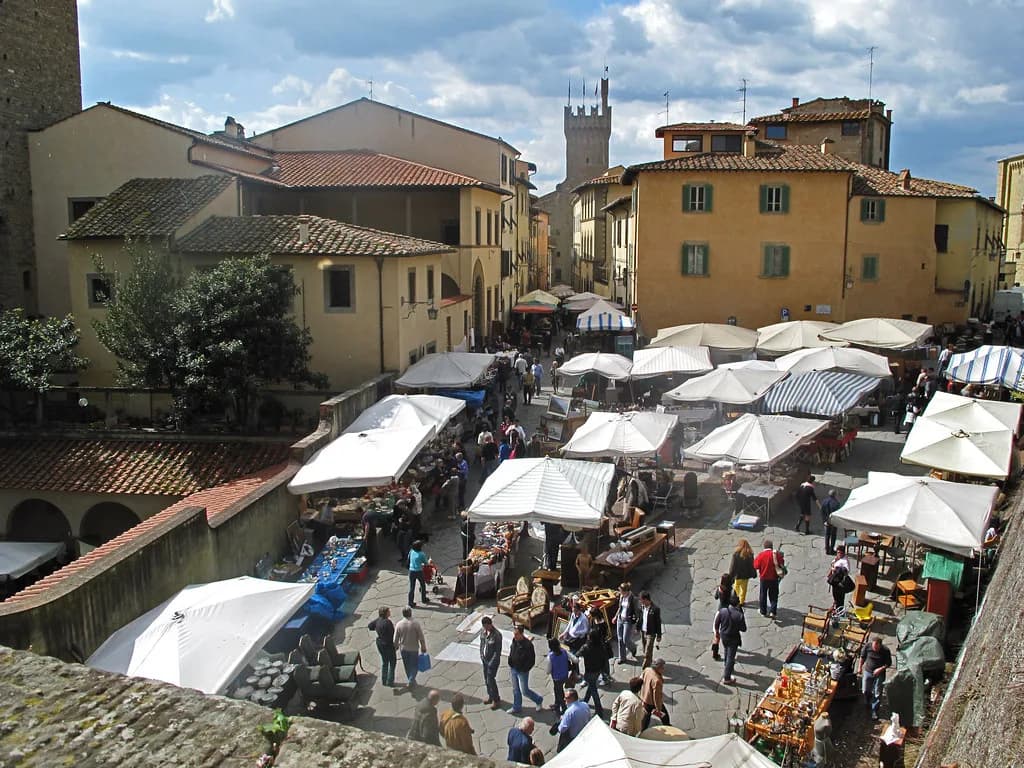
Piazza Grande is the main hub, but the market sprawls well beyond it, running under the Loggiato Vasariano and down into the surrounding streets. In practice you will move between the slope of the piazza, the covered loggia and ordinary city lanes that happen to be lined with trestle tables.
The market also reaches Piazza San Francesco and the Logge Vasari, so do not assume you have finished once you have circled the main square. Wear shoes for stone paving and accept that you will cover more ground than a single piazza suggests.
Scale is best described as hundreds of stalls rather than a fixed number, because counts quoted in older write-ups vary. Plan for a half day at minimum and a full day if you are seriously hunting.
What Is Actually for Sale
Expect furniture, paintings, books, historic prints, silverware, ceramics, glass, textiles, watches and old cameras, along with the copper and iron objects that turn up at Italian antiques markets. Mixed in are items that resist any category at all, which is often where the interest lies.
This is a dealers' market rather than a flea market of secondhand clothing, and you will see restorers working at their trade. Prices are not published anywhere reliable, so ask directly at each stall and treat any figure you read online as indicative at best.
Stalls are often loosely organised, with valuable pieces leaning against dusty frames. If you are chasing something specific, look patiently rather than skimming, and ask stallholders what they have kept out of sight.
Fair Weekend Plan: Timing and Route
Arrive early in the morning if you want to browse without crowds and to see stock before the most desirable pieces move. Saturday tends to serve buyers who want first pick, while Sunday brings the larger day-tripper flow, so choose according to whether you want selection or atmosphere.
Write a wish list before you go, with sizes and a ceiling for what you would spend. Without one, a large market encourages impulsive buying, and a piece of furniture bought at noon becomes a logistics problem by three o'clock.
Walk the full circuit once without buying, starting at Piazza Grande and working out through the loggia and side streets. That first pass gives you a sense of prevailing prices so your second pass is a negotiation rather than a gamble.
A Normal Day in Arezzo: What Changes
On an ordinary day the stalls vanish and the same streets read as a working Tuscan city, with the loggia and piazzas returned to architecture. If your interest is the medieval and Renaissance fabric of the centre, a quiet day gives you a much clearer view of it.
Shops, churches and museums operate on their own schedules rather than the market's, and no single pass covers all of them. Check each site's published opening times and ticket arrangements separately instead of assuming one Arezzo ticket opens every door.
A normal day is also better for slower wandering beyond the obvious squares. The city's quieter corners reward unhurried walking, which is difficult when several hundred stalls occupy the main routes through the centre.
Practical Tips for Market Day
Entry is free because the fair is held in public streets, so ignore any page selling tickets or tours as though they were admission. Your real constraints are cash, carrying capacity and stamina.
Bring cash in modest denominations and ask each seller which payment methods they accept, since small dealers vary. If you buy something bulky, ask about delivery or packaging before you hand over money, and confirm the practical details in writing where possible.
Pace yourself with breaks. A market of this size on stone streets tires legs quickly, and the centre's cafes fill up around midday, so a mid-morning stop is easier than a lunchtime one.
Food and Market Context Around the Fair
It is easy to conflate the antiques fair with a food market, but the Fiera Antiquaria sells objects, not produce. Do not arrive expecting a daily farmers' market in the same squares, because the antiques stalls are a monthly fixture rather than a permanent food hall.
For eating, treat the city's restaurants and shops as a separate plan from the market itself, and check current opening days directly rather than relying on a guide. Arezzo's food culture is worth a dedicated afternoon on a non-market day.
Pairing the Fair With Arezzo's Other Sights
The Basilica di San Francesco holds Piero della Francesca's fresco cycle of the Legend of the True Cross, one of the reasons Arezzo merits more than a market stop. It is a separate visit with its own access arrangements, so confirm times and any reservation requirement before you travel.
Arezzo also has a long goldsmithing tradition, and the workshops and shops around the centre are a worthwhile contrast to the antiques stalls. Neither activity is a secret, but both reward a slower pace than a rushed fair-day itinerary allows.
Getting There and Where to Base Yourself
Arezzo sits on the Florence–Rome rail corridor, which makes it easy to visit without a car, though we do not quote journey times here. Check current timetables with the operator, and note that a fair weekend increases demand for accommodation in the centre.
Staying within the historic centre puts the stalls on your doorstep, but expect noise and restricted driving access during the market. A base slightly outside the walls can be calmer, at the cost of a walk or a short bus ride in.
Book accommodation early for a fair weekend and confirm cancellation terms, since travel plans built around a monthly recurrence are easy to shift. For quiet stays, a normal weekend is simpler to arrange.
Plan Your Visit
The Fiera Antiquaria is a monthly two-day market spread through Arezzo's historic centre, free to enter and best approached as a half or full day on foot. Confirm the dates on the city's official tourism channels before booking, and remember the Saturday can fall in the month before the Sunday.
Choose a fair weekend if you want browsing, negotiation and the sociable bustle of a long-established market; choose a normal day if you want architecture, churches and a gentler look at the city. Either way, check opening times and ticket details for individual sights separately rather than assuming a single ticket covers them.
Frequently Asked Questions
When is the Arezzo antiques fair held?
It recurs on the first Sunday of every month, with trading also on the preceding Saturday. Because of that pattern, the Saturday sometimes falls in the month before the Sunday, so check both dates against your travel window. Confirm each edition on the city's official tourism channels.
Where is the Arezzo antique market located?
The main hub is Piazza Grande, and the stalls spread out under the Loggiato Vasariano and into nearby streets, reaching Piazza San Francesco and the Logge Vasari. It is part of the historic centre, so you can reach it on foot from most central addresses.
Is the Arezzo antiques fair free to enter?
Yes. It is a street market held in public squares and lanes, so there is no admission charge and no ticket to book. Anyone offering a paid ticket or entry tour for the market itself is selling something the fair does not require.
How big is the Arezzo antiques fair?
Plan for hundreds of stalls rather than a precise figure. Older write-ups quote different counts, and the market has no official published number to rely on. The practical implication is to allow at least half a day, and more if you are hunting for something specific.
What can you buy at the Arezzo antiques fair?
Typical stock includes furniture, paintings, books, historic prints, silverware, ceramics, glass and textiles, with watches, old cameras and assorted metalware alongside. Many stalls also carry items that resist categorisation. Prices are not published, so ask the seller directly.
Is Arezzo worth visiting when the fair is not on?
Yes, if your interests are architecture, churches and art. The Basilica di San Francesco, its Piero della Francesca frescoes and the city's goldsmithing tradition are reasons to come on a quieter day, when the centre is less crowded and you can see the squares themselves.
Sources
Continue exploring
More guides you'll find useful