Duomo di Trento Visitor Guide: What to See at San Vigilio
Plan a visit to Trento's Cathedral of San Vigilio on Piazza Duomo: what to see outside and inside, its Council of Trent legacy, and how to check hours.
On this page
The Cathedral of San Vigilio is the building that gives Piazza Duomo in Trento its weight, and even a short stop pays off if you know where to look. Before stepping inside, find the rose window facing the square, known as the Wheel of Fortune, and the loggias that catch the mountain light along the facade. Those two details alone separate a quick photo stop from an actual reading of the building. For wider planning, see Trento Attractions: Visitor Guides to 10 Sights.
Our research does not confirm current opening hours, admission arrangements or whether the crypt of San Vigilio can be visited, so this guide states none of them as fact. Check the cathedral's own website and the Trentino tourism board before you travel, and treat any blog listing hours or prices as out of date until an official page confirms it. The same caution applies to restoration work, which can close sections without much notice.
Where the Duomo Sits in Trento's Historic Centre
The cathedral lines the southern side of Piazza Duomo, the pedestrian heart of the old town, with the Fountain of Neptune at its centre and painted Renaissance residences such as Casa Cazuffi and Casa Rella framing the square. Local life runs through the arcades below, where cafe tables look out at the slate rooftops and the peaks beyond. Arriving on foot from the surrounding streets, you meet the cathedral as part of a continuous ensemble rather than as an isolated monument.
A short walk leads from the square to Via Belenzani, where the frescoed palace facades earned Trento its reputation as a painted city, with heraldic crests and classical motifs above street level. Keep looking up as you go; the decoration is the point of the street. This route makes a natural loop back toward the cathedral if you are piecing together a half day in the centre.
By train, Trento station sits within easy walking distance of the historic centre, and most of the monuments around Piazza Duomo are reachable on foot from there. Italo's high-speed trains connect major Italian hubs directly with Trento, which makes the cathedral feasible as a stop on a longer rail trip rather than a dedicated journey.
Reading the Exterior of the Cathedral of San Vigilio
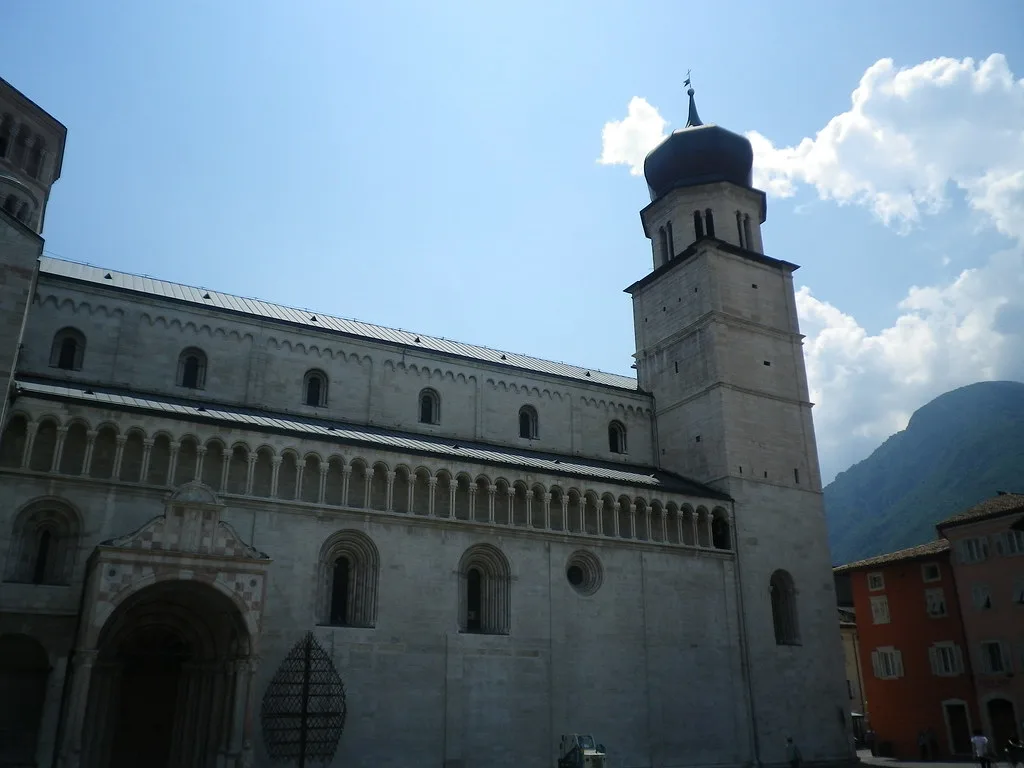
The Cathedral of San Vigilio is described as a masterpiece of Romanesque-Gothic architecture, built over the burial site of Trento's patron saint and anchoring the southern flank of the square. Outside, the grand rose window known as the Wheel of Fortune faces the piazza, framed by elaborate exterior loggias. Give the facade a few minutes before going in, because the stonework and window are easy to walk past when the square is busy.
Look at the cathedral as part of the square rather than alone. The Fountain of Neptune, the Palazzo Pretorio and the painted houses opposite all sit within a few steps, and the interplay between them is what makes Piazza del Duomo one of Trento's architectural set pieces.
Inside: Nave, Frescoes and the Chapel of the Crucifix
Step inside and the scale shifts: the soaring nave holds stone staircases, delicate frescoes and the solemn baroque Chapel of the Crucifix. That chapel houses the historic wooden crucifix before which the decrees of the Council of Trent were solemnly proclaimed, which is why it draws more attention than its size suggests. Approach it slowly and let the rest of the church reveal itself afterwards.
The cathedral was the primary venue for the Council of Trent between 1545 and 1563, a fact that gives the interior a historical charge beyond its art. Keeping that timeline in mind changes how you read the chapels and inscriptions, which otherwise blur into the general richness of an Italian church.
If you want the cathedral's architecture set against the broader city, the Italia.it weekend itinerary places the Duomo, the Chapel of the Crucifix and the frescoed palazzi of the square in a single walk from the cathedral to Piazza di Fiera. It is a useful framework for deciding how much time to give the square before moving on.
Why the Council of Trent Still Matters Here
Between 1542 and 1563 Trento sat at the centre of European affairs as the seat of the Council that reshaped the Church, and the city's museums and churches still organise much of their storytelling around it. The cathedral is the obvious starting point for that thread. Following it through the city turns a church visit into a themed walk.
The Basilica di Santa Maria Maggiore, a short walk away, hosted the third and final phase of the Council from April 1562 to December 1563, with prelates and theologians debating decrees inside its single nave. Its 53-metre bell tower is described as the tallest in Trento, which makes the church easy to pick out on the skyline. Pairing it with the cathedral gives you the two buildings where the Council's story actually unfolded.
The Museo Diocesano Tridentino in Palazzo Pretorio, where the prince-bishops once lived, displays paintings, wooden sculpture, illuminated manuscripts, textiles and Flemish tapestries from the 11th to 19th centuries, with multimedia context on the Council period. It is the best place in the city to fill in the history behind what you saw in the cathedral. Note that this is a separate museum, not part of the cathedral visit.
What the Cathedral Is Not: Separating Free Views from Ticketed Collections
Piazza Duomo and the cathedral's exterior can be admired as part of any walk through the centre, but the ticketed collections nearby are separate attractions with their own arrangements. The Diocesan Museum occupies Palazzo Pretorio and also manages the early Christian Basilica of San Vigilio under the cathedral, the Roman Porta Veronensis and the 45-metre Torre di Piazza. Because a single institution oversees several sites, it is easy to assume one ticket covers everything, so confirm the scope of what you are buying at the desk. Further visitor details appear in Tridentine Diocesan Museum, Trento - Sightseeing - Museums.
The same caution applies at Buonconsiglio Castle, the region's most important secular monument and the prince-bishops' residence, where the Torre Aquila's Cycle of the Months frescoes are the highlight but are managed separately from general castle entry. The castle typically opens Tuesday to Sunday with Monday closures standard, and the tower runs on timed entry with limited capacity, so booking ahead is advised. Hours vary by season and around temporary exhibitions, so check the museum's own site for the day you plan to visit.
For a change of register from churches and palaces, the SASS underground archaeological space beneath Piazza Cesare Battisti exposes more than 1,700 square metres of Roman Tridentum, including a stretch of paved road, mosaic fragments and craft workshops. It sits within the same compact centre, so it slots easily into a cathedral day.
Planning the Visit: Duration and What to Verify
As a rough recommendation rather than an official figure, allow around 30 minutes for the cathedral itself and half a day if you add Santa Maria Maggiore and the Diocesan Museum. The cathedral can carry a Council-of-Trent themed morning on its own when combined with those two sites, which sit within walking distance in the compact centre. Decide before you arrive whether you want a quick look or the fuller thread, because the second option changes your route.
Before travelling, confirm opening hours, admission arrangements and whether the crypt is accessible directly with the cathedral and through the Trentino tourism board, since sources consulted here do not verify them. Also check for restoration closures, which can affect access to chapels or sections of the interior. Build in a fallback so a closed door does not derail the day.
If the cathedral is closed on your dates, the square still works as a visit: the Fountain of Neptune, the painted facades and the Palazzo Pretorio exterior are all viewable from outside, and the Diocesan Museum and SASS offer indoor alternatives nearby. Shift your Council of Trent focus to Santa Maria Maggiore, which is an active parish church. That way the day keeps its shape even when one building is shut.
Pairing the Duomo with Nearby Sights
Around the cathedral, the strongest pairing is Piazza Duomo itself, followed by the frescoed palaces along Via Belenzani and the Diocesan Museum in Palazzo Pretorio. If you have a second day, the Renaissance streets and the Buonconsiglio Castle round out the historic centre, while MUSE in the Le Albere district suits families and anyone wanting a break from religious art. Choose by appetite rather than by checklist.
Beyond the centre, Monte Bondone rises above the valley and offers hiking, cycling and winter sports within a short drive, while Lake Garda sits under an hour away for sailing and windsurfing. These are full-day or half-day additions rather than cathedral add-ons. Keep them for a separate slot in your itinerary.
For travellers who like slower corners, the city rewards wandering between sights, and our guide to hidden gems in Trento helps you find quieter angles on familiar places rather than adding more monuments to the list.
Visiting Respectfully
The Cathedral of San Vigilio is an active place of worship, not only a monument, so keep voices low and avoid crossing in front of anyone praying. Modest dress is sensible in any Italian church, though specific rules for this cathedral are not confirmed here and are best checked on site. Photography inside may be restricted, so look for posted notices before raising a camera.
Services and parish activity can take precedence over sightseeing, so if you arrive during a Mass, wait outside or return later rather than walking the aisles. This is the simplest way to avoid friction with the community that keeps the building alive.
Make the Cathedral Part of a Slower Day
Treat the Duomo as the anchor of a walk rather than a box to tick: the Wheel of Fortune window outside, the Chapel of the Crucifix inside, then Santa Maria Maggiore and the Diocesan Museum to complete the Council of Trent story. Check official sources for hours, admission and crypt access before you go, and leave room for the square itself.
If you are building a wider trip, browse the Trento attraction guides for the castle, the piazza and the Roman underground, and keep one afternoon free for the mountains above the city.
Frequently Asked Questions
Is entry to the Duomo di Trento free?
Sources consulted for this guide do not confirm whether the Cathedral of San Vigilio charges for entry, so treat any claim either way with caution. Check the cathedral's own website and the Trentino tourism board before travelling, and confirm at the door whether any part of the interior carries a separate charge.
What are the Cathedral of San Vigilio opening hours?
Current opening hours are not verified here, and religious buildings often change schedules around services and seasons. Look for opening times on the cathedral's official site and the Trentino tourism board shortly before your visit rather than relying on older travel blogs.
Can visitors see the crypt of San Vigilio?
Access to the crypt is not confirmed for visitors, so plan as though it may be unavailable and ask on arrival. The Diocesan Museum manages the early Christian Basilica of San Vigilio beneath the cathedral, so its own site is a sensible place to check how that site is currently visited.
Why is Trento Cathedral important to the Council of Trent?
The cathedral was the primary venue for the Council of Trent between 1545 and 1563, and the baroque Chapel of the Crucifix holds the crucifix before which the council's decrees were proclaimed. That history is the reason the building matters beyond its architecture.
How long does a visit to the Duomo take?
As a recommendation rather than an official figure, allow around 30 minutes for the cathedral and half a day if you add Santa Maria Maggiore and the Diocesan Museum. Those three sites sit close together in the compact centre and work as a single walk.
What else is worth seeing near the cathedral?
Within a few minutes you have the Fountain of Neptune, the frescoed palaces of Via Belenzani and the SASS underground Roman site beneath Piazza Cesare Battisti. The Diocesan Museum in Palazzo Pretorio and Buonconsiglio Castle are separate ticketed attractions, so check each one's own arrangements.
Sources
- What to visit in Trento over a weekend - Italia.it
- Tridentine Diocesan Museum, Trento - Sightseeing - Museums
- Official site for holidays in Trentino Italy - Italian Alps
- Trento Travel Guide: Best Things to See, Museums & Views
- Buonconsiglio Castle Museum in Trento: Tickets & Guide
- Museo Castello del Buonconsiglio - Events in Italy by Dolcevia - Dolcevia®
- Spazio Archeologico Sotterraneo SASS - Sightseeing - Museums
- Basilica di Santa Maria Maggiore in Trento - Trento, Italy | Ciceru - Travel Stories & Adventure Guides
Continue exploring
More guides you'll find useful