
Torre Fornillo Positano Guide: The Watchtower Above Fornillo Beach
A practical guide to the watchtowers above Fornillo Beach in Positano: how to walk Via Positanesi d'America, what you actually see, and the limits on access.
On this page
The tower above Fornillo Beach in Positano is usually what brings this corner of the Amalfi Coast onto a walker's radar, but it is not a monument with a door. The structure most visitors notice and photograph from the coastal path is Torre Trasita, described in travel sources as a sixteenth-century watchtower now in private use. There is no ticket, no interior and no climbable staircase, so the walk itself is the event.
What you do get is a short cliff-cut path linking the main beach, Spiaggia Grande, to the quieter second bay. Published descriptions put the route at roughly 300 metres and about five to seven minutes at an ordinary pace, though steps, stone and photo stops stretch that. The reward is a west-facing pebble beach, a view back up at the stacked houses, and a clear look at the tower from outside.
Quick Answer: What the Tower Is and What a Visit Involves
Treat the tower as a landmark on a walk rather than a sight with opening hours. Sources describing this stretch present the towers as historic defensive structures and Torre Trasita specifically as a watchtower built against pirate raids, now a private residence. Nothing in the consulted material supports public entry, a guided interior or a bookable climb, so plan around the path and the beach.
The naming needs a caution. Travel writing about Fornillo identifies Torre Trasita as the tower dominating the bay and groups it with Torre Sponda and Torre Clavel as part of the same defensive line. If a map pin or tour description calls the tower above the beach Torre Fornillo, read it as an informal label for the same structure rather than a separate monument.
Before relying on any detail about tower access, path conditions or beach facilities, check the town authority's own pages. The Comune di Positano publishes official notices, and the town is the right place to verify claims if you see a tour advertising tower entry.
Where Fornillo Sits and How It Relates to Spiaggia Grande
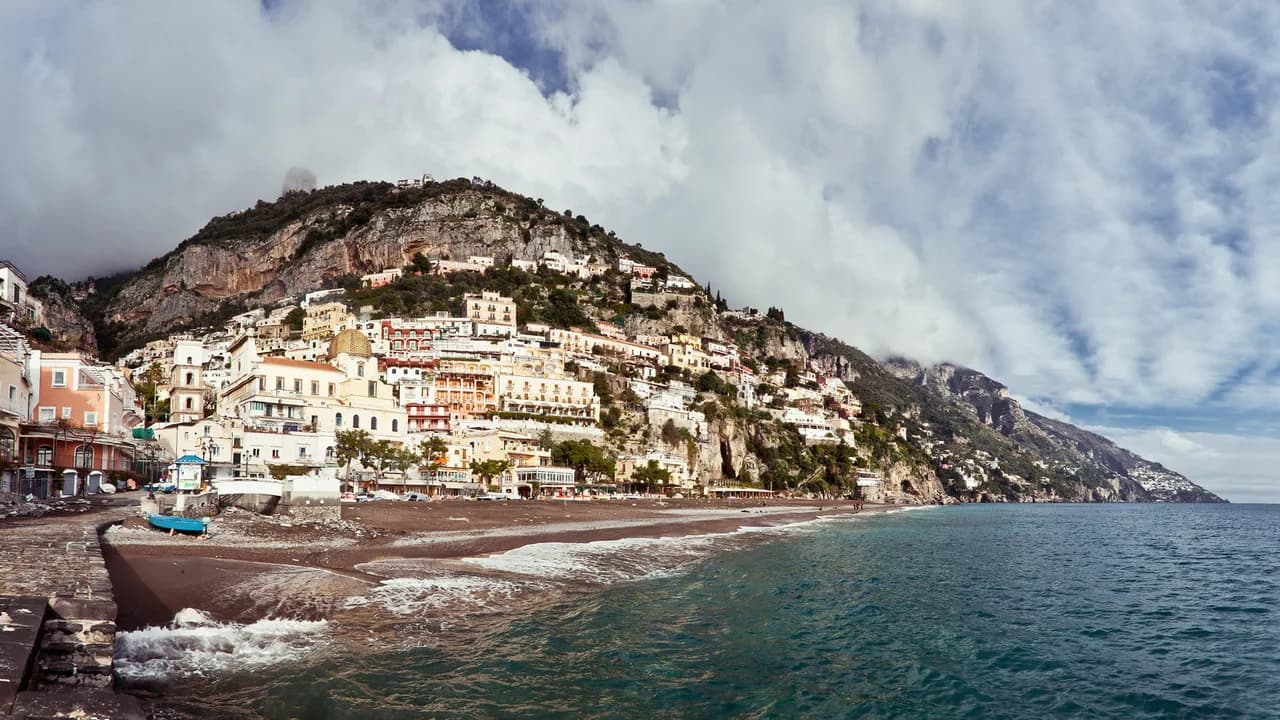
Positano climbs a cliff face above the Tyrrhenian Sea, and its two walkable beaches sit in separate small bays. Spiaggia Grande, also called Marina Grande, is the central beach beside the ferry port and the busiest part of town. Fornillo lies just west of it, reached by a path rather than by stepping off a street.
That geography explains the atmosphere. Spiaggia Grande carries the arrivals, the boat traffic and the densest line of restaurants; Fornillo is smaller and further from the port. One travel guide describes Fornillo as the calmer, less crowded alternative to the main beach and notes that most visitors are unaware of it. If the classic postcard view of the town is your priority, the main beach delivers it.
Getting oriented on foot is straightforward but vertical. The lanes and stairways connect beach level to the upper streets, and the pedestrian route to Fornillo begins near the main beach rather than up in town. Allow for climbing at the end of the day and treat every walking time on this side of Positano as approximate.
Getting There on Foot: Via Positanesi d'America
The standard route is the cliff-cut pedestrian path from Spiaggia Grande to Fornillo, known as Via Positanesi d'America. One beach guide gives it as about 300 metres and five to seven minutes, with the stone floor slippery in spots and closed shoes recommended. It hugs the rock above the water, so there is little shade and no shortcut once you start.
The name commemorates Positano families who emigrated to the United States in the late nineteenth and early twentieth centuries, which gives the walk more substance than a simple beach connection. Torre Trasita stands halfway along it, which is why the tower and the path are effectively the same outing.
Arriving by water is the alternative. A taxi boat from the Marina Grande port makes the crossing in a few minutes, according to the same guide, which saves the walk in the heat but skips the cliff path entirely. If the towers are what brought you, walk at least one way and save the boat for the return when your legs are tired.
Some visitors descend from the upper town by stairways rather than starting at the main beach. Those routes are steep, uneven and easy to misjudge from a map, so take the coastal path on a first attempt and experiment with shortcuts only once you know the layout. For wider planning, see A Positano Self-Guided Walk Through Lanes, Stairways and Belvederes.
The Tower You Will Actually Notice: Torre Trasita
Torre Trasita dominates the view into Fornillo bay from the path and the beach. It is described as a sixteenth-century watchtower, the largest of the three coastal towers here, and now a private luxury residence. That last point is the practical one: you see it from outside and you do not go in.
The dome that frames so many Fornillo photographs belongs to the Chiesa di Santa Maria Assunta above Spiaggia Grande, whose green and yellow majolica dome is visible across town. Church dome and watchtower together give the two beaches their recognisable skyline, and both are best appreciated from the path rather than from any interior.
Because the tower is a private building, keep expectations modest. No viewing platform, interpretive panel or access arrangement is documented. Use published descriptions to identify what you are looking at, and position yourself on the path or the shore for the photograph rather than expecting signage on site.
Sorting the Towers: Trasita, Sponda and Clavel
The towers along this stretch were not built as isolated landmarks but as a chain. Sources list Torre Trasita, Torre Sponda and Torre Clavel as elements of a defensive system raised against raids that threatened the southern Tyrrhenian coast into the eighteenth century. Seeing them as a network makes the walk more interesting than hunting one photogenic structure.
Descriptions that call Torre Trasita the largest and best-preserved of the group are a source's characterisation rather than an official record, so treat them as context. What matters for a visitor is position: the towers sit along and above the shoreline, visible from the path and from the water, forming the layered skyline this coast is known for.
To read the coastline properly, walk the path with the sea on your left and look back toward the main beach as well as forward into Fornillo bay. The changing angle shows how the towers relate to one another and to the town above. A short boat ride later in the day gives the view from the water, where the defensive logic becomes obvious.
Views and Timing: West-Facing Fornillo
Fornillo faces west, which shapes both the light and the swimming. One source notes shade arriving on the beach from around late afternoon and describes the sunset here, with the tower in silhouette, as a highlight; summer sunset sits around half past six in the evening according to that guide, but check the actual time for your date. Mornings bring calmer water and easier free spots.
Photographers should plan around the descent rather than just the beach. The path opens up steep compositions as you move along it, and the shore gives you the tower against the sky. Arriving before mid-morning means softer light on the water and less competition at the points where the path widens.
The walk down from the upper lanes is where most of the day's climbing happens in reverse. Descending is easy; the climb back is what people underestimate after hours in the sun. Build the walk into the coolest part of the day and keep the steepest stairways for the way down.
What Remains and What You Cannot Do
What remains is the tower structure itself, its position on the cliff and the line of defences it belonged to. What does not exist, according to the sources consulted, is public access: no climbable staircase, no interior visit, no ticket and no booking. Anyone offering tower entry as part of a tour should be able to show the operator's own permission, and the town authority is the place to verify it.
The same caution applies to beach facilities. One guide states that beach clubs along the Amalfi Coast generally operate from around May to October and that the peak months of July and August are the busiest, but each operator sets its own dates. Published prices from earlier seasons are historical, not current, so check with the individual club before budgeting.
Note also that most Amalfi Coast beaches are pebbles and rock rather than sand, which changes what you carry and how long you linger. The tower view is free from the path and the shore; the comfort layer, in the form of a lounger and umbrella, is the paid part of the day.
Pairing the Walk with a Beach Day: Free Sections and Clubs
Fornillo has a large free public area and a smaller free cove beyond the last lido, with several beach clubs occupying the shoreline between them. The free stretch fills quickly in high season, so arriving before mid-morning is the practical tactic if you want space near the water without paying. Look for open pebble with no reserved loungers; in Italy the sign reads spiaggia libera for the public zone.
The clubs along this bay, including Pupetto, Da Ferdinando, Fratelli Grassi and La Marinella, offer shade, showers and a base for the day in exchange for a rental charge. Bookings help on summer weekends, and rates vary with season and with position on the sand, so ask directly what a given day includes before committing.
A sensible split is to use the free section for the first part of the day and rent a lounger only when you want guaranteed shade. You can buy drinks and snacks from the beach bars without renting, which keeps costs down, and a thick towel or mat makes the pebbles far more comfortable.
Returning Uphill: Practical Routes
The climb back is the part worth planning in advance. One local guide recommends walking the promenade back to Spiaggia Grande and then taking an uphill bus from there, rather than attempting the steepest stairways with tired legs. Decide your exit route before you settle on the pebbles, not after the sun has drained you.
From the center, the main beach, the port and the bus stops sit within a short walk of one another. A hotel location guide gives Spiaggia Grande as about four minutes on foot and the port as about three minutes, and notes that ferries from the port serve Amalfi, Capri, Sorrento, Ischia, Salerno and Naples, so a boat onward is a realistic alternative to climbing. Further visitor details appear in Stay in the Heart of Positano | Palazzo Murat.
If you are staying in the upper town, a bus beats a final staircase in the afternoon heat. Coastal buses fill up in peak season and may pass full stops, so buy tickets in advance from a tobacconist and avoid depending on the last departure of the day.
What to Bring
Two kinds of footwear matter, and they are not interchangeable. Closed shoes with grip suit the stone path, which can be slippery in places; water shoes protect your feet on the pebbles and at the rockier entry near the quieter end of the bay. Pack both if you plan to walk and swim in the same outing.
The rest of the kit is straightforward: refillable water, sun protection, a hat and a towel thick enough to soften the stones. Leave passports and large amounts of cash behind, and carry a little cash as backup because card machines at small operators can fail.
Shade is limited on the path and arrives on the beach later in the day, so sun protection is not optional between late morning and mid-afternoon. If you plan to snorkel near the rocks, bring a mask and go early when the water is calmest, and check sea conditions locally before entering the water at either end of the bay.
Who This Walk Suits and Who Should Skip It
This walk suits travellers who enjoy a short coastal route with a view and a swim at the end, and who accept that the towers are scenery rather than attractions. It rewards an early start, a modest budget and a willingness to climb back up. Photographers get the most from it because the path changes character with the light.
Skip it, or take the taxi boat instead, if stairs and uneven stone are a problem, if you are travelling with a stroller or heavy luggage, or if you have limited mobility. One Amalfi Coast town guide is candid that Positano's cliffside layout is difficult for those with limited mobility, so plan accordingly.
Also skip the tower hunt if you were hoping for an interior, a guided climb or a panoramic platform. No source describes public access to any of these towers, so a day built around entering one will end in disappointment. Build the day around the path, the beach and the water instead.
A Suggested Half-Day Around Fornillo
A workable plan, offered as a suggestion rather than an official itinerary: start early, walk the coastal path from Spiaggia Grande to Fornillo while the light is soft, and identify Torre Trasita and its neighbours from the path. Settle on the free section of the beach for a swim, buy lunch or a drink from a beach bar, and decide by early afternoon whether to rent shade.
Finish with the sunset if the timing suits your dates, then walk the promenade back to the main beach and take transport uphill before you are exhausted. Verify current beach-club rates, seasonal opening and any town notices with the operators or the town authority before you go, since these details change from year to year. Further visitor details appear in Official event website.
Frequently Asked Questions
Can you visit or climb the tower above Fornillo Beach?
No public access is documented. The tower above Fornillo Bay is generally identified as Torre Trasita, a sixteenth-century watchtower now in private use. Sources describe it as scenery along the coastal path, with no ticket, no interior visit and no climbable staircase. Check with the Comune di Positano if you see a tour advertising tower entry.
How do you walk to Fornillo Beach and the tower from Spiaggia Grande?
Follow Via Positanesi d'America, the pedestrian path cut into the cliff from the main beach toward Fornillo. Published descriptions give it as roughly 300 metres and five to seven minutes, longer with photo stops. The stone surface can be slippery, so wear shoes with grip rather than sandals.
Which tower is visible above Fornillo Beach?
Torre Trasita is the tower most often photographed above Fornillo bay, standing halfway along the connecting path. Torre Sponda and Torre Clavel belong to the same coastal defence line. Names vary in informal use, so treat a Torre Fornillo label as a local name for the same stretch of defences.
Is Fornillo Beach free?
Part of it is. A large free public section and a smaller free cove sit alongside several beach clubs that charge for loungers and umbrellas. The free area fills early in high season, so arrive before mid-morning if you want a spot near the water without paying.
What is the best time of day for the Fornillo walk and sunset?
Mornings bring calmer water, softer light and better odds of a free spot on the pebbles. Evenings suit the west-facing sunset, when the tower stands in silhouette. Check the actual sunset time for your date, and start the return climb before darkness and fatigue combine.
Sources
- A Journey through the Amalfi Coast: Positano — eCKsplorer
- Official event website
- Stay in the Heart of Positano | Palazzo Murat
- The Best Beaches in Positano Italy (and Beach Clubs) - UPDATED 2026 — ckanani
- Fornillo Beach, Positano: 2026 Guide | How to Get There & Prices
- Fornillo Beach: Positano's Quieter Alternative | Hostel Brikette | Brikette Guides
Continue exploring
More guides you'll find useful





