
Piazza IV Novembre & Fontana Maggiore: Perugia Square Guide
See Perugia's 13th-century Fontana Maggiore and its carved reliefs, then plan a walk around the cathedral steps, Palazzo dei Priori and Corso Vannucci.
On this page
Piazza IV Novembre is where Perugia's hilltop streets open into a single civic room, and the Fontana Maggiore sits at its centre. Art historians rank the 13th-century fountain among the most important and best preserved in Italy, which makes it worth more than a passing photograph on the way to dinner.
The useful way to approach the square is to treat the fountain as a document rather than an ornament. Its carved panels record farm work, founding legends and the city's symbols, while the buildings around it show where power and money sat in medieval Perugia. Our suggestion is roughly 30 to 45 minutes for the square and fountain at an unhurried pace, longer if you climb the cathedral steps and look back at the whole composition.
Why Piazza IV Novembre Is Perugia's Civic Heart
Piazza IV Novembre sits on the spine of the historic centre, and the Fontana Maggiore stands in the middle of the square by the cathedral and the Palazzo dei Priori. Italia.it places the fountain squarely in Piazza IV Novembre and treats it as the city's emblem, which is a fair summary of how the space functions: residents cross it, students linger on the steps and visitors use it as a compass point.
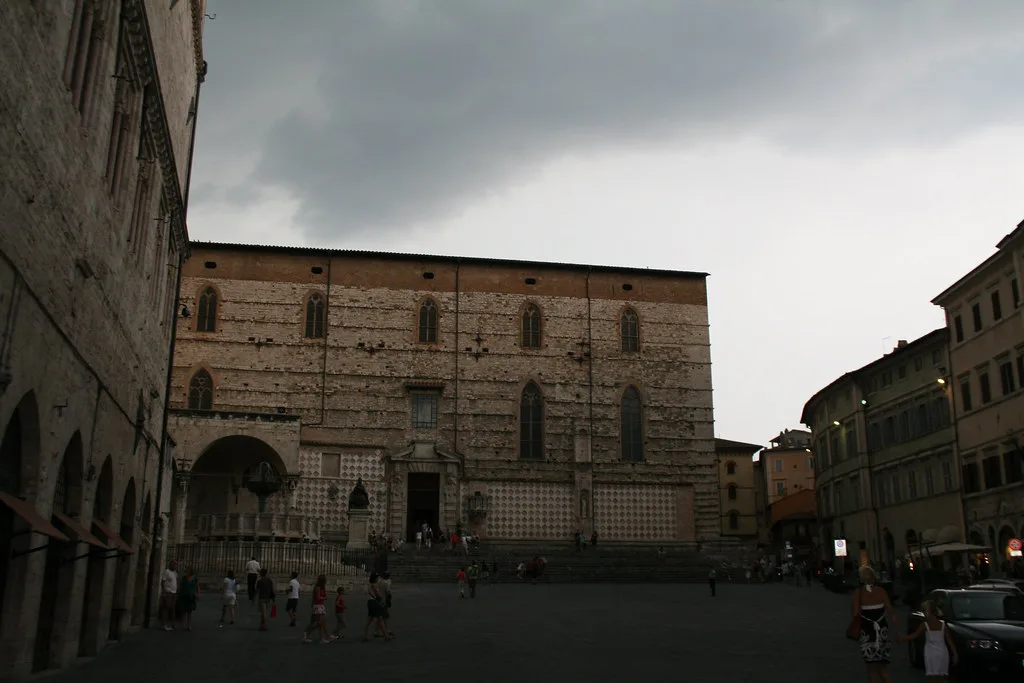
The square is not a single monument but a stage set of them. The Gothic Palazzo dei Priori rises on one side, the cathedral of San Lorenzo faces the fountain, and Corso Vannucci sweeps downhill as the city's main walking street. Treating these as one outdoor room explains why the fountain was built here rather than in a quiet corner: this was the address of civic authority.
That civic role matters for reading the fountain. Perugia's medieval commune needed water delivered to the town and chose to make the delivery a public display of wealth and competence. What you see today is therefore both infrastructure and propaganda, and the carving rewards a slower look than the crowds usually give it.
The Fountain Explained: Marble Basins and a Bronze Bowl
The Fontana Maggiore stacks two concentric marble basins, with a large bronze bowl above them from which jets of water rise vertically. That arrangement creates a visual balance that is hard to reproduce, and it means the fountain reads as a tiered sculpture from every side rather than a flat facade. Walk a full circle before you settle on a viewpoint.
One travel guide describes the basins as pink-and-white marble, a detail that becomes obvious in low sun when the stone warms against the grey of the palazzi. The fountain is not roped off behind glass, so the carving is best studied on foot at close range, moving slowly around the lower basin. Morning and late afternoon light both bring out different faces of the reliefs.
Allow yourself a second pass after reading the panels up close. From a few paces back, the upper bowl and the ring of figures resolve into a single silhouette, which is how most people actually see the fountain as they cross the square. That contrast between the close-up carving and the distant silhouette is the fountain's design achievement.
Reading the Reliefs: Labour, Legend, Zodiac and Griffin
Dozens of small statues and reliefs decorate the corners and sides of the fountain, and they are not decorative filler. Italia.it notes that they recount agricultural activities of the period in detail alongside legendary stories connected to the founding of the city, so the lower basin works as a calendar of work and a genealogy of place at the same time.
Look for the farming panels first, because they are the easiest to identify without a guide: figures, animals and tools of the seasons. Then switch to the legendary scenes, which reward a little background reading before you arrive. A single loop anticlockwise around the basin will take you through both categories without backtracking.
The zodiac signs and the griffin, Perugia's city symbol, complete the programme. The same travel guide lists the zodiac and the griffin among the fountain's decorative flourishes, and the griffin is the tell that this is civic art rather than church art. Finding it is a good way to keep children or distracted companions engaged with the carving.
Who Made the Fountain, and When
The fountain is attributed to the Pisan father-and-son team of Nicola and Giovanni Pisano, and the same travel guide dates the work to 1275 to 1278. Treat those dates as the commonly cited attribution rather than a line carved into the stone, and treat the sculptors' names as the frame for what you are looking at: a Pisan workshop translating local civic ideas into marble.
Knowing the workshop matters when you compare the fountain with what else you plan to see in Umbria. The same era of pulpits and carved stonework appears across central Italy, and the Perugian version is unusual for being an outdoor public object rather than a church interior. That context makes the fountain a useful first stop before any gallery visit.
The Square's Stage Set: Cathedral Steps and Palazzo dei Priori
On the far side of the fountain, steps rise to the austere Gothic cathedral, and those steps are where people and pigeons gather through the day. They are part of how the square is used rather than a separate sight, so sitting on them for a few minutes is a cheap way to read the square's rhythm. If mobility or steps are a concern, enjoy the view from the fountain side instead.
The Palazzo dei Priori, Perugia's town hall, presents a long Gothic front with crenellations along Corso Vannucci, and fan-shaped steps lead up to the Sala dei Notari, the lawyers' hall painted at the end of the 13th century. The palace is the counterweight to the fountain: one declared the commune's wealth in water and marble, the other housed its government.
Stand where the two meet and the square's logic becomes clear. The fountain sits in the open, the palace closes one side and the cathedral closes another, so the space works as an outdoor assembly hall. Photographers should note that the facade is broad and close, which makes a wide lens or a step back towards Corso Vannucci more useful than a zoom.
Approaching on Foot Along Corso Vannucci
Most visitors reach the square on foot along Corso Vannucci, the main thoroughfare that demonstrates how walkable Perugia is. The street carries the early evening passeggiata, a parade of residents and students that is part of the experience rather than an obstacle. Arrive from below and the square opens suddenly; arrive from above and you see the rooftops first.
Bars and cafes cluster along the Corso and in the side streets just off it, including Caffe del Banco on Corso Vannucci, which the travel guide recommends for coffee, cocktails or a local draft beer. Opening times can change, so check with the venue before you build an evening around one address.
A simple loop serves most visitors: come up the Corso, circle the fountain, climb the cathedral steps and look back, then continue to the palace front. From there you can descend via the Rocca Paolina escalators towards Piazza Partigiani, which the guide calls a typical urban experience in Perugia and a practical way to avoid retracing your steps uphill.
Pacing a Visit: Fountain First, Then Collections
Start with the fountain and the square before any interior, because the outdoor space sets the vocabulary for everything else. The Galleria Nazionale dell'Umbria, Umbria's foremost art gallery, occupies a Gothic mansion flanking Corso Vannucci and holds 13th-century paintings, Tuscan works and pieces by Perugino and Pinturicchio. Seeing the fountain first makes those panels and frescoes easier to place.
Next door, the palace's 15th-century Collegio del Cambio, a medieval money exchange, is graced by Perugino's frescoes fusing classical and Christian themes. This is a separate interior from the gallery, so plan your time and any tickets around each collection individually rather than assuming one entry covers the palace complex.
If your time is short, prioritise the square and one interior. The fountain, the palace facade and the cathedral steps can be seen without buying anything, while the gallery and the Collegio del Cambio are the kind of stops that reward a dedicated hour or more. Check current opening arrangements with each site before you go, since the buildings and their museums run their own calendars.
Free Piazza, Ticketed Neighbours
The piazza and the fountain are open public space, so the square itself costs nothing to walk through and the reliefs can be studied whenever you find it accessible. The buildings around it work differently: the palace houses civic rooms and museums, and the gallery and the Collegio del Cambio are separate paid interiors. Plan the square as free time and the collections as a budget line.
For current admission prices, hours and booking rules for the cathedral, palace, gallery or fountain surroundings, check each site directly before you travel. The city council and the regional tourism board are the starting points for updated visitor information, and seasonal arrangements change.
If you want to keep costs low, build the day around the free outdoor fabric: the square, the cathedral steps, the Corso and the Rocca Paolina escalators. Add one ticketed interior that matches your interest rather than trying to cover every collection in a single day in a hill city.
Extending the Walk: Rocca Paolina and Layered Perugia
Below the square, the Rocca Paolina is a helter-skelter of cobbled alleys and arched stairways, all that remains of a fortress commissioned by Pope Paul III Farnese in the 1540s. Its creation destroyed a prosperous neighbourhood, and Perugians waited until 1848 for the first partial demolition, with final destruction in 1860 during unification. The vaulted foundations now form a route into town from Piazza Partigiani.
Riding the escalators through the walls is the practical way to connect the modern lower town with the historic centre, and it is a good wet-weather or shoulder-season option. The tunnels also reveal the odd shop or exhibition venue, so they are worth ten minutes even if you do not need the transport.
Above ground, Etruscan Perugia survives in stretches of wall, gateways and the Arco Etrusco on via Ulisse Rocchi, the most monumental of the ancient gates. Combine that with the square and you have three layers of the same city within a short walk. For more overlooked corners beyond the main axis, our guide to hidden gems in Perugia covers quieter alternatives to the obvious stops.
Practical Tips for a Hill City
Perugia is a dense, hilly and multi-layered city, so build in more walking time than the map suggests and wear shoes that cope with cobbles and stairs. The route from Corso Vannucci to the cathedral steps and back down through the Rocca Paolina involves gradients, and the escalators help but do not remove every climb. Plan a short break at the fountain rather than two long ones elsewhere.
Expect company rather than solitude. The square is the meeting point for city life, the Corso hosts the passeggiata, and the travel guide notes that the area becomes a cultural hub at festival time, especially during Umbria Jazz. Early morning is a reasonable hope rather than a guarantee, so check the festival calendar before fixing dates.
If you are travelling for a specific event, confirm dates and any road or access changes with the organiser and the city before booking. Festival programming shifts the way the square is used, and a piazza thronged with concertgoers is a very different place from the one you may have read about. Allow a backup slot in your itinerary.
Day Trips That Start From the Square
Perugia is both the capital of Umbria and a practical gateway to the region, and the square is a natural starting point for day trips. The travel guide puts Assisi about 30 minutes east of Perugia by car, with the Basilica di San Francesco and the Bosco di San Francesco on Mount Subasio's slopes, and it repays a full day rather than a rushed half.
Gubbio, a medieval city in miniature, sits under an hour's drive north according to the same guide and clings to the side of Monte Ingino, with a funicular to the basilica of Sant'Ubaldo. Lake Trasimeno spreads west with Castiglione del Lago and Passignano along its shores, and the guide treats the cycle route around the lake as a classic full-day ride. Each suits a different pace, so pick one and enjoy it properly.
Whichever direction you choose, come back to the square in the evening if you can. The fountain, the palace front and the cathedral steps read differently under artificial light, and the Corso fills again for the passeggiata. It is a fitting end to a day spent moving between Umbria's hill towns.
Plan Your Visit
Treat Piazza IV Novembre as the first stop of your Perugia itinerary, not a footnote between restaurants. Circle the Fontana Maggiore twice, once for the agricultural panels and once for the zodiac and griffin, then climb the cathedral steps to see how the square is framed. That sequence costs nothing and gives you the vocabulary for every museum and church you visit afterwards.
Then layer on the rest of the city: the Galleria Nazionale dell'Umbria and the Collegio del Cambio if the art is the point, the Rocca Paolina escalators for the descent, and the Corso for the evening. Browse our Perugia Attractions hub to match each stop with a dedicated guide before you finalise the day.
Finally, confirm the practical details closest to your travel date. Check current opening arrangements for the interiors, festival dates with the organisers, and any access changes in the centre; the square itself stays open to the street, but everything around it runs to its own calendar.
Frequently Asked Questions
What does the Fontana Maggiore show and who made it?
The fountain has concentric marble basins and a bronze bowl above them, decorated with dozens of statues and reliefs. These include agricultural scenes, legends about Perugia's founding, zodiac signs and the city's griffin. One travel guide attributes the work to Nicola and Giovanni Pisano and dates it to 1275 to 1278; treat that as the commonly cited attribution rather than a certainty.
Is Piazza IV Novembre free to visit?
The square and the fountain are open public space, so walking through and studying the reliefs costs nothing. The buildings around it are separate: the palace houses civic rooms and museums, and the gallery and the Collegio del Cambio are distinct paid interiors. Check each site's current admission arrangements directly before you travel.
What is the best way to see the relief panels?
Walk one slow anticlockwise loop around the lower basin looking for farming scenes and tools first, then a second loop for the founding legends, zodiac signs and griffins. Compare the close-up carving with the silhouette from a few paces back, then view it again from the cathedral steps. Late afternoon light is kind to the pink-and-white marble.
How long should I spend on the square?
Our suggestion, not an official figure, is 30 to 45 minutes for the square and fountain unhurried, plus whatever time you want on the cathedral steps and in front of the Palazzo dei Priori. Add at least an hour for the gallery or the Collegio del Cambio if you plan to go inside. Perugia is hilly, so leave slack in the day.
When is the square busiest?
There is no dependable source for quiet hours, so do not plan around an empty piazza. The square is the city's meeting point, the Corso carries the evening passeggiata, and the area becomes a cultural hub at festival time, especially during Umbria Jazz. Check the festival calendar before fixing dates and allow a backup slot.
Can I combine the square with the gallery and the cathedral?
Yes, and the natural order is the square first, then one nearby interior. The Galleria Nazionale dell'Umbria flanks Corso Vannucci and the Collegio del Cambio next door has Perugino frescoes; they are separate collections with their own admission arrangements. Confirm current opening days and any ticket rules with each site, and do not assume one entry covers everything.
Sources
Continue exploring
More guides you'll find useful





