
Arco Etrusco Perugia: Visiting the Etruscan Arch
A focused guide to Perugia's Arco Etrusco: its third-century BC towers and arches, the Roman inscriptions, how to read the stonework, and nearby Etruscan sites.
On this page
Perugia's Arco Etrusco, also called the Arch of Augustus, is the monumental gateway that once faced the northern approach to the Etruscan city. It stands at the end of Via Ulisse Rocchi, near Piazza Fortebraccio, and map listings place it at Via Ulisse Rocchi 39. Because it sits in the street rather than behind a turnstile, you can study it without committing to a museum slot.
The gate rewards a slower look than most photo stops allow. Its value is not a single grand view but the way different building phases share one facade, so a few minutes spent locating the lower arch, the upper arch and the inscriptions changes what you see. Treat it as the opening chapter of Perugia's Etruscan story before you move on to the well or the archaeological museum.
Where the Arch Sits in Perugia
The arch marks the northern edge of the historic centre, on the route that once led into the Etruscan city. It is close enough to the main sights that you can fold it into a walk along Corso Vannucci or an evening passeggiata, but far enough that it feels like a separate stop rather than part of Piazza IV Novembre. Coming from the square, walk down Corso Vannucci and continue north until the street opens toward Piazza Fortebraccio.
That short approach is worth taking on foot, because the arch is the point where the dense medieval fabric gives way to the older fortifications. You do not need to plan a half-day around it; think of it as a twenty-minute encounter that sets up everything else. If you are building a wider itinerary, the Perugia Attractions hub covers how this sight compares with the city's other headline stops.
What You Are Actually Looking At
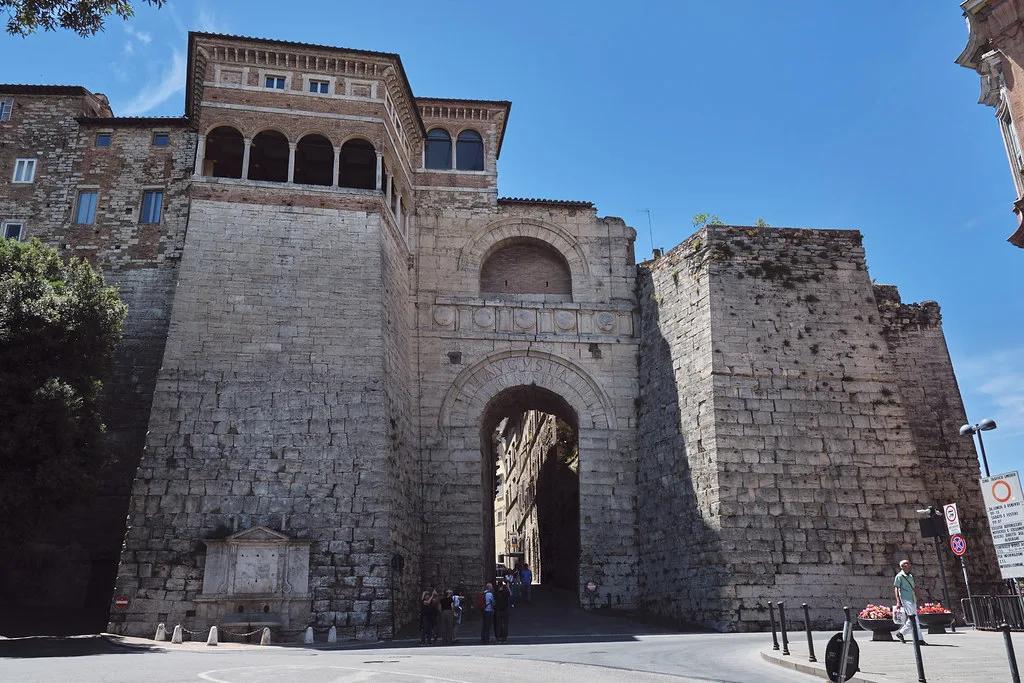
Travel writing describes the gate as a third-century BC Etruscan structure built as a monumental entrance rather than a simple hole in a wall. It is composed of two trapezoidal towers flanking a central facade of two overlapping round arches. Once you know that, the apparent asymmetry makes sense: the towers are not decorative bookends but part of the original defensive design.
The facade is a document of reuse. The lower arch carries the inscription Augusta Perusia, added after the Bellum Perusinum of 41 to 40 BC, while the line above reads Colonia Vibia, commemorating the emperor Vibius Trebonius Gallus. Read together, they show a gate that was rebuilt and re-labelled as Roman authority overwrote Etruscan Perugia. Looking for those two bands of lettering is the single most useful thing you can do at the site.
Later history is layered less legibly. The gate was absorbed into the city's defences and has weathered centuries of rebuilding around it, which is why the stonework does not read as a single clean period. Resist the urge to date every block you see; what matters is the sequence from Etruscan gateway to Roman monument to surviving city gate.
How to Read the Stonework
Start at ground level and step back far enough to take in both towers at once. From that angle you can see how the central facade projects slightly forward, which makes the double arches read as a deliberate display rather than a structural afterthought. Then move closer and line up the two arches vertically; the overlap is easier to see when you are almost underneath.
The inscriptions need a different distance. Stand back a few metres and slightly to one side so the lettering catches raking light, rather than pressing your nose to the stone in flat shade. Morning sun tends to hit the facade more directly, while later in the day the letters can fall into shadow; plan your reading accordingly rather than assuming the gate always photographs well.
Expect a street-level monument, not a curated archaeological park. There are no labels interpreting each block, so bringing a short note on the two inscriptions will do more for your visit than any audio guide. This is also why the arch works better as a first stop: once you have seen it, the Greek and Roman collections in the city's museums have a visual anchor.
Access, Timing and Practical Basics
The arch sits in public space at the edge of a residential street, so visiting means walking up to a historic structure rather than buying admission. Map listings describe the site as open around the clock, but those listings are third-party and can lag behind local changes. Treat always-available access as the reasonable expectation for a street monument and check the city's own pages if you are planning a trip around it.
There is no ticket office to consult and no published price, which is a good sign that this is a public thoroughfare rather than a ticketed attraction. What you should verify locally is whether any restoration fencing or street works affect the approach, since those change without notice. The comune's site is the place to start for that kind of current information.
Allow somewhere between ten and thirty minutes depending on how carefully you read the facade. This is not an official duration, just a realistic range for a monument without a visitor centre, toilets or a shop. Anything longer probably means you are combining it with the nearby walk described below.
A Suggested Walk North of the Centre
One satisfying way to extend the visit is to keep heading north through the streets beyond Piazza Fortebraccio rather than turning straight back. That direction eventually brings you toward the Church of San Michele Arcangelo, one of the oldest churches in Italy, dating from the fifth century AD and known for its unusual circular form. Treat this as a self-paced suggestion rather than a signposted route.
Do not expect a maintained heritage trail with wayfinding. Perugia's lanes bend, stairways cut through the hillside and the archaeology is scattered through ordinary residential streets, so a phone map is more useful than a fixed itinerary. If you would rather not commit to a longer walk, the arch alone is a complete stop.
Pairing the Arch with Perugia's Other Etruscan Traces
The arch makes most sense when it is not your only stop. Porta Marzia is another Etruscan gate, later embedded in the papal fortress, and it shows the same pattern of an ancient entrance surviving inside a newer defensive shell. Seeing both lets you compare how two gates were absorbed into the medieval and Renaissance city in different ways.
The Etruscan Well, or Pozzo Etrusco, is the second essential pairing. A hydraulic engineering work reached from Piazza Ignazio Danti, it is a ticketed underground site rather than a street monument, so it needs its own time slot and its own check of current opening days. Do not assume a single combined ticket covers the well, Porta Marzia and the arch; they are managed separately.
For objects rather than architecture, the National Archaeological Museum of Umbria holds Etruscan material including the Cippus from Perugia and a reconstruction of the Cai Cutu tomb. The museum sits in the former convent beside San Domenico, which is a different part of town from the arch. A sensible sequence is the arch first for context, then the museum later the same day or the next.
What to Skip If Time Is Short
If you have only a few hours in Perugia, the arch competes with the Piazza IV Novembre ensemble, the national gallery and the Rocca Paolina tunnels. The gate asks little of you and sits slightly off the main circuit, so it fits well at the start or end of a day rather than as the centrepiece. Skip it only if you have no interest in the city's pre-Roman layers.
If you are already planning to visit the well and the archaeological museum, keep the arch on the list: it is the cheapest and quickest way to see the Etruscan city in situ. If your interests lean toward Renaissance painting and Renaissance squares, defer it. A wider scan of the city's viewpoints and lesser-known corners can help you balance the day, including the Porta Sole belvedere and other elevated spots.
Visiting Respectfully
This is a working street, not a fenced ruin, and people live in the buildings that crowd up against the old walls. Keep your voice down near doorways, avoid blocking the passage while photographing, and watch for traffic where the road narrows. Steps, slopes and uneven paving are part of the approach, so wear shoes that cope with that rather than sandals.
Avoid touching or leaning on the inscribed stonework; oils and abrasion do real damage over time, and the lettering is the reason the gate is worth protecting. If you want a closer look at the upper inscription, use a zoom lens instead of leaning over any barrier.
Plan Your Visit
The Arco Etrusco is the rare Perugia sight that costs nothing, needs no booking and still repays preparation. Read up on the two inscriptions first, arrive with enough light to see the lettering, and give yourself a little time to walk around the towers instead of photographing from one spot.
Then let the gate point you onward: north toward San Michele Arcangelo if you want a longer walk, or back into the centre for Porta Marzia, the Etruscan Well and the archaeological museum. However you sequence it, viewing the arch early makes the rest of Perugia's Etruscan inheritance easier to read.
Frequently Asked Questions
Is the Etruscan Arch in Perugia free to visit?
It is a public gate standing in the street, so there is no admission desk or ticket to buy. Map listings describe it as accessible around the clock, though third-party listings can lag behind local works, so check the comune's website before making a special trip.
How long should I spend at the Arco Etrusco?
Ten to thirty minutes is realistic: enough to walk around both towers, read the two inscriptions and take a few photographs. The gate has no visitor centre, so any longer visit usually means combining it with the walk north toward San Michele Arcangelo.
What do the Latin inscriptions on the arch say?
The lower arch carries Augusta Perusia, added after the Bellum Perusinum of 41 to 40 BC, and the line above reads Colonia Vibia, in memory of the emperor Vibius Trebonius Gallus. Together they record the gate's incorporation into Roman Perugia.
Is the Arco Etrusco the same as the Arch of Augustus?
Yes. The gate is Etruscan in origin, but it is commonly called the Arch of Augustus because of its Roman-era inscriptions and association with Augustus, not because he built it. Expect to see both names in guidebooks and on maps.
Can I walk from the Etruscan Arch to San Michele Arcangelo?
You can continue north on foot after visiting the gate and eventually reach the early Christian church, which dates from the fifth century AD. There is no official heritage trail with wayfinding, so treat this as a self-paced wander and use a map app rather than expecting signposted streets.
Which other Etruscan sites in Perugia are worth pairing with the arch?
Porta Marzia, another ancient gate absorbed into later defences, and the Etruscan Well off Piazza Ignazio Danti make the strongest pairings. The National Archaeological Museum of Umbria adds the objects, including the Cippus from Perugia, that the architecture alone cannot show.
Sources
- Best Travel Guide Perugia | ArrivalGuides.com
- Etruscan Arch in Perugia, Italy - Apple Maps
- Etruscan Arch, Perugia, Italy - Reviews, Ratings, Tips and Why You Should Go – Wanderlog
- Etrusca Arch – Italian Reflections
- Official event website
- Etruscan Well, Perugia Travel Guide | Evendo
- Perugia – Tour Guide Umbria
- Perugia, Italy – A Complete Travel Guide to The Capital of Umbria
Continue exploring
More guides you'll find useful





