Teatro Farnese Visitor Guide: Inside Parma's Wooden Theatre
Plan a visit to Teatro Farnese in Parma, the all-wood court theatre inside Palazzo della Pilotta: how entry works, its 1618 origins, wartime loss and rebirth.
On this page
Teatro Farnese sits inside a palace complex rather than on its own city square, which is why many visitors pass it by on the way to Parma's galleries. Inside, it opens up as a vast wooden court theatre built for the Farnese dukes and now visited as one stop within the Palazzo della Pilotta.
This guide treats the theatre as part of the Pilotta complex, not as a standalone sight with its own ticket. Before you book, confirm on the operator page which ticket currently covers the theatre and which collections share that admission.
What and Where Teatro Farnese Is
The theatre is inside the Palazzo della Pilotta, a large palace complex in central Parma that now holds several cultural collections; one listing gives its address as Piazza della Pilotta, 15, in Parma.
Treat the theatre as one room within a much larger building rather than a separate museum. That distinction shapes your visit, because your entry, security checks and movement through the palace are shared with everyone else seeing the galleries that day.
How Entry Works: The Pilotta Ticket, Not a Standalone Visit
The theatre is entered through the Palazzo della Pilotta complex rather than through a theatre entrance of its own. Because the exact ticket scope and price are not published in the operator text available here, check the palace's own site before you commit to a date.
Within the complex, one published overview notes that the Palazzo also houses the Galleria Nazionale di Parma, the Archaeological Museum and the Biblioteca Palatina alongside the theatre. That describes what is in the building, not proof that one ticket covers all of it, so confirm current scope rather than assume.
If you want to compare other things to do before deciding where to spend your day, start with the Parma Attractions hub and build a shortlist around the Pilotta. That way a changed ticket scope or a busy palace does not derail your whole plan.
What You Actually See: The Wooden Auditorium and Stage
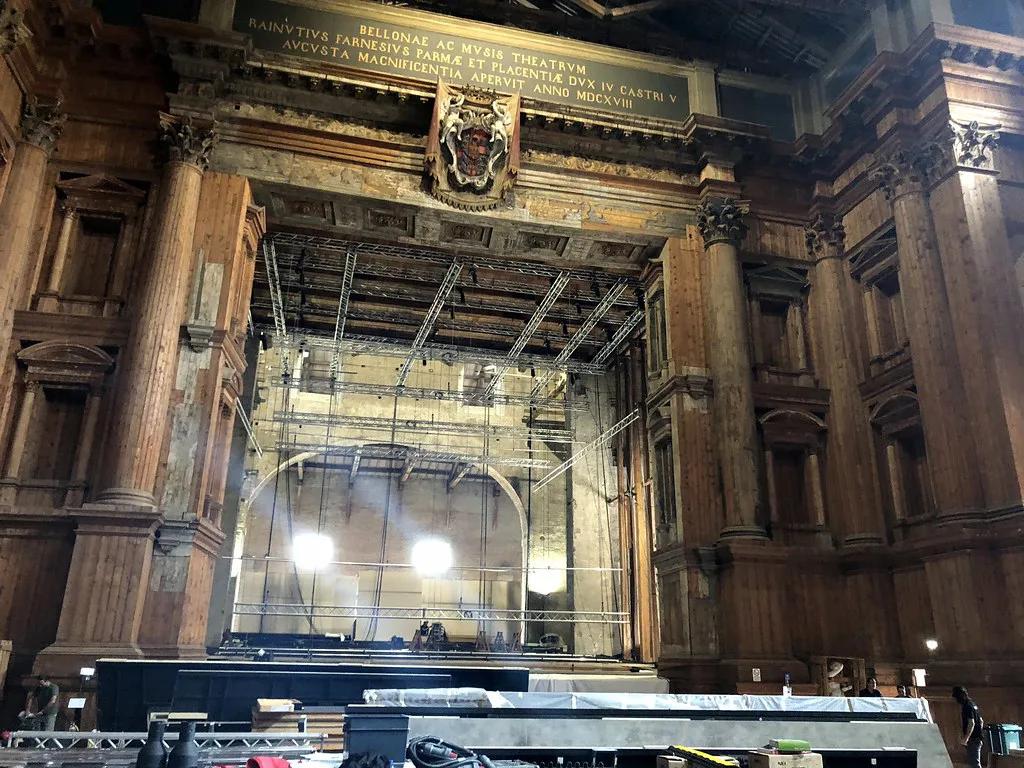
The first thing most visitors register is scale: a U-shaped stepped auditorium facing a permanent stage, built almost entirely of wood and finished with stucco and paint. One account describes Teatro Farnese as one of the first theatres designed with a fixed stage rather than a temporary, changeable one.
Look first at how the seating steps relate to the stage opening, then walk the perimeter to see how the auditorium is enclosed. The painted backdrop and the statues and paintings framing the stage are what create the theatre's sense of an open, painted world.
Sources disagree on capacity, with figures ranging roughly from 3,000 to 3,500 spectators. Rather than anchoring on one number, read the room for its proportions and the steepness of the steps.
Origins: Ranuccio I Farnese and Giovanni Battista Aleotti
The theatre was commissioned for Duke Ranuccio I Farnese and attributed to the architect Giovanni Battista Aleotti, with construction generally placed around 1617 to 1619. Sources vary slightly on the exact year, so treat the early seventeenth century as the reliable frame.
Aleotti's design is described as modelled on Palladio's Teatro Olimpico in Vicenza, which is why the room reads as a learned Renaissance interpretation of ancient Roman theatre. That lineage helps when you look at the stage opening and stepped seating: both are deliberate references, not only practical choices.
The theatre occupies a space in the Pilotta previously used as an armoury and for knightly tournaments, which helps explain the sheer size of the room. It also explains why the theatre feels embedded in a working palace rather than placed in a purpose-built opera house.
A Theatre That Was Barely Used
The elaborate stage machinery was costly enough that the theatre hosted very few performances, by one account no more than about a dozen, with a last performance in the early 1730s before it fell out of active use.
Hold that history in mind as you walk the auditorium: this was a court statement as much as a working playhouse. Its grandeur was partly the point, and its long silence is part of why the room survives in such legible form today.
Bombing and Reconstruction
Several accounts agree that the theatre was largely destroyed in the Second World War, with one source dating an Allied bombing raid to 1944. That wartime loss, rather than a single early fire, is the destruction story most sources foreground.
The theatre you see today is a twentieth-century reconstruction rather than an untouched original. Rebuilding followed the original design and used recovered material, with one overview placing its reopening in 1962 after the wartime loss.
The practical consequence for visitors is that you are looking at a careful re-creation, not a survival. That makes details such as the faux-marble surfaces and the timber joinery especially interesting: they show how the reconstruction read the original design.
Reading the Faux-Marble Wood
The structure is wood, but much of its surface is stucco painted to imitate marble, a technique that underlined the theatre's celebratory, ephemeral purpose. Instead of looking for stone, look for painted veins and surfaces that imitate stone at a glance but reveal timber at the edges.
That single viewing instruction changes how the room reads: the theatre was designed to impress for an occasion, not to last as masonry. Comparing painted surfaces with exposed structural wood shows the gap between theatrical effect and honest material.
Context Inside the Pilotta
The Pilotta is a complex, not a single gallery, so decide what you want from the same visit before you go in. Alongside the theatre you can plan time for the national gallery, the archaeological museum and the Palatine library, but confirm which of these share your ticket.
A sensible sequence is to see the theatre first while your attention is fresh, then move into the galleries and library. If you reverse the order, the theatre can feel like an afterthought at the end of a long museum visit, which undersells the room.
Time and Pacing
Allow roughly twenty to thirty minutes for the theatre itself if you want to read the room and look closely at the stage and surfaces. That is a suggested duration, not an official figure, and it assumes you are not attending a performance or guided talk.
For the whole Pilotta complex, plan closer to half a day if you intend to see the national gallery, the archaeological collections and the library as well. If your time in Parma is short, choose either the theatre plus one collection or the theatre plus a city walk rather than trying to do everything.
Nearby Pairings: Piazza Duomo and San Giovanni Evangelista
Piazza Duomo is a short walk from the Pilotta and holds the cathedral, the Baptistery of Parma and the Diocesan Museum, making it a natural second stop. The cathedral is free to enter, while the baptistery and diocesan museum are ticketed, so decide in advance which interiors you want.
San Giovanni Evangelista, directly behind the cathedral, holds Correggio's earlier dome and is free to enter, with separately managed cloisters and pharmacy. Pairing it with the cathedral makes a compact morning and gives you a second dome to compare with the cathedral's.
If you want to go beyond the obvious stops, the hidden gems in Parma guide helps you fit smaller churches and courtyards around the same route. Keep the theatre as the anchor and let the surrounding squares fill the rest of the day.
Practical Checks Before You Go
Opening hours for the theatre and the wider Pilotta are not consistently published across the sources reviewed here, so confirm them on the palace site before travelling. One third-party listing shows the complex closed on Mondays and open 09:00 to 19:00 other days, but treat that as a prompt to check rather than a confirmed schedule.
Ask about guided visits and any performances in the theatre when you book or arrive, because schedules and availability change. Do not assume a concert or tour will run on your dates, and do not rely on a past listing as proof that tickets are on sale.
Finally, verify ticket scope rather than assuming one admission covers every collection in the complex. That one check prevents the most common disappointment: arriving at the theatre and finding your ticket does not include the rooms you planned to see next.
What Not to Expect
Do not expect a separate single-site ticket for the theatre; it is visited as part of the Pilotta complex. Also do not expect a fixed capacity to be quoted at the door, since published figures vary between roughly 3,000 and 3,500.
It is also unwise to plan around the room being quiet or empty, since the theatre is one stop within a busy palace and visitor flow varies by season and time of day. Build flexibility into your timing rather than expecting a solitary experience.
Plan Your Visit
Teatro Farnese rewards a little preparation: know that you enter it through the Pilotta complex, check current ticket scope and hours on the palace site, and allow more time for the building than for the theatre alone. The wooden auditorium is the highlight, but the surrounding collections and nearby Piazza Duomo make the day.
If you are weighing other sights in the city, use the Parma attractions guide to compare options, and keep the theatre as a fixed point in a slow half-day rather than a rushed extra stop.
Frequently Asked Questions
Is Teatro Farnese inside Palazzo della Pilotta?
Yes. The theatre is housed within the Palazzo della Pilotta complex in central Parma; one listing gives the address as Piazza della Pilotta, 15. You enter it as part of a visit to the complex rather than through a separate theatre entrance.
Is the theatre original or rebuilt?
It is a reconstruction. Sources describe the theatre as largely destroyed in the Second World War and rebuilt in the twentieth century following the original design, using recovered material. The room you see today reflects that reconstruction rather than an untouched seventeenth-century interior.
Does one Pilotta ticket cover the theatre?
The theatre is visited within the Palazzo della Pilotta complex, but the exact current ticket scope is not confirmed in the operator text available here. Verify on the palace site before booking, and do not assume one admission automatically covers every collection in the building.
Can you see a concert or guided tour there?
The theatre has been used for performances and cultural events, but schedules and availability change. Ask about guided visits and any performances when you book or arrive, and do not rely on an old listing as confirmation that tickets are on sale for your dates.
How long should you spend at Teatro Farnese?
Allow roughly twenty to thirty minutes for the theatre itself as a suggested duration, and closer to half a day if you plan to see the wider Pilotta collections. These are planning estimates, not official figures, so adjust them to your pace.
Sources
- Teatro Farnese - One of the most beautiful wooden theatres in the world | Ita.travel
- Teatro Farnese Reviews | Tripexpert
- Casa Chiesi » Teatro Farnese: A special Theater in Parma
- Farnese Theater Tickets [2026] - Promos, Prices, Reviews & Opening Hours | Trip.com
- Official event website
- San Giovanni Evangelista, Parma: Correggio's Other Dome
- The Cathedral of Parma: Between Romanesque and Renaissance | Vivere in Italien
Continue exploring
More guides you'll find useful