
Galleria Nazionale di Parma: Pilotta Guide
A practical guide to Parma's Galleria Nazionale inside Palazzo della Pilotta: what the collection holds, how long to allow, and what to confirm before you go.
On this page
The Galleria Nazionale is the picture gallery at the heart of Parma's Palazzo della Pilotta, an unfinished Farnese palace that also shelters a historic library, a wooden theatre and an archaeology museum. For a visitor, the practical question is not whether to go but how to sequence it: which rooms to prioritise, what sits next door, and how much of the day the complex will absorb. An Artsupp listing reports the gallery open Tuesday to Sunday from 10:30 to 19:00, with last entry at 18:00, closed on Mondays and on 25 December; that is a third-party listing, so confirm on the operator's own site before travelling.
What the Galleria Nazionale Is and Why It Anchors a Parma Art Day
The gallery's roots lie in the ducal collecting of the Farnese and Bourbon courts and in the Academy of Fine Arts founded in Parma in 1752, whose student works and prize paintings fed into the collection. Later, Maria Luigia of Austria commissioned a new display that gave prominence to Correggio's large altarpieces. The result is a gallery that reads as a portrait of a small ducal capital rather than a survey of all European painting.
That history matters for pacing. The collection rewards close looking at a modest number of rooms rather than a march past famous names, and it sits within a complex where three other collections compete for the same hours. If you want Parma's art in context, start here and let the cathedral and the church of San Giovanni Evangelista follow, because the gallery's painted altarpieces and the city's frescoed domes tell one continuous story.
Where It Is: Piazzale della Pilotta 15 and the Palace Around It
The gallery is listed at Piazzale della Pilotta 15, inside the Palazzo della Pilotta. The palace takes up a large area between Piazza Duomo and the Ponte Verdi bridge, so you can walk from the cathedral square to its courtyards in a few minutes rather than treating the two as separate excursions.
The name Pilotta comes from pelota, the ball game Spanish soldiers played in one of the courtyards in the sixteenth century. Construction began modestly in 1580 and sprawled over the following two and a half centuries, and parts of the complex were destroyed in 1944 air raids. Knowing this helps you read the building: it is a layered, partly unfinished shell rather than a single coherent museum block, which is exactly why its collections remain separate rather than seamless.
What Hangs Here: The Ducal Legacy
Begin with the Correggio connection, because it is the thread that ties the gallery to the rest of the city. The gallery holds major altarpieces by Correggio, and the ducal display was designed around them after they returned from Napoleonic expropriation. That return shaped the modern hang: large religious panels were given room to be seen as paintings rather than as church furniture.
Among the works visitors most often single out is the unfinished head known as La Scapigliata, attributed to Leonardo da Vinci. Treat the attribution as the gallery frames it, an attribution rather than a signed certainty, and give it time rather than a glance. Canaletto's capriccio with Palladian buildings is another rewarding stop, showing a Rialto Bridge design that was never built.
Parmigianino is best seen in the city's churches, but the gallery provides the broader frame for the school that grew around him. Use the gallery to learn the names, then go and see the frescoes in situ. This is the most useful way to make the collection feel alive rather than dutiful.
Layout and the Rest of the Pilotta Complex
Treat the Pilotta as several collections under one roof rather than one museum. Alongside the Galleria Nazionale you will find the Palatina Library, the National Archaeological Museum, the Bodoni Museum and the Teatro Farnese. The library, originally intended as a public library, holds more than 708,000 printed works, including early parchment Gospel manuscripts. Plan which of these you actually want, because trying to see all of them well in one push rarely works.
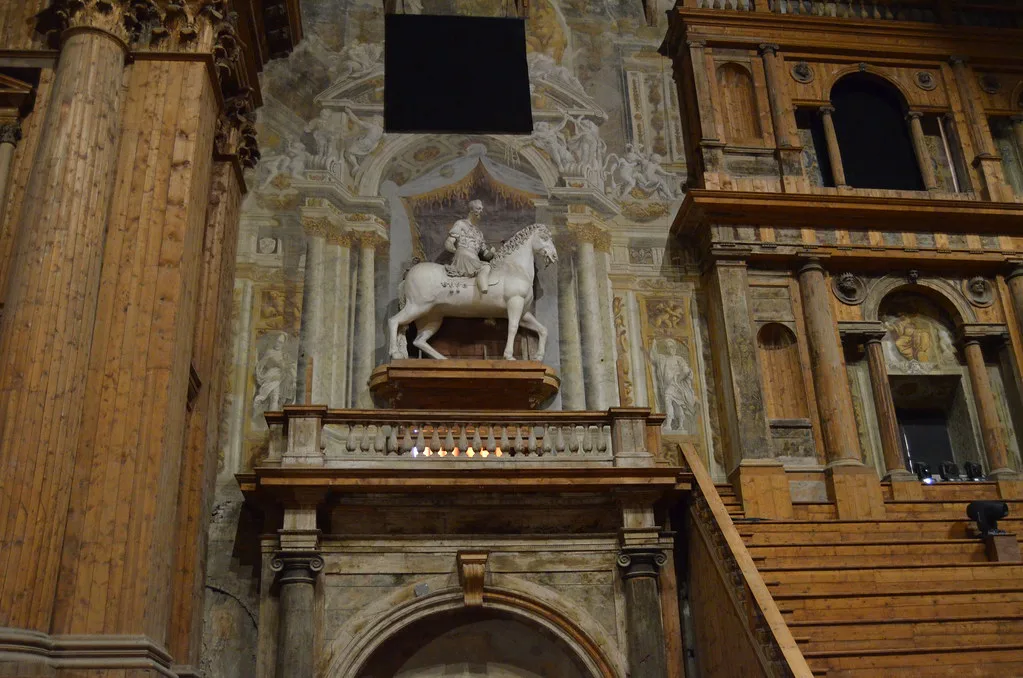
The Teatro Farnese is the complex's showstopper for many visitors: a vast wooden auditorium built from 1618 for Duke Ranuccio Farnese, badly damaged in the Second World War and later restored. It sits inside the same palace, which makes a short theatre stop an easy addition to a gallery visit rather than a separate trip. Give it twenty to thirty minutes and let the gallery carry the longer stretch.
Tickets and Opening Pattern: What to Verify Before You Go
An Artsupp listing reports the gallery opening Tuesday to Sunday from 10:30 to 19:00, with last entry at 18:00, closed on Mondays and on 25 December. That is a third-party listing rather than the operator's own page, so confirm the current pattern on the official Palazzo della Pilotta site before you build a day around it. Monday closures are the most common trip-wrecker in Parma, and a public holiday can shift things again.
On ticket scope, be careful. Sources report various arrangements over the years, and a figure quoted in an older account is out of date. Do not assume that one ticket automatically covers the gallery, the theatre, the library and the archaeological museum. Check the official ticket page for what each option includes, the current price and any reduced categories, and buy on the operator's terms rather than a reseller's description.
How Much Time to Allow, and How to Sequence the Visit
As an editorial suggestion rather than official guidance, allow about two hours for the gallery and a further hour for the Teatro Farnese and a quick look at the palace courtyards. If you add the archaeological museum or the library, budget the better part of a day. The complex rewards a slower pace: one strong collection seen properly beats three seen through doorways.
A workable order is gallery first, theatre second, then out into the city. That sequence puts the paintings before the architecture and leaves you free to walk to Piazza Duomo while your attention is still fresh. If you arrive late in the day, reverse it: see the theatre first, since it takes little time, then give the gallery whatever remains before last entry.
Pairings Nearby: Churches, Domes and a Ducal Museum
Parma Cathedral on Piazza Duomo is free to enter, while the baptistery and diocesan museum are ticketed, so the square offers both a no-cost stop and a paid one. The cathedral holds Correggio's Assumption in its dome, painted after he had worked out the method elsewhere. Check the cathedral's own opening arrangements before you go, since visits pause during services.
San Giovanni Evangelista, directly behind the cathedral, holds Correggio's earlier dome, the Vision of St John on Patmos, painted in the early 1520s before the cathedral fresco. The church is free and takes about forty minutes; the cloisters and the sixteenth-century Spezieria, a preserved monastic pharmacy, are managed separately and keep their own hours, so ask inside rather than assuming. Seeing this dome before the cathedral's makes both easier to read.
For the ducal world behind the gallery's paintings, the Museo Glauco Lombardi in Palazzo di Riserva collects objects tied to Maria Luigia and the Bourbon period, including her fortepiano and an 1812 portrait by Lefèvre. It opened in its current home in 1961, after the collector's earlier display at Colorno. It is a compact, focused counterpoint to the Pilotta's scale.
If the baptistery draws you, note that the octagonal pink Verona marble building begun in 1196 is one of the city's most photographed interiors and is often busy at midday. If you would rather spread your attention across quieter corners of the city between museum stops, the hidden gems in Parma are worth planning into the same afternoon rather than saved for a separate trip.
Mistakes to Avoid on a Pilotta Visit
The three common errors are assuming Monday opening, assuming one ticket covers everything, and arriving without a plan for the complex's several collections. Each is easily fixed by checking the operator's site the day before and writing down which two collections you actually want. A printed or saved copy of the plan helps, since mobile reception inside thick palace walls can be patchy.
A fourth mistake is treating the gallery as a rainy-day filler. It holds the paintings that explain the rest of Parma's art, and it deserves a slot in the itinerary rather than the leftover hour. Bookend it with the cathedral and San Giovanni Evangelista, and the city's Correggio story will make sense in a single day.
Plan Your Visit
The Galleria Nazionale rewards preparation more than spontaneity. Confirm the day's opening on the official Pilotta channels, check what your ticket actually includes, and decide in advance whether you are there for the paintings alone or for the theatre and library too. Then walk out into Piazza Duomo and let the domes finish the story the gallery began.
Frequently Asked Questions
Is the Galleria Nazionale in Parma open on Mondays?
An Artsupp listing reports the gallery closed on Mondays, with Tuesday to Sunday hours of 10:30 to 19:00 and last entry at 18:00, and closure on 25 December. That is a third-party listing, not the operator's own page, so check the official Palazzo della Pilotta site before you travel, particularly around public holidays.
Does one ticket cover the gallery, the Farnese Theatre and the archaeological museum?
Do not assume so. Ticket arrangements have changed over time and older accounts quote figures and inclusions that are no longer reliable. Check the official Pilotta ticket page for what each option covers, what it costs and which reductions apply before you buy.
What are the highlights of Parma's National Gallery?
Look for Correggio's large altarpieces, central to the ducal display, and the unfinished head known as La Scapigliata, attributed to Leonardo da Vinci. Canaletto's capriccio with Palladian buildings is another rewarding stop. Parmigianino's frescoes are best seen in the city's churches, which is why the gallery pairs so well with San Giovanni Evangelista.
Is the cathedral free while the gallery is ticketed?
Parma Cathedral is free to enter, while the baptistery and diocesan museum are ticketed and sold as a combination. The Galleria Nazionale is a ticketed museum and should be planned and budgeted separately. Check each site's own page for current conditions, since access rules can change.
How long should I allow for the gallery and the Pilotta complex?
As an editorial suggestion, allow about two hours for the gallery and another hour for the Teatro Farnese and the courtyards. Adding the archaeological museum or the library can fill most of a day. These are planning estimates, not official visiting times.
Where exactly is the Galleria Nazionale?
It is inside the Palazzo della Pilotta at Piazzale della Pilotta 15, in central Parma. The palace sits between Piazza Duomo and the Ponte Verdi bridge, so you can walk from the cathedral square in a few minutes. The same complex houses the Palatina Library, the Teatro Farnese, the National Archaeological Museum and the Bodoni Museum.
Sources
- National Gallery, Parma | Hours, exhibitions and artworks on Artsupp
- Parma’s Palazzo della Pilotta – Italian Reflections
- San Giovanni Evangelista, Parma: Correggio's Other Dome
- The Glauco Lombardi Museum - napoleon.org
- Piazza Duomo Parma - Cathedral, Baptistery, Bishop's palace
- The Cathedral of Parma: Between Romanesque and Renaissance | Vivere in Italien
- Teatro Farnese - One of the most beautiful wooden theatres in the world | Ita.travel
Continue exploring
More guides you'll find useful





