Parma Cathedral Visitor Guide: Correggio's Dome and Antelami
Plan a visit to Parma Cathedral: free entry, Correggio's dome fresco and Antelami's Deposition relief, plus the ticketed Baptistery next door on Piazza Duomo.
On this page
Piazza Duomo packs an unusual amount of art into one small square. The cathedral is free to enter, while the pink marble Baptistery a few steps away is ticketed, often with a combination that also covers the diocesan museum, so it helps to know which door takes money and which does not.
Most visitors come for two works: the dome fresco Correggio painted in the 1520s and Benedetto Antelami's Deposition relief from 1178. Both sit inside an otherwise Romanesque church consecrated in 1106, which is why the building reads as a northern Italian medieval shell layered with Renaissance colour.
Allow roughly an hour inside the cathedral as a comfortable suggestion, then decide separately whether the Baptistery earns another forty minutes. Everything here is walkable and compact, which makes Parma Attractions easy to plan without transport.
Why Parma Cathedral Matters
The present cathedral replaced an earlier church destroyed by fire, with construction starting in the 11th century and consecration following in 1106. A powerful earthquake in 1117 damaged the new building, and consolidation work continued into the mid-12th century, which helps explain the sober, heavy Romanesque character of the exterior and nave.
Look at the facade before going in: a gabled front divided by horizontal bands, arcades and sculptural ornament, in light stone. Emilia Romagna Welcome describes the cathedral as a supreme example of Romanesque style in the Po valley, a fair summary of why architecture-minded visitors treat the square as a destination rather than a pass-through.
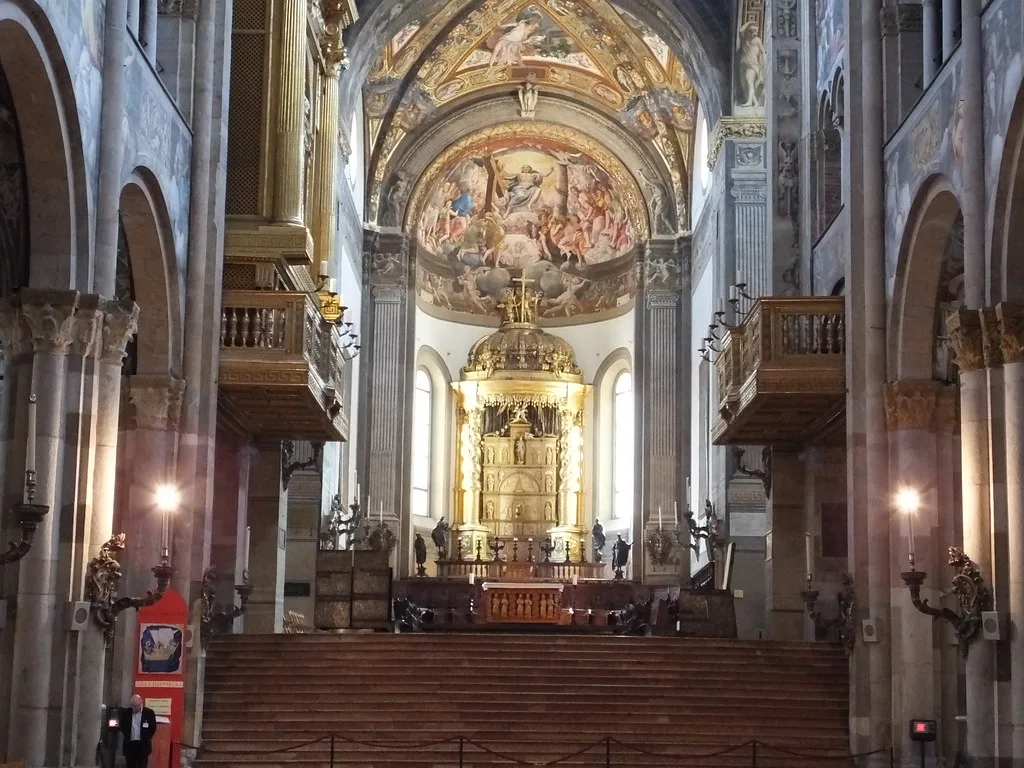
Inside, the surprise is the layering. The three-aisled Romanesque space was later covered with 16th-century fresco cycles along the nave, so the interior feels busier and more colourful than the severe shell outside promises. Give the nave a few minutes before heading for the dome, because the contrast is the point.
Correggio's Assumption: in the Dome, Not the Apse
One common error places Correggio's Assumption in the apse. It is painted inside the crossing dome, and you view it by standing beneath the cupola and looking straight up. The commission was awarded in 1522 and the fresco is generally dated to the 1520s and early 1530s.
The composition is built for that upward view: apostles at the base, clouds and circling figures above, the Virgin rising toward the centre, and architecture dissolved by paint so the dome seems to open. Lonely Planet calls it a kaleidoscopic swirl of cherubs and whirling angels, which is close to what your neck tells you after a minute.
Practical tip: give your eyes time to adjust to the low light, then walk slowly around the crossing rather than standing in one spot. The foreshortening shifts with your position, and details that look like noise from directly below resolve once you move. Binoculars help if you want to study faces near the top of the cupola.
If you can, see San Giovanni Evangelista first. Correggio painted its smaller dome, the Vision of St John on Patmos, in the early 1520s before starting the cathedral Assumption, and seeing the quieter version first makes the scale of the later fresco much easier to read.
Antelami's Deposition and the Gilded Pulpit
In the southern transept hangs Benedetto Antelami's Deposition, a relief of 1178 considered a masterpiece of its type. Its carved figures are restrained and vertical where Correggio is swirling, so the two works reward being seen a few minutes apart rather than as a checklist.
The cathedral interior also holds a gilded pulpit and ornate lamp-holders that strike many visitors as unexpectedly baroque inside a Romanesque church. Note the distinction: the pulpit is described in visitor sources, but none of them attributes it to Antelami, so treat any claim of his authorship with caution until you see it confirmed on site.
Antelami's presence in Parma is broader than this one relief. He was commissioned in 1196 to build the Baptistery next door and carved its portals himself, which makes the square a compact Antelami trail: relief inside the cathedral, building and sculpture outside.
Reading the Nave and Crypt Without Rushing
The nave frescoes cover scenes from the life of Christ in a busy, almost narrative sequence, with painted prophets perched under the murals. Rather than trying to identify every panel, pick two or three and look at how the figures are staged, then move on before fresco fatigue sets in.
The crypt below is easy to overlook and worth a short detour, since it is often quieter than the nave above. Treat it as a place to slow down rather than a tick-box stop, and keep your voice low if services or private prayer are underway.
A literary footnote for the square: the medieval chronicler Fra Salimbene de Adam was born at Strada al Duomo 7, where a plaque marks the site, and was baptised in 1221 in the Baptistery. It is a small detail that ties the buildings to a named person rather than an abstract art history.
Free Cathedral, Ticketed Baptistery and Museum
Entry to the cathedral itself is free, and SmartGuide lists daily windows of 9am to 12.30pm and 3pm to 7pm, though hours can change and should be confirmed before you travel. If you are planning the day around a single opening, check the Piazza Duomo site the week you go rather than relying on a blog.
The Baptistery is a separate, ticketed monument, unlike the free cathedral, and its ticket is often sold together with the diocesan museum on the same piazza. Do not assume the cathedral's free entry extends next door, and buy the combination at the museum ticket desk rather than expecting to walk in.
Ticket prices and any reductions change, and published figures do not always agree, so read the fare at the desk or on the official booking page before paying. The Fabbriceria publishes visiting passes and hours for the cathedral, Baptistery, museum and bishop's palace as one square-wide system.
Suggested Time and a Slow Morning
Plan roughly an hour for the cathedral if you want the dome, the Deposition and the nave without hurry, and add about forty minutes for the Baptistery, whose painted sixteen-sided vault and carved months cycle reward a slow circuit. These are suggestions, not official timings.
A sensible order is San Giovanni Evangelista first, then the cathedral, then the Baptistery, because the three sit within a couple of minutes of each other and the art builds in scale. San Giovanni's church is free, with cloisters and a historic pharmacy managed separately and sometimes restricted, so ask inside if you want to see them.
If you only have an hour in Parma, choose the cathedral dome over everything else. If you have a morning, add the Baptistery; if you have a day, continue to the Pilotta. The hidden gems in Parma guide covers the quieter corners worth folding into the same walk.
Dress, Services and Quiet Etiquette
The cathedral is an active place of worship, so cover shoulders and knees and keep voices low, especially near the altar and crypt. No official dress code is published for visitors, so treat this as ordinary courtesy in an Italian church rather than a stated rule you can look up.
Visits are suspended during services, which is the main practical reason to check timing before you set out. If you arrive and find the doors busy with a congregation, wait on the piazza and look at the facade instead of slipping in.
Photography inside is generally tolerated without flash, but follow any posted signs and step aside from anyone praying. The Baptistery, being ticketed, has its own rules set by the operator rather than the cathedral.
Where to Go Next on Piazza Duomo and Beyond
The Palazzo della Pilotta holds the national gallery, archaeological museum, Palatine library and the wooden Teatro Farnese, and a single ticket covers several of those collections, so budget half a day if you want the whole complex.
The Teatro Farnese was built in 1618 for the Farnese court, destroyed by Allied bombing in 1944 and rebuilt from its own fragments, reopening in 1962. It is a short walk from the cathedral and pairs naturally with a Piazza Duomo morning.
For a change of register, the Museo Glauco Lombardi in Palazzo di Riserva holds Marie-Louise's possessions, including portraits, the imperial wedding gift and her fortepiano. It is a smaller, quieter collection and a good afternoon counterweight to church interiors.
Piazza Garibaldi, a short walk away on the old Roman crossroads, is the place to end with coffee or an aperitivo and watch the evening passeggiata. Parma Attractions lists the wider set of sights if you want to extend beyond the cathedral square.
Plan Your Visit
Build the day around one fixed point: the cathedral is free and open in defined windows, while the Baptistery and diocesan museum are ticketed with their own hours. Confirm both on the Piazza Duomo site before you go, because hours and visiting passes change.
Go early, look up slowly, and save the Baptistery for after the dome so the two Correggio ceilings land in the right order. The result is a half-day in Parma that feels unhurried and honest about what you actually see.
Frequently Asked Questions
Is Parma Cathedral free to enter?
Yes. The cathedral itself has free entry, while the Baptistery next door and the diocesan museum are ticketed and often sold together. Do not assume one ticket covers the whole square.
Where is Correggio's Assumption fresco?
It is painted inside the crossing dome of Parma Cathedral, not in the apse. Stand beneath the cupola, let your eyes adjust, and move around the crossing to see how the foreshortening shifts.
What did Antelami sculpt in Parma Cathedral?
The Deposition relief of 1178 in the southern transept is the work associated with him there. The cathedral's gilded pulpit is described in visitor sources, but none attributes it to Antelami.
How long should I spend in Parma Cathedral?
An hour is a comfortable suggestion for the dome, the Deposition and the nave, and about forty minutes more for the Baptistery. These are planning suggestions, not official guidance.
Is the Baptistery included with the cathedral?
No. The cathedral is free, while the Baptistery is a separate ticketed monument, usually combined with the diocesan museum. Check the current fare at the ticket desk or the official booking page.
What else should I see near Parma Cathedral?
San Giovanni Evangelista, directly behind the cathedral, holds Correggio's earlier dome and is free to enter. Further afield, the Palazzo della Pilotta and its Teatro Farnese make a strong afternoon.
Sources
- The sights of Parma | Emilia Romagna Welcome
- Parma Baptistery: Antelami's Pink Octagon and What Is Inside
- Audio guide for Parma Cathedral, Parma | SmartGuide
- Cattedrale di Santa Maria Assunta | Parma, Italy | Attractions - Lonely Planet
- Julian Porter, Q.C. » Parma Cathedral
- San Giovanni Evangelista, Parma: Correggio's Other Dome
- Literary itinerary in Parma and surrounding areas | Visit Emilia
- The Glauco Lombardi Museum - napoleon.org
- Piazza Duomo Parma - Cathedral, Baptistery, Bishop's palace
- The Cathedral of Parma: Between Romanesque and Renaissance | Vivere in Italien
- Teatro Farnese - One of the most beautiful wooden theatres in the world | Ita.travel
Continue exploring
More guides you'll find useful