Parma Baptistery Visitor Guide: What to See and How Tickets Work
Plan a visit to Parma's pink Verona marble Baptistery: Antelami's carved portals, the painted interior, how the combined pass works and a suggested visit time.
On this page
The Baptistery of San Giovanni Battista is the building that tells you where you are in Parma. Its octagonal shell of pink Verona marble, running across four levels of open loggias with eight turrets around a central dome, stands on Piazza Duomo beside the cathedral, and it is the first thing most visitors photograph. The practical detail to plan around is that the Baptistery is a ticketed building while the cathedral next door is free, and its hours and visiting passes are published by the square's operator rather than fixed all year.
Allow about forty minutes for the interior and the exterior portals, longer if you want to study every carved panel. That figure is a working suggestion for pacing your morning, not a published visiting time. Check the operator's opening hours page before you leave your hotel, because restoration work and religious services can change access at short notice.
Where the Baptistery Sits on Piazza Duomo
The Baptistery occupies the east side of Piazza Duomo, in the historic centre of Parma, in the Emilia-Romagna region. The cathedral, dedicated to Santa Maria Assunta, faces it across the same small square, and the Diocesan Museum and the church of San Giovanni Evangelista are both within a couple of minutes' walk. The address published for the Baptistery and the cathedral complex is Piazza Duomo 7.
The square is compact, and once you arrive everything on it is visible in one glance. Treat the Baptistery, the cathedral and the Diocesan Museum as three separate stops that happen to share a paving stone, each with its own entry arrangement.
The History of the Pink Marble Octagon
Construction started in 1196 under the architect and sculptor Benedetto Antelami, with local citizens donating stones for the foundation, and the work stretched over decades. That long campaign is why the building reads as Romanesque in structure but gains Gothic detail in the upper levels: four tiers of open loggias and eight turrets create a strong vertical rhythm around the dome.
The name is not decorative. The Baptistery is the place where the sacrament was performed by immersion from the thirteenth century, a practice that was already unusual in medieval Italy. The font sits at the centre of the interior, an arrangement that shapes how you walk through the building: you circle rather than proceed in a straight line.
Official tourism material for the city places the Baptistery within a walking itinerary of central Parma that begins at Piazza Duomo, noting that the medieval chronicler Salimbene de Adam was baptised here in 1221. That link matters less for the visitor than the physical building, but it explains why guides treat the square as the start of the city's history. Further visitor details appear in Literary itinerary in Parma and surrounding areas | Visit Emilia.
Antelami's Sculpture: What to Read on the Portals
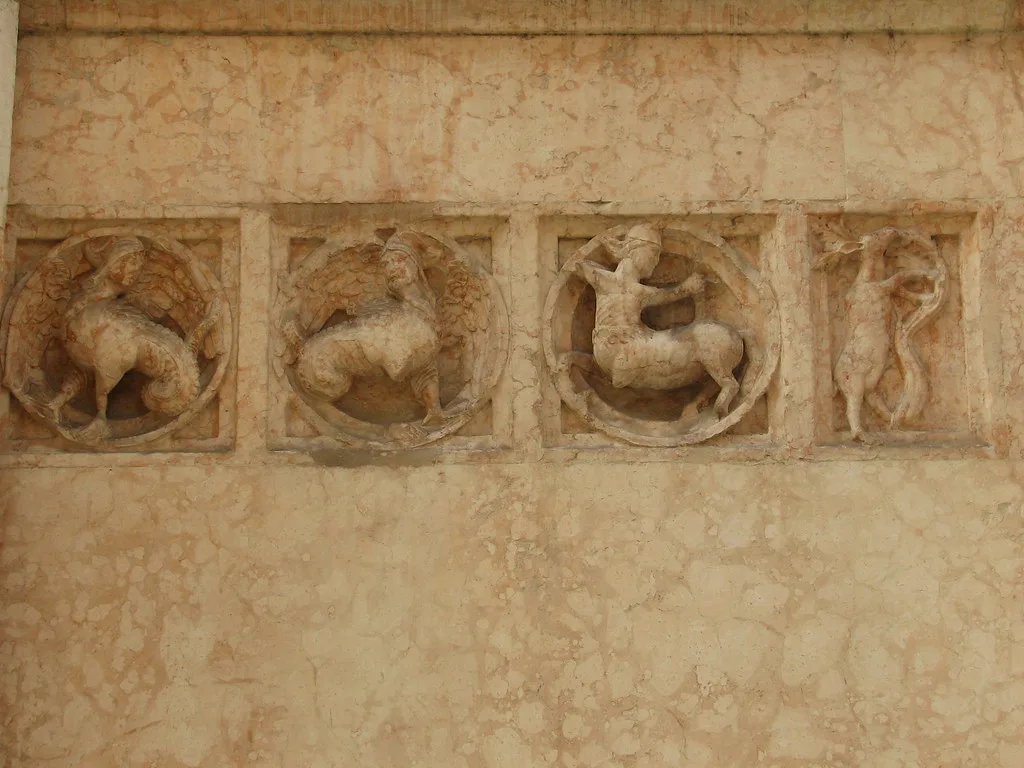
Start outside. The reliefs on the outer walls show sea creatures and mythological figures alongside religious subjects, and the carving reveals how medieval artists connected the natural world with theological ideas. The so-called Portal of Life carries a lunette sculpture of a man eating honey in a tree, an unusual motif that links natural and spiritual nourishment in a single image.
The main entrance faces north and is framed by a tympanum and further decoration; the westward doorway is similarly ornate, while the rear entrance is plainer. Walk a full circuit before going in, because the most rewarding details sit at shoulder height and below eye level where you would not naturally look. This is sculpture that rewards slow looking rather than wide-angle photography.
Inside, a series of statues along the walls depicts the seasons of winter and summer and all the months of the year, so look for a carved calendar as you move around the room. Travel accounts of the building also note the sixteen wall panels and the painted triangular panels in the dome, which together make the interior richer than its plain exterior suggests.
Inside: Vaults, Frescoes and the Pool
Inside, the octagonal exterior opens into a sixteen-sided room with the baptismal font at its centre and a fresco on each wall panel. The ceiling carries a series of sixteen triangular paintings in the dome, so the single best thing you can do is stop and look up before you walk a circuit. Allow time for your eyes to adjust in the dimmer interior before reading the lower panels.
Access to the interior is through an outdoor stairway leading directly to the main door, which is also where you see the carved portals at close range. AroundUs lists the building as having limited wheelchair access, but that is an aggregator rather than an operator rule; ask the custodians on the square about the current entrance route if step-free access matters to you.
One practical reminder: search results sometimes confuse this Baptistery with the cathedral of Palma de Mallorca, which is a much larger Gothic building with a completely different ticketing setup. If a page describes an enormous cathedral with Gaudí interiors, you are on the wrong island; the Parma building is an octagon of a few dozen metres in any direction.
Tickets: What the Combined Pass Covers and What It Does Not
The most important rule for budgeting is this: the cathedral is free to enter, and the Baptistery is a separate ticketed building. The Baptistery is normally visited on a pass that also covers the Diocesan Museum Benedetto Antelami, which sits in the same square complex. Do not assume the cathedral, the Baptistery and the museum share one ticket, because they do not.
Pricing and pass scope change, so we do not publish a current figure here. Check the operator's own opening hours and visiting passes page, which is the source of truth for what your money covers on the day you visit. If a website quotes an old figure, treat it as history rather than a price.
A guided tour is a reasonable alternative if you would rather have the sculpture explained. One local operator runs a two-hour walking tour of the centre that includes the exterior of the Baptistery and entrance to the Cathedral and the church of Saint John the Evangelist, with a reservation required and a minimum number of participants before it runs. Read the inclusions carefully, because a city walking tour may cover the Baptistery exterior rather than admission inside it.
The Rest of the Piazza Duomo Ensemble
The cathedral next door is the essential comparison, and it is free. Its Romanesque nave carries later fresco cycles, and the treasure is the crossing dome by Correggio, the Assumption, painted in the 1520s and influential enough to be treated as a turning point in European ceiling painting. Because it costs nothing, it is the sensible place to start.
Then a two-minute walk brings you to the church of San Giovanni Evangelista, directly behind the cathedral. It holds Correggio's earlier dome, the Vision of St John on Patmos, painted in the early 1520s, plus frescoes by Parmigianino in the left aisle when he was still in his teens. The church itself is free, though the cloisters and the historic pharmacy at the end of one cloister are managed separately, so ask inside rather than assuming they are open.
If you have time left on the same morning, walk to the Palazzo della Pilotta and the wooden Teatro Farnese inside it. That is a separate ticket again, and an entirely different kind of visit; do not fold it into the Piazza Duomo pass in your head. The city rewards you for separating these experiences rather than buying one mega pass.
How Long to Allow and the Best Order
A realistic working budget for the square is about two hours: forty minutes for the Baptistery, forty for the cathedral and its dome, and forty for a wander across the square and a pause at a café. That is a suggestion, not a published rule. If you only have half an hour, do the cathedral first and look at the Baptistery portals from the square even if you do not buy a pass.
See the cathedral first, then the Baptistery. Doing it the other way round means the free cathedral can feel like an anticlimax, whereas the sequence lets you absorb the free barrel-vaulted interior and then pay attention to what the ticket actually buys: a sculpted façade, a painted dome and a museum collection next door. Save San Giovanni Evangelista for last, since its quieter Correggio dome makes more sense after the cathedral.
If you are building a slower day, pair the square with a walk through the less-visited corners of the centre. Our guide to hidden gems in Parma suggests the quieter churches and courtyards that fit naturally around a morning at Piazza Duomo.
Practical Tips for the Visit
Check the operator's page on the morning of your visit rather than the night before, since services can suspend visits with no advanced notice. The cathedral's own visiting window and suspension rules are published on the same site, but the Baptistery's pass system is managed separately and should be confirmed on site. If the building is closed, the exterior and the portal carvings are always visible from the square.
Dress for a working church rather than a museum, with covered shoulders and knees, and carry a scarf in summer. The marble floor and vaulted interior stay cool even in August, which makes the Baptistery a sensible stop in the hottest part of the day. A small bag is easier than a backpack on the stairway entrance.
If you are in Parma mainly for the food, do not skip the square. A cheese and ham tasting elsewhere in the city is not a substitute for an hour among Antelami's carvings, and the two combine well into a slow day. The same logic applies to the city's less famous corners, which are best treated as time-fillers between the major sights rather than alternatives to them.
Plan Your Visit
The Baptistery is the rare Italian monument where the sculpture, not the scale or the fame, is the reason to buy the ticket. Its pink marble octagon, the portal reliefs and the painted vaults reward slow attention in a way that a large cathedral rarely does. Budget forty minutes, go after the cathedral, and confirm the pass and hours before you arrive.
For everything else in the city, the Parma Attractions hub links the individual guides and keeps ticket scope straight between the free churches and the paid complexes. If you want to build a longer itinerary around the square, start there and use the Baptistery as your anchor.
Frequently Asked Questions
Do I need a separate ticket for the Parma Baptistery?
Yes. The Baptistery is ticketed, while the cathedral next door is free to enter. The Baptistery is normally visited on a pass that also covers the Diocesan Museum Benedetto Antelami in the same square complex, and that pass does not include the cathedral. Check the operator's own page for the current scope of the pass before you travel.
Is the Cathedral of Parma free to enter?
The cathedral is free, which is why most visitors go there first and save the Baptistery for after. The cathedral holds Correggio's dome fresco of the Assumption and Antelami's Deposition relief. Confirm the current opening window on the operator's page, since visits can be suspended during services.
How long should I allow for the Baptistery?
About forty minutes for the exterior and the interior is a reasonable working figure, and longer if you want to study the portal carvings and the seasonal statues. It is a suggestion for pacing, not a published visiting time. If you also plan to see the cathedral and San Giovanni Evangelista, allow two hours for the area around Piazza Duomo.
Should I see the Baptistery or the cathedral first?
The cathedral first. It is free, it holds the public headline frescoes, and it gives you a baseline for what the Baptistery ticket then buys. Finish with San Giovanni Evangelista behind the cathedral, where Correggio's quieter dome and Parmigianino's early frescoes make more sense once you have seen the larger versions.
What should I look at on the outside of the Baptistery?
The sculpted portals are the main event. The reliefs include sea creatures and mythological figures alongside religious subjects, plus a lunette sculpture of a man eating honey in a tree on the Portal of Life. The main entrance faces north and is framed by a carved tympanum, while the rear entrance is plainer. Walk a full circuit before going in.
Sources
- Baptistery of Parma - Religious baptistery in Parma, Italy
- Discover Parma | Visit to the city and its masterpieces | Artemilia
- Parma, Italy – Other Distractions – Tickets For Two Plus Baggage
- San Giovanni Evangelista, Parma: Correggio's Other Dome
- Literary itinerary in Parma and surrounding areas | Visit Emilia
- Piazza Duomo Parma - Cathedral, Baptistery, Bishop's palace
- The Cathedral of Parma: Between Romanesque and Renaissance | Vivere in Italien
Continue exploring
More guides you'll find useful