Torre dell'Orologio, Padua: Clock Tower Visitor Guide
Plan a visit to Padua's Torre dell'Orologio in Piazza dei Signori, home to a 1344 astronomical clock, with email booking and seasonal tour times.
On this page
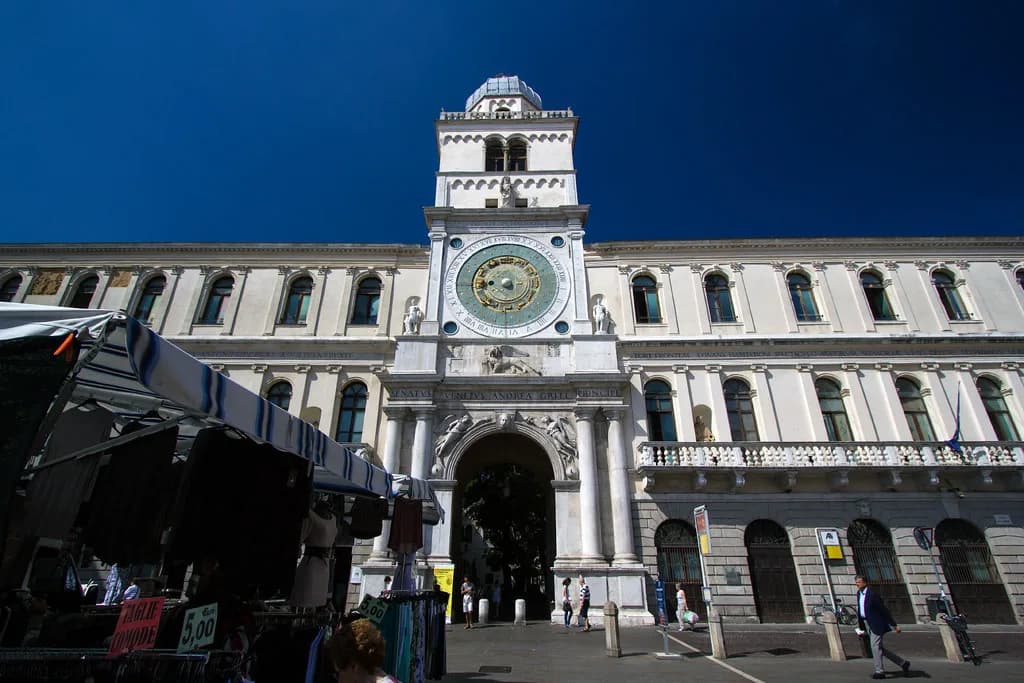
Padua's Torre dell'Orologio stands at the edge of Piazza dei Signori, a short walk from the city's better-known fresco sites. Its astronomical clock was built in 1344 by Jacopo Dondi of Chioggia, and the city's tourism office describes it as the oldest functioning astronomical clock still in its original tower. That claim is narrower than it sounds, so read it precisely.
The tower is not a monument you can wander into at will. The city's tourism listing states that visits are by reservation only, arranged by email through Legambiente Padova, and that published guided-visit slots follow separate winter and summer timetables. Treat those as a starting point, not a guarantee: schedules and access terms can change, so reconfirm with the operator before you build a day around a visit.
What It Is and Where It Stands
This clock tower is in Padua, on Piazza dei Signori, not in Venice and not in Bologna. Its lower floors hold the clock mechanism, while the upper two floors once housed the Master Clocksmith responsible for maintaining the astronomical clock, according to the city's tourism office. That arrangement reflects how closely the instrument was watched over.
The same name appears elsewhere in Italy, which causes real confusion in search results. Venice's Torre dell'Orologio rises over Piazza San Marco at the entrance to the Merceria, and Bologna has a clock tower in Palazzo d'Accursio. If you are looking for either of those, this is the wrong guide; check which piazza you actually plan to stand in.
The Astronomical Clock Explained
The dial is built as concentric bands. The outer ring carries the hours in Roman numerals, a middle band of lead sheets is decorated with copper stars, the next band shows the zodiac reliefs, and the planet Earth sits at the very centre. Once you see the layers, the face stops looking like a clock and starts reading like a diagram of a universe, which is exactly what it was meant to do.
The clock follows Ptolemy's geocentric model, with the movements of the planets plotted around an Earth at the centre. One detail rewards a second look: the zodiac sign of Libra is missing. Dondi worked from Roman accounts in which Scorpio occupied two months, its body and its tail, and the association of that tail section with Libra came later.
Inside the Tower: Five Floors and a Clocksmith's Quarters
The tower measures roughly thirty metres across five floors. The lower three contain the clock mechanism, including a so-called bird-cage movement with two separate trains, one for keeping time and one for chiming. The upper two floors held the accommodation of the clocksmith, whose job was to keep the astronomical clock running.
The guided visit is your only route inside, and it is worth knowing what the sources do not say before you book. The city listing describes the floors and the mechanism but does not describe a climbable panoramic terrace or a city view from the tower, so do not choose this visit expecting one. Ask the operator directly if a view matters to you.
How the Reservation System Works
Booking is not handled through a ticketing platform. The tourism listing gives an email address for reservations through Legambiente Padova, and describes entrance as free with obligatory booking. Reach out early, state your preferred date and ask which language the tour will run in, since the listing does not spell out languages or group sizes for this tower.
Walk-in entry is not something to plan around. Because visits run on a reservation system tied to fixed slots, turning up without a confirmed place risks finding no room available for you that day. Keep the operator's written confirmation with you and arrive a few minutes early rather than relying on memory.
Reading the Winter and Summer Schedules
The tourism office publishes two timetables rather than one year-round list. In the winter timetable, covering 1 October to 30 April, tours run on Wednesdays and Fridays at 9.30 a.m. and 11.15 a.m., and on Saturdays at 9.30 a.m., 11.15 a.m., 3.30 p.m. and 5 p.m. The summer timetable, 1 May to 30 September, moves the Wednesday and Friday tours to 9.30 a.m. and 10.30 a.m., with Saturday tours at 9.30 a.m., 10.30 a.m., 5.30 p.m. and 6.30 p.m.
Notice how few windows exist each week. Tours are concentrated on three weekdays, so a Monday or Tuesday in Padua will not give you a chance at this tower. If the clock is a priority, arrange your days so a Wednesday, Friday or Saturday is free, and check which seasonal timetable applies to your dates before writing to the operator.
Confirming Times, Access and Any Charges
No reliable source consulted here gives a current ticket price for Padua's tower, and published listings can lag behind real operating terms. Do not budget from memory or from a search snippet. Put your price, access and language questions in the same email you send to reserve, and ask whether anything inside the tower may be off-limits on your date.
It also helps to separate free public worship from ticketed interiors elsewhere in the city, because Padua blends the two constantly. The Abbey of Santa Giustina, for instance, posts daily opening hours and free entry on the city tourism site, while some chapels and the wooden choir within it require an authorised guide. Assume nothing about shared tickets and check each site on its own terms.
Pairing the Tower With a Padua Day
Piazza dei Signori sits inside the dense historic core, so the tower fits naturally into a walking day rather than a dedicated excursion. A route through the centre can take in the square, the market streets and the fresco sites without any transport, though the city's heat in midsummer argues for a morning start.
The Scrovegni Chapel is the obvious headline pairing, but it runs on its own limited-capacity system: entry is regulated and the number of visitors per time slot is limited, and booking in advance is strongly advised. Fit the two bookings together before you finalise dates, since a sold-out chapel slot cannot simply be swapped for another hour.
If you want a longer walk south, Prato della Valle anchors the city's southern edge, and the abbey beside it is a natural stop. A walk through the centre can also take in the Basilica di Sant'Antonio, making a three-part day of the tower, the frescoes and one large church realistic if your bookings cooperate.
Practical Cautions Before You Go
The sources here do not describe stairs, lift access, step counts or interior conditions for Padua's tower, so readers with mobility concerns should ask the operator rather than assume. It is equally unwise to assume an evening slot means easier access. Put the question in writing and wait for an answer before paying for travel.
Slot scarcity is the main practical risk. With tours on only three weekdays, a single missed confirmation can cost you the visit, so keep the operator's email and send a short reminder if you have not heard back a reasonable time before your trip. Carry the confirmation on your phone and in print if you can.
Plan Your Visit
The Torre dell'Orologio rewards preparation more than spontaneity. Pick a Wednesday, Friday or Saturday, confirm which seasonal timetable applies to your dates, and email Legambiente Padova well ahead to reserve a place. With that secured, the square, the clock face and the surrounding streets make an easy half-day.
Build the rest of your Padua plan around the bookings you can actually get, rather than the other way round. The chapel and the tower both limit how many people pass through, and that constraint shapes the itinerary far more than distance does.
Frequently Asked Questions
Do you need to book Padua's Torre dell'Orologio in advance?
Yes. The city's tourism listing states that the clock tower can be visited by reservation only, arranged through Legambiente Padova. Because tours run on limited days and fixed times, contact the operator before your trip rather than arriving and hoping for a place.
How do you reserve a visit to the clock tower in Piazza dei Signori?
The tourism office publishes an email address for Legambiente Padova, which handles reservations, along with a phone number. Write with your preferred date and ask for confirmation, then check the reply against the published winter or summer timetable before you commit to travel plans.
What can you see inside Padua's clock tower?
Across five floors you pass the clock mechanism on the lower three levels, including the bird-cage movement with its timekeeping and chime trains, and reach the upper floors that once housed the Master Clocksmith. The city listing does not describe a panoramic terrace, so ask about views before booking if that is your aim.
Why is Libra missing from the clock face?
Jacopo Dondi drew on Roman sources in which Scorpio covered two months, represented by the body and the tail. Libra was later associated with that tail section, so the sign does not appear on the 1344 dial. The zodiac band otherwise shows the signs in relief around the dial.
Is Padua's Torre dell'Orologio the same as the one in Venice?
No. Padua's tower stands on Piazza dei Signori and carries an astronomical clock built in 1344. Venice's clock tower is on the north side of Piazza San Marco at the entrance to the Merceria, and Bologna has a third clock tower in Palazzo d'Accursio. They are separate sites with separate visiting arrangements.
How long does a visit to the clock tower take?
The sources consulted do not publish a tour length for Padua's tower, so treat any figure you see elsewhere with caution. Ask the operator when you reserve, and leave buffer time either side, since the tower sits in a busy square and your slot may run close to another booking.
Sources
Continue exploring
More guides you'll find useful