
Castello D'Albertis Visitor Guide: World Cultures Museum in Genoa
Plan a visit to Castello D'Albertis in Genoa: the captain's Gothic-revival castle, its regional world-culture collections, the romantic garden and city views.
On this page
Castello D'Albertis sits above Genoa as a Gothic-revival castle built between the late 1800s and early 1900s, and it now houses the Museum of World Cultures. The collections were assembled by the sea captain Enrico Alberto D'Albertis, whose travels explain why the rooms are organised by region rather than by chronology. It suits travellers who prefer a compact, personal collection with a view over a large, anonymous one.
You reach the castle either on foot from Borgo del Carmine, a short walk from Via Balbi, or by the Balbi–Montegalletto lift, which arrives directly in front of the entrance. That choice changes the effort of the visit considerably, so decide before you set out. The independent guide describes both routes.
What the Castle Is and Why It Feels Different
This is not a purpose-built museum but a collector's home, and that is the reason to come. Enrico Alberto D'Albertis built a Gothic-revival residence overlooking the city and filled it with objects from his voyages. The operator's site presents the castle, its philosophy and the captain's journeys as distinct sections, which tells you the visit is as much about the man as about the artefacts.
The museum belongs to the city's wider museum network, so it sits alongside institutions such as the Galata Museo del Mare and the Museo d'Arte Orientale E. Chiossone. If you are planning several Genoa museums, our Genoa Attractions hub maps the main sights before you commit days to any single one.
Budget a focused half-day rather than a full one. That duration is our editorial suggestion, not an official figure, and it assumes you read the rooms rather than skim them. Anyone with a specialist interest in Oceanic or Pre-Columbian material will want longer.
Getting There: Walking Up or Taking the Lift
The on-foot approach starts at Borgo del Carmine, a few steps from Via Balbi, and climbs to the castle through the historic streets below. The lift alternative, Balbi–Montegalletto, delivers you right in front of the castle entrance. Treat this as a genuine decision: the walk gives you the neighbourhood and the climb, the lift saves your legs for the collection.
Because the lift is a public transport link rather than part of the museum, its timetables and fares are separate from admission. Check current service information and museum opening before travelling; neither is stated here because both change. If you are staying in the Centro Storico, the walk to Borgo del Carmine is short, and our Genoa neighborhoods guide explains how the lower quarters connect.
The Building and the Captain Behind It
Enrico Alberto D'Albertis was an eccentric sea captain, and the castle was his home before it became a museum. The displays include his travel photographs and drawings, alongside the objects themselves, so the rooms read like a life arranged geographically. Look for the connection between a photograph and the artefact beside it; that pairing is what makes the collection legible.
His relative Luigi Maria D'Albertis also appears in the museum's narrative as a traveller and collector. The site treats the captain's dwelling, his journeys and the family's travels as linked themes. Knowing this helps you read sections that might otherwise seem a random assortment of continents.
Reading the Collections by Region
The collection is organised by region, which is the single most useful thing to know before you enter. The Pre-Columbian Americas section covers cultures including Moche, Nasca, Chancay, Chimù and Inca, with a separate Mesoamerican area reaching Costa Rica, Honduras, Teotihuacan, the Aztec and the Maya of Copan. Oceania covers Aotearoa New Zealand, Australia, Polynesia and Fiji, while North America covers Hopi and Plains Indians material.
A separate strand treats traditional medicines across Chinese, Indian, Tibetan and Arabic-Islamic traditions, and another covers the music of peoples with a sensory archive and library. If your time is short, choose one geographic area and one thematic strand rather than trying to cover everything. This grouping is also why the museum rewards travellers who have already visited the Museo d'Arte Orientale E. Chiossone: the Asian material here is thinner but sits in a different context.
Rooms Worth Pausing In
The museum names several interiors on its own pages, including the Columbian Room, the Sundials Room, the Turkish Living Room and the Captain's Cabin. These are period rooms as much as display spaces, and they carry the atmosphere of the house. The travel photographs and the drawings form another set of rooms, where the captain's eye for places he visited comes through directly.
If you have been following the history of Genoa as a maritime power, the Columbian Room is the natural stopping point, given the city's claim on Columbus. Otherwise, head for the Captain's Cabin to understand how the collector lived among his objects. Either way, these interiors are why the castle works as a visit rather than a catalogue.
The Romantic Garden and Its Sundials
The castle grounds include a romantic garden, a mural and an ethno music garden, according to the operator's own structure for the site. The sundials are treated as a subject in their own right, with a dedicated room inside and outdoor examples. Allow time to walk the garden before or after the rooms rather than treating it as an exit route.
Whether the garden is included in the museum ticket is not stated in the sources consulted, so ask at the ticket desk on arrival or check the current visitor information before you go. Do not assume it is free simply because it is outdoors. This is exactly the kind of detail that changes between seasons and between operators.
Views From the Keep and the Balcony
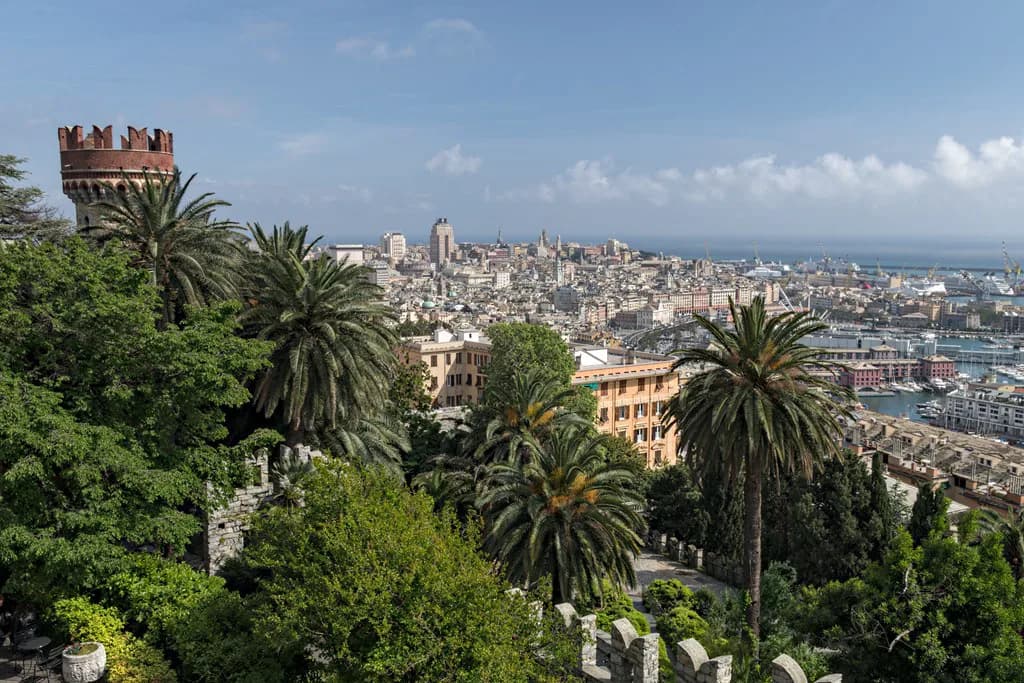
The castle's position gives it a view of the city from the keep and the balcony, and both are worth the climb inside the building. The panorama takes in the historic centre and the port, which is a useful orientation early in a Genoa stay. Because the castle sits above the streets you have just walked, the view also makes sense of the geography.
Photographers should note that the best light is not guaranteed at any hour, and the sources consulted do not give a time when the keep or balcony is open. Check on arrival whether both are accessible on the day of your visit. The views are the reason many people come, so it is fair to ask before buying a ticket.
Pairing the Castle With Spianata Castelletto
Spianata Castelletto is the viewpoint over the old town from the hill of Castelletto, and it sits naturally in the same excursion as the castle. Combining the two makes the uphill trip pay off twice: one museum and one open terrace. Our Spianata Castelletto visitor guide covers the terrace itself, while this guide deals with the castle.
The visitgenoa site lists a Castelletto lift among the city's funiculars and rack railways, which is useful when planning a route that avoids retracing your steps. Beyond that, treat the walk as a slow half-day: castle first, then the terrace, or the reverse if the weather is uncertain. Our hidden gems in Genoa guide suggests other quieter stops, such as the Cimitero Monumentale di Staglieno, for travellers who want a full day away from the port crowds.
Practical Checks Before You Go
Three details change too often to repeat here: ticket prices, opening hours and lift service. Check the official Musei di Genova pages for current admission and hours, and the city tourism site for transport information. If you plan to visit several museums, ask whether a combined card covers this castle rather than assuming it does.
The visitgenoa site describes the Genova Museum Card as a single ticket valid for 24 hours across 28 city museums, but the list does not confirm Castello D'Albertis specifically. Confirm eligibility at the ticket desk. The official tourism site is the right place to verify events and closures, and our Genoa with kids guide is useful if you are travelling as a family and need to balance museum time with outdoor stops.
Plan Your Visit
Castello D'Albertis works best as a deliberate, unhurried stop rather than a box to tick. Decide between the Borgo del Carmine walk and the Balbi–Montegalletto lift, pick one region and one theme inside, and leave time for the garden and the views. That structure turns a castle of curiosities into a coherent visit.
Before you travel, verify opening hours, admission and lift service on the official sources, because none of them are fixed. Pair the castle with Spianata Castelletto and the Centro Storico for a full day on Genoa's hillside, and keep the museum's regional layout in mind so you spend your time on the collections you care about.
Frequently Asked Questions
How do you get to Castello D'Albertis in Genoa?
You can walk up from Borgo del Carmine, which is a few steps from Via Balbi, or take the Balbi–Montegalletto lift, which arrives directly in front of the castle entrance. The walk gives you the neighbourhood and the climb; the lift saves effort. Lift times and fares are separate from the museum and should be checked before you travel.
What is inside the Museum of World Cultures at Castello D'Albertis?
The collection is organised by region, covering the Pre-Columbian Americas, Oceania and North America, alongside thematic sections on traditional medicines and the music of peoples. Period rooms such as the Columbian Room, the Sundials Room, the Turkish Living Room and the Captain's Cabin sit within the displays, and travel photographs and drawings fill out the story of the collector.
Is the garden at Castello D'Albertis free to visit?
The sources consulted do not state whether the romantic garden is included in the museum ticket or open separately. Ask at the ticket desk on arrival, or check the current visitor information on the official Musei di Genova pages before you go. Do not assume it is free because it is outdoors.
How long does a visit to Castello D'Albertis take?
Allow roughly half a day, though that is our suggestion rather than an official figure. The rooms, the garden and the views from the keep and balcony each take time, and anyone with a specialist interest in the Oceanic or Pre-Columbian material will want longer. Combining the castle with Spianata Castelletto fills the rest of a morning or afternoon.
Can you walk to Castello D'Albertis instead of taking the lift?
Yes. The castle can be reached on foot starting from Borgo del Carmine, a few steps from Via Balbi, according to the independent guide. The walk involves a climb through the streets below the castle, so wear suitable shoes and allow extra time. The Balbi–Montegalletto lift is the alternative if you would rather save energy for the museum.
What else can you see near Spianata Castelletto?
Spianata Castelletto is the viewpoint over the old town from the hill of Castelletto, and the castle and the terrace combine naturally in one outing. The Castelletto lift is listed among the city's funiculars and rack railways, which helps with route planning. Further afield, the Cimitero Monumentale di Staglieno is a quieter stop for travellers with a full day.
Sources
Continue exploring
More guides you'll find useful





