
Tuvixeddu Necropolis Cagliari: A Practical Visitor Guide
Visit Cagliari's Tuvixeddu necropolis: the Punic well tombs, the Roman layers, free daily park access, gate locations and what to confirm before you go.
On this page
Tuvixeddu is one of those Cagliari places where a short walk delivers far more than the surface suggests. The wide lawns and paths look like an ordinary neighbourhood park, but the rocky slopes around you are perforated with tombs cut into the limestone by the Carthaginian population and later reused by the Romans. For a city break, this is a compact, free stop that rewards a little reading beforehand.
The park sits in the popular Sant'Avendrace quarter, on one of the hills on which Cagliari was built, and entry is free and daily, according to the municipality. The published gate hours are seasonal and the official page was last updated in October 2022, so treat those hours as a starting point rather than a 2026 guarantee and recheck before a late evening or winter visit.
It helps to position Tuvixeddu among the city's better-known stops. If you're mapping an itinerary, the broader list of Cagliari Attractions gives you a sense of how this hill fits between the archaeological museum, the Roman amphitheatre and the waterfront.
Where the park sits and why the hill matters
The Parco di Tuvixeddu occupies a modest area of roughly three and a half hectares in the Sant'Avendrace district, tucked into the northern part of central Cagliari. The municipal entry lists the address as Via Falzarego in the 09123 postcode, with a second gate on Via Is Maglias. Because the hill climbs, plan for some uneven ground and choose the gate closest to where you're arriving.
The location is no accident. If you look for hidden gems in Cagliari, you'll find that several of the best stops are woven into ordinary residential streets rather than fenced off in a dedicated precinct, and Tuvixeddu is the clearest example. You can combine the park with a wander through Sant'Avendrace without committing a whole day.
The most useful thing to keep in mind is that this was a city of the dead attached to a living settlement, not a ceremonial monument on the edge of town. Visitors who expect a museum interior may be surprised; the experience is largely a walk among open slopes and visible tomb openings. Read the interpretive material before you arrive so the rock face makes sense.
What Tuvixeddu actually is: well tombs in limestone
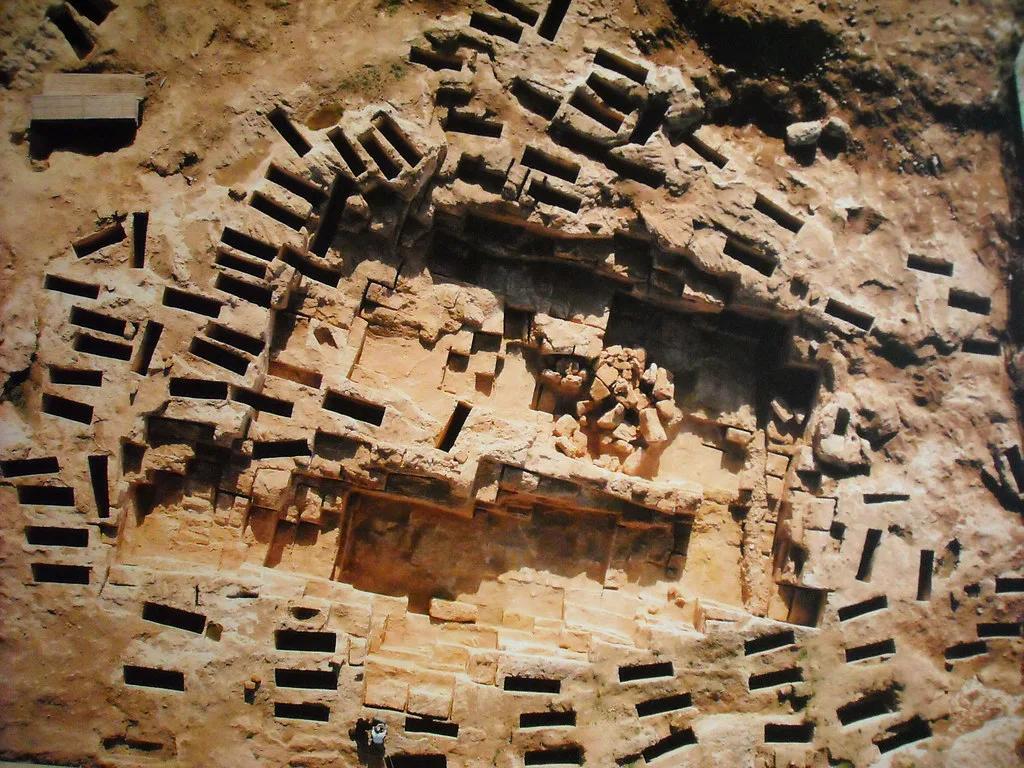
The name Tuvixeddu comes from a word for a small hole, and that is the site's defining feature. Instead of ground-level graves, the deceased were lowered into vertical shafts cut deep into the rock, which gives the necropolis its distinctive pockmarked profile. The practice is associated with the Phoenician-Punic tradition and spans the sixth to third centuries BC.
The municipality describes the site as the largest necropolis in the Mediterranean basin, a claim worth repeating as an attribution rather than a settled fact. What you can see for yourself is the scale of the excavation: dozens of openings are cut into the limestone in a way that reads as an entire city of shafts. Some tombs retain painted interiors, though that is not the same as being able to step inside.
Over the centuries the hill also held Neolithic traces and later residential and industrial use, so the site is layered rather than pristine. That complexity is why the park looks partly natural and partly scarred. Bring a phone with the municipality's page open to check the current published opening hours, since the page's own data dates from 2022.
How to read the burial custom and grave goods
Well tombs were not simple holes. The dead were buried with objects intended for the journey to the afterlife, and excavations have brought out necklaces, scarabs, gold pendants and other jewellery along with amphorae, weapons, coins and small statuettes. Knowing what was placed in the graves gives the rock face a purpose: each shaft was a sealed container for a person and their possessions.
Some tomb walls carry painted decoration with floral, mythological or geometric motifs. The Tomb of the Sid and the Tomb of the Ureus are named for symbols associated with Sardinian-Punic and Egyptian religious imagery respectively. Unless you join a specialised tour, you may not be able to study these interiors closely, so treat them as context for what you see outside.
The site's comparison with Etruscan necropolises is a helpful lens. Like those Italian counterparts, the value is in the ritual system: the placing of objects, the choice of vertical shafts rather than chambers, and the way later generations returned to the same ground. That is the story to carry with you rather than a checklist of individual tombs.
The Roman layer and the Grotta della Vipera
During the Republican period the necropolis was enlarged and diversified, with cremation burials, trenches, chambers and arcosolium tombs similar in form to those in the catacombs. The municipality also highlights the Grotta della Vipera, a Roman-era burial associated with the site. Seen together with the Punic shafts, this is what makes Tuvixeddu a multi-period cemetery rather than a single-epoch ruin.
What you can actually see on a self-guided walk may be limited, because the Roman structures are not all equally exposed or equally open. Budget time for the interpretive signs and the landscape, and don't assume you will enter the chambers. If Roman burial architecture is a priority, plan a separate stop at one of the city's collections; do not expect every ancient site in Cagliari to share a ticket.
Quarrying, Villa Muscas and the road to protection
The hill's modern history explains why it looks the way it does. Limestone was quarried for building materials, and in the twentieth century the summit held Villa Muscas, a house connected to the cement works that caused the destruction of many tombs; it now stands abandoned above the necropolis. The first archaeological safeguarding work began in the 1960s.
During the Allied bombings of the Second World War, local residents used the necropolis as an air-raid shelter, and some even lived inside it. The site's public life is more recent still: it opened for the first time during Monumenti Aperti in 1997, and the park was created in 2014. Since then it has been freely and daily accessible as an urban green area.
Practical access: entrances and published hours
The main entrance is at Via Falzarego 49, with a secondary entrance on Via Is Maglias. The municipality publishes monthly hours that shift with the season: roughly 06:00 to 21:00 in winter and spring months, 05:30 to 22:30 from April through September, and 06:30 to 22:00 in October, November and December. Those figures come from a page last updated on 5 October 2022, so confirm the current gate times before relying on them.
If the municipal page has not been refreshed, a quick check with the Comune di Cagliari's tourism or parks information is the safest way to avoid a closed gate or a shortened opening. The wider portal also lists events and city notices that can affect access to green areas. Don't assume the hours you read on a third-party blog match the current schedule.
There are parking areas adjacent to the entrances, according to the municipal page, but the park itself does not allow vehicles beyond the entrances. That makes a short walk from the surrounding streets the norm. Given the hill's limestone terrain, wear shoes you can walk on uneven ground with.
What the park offers and what it does not
The municipality's facility list is unusually specific: toilets are available, but there is no play area, no dog area and no refreshment point. Dogs are allowed only on a leash. Adult cyclists are not admitted to the garden for safety reasons, though accompanied children under eight may bring bicycles. Access for disabled visitors is provided.
That last point needs qualification. The municipality confirms disabled access to the park, but it says nothing about the tomb areas or the rougher parts of the slope, which are uneven rock. Plan a route that keeps to the main paths if mobility is a concern, and ask on site how far the accessible routes extend rather than assuming every viewpoint is reachable.
Because there are no kiosks, bring water, especially in the warmer months. That is also a practical argument for a shorter visit in the middle of the day and a longer one in the early morning or late afternoon, when the limestone holds less heat. A free park with a toilet block but no café is a different proposition from a museum stop.
Free park versus paid archaeology
The park is a free, daily public space, and that is distinct from the ticketed archaeological collections elsewhere in Cagliari. If you want to see excavated objects and detailed displays, you will need a museum or another paid site; the necropolis itself is primarily an outdoor landscape. Do not expect a single ticket that unlocks the tombs and the city's museums together.
There is also no published indication that the municipality runs guided tours inside the park, and the tombs should not be treated as enterable interiors. Where an operator advertises a tour that includes Tuvixeddu, treat it as a third-party service to check independently. The town's main tourism portal lists culture and events information, but the specific scope of any tour must come from the operator.
Suggested visit duration and a realistic pairing
As a rough planning figure, allow about an hour for the park itself, and a little more if you want to read the interpretive material carefully. This is a suggested duration, not an official one; the site is not large, but the slope and the stops slow you down. If you are short on time, a 40-minute loop is usually enough to get a sense of the well tombs.
For a half-day, pair the necropolis with the Roman amphitheatre and the crypts of the Stampace area rather than trying to add every sight in the centre. A named operator, Vivacagliaritour, advertises a two-and-a-half-hour archaeological tour that includes Tuvixeddu alongside the amphitheatre, Villa Tigellio and two crypts, meeting at Calata Azuni. Check with the operator directly for current availability and price before building your day around it.
Try to see the necropolis and at least one museum or monument on separate visits rather than rushing both. Cagliari Attractions gives you profiles of the main sights so you can decide which pairing suits your interests. Building in a rest between stops is sensible on a hot day.
Guided options and what to verify
The park is open and free, so a formal guide is optional for a first visit. If you want the Punic burial customs explained, the third-party archaeology tour is one route, but its schedule and price belong to that operator and should be confirmed at the time of booking rather than assumed. Ask whether the tour enters the necropolis area and what is included before you pay.
The municipality's main portal is the place to check for any official notices about the park, including seasonal changes or events. Look for notices about the Parco di Tuvixeddu specifically, since general city news may not mention the necropolis. If nothing official is posted, plan for an independent walk and rely on the interpretive signs.
Best time to go on a limestone hill
Tuvixeddu is an outdoor site with limited shade, and the limestone reflects heat. In summer, aim for the early morning or the last two hours before closing, when the light is softer and the stone is cooler. In winter, the published afternoon close still leaves a usable window, but check the gate times because the schedule changes by month.
Spring and autumn are the most forgiving seasons for walking the slopes, and the vegetation along the canyon area is greener after rain. Carry water and sun protection regardless of the season, and avoid the middle of a hot day if you plan to linger over the tomb openings.
Plan Your Visit
Tuvixeddu rewards travellers who arrive with a little context: a free park, a striking limestone landscape and a burial tradition that shaped how a whole necropolis looks. Check the official gate times before you go, bring water, and expect to look at the tombs rather than walk through them.
For the wider city picture, start with Cagliari Attractions and build a route around what interests you most. If you have an hour and a taste for ancient landscapes, this hill in Sant'Avendrace should be on the list. For related planning, see Parco di Monte Urpinu Cagliari: Visitor Guide to Views & Walks.
Frequently Asked Questions
Is the Tuvixeddu necropolis free to visit?
The Parco di Tuvixeddu is a free public park with daily access, according to the municipality. There is no ticket office for the grounds themselves. Any tour that includes the site is a separate service, so confirm its scope and cost with the operator directly.
Can you go inside the tombs at Tuvixeddu?
The park is an open landscape with tomb openings cut into the rock, and no official source indicates that individual Punic or Roman tombs can be entered. Treat the site as a place to view the architecture and read the context. Ask on site if you have specific questions about any chamber.
Where are the entrances to the Parco di Tuvixeddu?
The main entrance is at Via Falzarego 49 in Cagliari, with a secondary entrance on Via Is Maglias. Parking is adjacent to the entrances, but vehicles cannot enter the park itself. The gates are seasonal, so check the municipality's published hours before a late or winter visit.
Are there guided tours of Tuvixeddu?
No official municipal guided tour is published for the necropolis, so the safe assumption is that you will explore independently. One third-party operator, Vivacagliaritour, advertises an archaeology tour that includes Tuvixeddu; confirm availability, timing and price with that operator before planning around it.
Is the park accessible for wheelchair users?
The municipality lists disabled access to the park, but it does not describe how far accessible routes extend across the slopes or into the tomb areas. The ground is limestone and uneven in places. If mobility is a concern, ask on site and keep to the main paths.
How long does a visit to Tuvixeddu take?
Allow about an hour for a comfortable walk and to read the interpretive material, or around 40 minutes for a shorter loop. This is a suggested duration, not an official figure. Add time if you plan to walk both entrances or continue into Sant'Avendrace.
Sources
Continue exploring
More guides you'll find useful





