
Basilica di Santa Maria Maggiore Bergamo: Visitor Guide
Visit Santa Maria Maggiore in Bergamo's Città Alta: what to see inside, Lion Portals, Donizetti's tomb, ticket scope, free categories and an easy access route.
On this page
Santa Maria Maggiore sits on Piazza Duomo in the upper town of Bergamo, and it is the kind of church you notice twice: once for the severe Romanesque stone outside, then again for the Baroque burst of colour the moment you step in. The building began as a plague vow in the 1100s, which explains why it feels less like a monument and more like a promise the city kept. Plan around one practical point first: visitor entry is ticketed for people who live outside Bergamo and its province, with reduced and free categories listed by the tourism board.
The Vow of 1137 and Why the Church Looks the Way It Does
In the early 1100s a plague epidemic swept Europe, and the people of Bergamo promised the Madonna a church if the contagion receded. Construction began in 1137 on Piazza del Duomo, according to the city's tourism board, and the church was embellished over the following centuries. That layered history is why the severe Romanesque lines of the exterior contrast with the Baroque interior you find once inside.
The site itself was already sacred long before the basilica: a pagan temple to Clementia stood here in Roman times, and an eighth-century church dedicated to the Virgin preceded the present building. Knowing that helps you read the piazza as a palimpsest rather than a single architectural set piece. Look at the stonework before you go in, because the outside tells a different story from the one the interior tells.
No Central Facade, No Main Door: How to Enter
One of the basilica's oddities is that it has no central entrance and no free-standing facade; the front wall once formed a single continuous surface with the adjoining palace. All four entrances are lateral, which changes how you approach the church and which square you arrive from. On the north side, the Porta dei Leoni Rossi opens toward Piazza Duomo.
On the south side, the Porta dei Leoni Bianchi faces Piazza Rosate. If you arrive expecting a grand front door you will circle the building looking for one, so orient yourself by the two piazzas instead. The southern portal is also the accessible entrance, according to the basilica's accessibility data sheet.
The Lion Portals and the Marble Behind Them
Four red and white marble lions guard the northern and southern entrances, set at the base of the columns of the fourteenth-century porticoes by Giovanni da Campione. The colour difference is geological rather than symbolic: the red lions are carved from Veronese marble, while the white ones use Candoglia marble from the Piedmontese Val d'Ossola. They have become one of the most recognisable emblems of the city.
Slow down here, because these portals carry detail you miss at walking pace. The lions sit low, at column base height, so you need to step close and slightly aside to see the carving properly. Pair the viewing with a look at the portico structure above, which was built to shelter the entrances.
Medieval Measures Engraved in Stone
Between the two doors on the northern side, the medieval measures used in Bergamo are fixed to the wall: the Capitium Comunis Pergami, a cavezzo of 2.63 metres, and the Brachium, an arm of 53.1 centimetres. Weavers and merchants referred to these marks when doing business, which makes them a working piece of civic infrastructure rather than decoration. They are easy to walk past, so look at the wall between the portals rather than at the doors.
What to See Inside: Lotto, Tapestries and the Inlaid Choir
Inside, luminous frescoes, elaborate stuccoes, precious tapestries and wooden inlays designed by Lorenzo Lotto decorate the church. Lotto's work here represents a high point of Renaissance art in the city, with saturated colour and expressive figures. The inlaid wooden choir is the element visitors tend to remember, partly because it is furniture-scale craftsmanship rather than wall painting.
The choir stalls and the Treasure Museum are shown by Touring Club volunteers from Thursday to Sunday in the mid-afternoon, according to the tourism board's listing. Treat that as a separate visit strand rather than assuming one ticket covers everything in the complex. Check the current arrangements with the Fondazione Mia before you build a day around it.
Donizetti's Tomb and the Opera Connection
Gaetano Donizetti's funeral monument stands inside the basilica, making the church a stopping point for opera lovers who associate the composer with Bergamo. Donizetti was born in the city, and the tomb turns a general art visit into something more specific for anyone who follows bel canto. If you are travelling with a music-minded companion, build this into the route before you reach the choir.
Tickets, Free Categories and What the Price Covers
The basilica is not uniformly free or uniformly ticketed. The tourism board lists a full ticket for non-residents of Bergamo and its province, a reduced rate for visitors aged 14 to 25 and for people over 70, and free entry for residents, children up to and including 13, disabled visitors with an accompanying person, schools up to secondary level, priests, nuns, journalists, and military and law enforcement. Entry during religious services is free. Read the official page for the current figures rather than relying on older listings, since rates can change.
Ticket scope matters when you plan: the price quoted for the basilica is for the church visit, and the volunteer-led Treasure Museum and wooden inlay visits are presented separately. Do not assume a single purchase unlocks every space on the piazza. If your group mixes residents and non-residents, or spans the age bands, check each person against the categories before you queue.
Opening Times and How to Verify Them
The Visit Bergamo listing gives weekday hours split between late morning and afternoon, longer Saturday hours, and Sunday hours divided around morning mass. Because these times change with the liturgical calendar and season, confirm them on the official basilica page or with the Fondazione Mia before you travel. Volunteers staff the Treasure Museum and inlay visits only on certain days, so a church visit and a museum visit may need separate slots.
For citywide context, the tourism board's events calendar and the municipal site publish current exhibitions and civic openings that can shift your day. Neither is a substitute for the basilica's own hours, but both help you avoid arriving in Città Alta on a day when something else has drawn the crowds.
Accessibility in Practice
The accessibility data sheet is unusually candid. The only accessible entrance is the south-west secondary portal, which is always open with a wide, level doorway; the approach is a downhill pedestrian route with cobblestones and no tactile paving, and the funicular upper station sits roughly 280 metres away. Inside, most of the floor is level, but the presbytery and choir are preceded by three steps, and artworks kept in the presbytery are not visible from the accessible area.
Parking is limited: Piazza Rosate has public parking reserved for residents with cobblestone paving and no designated accessible bays, while Piazza Mercato del Fieno, about 300 metres away, has one designated accessible space. There are no accessible restrooms in the basilica, and no specific aids for visually impaired visitors. Visitors with mobility or visual impairments are advised to come with a companion, so plan the piazza stop accordingly.
How Long to Allow and What to Pair With It
As a suggestion rather than official guidance, allow around 30 to 45 minutes for the church itself if you want to read the lion portals, find the stone measures and sit with the inlaid choir. Add a separate slot if the Treasure Museum is open during your dates. The building rewards a slow pass rather than a checklist sprint, and the lateral entrances mean you will want a few minutes to work out which door you came in by.
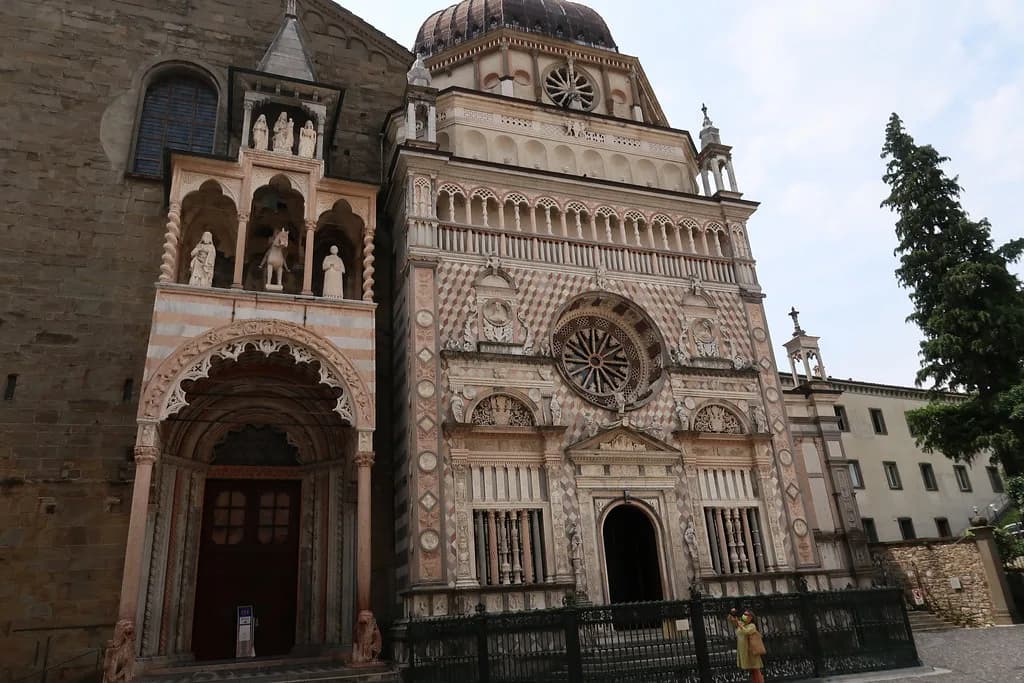
Piazza Duomo stacks several sights within a few steps, including the Colleoni Chapel beside the basilica, so the church works well as one stop in a compact upper-town circuit. Beyond the piazza, Città Alta's lanes, walls and viewpoints reward an unhurried walk.
Where the Basilica Fits in a Bergamo Itinerary
The basilica belongs in the first half of a Città Alta day, before the upper town fills and while you still have patience for detail. Treat it as an anchor rather than the whole morning, then move outward through the piazza and lanes. Our Bergamo Attractions hub maps the surrounding sights so you can order them without backtracking.
If you want the quieter, less obvious corners of the upper town alongside the headline churches, the hidden gems in Bergamo guide covers the lanes and viewpoints that sit off the main piazza route. Read it before you fix your route, so the basilica sits inside a walk rather than at the end of one. Visitors using the funicular or arriving by car can plan the southern approach from Piazza Mercato del Fieno, which the accessibility sheet names as the practical drop-off side.
Plan Your Visit
Santa Maria Maggiore rewards planning on two fronts: knowing that entry is ticketed for non-residents with free categories for residents and several other groups, and knowing that the accessible route enters from the south-west portal across cobblestones. Check the basilica's own page for current hours and volunteer-led museum days before you go, and do not rely on old listings.
Build the visit around the Lion Portals, the engraved medieval measures and the inlaid choir, and leave room for the piazza outside. Bergamo's upper town works best at a walking pace, and this church is the reason to slow down on Piazza Duomo. For related planning, see Duomo di Bergamo: Città Alta Cathedral Visitor Guide.
Frequently Asked Questions
Do you need tickets for the Basilica di Santa Maria Maggiore in Bergamo?
Yes, for many visitors. The tourism board lists a paid ticket for people who live outside Bergamo and its province, with a reduced rate for younger visitors and people over 70, and free entry for residents, young children, disabled visitors with a companion, school groups and several other categories. Entry during religious services is free. Check the official basilica page before you travel, because rates and categories can change.
What should you not miss inside Santa Maria Maggiore?
Prioritise Lorenzo Lotto's frescoes and the inlaid wooden choir, the tapestries and stuccoes, and Donizetti's funeral monument. Outside, the four marble lions at the lateral portals and the medieval measures engraved between the northern doors are easy to walk past. The Treasure Museum and inlay visits are led by Touring Club volunteers on limited days, so confirm they are running during your dates.
Why does the basilica have no main entrance or central facade?
The church originally shared a continuous front wall with the adjoining palace, so it was built without a free-standing facade or central door. All four entrances are lateral: the Porta dei Leoni Rossi faces Piazza Duomo on the north side, and the Porta dei Leoni Bianchi faces Piazza Rosate on the south. This is why the south-west portal is the one used for accessible entry.
How do you reach the basilica if you use a wheelchair or have limited mobility?
Use the south-west secondary portal, which the accessibility data sheet describes as the only accessible entrance, always open with a wide and level doorway. The approach is downhill and cobbled, and the funicular upper station is roughly 280 metres away. Inside, most of the floor is level, but the presbytery and choir have three steps, and there are no accessible restrooms.
Is Santa Maria Maggiore worth visiting?
It is one of the upper town's central monuments, and the combination of the Romanesque exterior, the Baroque interior, the Lotto inlays and Donizetti's tomb gives it more substance than a quick photo stop. The lateral entrances and the stone measures add a layer most short visits miss. Allow time to read the portals and the choir rather than treating it as a passing stop.
Which popes are associated with Santa Maria Maggiore in Bergamo?
The basilica's own visitor information focuses on its history, art and the Donizetti monument rather than papal burials, and the available sources do not name popes connected with this church. If you are researching a specific papal link, check with the Fondazione Mia, which manages the basilica, before repeating a claim. Do not confuse this church with the Roman basilica of the same name.
Sources
Continue exploring
More guides you'll find useful





