Accademia Carrara Bergamo: Visitor Guide to the Art Gallery
Plan a visit to Accademia Carrara in Bergamo: its collecting history, the painters to look for, how the rooms are arranged, and how to pair it with GAMeC.
On this page
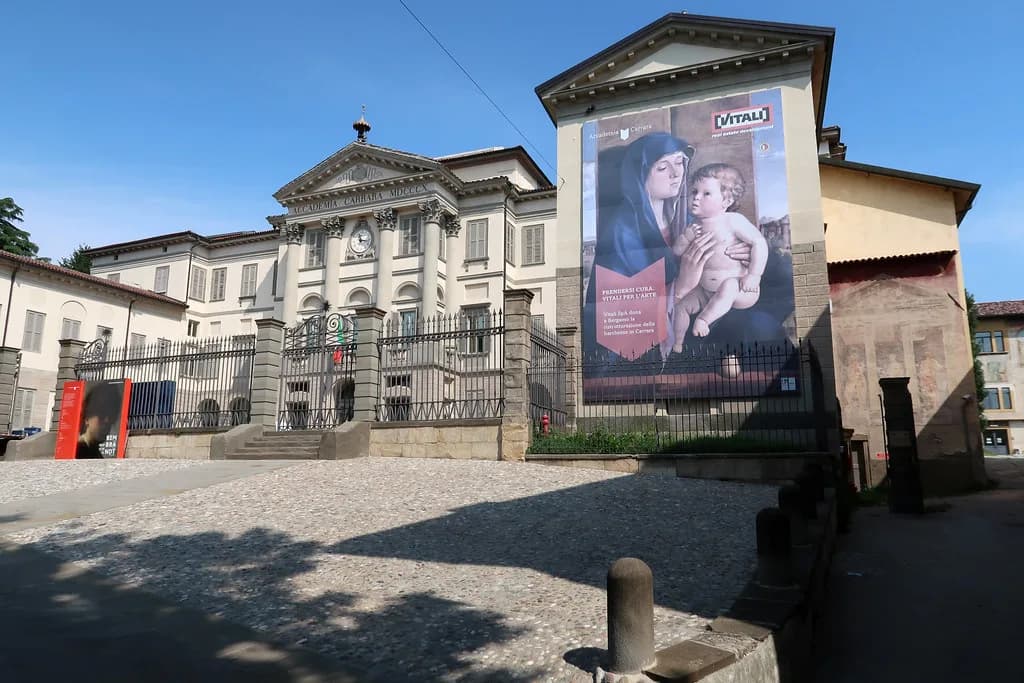
Accademia Carrara is not a former royal palace or a national collection built by decree. It is a gallery assembled from the gifts of Bergamo families, founded in 1796 around the collection of Count Giacomo Carrara and enlarged over two centuries by further bequests. That origin shapes what you see: dense clusters of Lombard and Venetian painting rather than a tidy survey of Western art. Related guide: Rainy Day in Bergamo: Indoor Art, Museums and Covered Walks.
The museum sits in the lower town on Piazza Giacomo Carrara, in a neoclassical building on the edge of Città Bassa rather than inside the walled upper city. It is a short walk from the funicular that climbs to Città Alta, which makes it easy to place between the two halves of Bergamo in a single day.
Where the Gallery Sits in Bergamo
Bergamo divides into a modern lower town on the plain and the medieval upper town on its hill, and the gallery belongs firmly to the lower one. The building faces Piazza Giacomo Carrara, with the Accademia's art school in a neighbouring building and GAMeC, the modern and contemporary gallery, in a former convent opposite. Treat the square as a small museum quarter rather than a single stop.
Reaching it on foot from the train station or Porta Nuova takes you through Città Bassa's shopping streets, which is a pleasant but not short walk. Using public transport to cover the plain and saving your legs for the cobbles of the upper town is the more comfortable plan. For route planning and current tickets, the local transport operator publishes line and fare information; fares change, so check before you travel rather than relying on old blog posts.
The Collecting Story Behind the Collection
Giacomo Carrara's 1796 bequest is the seed of everything else. Successive Bergamo collectors added paintings, sculptures, medals and plaques, and the institution describes itself as a museum of collecting for that reason. Read the wall labels with that in mind: works arrive here through individual taste and civic generosity, which explains the uneven but often surprising depth of certain schools.
Because the core came from private collections, the gallery is strongest where Bergamo's merchant and noble families had connections: Venetian and Lombard painting above all. If you arrive expecting the breadth of a major national gallery you may be disappointed; if you arrive expecting concentrated quality in a manageable number of rooms, it delivers. The official site publishes the collection's structure, including the decorative arts alongside the paintings.
How the Rooms Are Arranged
A rehang reported in early 2023 reorganised the galleries into sixteen rooms across two sequences. The first follows Italian art from the Gothic period into the Renaissance, with strong groups from the Po Valley and Venice plus Tuscan works. The second traces the figurative tradition between Lombardy and the Venetian mainland from the fifteenth to the eighteenth century, with particular weight on the Bergamo context.
Navigating by sequence rather than by checklist is the practical consequence. Start at the beginning and let the rooms carry you forward; the collection rewards that chronological approach. Any single painting may be off view for conservation, loan or reinstallation, so ask at the desk about specific works rather than assuming the highlights list is a guarantee.
The route closes with a nineteenth-century section that reflects the Accademia's own painting school and its protagonists. This is the part most casual visitors rush, and it is worth ten unhurried minutes: it explains what the institution became, not just what it bought.
Painters to Look For
The Renaissance rooms hold the names most visitors come for. Look for Pisanello and Mantegna among the early masters, Bellini and other Venetian painters of the Quattrocento, and Florentine works by Botticelli and Raphael. The Raphael is a young Saint Sebastian, painted when he was not yet twenty, and it is the kind of small, early panel that repays close looking rather than a quick photograph.
The Lombard sequence is where the gallery becomes distinctive. Lorenzo Lotto, Giovanni Battista Moroni, Evaristo Baschenis and Fra Galgario anchor a narrative that makes sense of Bergamo and its mainland connections. Moroni's portraits and Baschenis's still lifes of musical instruments are the sort of works that linger; give them the time you were going to spend queueing elsewhere.
Pairing Accademia Carrara with GAMeC
GAMeC occupies a former convent directly opposite the Carrara and shows modern and contemporary work. The pairing works because the two collections occupy different mental registers: you leave the old masters and step into a building where the hang, the lighting and often the scale of the works are different. It is a deliberate contrast stop, not an afterthought.
Plan the split before you go, because energy is the real constraint. A common approach is the Carrara first, while your attention is fresh for small panels and dark rooms, then GAMeC afterwards when you can tolerate a more experimental display. Check each institution's own site for what is currently showing and for its own admission terms; the two are separate museums, so do not assume one ticket covers both.
If contemporary art is not your priority, spend the second half on the PwC Gardens instead. The gardens and the Bù Bistrot were added in 2024 as a new public space linking the museum to the outdoors, reported as a romantic park with a connecting walkway. Treat that as context rather than a promise of what is open on your date.
Practical Planning Before You Go
This guide deliberately does not list admission prices, opening hours, closure days or booking rules. Those details change, and the authoritative source is the museum itself. Check the official site shortly before your visit for opening times, ticket categories and whether timed entry or online booking applies on your date, and note that any third-party listing may be out of date.
Allow more time than you think for a gallery of this size. A focused pass on the Renaissance sequence and the Lombard portraits is a reasonable half-day suggestion, not official museum guidance. A slower visit that includes the nineteenth-century rooms and the decorative arts takes longer, and adding GAMeC on the same day pushes you toward a full afternoon.
Bergamo's wider sightseeing is largely free at the point of entry. Piazza Vecchia, the Venetian Walls and the streets of Città Alta cost nothing to walk, while church interiors and the gallery are separate ticketed propositions; Santa Maria Maggiore, for example, publishes its own visitor charges and opening times. Budget attention as carefully as money, and save the paid interiors for the places you actually care about.
Suggested Durations and Combinations
For a highlights visit, two hours at the Carrara is a sensible suggestion, with a break in the gardens or a café before deciding on GAMeC. For a full-collection visit with the Lombard rooms and the nineteenth-century close, allow a morning. These are suggestions for pacing, not published museum durations.
The gallery combines naturally with Città Alta on the same day. Walk or ride the funicular up after your visit, cross Piazza Vecchia, and continue to the Venetian Walls for the late-afternoon light. If you want to avoid the obvious circuit, the same upper town rewards aimless wandering: the hidden gems in Bergamo are often stairways and small churches rather than headline sights.
Travellers staying longer can use the gallery as a rainy-day anchor and build the rest of the trip around the upper town. For a structured look at the city's other sights, from the Campanone to the Rocca, our Bergamo Attractions collection covers what each one involves.
Plan Your Visit
Accademia Carrara rewards a deliberate visit rather than a tick-box stop. Read it as a collection of Bergamo's own gifts, follow the room sequence instead of hunting individual paintings, and give the Lombard portraits the time they deserve.
Confirm hours, tickets and booking on the official site before you go, then decide whether GAMeC, the gardens or the funicular to Città Alta is the better use of your remaining afternoon. Whichever you choose, you will leave understanding Bergamo's art better than when you arrived.
Frequently Asked Questions
Is Accademia Carrara worth visiting in Bergamo?
Yes, particularly if you care about Renaissance and Lombard painting. It is a concentrated collection built from private bequests, with works by Bellini, Mantegna, Botticelli, Raphael, Lotto and Moroni in a manageable number of rooms. If you prefer contemporary art or only have an hour, GAMeC opposite or the free upper town may suit you better.
How long should I spend at Accademia Carrara?
A focused highlights visit of about two hours is a reasonable suggestion, while a slower full-collection visit including the nineteenth-century rooms takes longer. These are pacing suggestions, not official guidance. Add time if you plan to continue to GAMeC on the same afternoon.
Can I visit Accademia Carrara and GAMeC in the same afternoon?
It is possible, since the two museums face each other on the same square in Bergamo's lower town. They are separate institutions with their own admission terms, so check each site for current tickets and opening times. Doing the Carrara first, while your attention is fresh, then GAMeC is the more comfortable order.
What paintings should I not miss at Accademia Carrara?
Look for the early Renaissance sequence with Pisanello, Mantegna, Bellini, Botticelli and Raphael's Saint Sebastian, then the Lombard rooms with Lotto, Moroni, Baschenis and Fra Galgario. Individual works can be off view for conservation or loans, so ask at the desk if a specific painting matters to you.
How do I get to Accademia Carrara from Città Alta?
The gallery is in the lower town on Piazza Giacomo Carrara, so you leave the walled upper town by funicular or on foot and continue through Città Bassa. Local buses also serve the lower town; check current routes and fares with the transport operator rather than relying on older guides.
Is the Accademia Carrara the same as the art school?
They are connected but distinct. The Accademia Carrara is the museum, while the School of Fine Arts occupies a neighbouring building and trains students. The museum's nineteenth-century rooms reflect that school's history, but your admission to the gallery is a separate matter from the school.
Do I need to book tickets in advance?
That depends on current arrangements, which this guide does not state. Check the official Accademia Carrara site shortly before your visit for opening times, ticket categories and whether timed entry applies. Booking details change, and third-party listings can be out of date.
What else can I see for free near the gallery?
The upper town's squares, streets and Venetian Walls are free to walk, and the walk itself is one of Bergamo's best experiences. Church interiors such as Santa Maria Maggiore have their own charges and opening times, so check before you go. The gallery and other museums are separately ticketed.
Sources
Continue exploring
More guides you'll find useful