Basilica di San Giacomo, Bellagio: Romanesque Church Guide
Plan a visit to Bellagio's Romanesque Basilica di San Giacomo: stone facade, bell tower, artworks and the hilltop piazza above the waterfront.
On this page
Bellagio's parish church sits on the hillside rather than the shoreline, which is why many day-trippers pass it by on the way to the ferry. Climbing through the stepped lanes of Il Borgo to Piazza della Chiesa takes only a few minutes, and the reward is a compact Romanesque building with an unusually rich interior. This guide focuses on one named monument: what to look for, how to pace the stop, and which details to verify before you rely on them.
As a working parish church, the basilica is not a ticketed attraction in the way the villa gardens are. The safest expectation is a short, self-guided look around; treat opening hours, entry conditions and any liturgy as things the parish sets rather than a published visitor schedule. Confirm current details with the Parrocchia di Bellagio before building a day around them.
Where Piazza della Chiesa Sits Above the Waterfront
The church occupies Piazza della Chiesa, uphill from the boat docks and the lakeside arcades. Bellagio divides into an upper strip along Via Garibaldi and a lower shoreline, joined by steep stepped lanes rather than roads, so the square is best reached on foot as part of the climb.
Salita Serbelloni is the most photographed of these staircases, lined with shops and restaurants, and it funnels a lot of people uphill through the day. A useful alternative on the approach is walking left from the boat dock past the Villa Serbelloni hotel and up Via Roma, where a sidewalk leads more gently to Via Garibaldi before you cut across to the church.
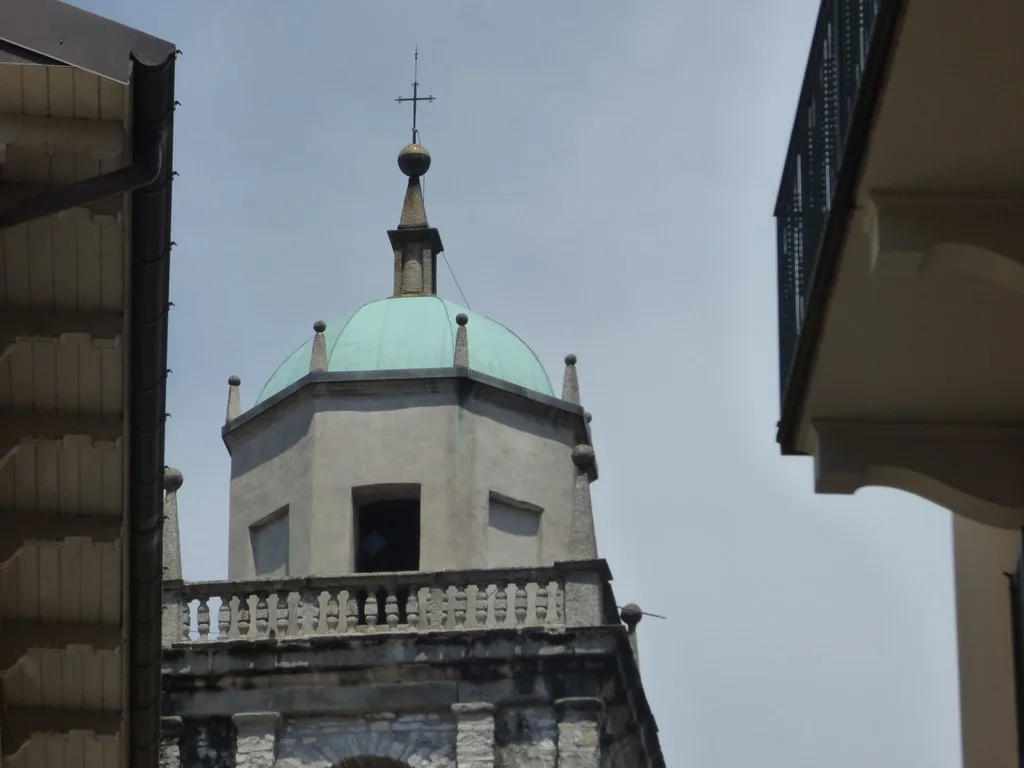
Once you are on the square, the geography makes sense: the grey stone facade and its tall bell tower are visible from the surrounding lanes and from the water, which is why the church reads as a landmark long before you reach it. Plan the church as a pause inside a walk rather than a separate excursion.
The Building: Romanesque-Lombard Bones in Moltrasio Stone
The basilica is described as a Romanesque-Lombard example built between 1075 and 1125 by the Masters of Como, the itinerant stoneworkers whose work dots the lake. The exterior is plain grey stone, with three naves and apses decorated with hanging arches, plus a hefty bell tower attached at the side.
The stone is local Moltrasio material, and the spare facade sits squeezed against the bell tower, which rises high enough to be seen from the lakefront promenade. Later renovations touched the interior in the Baroque period, but the building kept a restrained feel rather than acquiring heavy decorative overload.
Treat the tower as a piece of architecture to look at, not a viewpoint to climb. Nothing in the parish or tourism material describes public access to the top, so admire it from the piazza and enjoy the views from Punta Spartivento instead.
Inside the Nave: Three Naves and a Quiet Atmosphere
Inside, the church opens into three narrow naves ending in a triple apse, a layout typical of the Como Romanesque school. The low light and stone surfaces make it a cool, quiet stop on a hot afternoon, and the scale is intimate enough to take in within a few minutes of standing still.
The Baroque renovation softened the interior without the excess usually associated with that style, so the overall impression stays sober. Mosaics added in the early twentieth century bring colour to the apse area, and the marble pulpit rests on four columns representing the evangelists.
Visitors consistently describe the interior as the surprise of the visit: a plain shell outside, gold and colour within. Keep your voice down and dress for a place of worship, since services may be in progress when you arrive.
The Artworks to Seek Out
The church holds a small but varied collection, and knowing the highlights turns a quick look into a proper visit. Start with the archaic crucifix from the twelfth century and the triptych by Foppa dated 1432, both cited among the principal works.
Elsewhere in the interior, look for a Deposition of Christ from the school of Perugino and a polychrome wooden sculpture of the buried Christ in the Spanish-Baroque manner. An ornate altar from the late sixteenth century anchors the sanctuary, and the overall mix spans several centuries in a single room.
The Foppa triptych and a canvas of the martyrdom of St James appear in the fuller list of works published for the church, alongside paintings of saints and a venerated image of the Virgin. If you want to identify individual pieces, photograph labels rather than relying on memory, and avoid flash where it is discouraged.
What the Piazza Adds
Piazza della Chiesa is more than a forecourt. It has a central fountain, an old tower that once belonged to the castle overlooking the promontory, and a ring of shops, galleries and cafes, making it a natural place to sit after the church.
That tower now houses the Torre delle Arti, an exhibition and events space for local, national and international artists. Check what is showing when you are in town; small exhibitions here often go unnoticed by visitors heading straight for the waterfront.
If the bells ring while you are on the square, the sound fills the whole piazza, one of the small moments that makes the climb worthwhile. Time your coffee stop loosely around that rather than treating the church as a box to tick.
Practical Expectations: Entry, Hours and Duration
Entry costs and daily opening hours are not published in any consistent form in the sources consulted. One traveller's report describes the church as free to enter, but that is a visitor account rather than an operator statement, so treat it as a likely rather than guaranteed arrangement and check with the parish before relying on it.
Mass times are also set locally and change seasonally, so contact the Parrocchia di Bellagio or ask at the tourist office in the town before you go. Do not plan a trip around a specific service unless it has been confirmed directly.
As a suggested duration rather than an official one, allow about fifteen to thirty minutes inside, and add time for the square and a coffee. Readers who prefer a slower pace often combine the church with the rest of the upper town in a single morning.
Pairing the Visit With a Half-Day Walk
A sensible route starts at the ferry dock, climbs Via Roma to Via Garibaldi, stops at Piazza della Chiesa, then descends by a quieter salita to the waterfront. From there the lakeside promenade runs south toward the Villa Melzi gardens, where the grounds are ticketed and the villa itself is not open.
In the other direction, the walk to Punta Spartivento takes roughly ten to fifteen minutes from the dock and is mostly flat, with a park at the tip where the three branches of the lake meet. It is free to enter and a better use of your time than any tower climb in town.
If you have a full day, add a ferry hop to Varenna or a wander through San Giovanni and Pescallo, the two former fishing hamlets on the peninsula. These quieter corners balance the busy central lanes and are easy to reach on foot.
Accessibility and Pacing
Bellagio's centre is a web of stepped alleys, and the church sits up the hill from the boats. Anyone with limited mobility or a pushchair should plan the approach via Via Roma and expect some slopes, and should check with the parish about access inside before travelling.
The crowded staircases are not ideal for people with balance issues, and the lack of handrails on Salita Serbelloni is worth knowing in advance. Choosing a quieter salita or the Via Roma road makes the climb more comfortable and hardly adds time.
Pacing matters more than distance here. A short stop at the church, a look at the piazza and a slow descent gives you the flavour of the upper town without turning the day into a stair workout.
Plan Your Visit
The Basilica di San Giacomo is a small, free-standing pleasure: a Romanesque shell with a surprisingly rich interior, sitting on a square that also holds a fountain, an old tower and a handful of cafes. Build it into a climb through the Borgo rather than a detour, and the stop takes on more meaning.
Check current opening arrangements with the parish before you set out, allow a modest window of time, and pair the visit with the waterfront, Punta Spartivento or the gardens at Villa Melzi. Those pairings are what make the church a natural part of a Bellagio day rather than an afterthought.
Frequently Asked Questions
Is there an entrance fee to visit the Basilica di San Giacomo in Bellagio?
One visitor report describes entry as free, but this has not been confirmed as current parish policy. Check with the Parrocchia di Bellagio before you travel, and treat the church as a working place of worship rather than a ticketed attraction.
How long does it take to see the church and Piazza della Chiesa?
As a suggestion, allow about fifteen to thirty minutes inside the church and a little extra for the square, the fountain and a coffee. This is an editorial estimate, not an official visiting time.
What artworks should I look for inside the basilica?
Look for the twelfth-century archaic crucifix, the Foppa triptych dated 1432, a Deposition from the school of Perugino and the polychrome wooden sculpture of the buried Christ. The late sixteenth-century altar and the early twentieth-century mosaics are also worth seeking out.
Can you climb the bell tower?
Nothing indicates that the bell tower is open to visitors. Treat it as a landmark visible from the piazza and the lake, and head to Punta Spartivento for elevated views instead.
When is the church open to visitors?
Opening hours are not consistently published, so contact the Parrocchia di Bellagio or ask at the tourist office in Bellagio before relying on a specific time. Avoid planning around a service unless it has been confirmed directly.
How do I walk to the church from the Bellagio ferry dock?
Walk left from the dock past the Villa Serbelloni hotel and up Via Roma, which leads more gently to Via Garibaldi, then cut across to Piazza della Chiesa. Alternatively, take Salita Serbelloni or a quieter salita if you prefer stairs.
Is the church visit suitable for people who struggle with stairs?
The centre is full of stepped lanes and the church sits uphill, so allow extra time and choose the Via Roma route. Ask the parish about access inside before you travel if step-free entry matters to you.
Sources
- Bellagio - San Giacomo Church | Bellagio Lake Como... the Pearl of Lake Como
- Bellagio Basilica of San Giacomo, Church in Lake Como, Italy
- What to do and see in Bellagio - myLakeComo.co
- A Day in Bellagio — Two Parts Italy
- [2026 Bellagio Attraction] Basilica of St. Giacomo Travel Guide & Travel Experiences | Updated Oct | Trip Moments
- Official event website
- La Punta Spartivento | Explore Lake Como Explore Lake Como | La Punta Spartivento
- Punta Spartivento, Bellagio: The Best Lake Como Viewpoint
- Bellagio, Lake Como: 12 Things to Do & Is It Worth It? (2026)
- Bellagio, Italy: Things to Do & What to See | Lake Como Travel
Continue exploring
More guides you'll find useful