
Torre dello Ziro Visitor Guide: Hike Above Amalfi and Atrani
Plan the Torre dello Ziro walk above Amalfi with source-based routes from Pontone to Atrani, terrain notes, views, legend, and how long to allow.
On this page
Torre dello Ziro is a ruined watchtower on the ridge above the Amalfi Coast, looking down on Amalfi and Atrani. No road reaches it, so the visit is a walk: usually a point-to-point route that starts in Pontone, a hamlet of Scala, and finishes with a staircase descent into Atrani. Positano.com estimates the walk at 4–5 km and 2–3 hours, which is a reasonable planning figure rather than an official one.
The tower was built in 1480 by Antonio Piccolomini, Duke of Amalfi, as part of a coastal warning system against Saracen raids. Today it is a roofless stone shell in a pine wood, surrounded by the older fortress walls of the Dukedom of Amalfi and open to wide views of the Gulf of Salerno. The walk is more about the ridge, the walls and the descent than about the tower interior, which has no roof or rooms to explore.
Where the tower sits and what you see
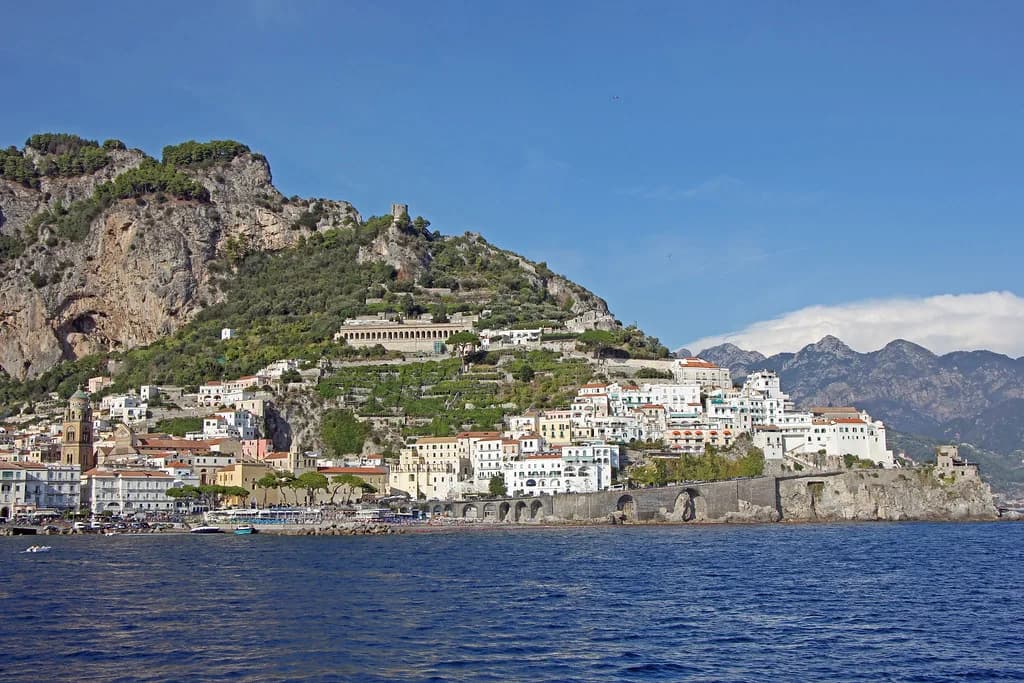
The tower stands on the ridge between Ravello and Amalfi, with Scala's Pontone hamlet on one side and the Torrente Dragone valley below. From the walls you look down on the pastel roofs and seafront of Amalfi and Atrani, and across the Gulf of Salerno. Looking up the slope, Villa Cimbrone at Ravello is visible among the greenery.
Because the tower is on a high point halfway between Ravello and Amalfi, the views shift constantly along the route. The fortress walls of the former Dukedom of Amalfi are part of the same defensive line, and you pass them before reaching the tower itself. A small pine wood wraps around the tower, with several little paths threading through it.
Route option A: start in Pontone
Most published descriptions begin in Pontone, a frazione of Scala that can be reached by bus from Amalfi or on foot from Ravello via a short path. From the village square, take the steps and follow the road for about ten minutes until a flight of steps on the left leads toward Atrani. Signs for the Torre appear along the way, and the route soon reaches the steps up to the fortress.
The Pontone start has a practical advantage: you gain height gradually on the approach and then descend into Atrani at the end, so the steepest sustained walking is downhill. The trade-off is that you finish in a different village from where you began, which means planning the return leg before you set out. Atrani has its own connections back to Amalfi, but services change, so check locally.
Route option B: approach from Amalfi
A common variant starts lower, from Amalfi or the Atrani side, and uses the staircase network to climb toward the ridge. One source describes a hike from Amalfi to Scala, about 2.5 km with a minimum altitude near sea level and a maximum around 253 m. That vertical gain is the part most casual descriptions understate, because it arrives in repeated flights of steps.
If you start from Amalfi, the natural finish is the staircase descent into Atrani, where you can walk back along the coast road or pick up a bus or ferry. Do not treat any published staircase name as a guarantee that the route is open or unchanged; confirm the current path with local information before committing. Bring the same footwear and water you would for any sustained stair walk.
Length and difficulty: why the numbers differ
The two main published estimates do not match. Positano.com describes 4–5 km over 2–3 hours and grades the walk easy, while Living Amalfi gives roughly 2.5 km with medium difficulty on the CAI E scale. The likely explanation is that they measure different start and end points: a Pontone-to-Atrani traverse covers more ground than a direct Amalfi-to-Scala climb.
Plan conservatively: allow the longer time and treat the easy label as a description of technical difficulty rather than effort. On the Amalfi Coast, an easy path can still mean hundreds of stone steps in the sun. The CAI E grading is a useful reminder that this is a proper trail, not a paved promenade.
Terrain and what to expect underfoot
The route is built from staircases, mule tracks and path junctions rather than smooth trail. There are shaded stretches, particularly in the pine wood around the tower, but much of the ridge is exposed to the sun. That combination of stone steps and heat is what makes a short walk feel longer than the distance suggests.
Living Amalfi notes springs along the path and some cooling shade, but do not rely on either as your only water source. Stout shoes with grip are more useful than sandals on worn stone, and a light layer helps in the wind on the open sections. Conditions on tracks above the coast can change after rain, so check locally before setting out.
What to see along the way
Before the tower, the path reaches the fortress walls that once formed part of the Dukedom of Amalfi's defences. These are the most substantial built remains on the walk, and they frame the approach to the tower. From the high point you can see Villa Cimbrone above and the valley of the Torrente Dragone below.
The tower itself is a round stone lookout with splendid views over the Gulf of Salerno and the villages on the hills and seafront. There is no documented ticket office or interior collection, so most visitors treat the ridge, the walls and the tower exterior as the destination. For other overlooked corners of the town below, see the hidden gems in Amalfi guide.
The duchess legend, told as legend
Local storytelling attaches a dark history to the tower. Giovanna d'Aragona, Duchess of Amalfi, is said to have been imprisoned there with her two young sons after her husband's death and an affair with the court butler, and the story ends with their murder. Some residents say the tower is haunted and prefer to avoid it.
These accounts are legend rather than documented history, and sources differ on details such as the century. Treat the story as part of how the tower is remembered locally, not as a verified account of events. It adds atmosphere to a ruin that otherwise offers little interpretation on site.
Timing the walk around light and heat
Because so much of the route is open to the sun, start early in the warmer months and carry more water than you think you need. The published 2–3 hour estimate assumes steady walking; add time for photographs at the tower and for rests on the staircases. Late afternoon is the other sensible window, though you need enough daylight to finish the descent safely.
Winter and spring bring cooler walking but also shorter days and the chance of wet stone. Check the weather and the state of the paths locally rather than relying on a fixed season rule. If rain is forecast, save the ridge for another day.
Combining the walk with Amalfi, Ravello and Atrani
The classic combination is a morning walk from Pontone, a pause at the tower, and a descent into Atrani for lunch. From Atrani it is a short coastal walk back to Amalfi, where you can spend the afternoon in the old town. If you want more of the town on foot, an Amalfi self-guided walk is a good way to structure the rest of the day.
Ravello can be added before or after the walk rather than in the middle, since it sits above Pontone. Trying to fit Ravello, the tower and a full Amalfi sightseeing list into one day usually means rushing the ridge. If you have time, the Valle delle Ferriere visitor guide covers a nearby valley walk that pairs well with a second day.
Practical checks before setting out
There is no reliable published ticket price, opening time or booking requirement for the tower, so do not budget for one or plan around a gate. Instead, confirm with local tourist information or your accommodation that the paths are open and that the descent you plan is passable. The reserve above Scala, the Riserva Naturale Valle delle Ferriere, is the official reference for the surrounding protected area, but it publishes no visitor timetable for the tower itself.
Carry water, wear shoes with grip, and tell someone your route if you are walking alone. Mobile coverage on the ridge can be patchy, so download an offline map rather than depending on a live signal. For a broader orientation to the area's sights, start with the Amalfi Attractions hub before fixing your days.
Plan Your Visit
Torre dello Ziro rewards walkers who treat it as a ridge walk rather than a monument visit. Start in Pontone if you want the gentler direction, or climb from Amalfi if you prefer to finish in Atrani, and allow the longer of the published estimates. The tower exterior, the fortress walls and the coastal views are the point of the trip.
Before you go, check path conditions and transport locally, since access details above the coast change with weather and maintenance. Build in a buffer for the staircases, and keep the duchess story as legend rather than fact. A well-timed morning start leaves the afternoon free for Amalfi itself.
Frequently Asked Questions
Is Torre dello Ziro free to visit?
The sources consulted describe no ticket office, admission fee or booking requirement for the tower. It is reached on foot along public paths, and the ridge, the fortress walls and the tower exterior are what visitors see. Check locally before you go, because access arrangements above the coast can change.
How difficult is the Torre dello Ziro hike?
Published descriptions differ. Positano.com grades the Pontone-to-Atrani walk as easy, while Living Amalfi lists the Amalfi-to-Scala trail as medium difficulty on the CAI E scale. In practice the route is stair-heavy and largely sun-exposed, so wear shoes with grip and allow for the climb even if the technical difficulty is modest.
How long does the Torre dello Ziro walk take?
Positano.com estimates about 2–3 hours for the Pontone-to-Atrani route, and that is a sensible planning figure. Add time for photographs, rests on the staircases and the descent into Atrani. Living Amalfi's shorter distance figure reflects a different start and end point, so allow the longer estimate to be safe.
Can you hike to Torre dello Ziro from Amalfi instead of Pontone?
Yes, the ridge can be approached from the Amalfi and Atrani side using the staircase network. That direction involves more sustained climbing in a shorter distance, and you can finish with the descent into Atrani. Confirm the current path locally, since specific staircases and signs are not guaranteed to be unchanged.
Sources
Continue exploring
More guides you'll find useful





