Duddingston Village, Edinburgh: Guide to the Sheep Heid Inn, Kirk & Loch
Plan a visit to Duddingston Village, Edinburgh: Duddingston Kirk, the Sheep Heid Inn, Dr Neil's Garden, and the back-door route up Arthur's Seat.
On this page
Duddingston Village, Edinburgh: A Practical Guide to the Kirk, the Sheep Heid Inn, and Arthur's Seat's Back Door
Last updated September 2026. Duddingston village Edinburgh sits at the foot of Arthur's Seat, a 12th-century conservation area with a working parish kirk, one historic pub, and almost no shops. Where the Royal Mile's crowds thin out, this lochside settlement offers a quieter route into the city's medieval history and a back-door path up the hill. A guide to quieter Edinburgh corners covers more low-key spots across the city, for a broader look beyond this one village.
How to Get to Duddingston Village From Central Edinburgh
Three practical routes connect central Edinburgh to Duddingston village. On foot, Queen's Drive through Holyrood Park leads southeast past the loch. Walkers can also follow the Innocent Railway path, a former rail line now used for walking and cycling. Lothian Buses routes 12 and 44 run from the city centre and stop within a short walk of the village core. Driving works too, but street parking is limited once inside the village's narrow lanes, so a taxi suits visitors skipping the walk in. Sat-nav and rideshare apps generally place the village under postcodes EH8 and EH15, worth having ready when booking a taxi. This village sits within Edinburgh's wider patchwork of residential districts, and a citywide neighbourhood breakdown covers how each one differs. For current citywide transport advice, Edinburgh's official visitor guide is worth checking before a first trip out.
- Walk via Queen's Drive through Holyrood Park, or take the Innocent Railway path
- Take Lothian Buses route 12 or 44 from the city centre
- Drive or taxi in, since street parking is limited on the village's lanes
Where the Name "Duddingston" Comes From
Duddingston's earliest recorded name was Treverlen, part of an estate granted to the Tironensian monks of Kelso Abbey by David I of Scotland between 1136 and 1147. Ownership passed to an Anglo-Norman knight named Dodin de Berwick, who by around 1150 referred to himself as lord of "Dodinestoun," or Dodin's farm. That name gradually shifted through several spellings before settling as Duddingston by the 1200s. Beyond the name, the settlement grew into a working village supported by coal mining, salt production, and weaving. Records from the 18th century describe more than 40 looms producing a coarse linen called Duddingston hardings. In January 1542, James V paid roughly 400 Scots pounds for land at Duddingston that was added to Holyrood Park. James Hamilton, 8th Earl of Abercorn, bought the wider estate in 1745 and commissioned architect Sir William Chambers to design Duddingston House, a Palladian mansion completed in 1768. A Celtic Cross war memorial, erected in 1921, now stands in the village in memory of local residents who died in the First World War.
Duddingston Kirk: A 12th-Century Nave, Jougs, and a Bodysnatcher Watchtower
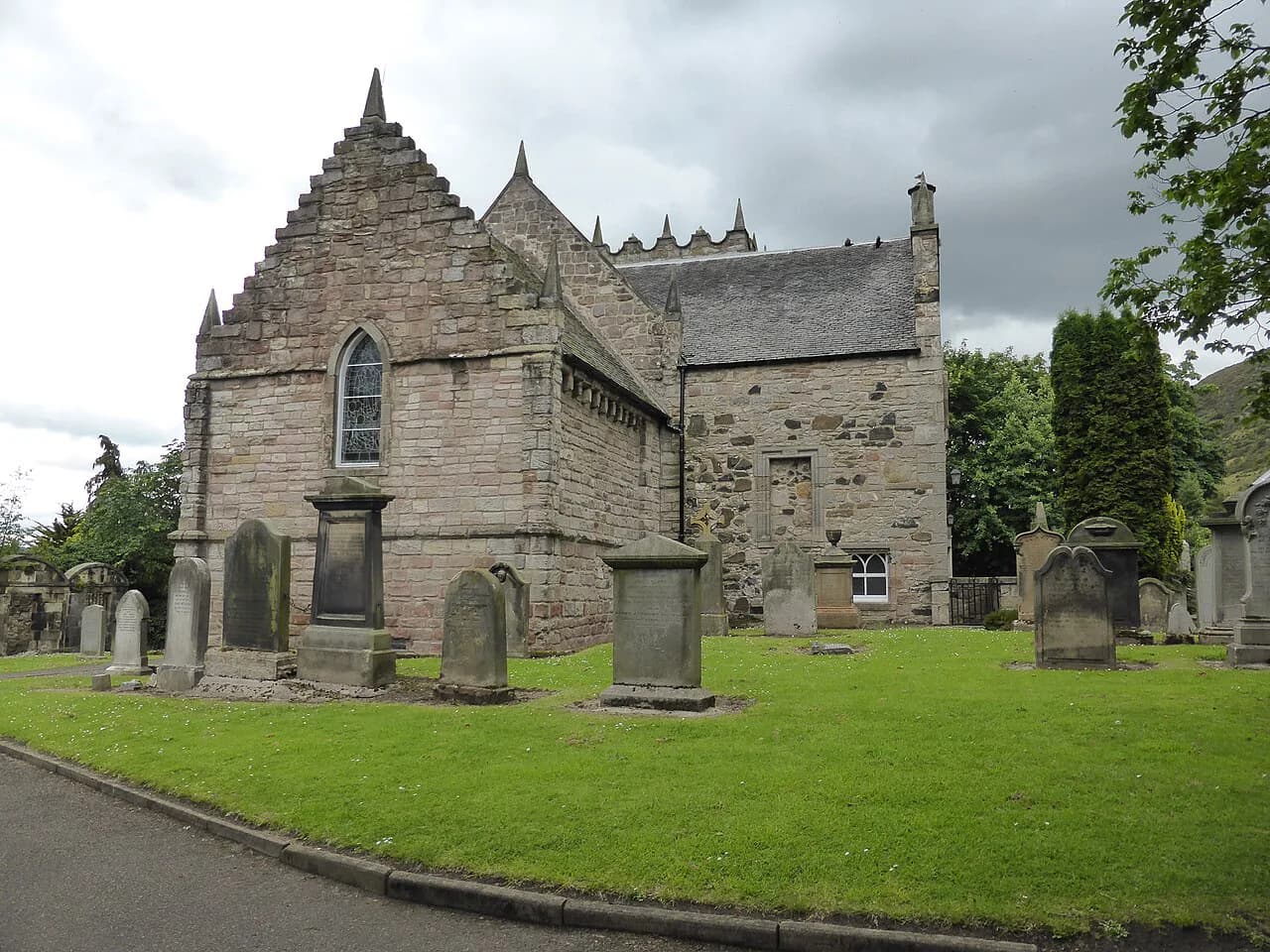
Duddingston Kirk traces its origins to the early 1100s, and its south wall is among the oldest surviving pieces of church architecture in the area. Builders substantially reworked the structure in 1631 and again in the 19th century, so today's silhouette mixes crow-stepped gables with later Victorian repairs. At the graveyard gate, look for the jougs, an iron neck collar once used to publicly shame minor offenders. Nearby stands the loupin-on-stane, a stone block that let riders mount their horses. A small guard house beside the entrance was built in the early 19th century to deter bodysnatchers from robbing fresh graves. Between 1998 and 2016, the theatre company Theatre Alba staged Edinburgh Festival Fringe productions in the Kirk's gardens. Its Passion Plays series ran there each Easter Sunday from 2003 until 2018. The Kirk's Garden Room café typically opens Thursday through Sunday in the warmer months for tea and cake. Hours shift seasonally, so confirm current days before planning a stop.
The Sheep Heid Inn: Inside Scotland's Oldest Pub
An inn has stood on this site since 1360, giving the Sheep Heid Inn its reputation as Scotland's oldest pub. Its current building dates mostly from the 18th century and was renovated in 2019, with a bar, two dining floors, and a courtyard. Out back sits a 19th-century skittle alley built around 1870, and a skittles club founded in 1882 still plays there weekly. Local tradition holds that Mary, Queen of Scots played skittles in the courtyard. In 1580, King James VI reportedly gave the landlord a ram's-head snuff box; the original is now kept at Dalmeny House, and a copy still sits behind the bar. Because Duddingston has almost no other cafes or shops, the Sheep Heid Inn functions as the village's only real dining stop. Check its site directly for current skittle-alley booking terms and opening hours before building a visit around a meal there.
When Bonnie Prince Charlie's army camped at Arthur's Seat in 1745, the Sheep Heid Inn had already stood on this site since 1360—nearly 400 years earlier.
Dr Neil's Garden and Duddingston Loch's Wildlife
Dr Neil's Garden sits behind a stone gate between the Kirk and the loch. Physicians Andrew and Nancy Neil began planting it in the early 1960s around a working physic garden of medicinal plants. Entry runs on a suggested donation rather than a fixed ticket, and the garden closes seasonally, so confirm current hours before visiting. Opening hours and layout details for the garden live in a separate Dr Neil's Garden guide. Beyond the garden, the loch has operated as a wildlife reserve since 1923 under the Scottish Wildlife Trust, which expanded the sanctuary onto adjoining Bawsinch land in 1971. The loch is best known for Henry Raeburn's 1790s painting of a minister ice-skating on its surface. A set of Bronze Age weapons, roughly 3,000 years old, was dredged from its waters in 1778 and is now held at the National Museum of Scotland.
The Back-Door Route Up Arthur's Seat From Duddingston
A car park sits just inside the Queen's Park gates near the village. From there, a stairway of roughly 400 steps climbs to a midpoint bench with views toward Dunsapie Loch and East Lothian. Beyond that bench, a grass slope continues to the summit, though this guide treats the ascent as an optional extension rather than the main event. Compared with the direct, heavily used path from Holyrood Palace, the Duddingston side sees fewer visitors and breaks the climb into a stepped section followed by a gentler slope. Past the Sheep Heid Inn, a Duddingston Conservation Society-run community land area also connects informally toward the Arthur's Seat paths, though the routing through it is easy to lose. For full route detail, elevation notes, and photo spots at the top, see the city's viewpoint-by-viewpoint guide.
The roughly 400 steps climbed from Duddingston see fewer visitors than the direct Holyrood Palace route, partly because the village lacks the shops and cafes that anchor neighboring alternatives.
Bonnie Prince Charlie and the Village's Jacobite Past
On the night of 19 September 1745, Bonnie Prince Charlie held a council of war in a village house ahead of the Battle of Prestonpans. That house is now traditionally known as Bonnie Prince Charlie's Cottage. His Jacobite army camped around Dunsapie Loch on Arthur's Seat while the council met. Documentary evidence for the exact cottage is limited, though local tradition has held firm for centuries. A different piece of village folklore comes from Reverend John Thomson, a former minister of Duddingston Kirk. Thomson is credited with the Scottish saying, "We're all Jock Tamson's bairns," meaning everyone is equal in the eyes of God, a phrase still used across Scotland today. Author and encyclopedist Dr. James Tytler also lived in the village in the 1770s and, in 1784, became Britain's first balloonist after rising 105 feet and landing safely nearby.
Planning Your Visit: Costs, Timing, and the No-Shops Rule
Most of Duddingston costs nothing to see. Entry to Duddingston Kirk, the loch path, and Dr Neil's Garden costs nothing fixed, though the garden asks for a suggested donation. The only real spend is food, since the village has no bakery, coffee shop, or convenience store. Budget for one proper meal at the Sheep Heid Inn, priced in line with any other traditional Edinburgh pub. Check the inn's own site for current menu prices and skittle-alley booking terms. Unlike Dean Village or Stockbridge, both known for their own row of cafes and boutiques, Duddingston keeps its commercial footprint to that single pub. Morning light suits photographs of the Kirk and loch, while a late-afternoon arrival times well with a pub dinner before the walk back. The most common mistake is treating Duddingston like a shopping street. There is exactly one pub and no row of cafes, so eat beforehand if timing does not line up with the inn's hours. Cobbled lanes, uneven kirkyard paths, and the climb toward Arthur's Seat all reward sturdy, flat-soled shoes over anything with a slick sole.
| Feature | Traditional Old Town Route | Duddingston Village Route |
|---|---|---|
| Atmosphere | High-energy, tourist-centric | Quiet, residential, historic |
| Dining options | Dozens of cafes and takeaways | One historic pub, the Sheep Heid Inn |
| Accessibility | Paved streets, though steep in places | Cobbled lanes, narrow, with steps near the Kirk |
| Arthur's Seat access | Direct path from Holyrood Palace, heavily used | Stepped route via the village, fewer crowds |
Pairing Duddingston With Nearby Edinburgh Highlights
Duddingston historically sat on the route between the Palace of Holyroodhouse and Craigmillar Castle, making it a natural stopping point for travelers moving between the two. That same position makes it easy to combine today. Holyrood Palace, at the far end of Holyrood Park, anchors the historic route's western end, while Craigmillar Castle's ruins mark its southern side. Portobello's promenade and beach sit a short distance away for a seaside contrast after the village's stone lanes. A seaside guide to Portobello covers how to get there and what to do once you arrive.
For trip-planning details, see The Water of Leith Conservation Trust.
For related deep-dives, see our Edinburgh in the Rain: The Ultimate Rainy Day Guide and Water of Leith Walk: Complete Route & Segment Guide (2026) guides.
Frequently Asked Questions
Is Duddingston village worth visiting on a short Edinburgh trip?
Yes, if a quiet, historic alternative to the Royal Mile fits the itinerary. A loop past Duddingston Kirk, Dr Neil's Garden, and the loch covers the village's core sights without needing a full day.
Are there shops or cafes in Duddingston village?
No, the village is almost entirely residential, with no convenience stores or rows of cafes. Plan meals around the Sheep Heid Inn, or the Kirk's seasonal Garden Room café, which typically opens Thursday through Sunday in summer.
How do you get from central Edinburgh to Duddingston village?
Lothian Buses routes 12 and 44 run from the city centre to the village. Walkers can follow Queen's Drive through Holyrood Park or the Innocent Railway path, and drivers should expect limited parking on the narrow local lanes.
Can you hike Arthur's Seat directly from Duddingston village?
Yes, a stairway of roughly 400 steps climbs from a car park near the village to a midpoint bench, and a grass slope continues from there to the summit. This route sees fewer crowds than the direct path from Holyrood Palace, though it still involves a genuine climb.
What does "Jock Tamson's Bairns" mean, and where does it come from?
This phrase means everyone is equal in the eyes of God, credited to Reverend John Thomson, a former minister of Duddingston Kirk. It is still used across Scotland today as a way of saying everyone shares common ground.
Is Dr Neil's Garden free to visit?
Entry runs on a suggested donation rather than a fixed admission price, and the garden closes seasonally. Check current hours directly with the garden before visiting, or see the dedicated Dr Neil's Garden guide for its full opening pattern.
Is there a war memorial in Duddingston?
Yes, a Celtic Cross war memorial erected in 1921 stands in the village, commemorating local residents who died in the First World War. It sits along the walking route near the Kirk, so it is easy to see without a detour.
When is the best time of day to visit Duddingston?
Morning suits photography, when the Kirk and loch tend to be quieter and the light is even. Late afternoon works well for combining the visit with dinner at the Sheep Heid Inn before heading back into the city.
Is Duddingston accessible for visitors with limited mobility?
Cobbled lanes, kirkyard paths, and the hillside setting include slopes and uneven surfaces that make a mobility-limited visit challenging on foot. Private transport that drops closer to the Kirk and pub reduces the amount of walking compared with the full route from central Edinburgh.
Continue exploring
More guides you'll find useful