
Two Days in Bolzano: A Slow Itinerary With One Mountain Half-Day
Plan two days in Bolzano around the arcades, Piazza delle Erbe and Ötzi, then add one half-day by cable car or castle, with tips on where to base yourself.
On this page
Bolzano rewards a slower pace than its compact size suggests. The city is marketed as the gateway to the Dolomites, and its own tourism board presents it as a place where Tyrolean and Mediterranean influences meet in the arcades, museums and wine. Two days is enough to cover the historic core properly and still fit one excursion beyond it, provided you resist cramming in a third.
This itinerary treats Day 1 as a walking day through Piazza Walther, the cathedral, the Via dei Portici arcades and the Piazza delle Erbe market. Day 2 pairs one museum with one half-day extension, either the Renon/Ritten cable car or a castle. That single trade-off is the decision that shapes a good two-day visit.
Quick Planning Frame: One Core Day, One Museum-and-Mountain Day
The simplest structure is to keep Day 1 entirely walkable inside the old centre and to reserve Day 2 for one ticketed museum plus one sortie out of the city. Splitting the trip this way means you never cross town twice in a morning. The main risk is trying to add a castle and a cable car on the same day, which leaves little time in either.
The city's own tourism board describes Bolzano as a compact destination with cable cars that lift you from the urban centre into mountain landscapes in minutes. That closeness is what makes a half-day extension realistic rather than a whole-day trip. Treat the cable car and the castles as alternatives, not a checklist. The tourism board's official site is the source for this claim about cable cars.
Where to Base Yourself to Avoid Backtracking
Staying within walking distance of Piazza Walther and the arcades removes most daily transfers. From there, the cathedral, the Dominican Church, the Piazza delle Erbe market and several museums sit close together, so you can return to your room between the morning and evening without losing time. A base outside the centre can be cheaper or quieter, but it adds a commute to each end of the day.
The tourism board lists its information offices at Piazza del Grano 11 and Via Alto Adige 60, which are useful landmarks when you orient yourself on arrival. Staff there can confirm current ticket arrangements and transport rather than relying on an old guide. If you plan a cable-car half-day, ask which valley station is closest to your accommodation before you commit to a hotel.
Day 1 Morning: Piazza Walther, the Cathedral and the Arcades
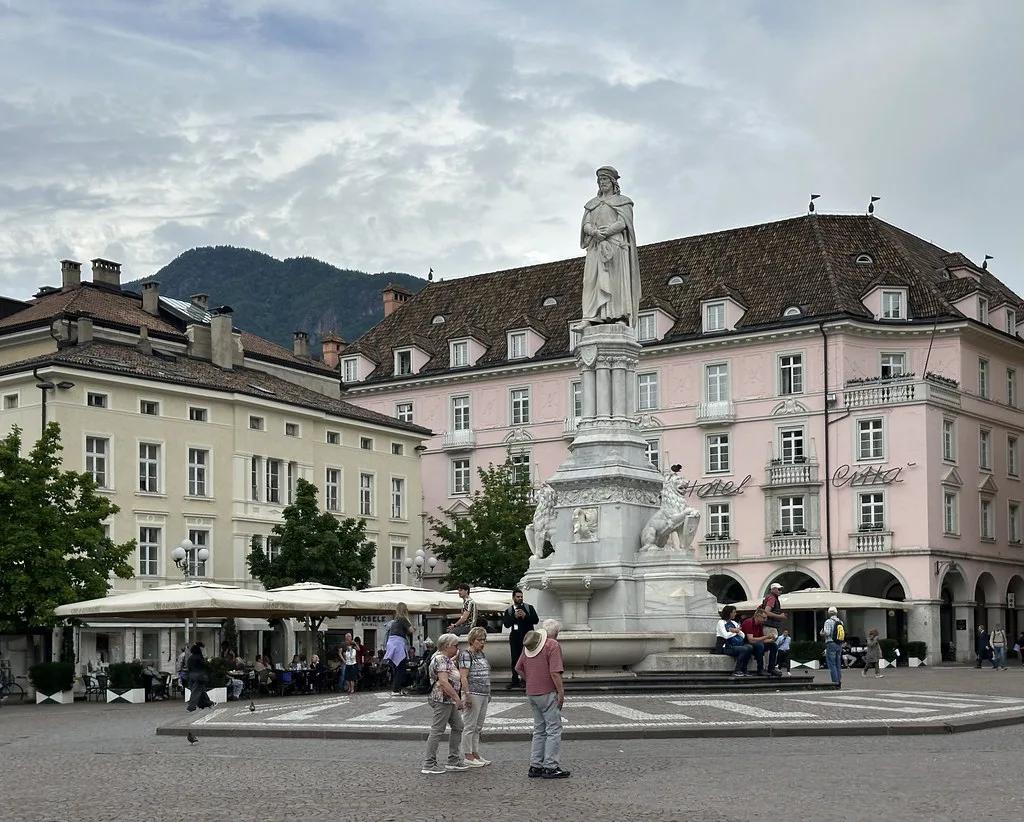
Start in Piazza Walther, the main square framed by cafés and the Gothic cathedral with its patterned roof. The cathedral exterior is the landmark, while the interior and any associated collections should be checked separately before you assume access. From the square, walk into the Via dei Portici arcades, the medieval shopping street where you can browse without committing to a purchase.
A few minutes on foot brings you to the Dominican Church, described by the Italo travel blog as one of the city's artistic highlights for its Giotto-school frescoes. The blog's walking route then continues to Piazza delle Erbe, where the fruit, vegetable, spice and flower market gives the morning its smell and colour. Keep your pace loose here rather than treating the market as a quick photo stop.
The same Italo blog states that the Piazza delle Erbe market is open every day of the week and closed on Saturday afternoons, Sundays and holidays. That wording applies to this market only, so do not extend it to other markets or shops. If your visit falls on a Sunday, plan the morning around the cathedral square and the arcades instead.
Day 1 Lunch and Afternoon: South Tyrolean Food and a Riverside Walk
Lunch is the moment to try speck, dumplings or a plate of Tyrolean and Mediterranean-influenced cooking. The Italo blog mentions Voegele in the centre and Forst near the museum as examples, but neither is a ranking, so choose by menu and availability rather than by reputation. Booking ahead helps at peak weekend lunchtimes.
In the afternoon, slow down along the Talvera riverside park or under the arcades. The Backroads guide suggests the leafy Talvera park as a place to relax with a glass of Gewürztraminer after a morning of walking. Treat the park as a suggested resting point rather than a verified free attraction, and check locally if you plan to combine it with a specific museum visit.
If you want more than the core sights, this is the moment to browse the city's hidden gems in Bolzano for quieter corners and short walks that fit between lunch and dinner. Keep any detour within the centre so Day 1 stays car-free and on foot. That discipline is what leaves Day 2 free for the mountain.
Day 1 Evening: Aperitivo and a Glass of Local Wine
Bolzano positions itself as a wine city, and the tourism board highlights the local wine routes alongside Lagrein and other South Tyrolean labels. An evening aperitivo under the arcades or in Piazza Walther is a low-effort way to end the day without another transfer. Ask for a glass of Lagrein if you want something dark and structured, or Gewürztraminer for something aromatic.
Resist the temptation to book a formal multi-course dinner and a wine tasting on the same evening. Two days is short, and a late night makes the Day 2 museum harder to enjoy. A single bar stop with a small plate keeps the next morning intact.
Day 2 Morning: Choose Between Ötzi and Museion
The South Tyrol Museum of Archaeology is the reason many visitors come to Bolzano, since it houses Ötzi the Iceman, a mummy estimated at over 5,000 years old according to the Italo blog. Museion, the city's contemporary art museum, offers a very different morning. Pick one rather than racing through both.
If you choose the archaeology museum, give it a focused two hours and leave the rest of the morning free for the half-day extension. If contemporary art appeals more, Museion is the calmer option and pairs well with a later start. Either way, confirm opening hours and ticket scope on the operator's own page before you go, since the travel blogs do not provide current admission details.
For a broader overview of the city's sights before you commit, the Bolzano Attractions hub gathers visitor guides to individual museums and monuments in one place. Use it to check which interiors are ticketed and which exteriors are simply free to walk past. That distinction matters when you are fitting a museum into a half-day.
Day 2 Half-Day Option A: The Renon/Ritten Cable Car
The Renon cable car is the quicker way to trade streets for altitude. The Backroads guide describes riding it up to the Ritten/Renon plateau to hike among the earth pyramids and take in views toward the Dolomites. The earth pyramids are a suggested stop rather than a verified free or always-open site, so check conditions on arrival.
This option suits travellers who want landscape rather than frescoes. It also keeps you close to the city, which means you can return for a late lunch without a long transfer. Cable-car schedules, frequency and journey times are not published in the sources used here, so confirm them with the operator on the day.
Day 2 Half-Day Option B: Castel Roncolo or Castel Firmiano
If frescoes and castle walls appeal more than mountain air, choose one castle. Castel Roncolo, also called Runkelstein, is known for its medieval frescoes and is reachable on foot from the centre according to the Backroads guide. Castel Firmiano, reachable by public transport, houses the Messner Mountain Museum Firmian and offers a different, mountaineering-focused visit.
Compare them by what you actually want to see: painted interiors at Roncolo versus the MMM Firmian collection at Firmiano. The Italo blog also notes that Roncolo sits in a panoramic setting and that Firmiano is the Messner Mountain Museum headquarters. Admission prices and opening days are not given in these sources, so check each operator's page before setting out.
Day 2 Evening: A Slow Dinner and an Easy Departure
Keep the final evening close to your accommodation and avoid a late booking that forces a rushed morning. A relaxed dinner with a glass of local wine is a better use of the last night than a second excursion. Pack before dinner so departure the next morning is straightforward.
If you are leaving by train, confirm your departure point and any ticket collection the day before. The Italo blog notes that Bolzano is served by high-speed rail, but specific timetables and journey times should be checked with the operator. This is also the moment to decide whether a third day is worth adding.
What to Defer If You Only Have Two Days
A third day is best spent outside the city rather than adding another museum. The Italo blog suggests a bike ride toward Lake Caldaro along the Oltradige Cycle Path, warning that the final stretch near the lake is not suitable for beginners. The Backroads guide mentions Dolomite villages such as Ortisei and Corvara as extensions, with approximate travel times that depend on your mode of transport.
If you cannot add a day, defer the second castle, the lake ride and any long Dolomite excursion. Two days should feel like a complete short break rather than a failed attempt at a week. That is the honest trade-off behind this itinerary.
Practical Notes: Language, Crowds and Checking Details
Italian, German and Ladin are all spoken in the region, and the Backroads guide suggests learning a few greetings in each. Signage in the centre is usually multilingual, but smaller sites may not be. Carrying the Italian and German names of a place helps when asking directions.
Seasonal crowds are heaviest around the Christmas market period, when Piazza Walther becomes the centre of attention. The tourism board promotes the Advent market, but exact dates vary by year and are not fixed in the sources used here. Check the city's official site before planning a winter visit around it.
Before any ticketed visit, confirm opening hours, closure days and what a ticket actually covers on the operator's own page. Several sights in Bolzano sit in complexes where one ticket does not automatically include everything. The travel blogs summarised here are useful for city-level planning, not for current admission rules.
Plan Your Visit
Two days in Bolzano work best when Day 1 stays on foot and Day 2 makes one clear choice: mountain or castle. Base yourself near Piazza Walther and the arcades to cut transfers, and keep the evenings simple so the second morning is not rushed. That structure leaves room for the city's slower pleasures rather than a race between ticket desks.
Use the city's official tourism site to confirm current information before you travel, and treat any blog itinerary as a starting point rather than a schedule. Prices, hours and transport details change, and the operator is always the final word. For related planning, see Bolzano Neighbourhoods Guide: Where to Stay for First-Timers.
Frequently Asked Questions
What is the best way to spend two days in Bolzano without backtracking?
Keep the first day entirely within the historic centre, covering Piazza Walther, the cathedral, the Via dei Portici arcades and the Piazza delle Erbe market on foot. On the second day, choose one museum, either the South Tyrol Museum of Archaeology or Museion, and pair it with a single half-day extension: the Renon/Ritten cable car or a castle such as Castel Roncolo or Castel Firmiano. Staying near the centre minimises transfers between these stops.
Should I choose the Renon cable car or a castle for my half-day?
The Renon cable car suits travellers who want mountain views and a short hike, as the Backroads guide describes riding it up to the Ritten/Renon plateau. A castle such as Castel Roncolo appeals more if you prefer medieval frescoes and a walk from the centre. Both options fit a half-day, but you should confirm current schedules, ticket prices and opening times with the operator before you go.
Is the Piazza delle Erbe market open on Sundays?
According to the Italo travel blog, the Piazza delle Erbe market is closed on Sundays, Saturday afternoons and holidays. If your visit falls on a Sunday, plan to explore the cathedral square, the arcades and the Dominican Church instead. Always check the market's current trading days with the local tourism office, as these details can change.
Sources
Continue exploring
More guides you'll find useful





