
Trieste in One Day: A Walkable Itinerary with Coffee Stops
One day in Trieste on foot: Piazza Unità d'Italia, Cavana lanes, the Canale Grande, San Giusto hill, historic cafés and an optional ticketed Miramare add-on.
On this page
Trieste suits a one-day visit because its headline sights sit close together: a sea-facing square, lanes that still feel part Habsburg, a single canal, a Roman theatre and a hill fort, all reachable on foot from the centre. The plan below is a suggested sequence, not an official schedule, so shift the timings to suit your pace and the weather.
One planning distinction matters more than any other: most of Trieste's best moments are free and outdoors, while the interiors at Miramare and the collections inside the San Giusto castle complex are separate, ticketed experiences. Build the day around the free fabric of the city, then decide whether a castle interior earns a slot.
Set Expectations: A Suggested Walking Plan, Not a Sprinted Checklist
Treat the route as a loop through the centre with a hill climb in the middle, starting at Piazza Unità d'Italia and returning there or to the Canale Grande for an evening drink. Count on a full day of walking with pauses, and wear shoes that handle cobbles, because Trieste's streets and the climb to San Giusto are hard on thin soles.
A car or public transport is what reshapes the day, not walking within the centre. If Miramare is the priority, budget a half-day for the gardens and interiors and accept that the old-town loop compresses; if you keep everything in the centre, the day stays relaxed. Either way, confirm current transport times and opening arrangements with the city's official tourism pages before you set out.
Morning Stop One: Piazza Unità d'Italia and Its Sea-Facing Palaces
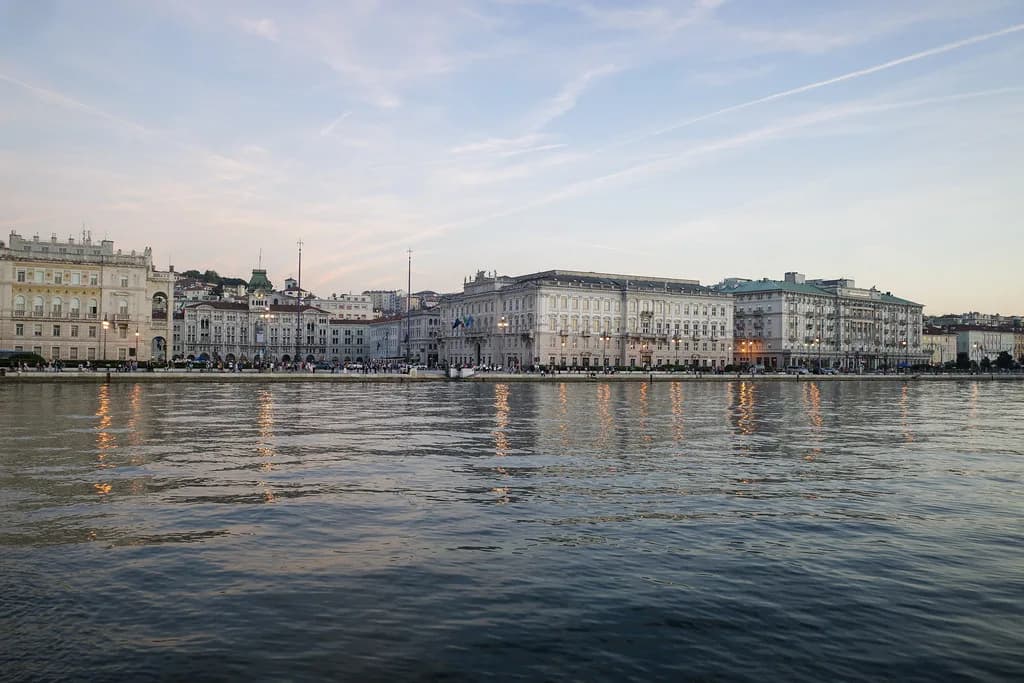
Start early at Piazza Unità d'Italia, described as the largest sea-facing square in Europe, where the town hall, government palaces and historic cafés frame an opening onto the Adriatic. Walk to the waterfront edge for the reverse view of the facades, then circle the fountain before the café terraces fill.
This is a free, open public space, which makes it the right anchor for a short day: no ticket queue, no fixed entry time. Caffè degli Specchi, dating from 1839, sits right on the square if you want the classic address, but you can equally take your first coffee elsewhere and keep the square as a place to look rather than spend.
For a wider sense of what surrounds the centre, including corners that reward a detour, the guide to hidden gems in Trieste is worth skimming before you fix your route.
Coffee Break: How to Order Like a Triestino
Trieste's coffee vocabulary is worth learning before you reach the bar. A nero is an espresso, a nero in B arrives in a small glass, and a capo in B is the local glass-served macchiato; ordering a cappuccino after lunch may draw a raised eyebrow even if you get served. Standing at the bar is cheaper and faster than taking a table, though table prices are not fixed nationally and vary by café.
Three historic cafés anchor different parts of the route: Caffè San Marco, open since 1914 and associated with the city's literary past, Caffè Tommaseo, serving since 1830, and Caffè degli Specchi on the square. Choose one for the morning ritual rather than trying all three, and treat the rest as landmarks you pass.
Menus and prices vary, so check the board or ask before ordering rather than relying on an old figure from a guidebook. If coffee culture is the reason you came, the coffee stop is the one place where spending a little more for a historic room makes sense.
Mid-Morning Walk: Cavana, the Arco di Riccardo and Piazza della Borsa
From the square, drift inland through Cavana, a neighbourhood of narrow lanes and small bars that becomes the city's evening drinking quarter but is quieter mid-morning. Look for the Arco di Riccardo, an ancient Roman arch embedded in the old streets, then continue to Piazza della Borsa, the former financial heart of the Austro-Hungarian port.
This stretch is where Trieste's layered identity is easiest to feel on foot: Roman stone, Habsburg facades and everyday shops within a few minutes. There is nothing to book and no gate to pass, so it also works as a flexible buffer if the morning has run long.
If you want to read the city through its imperial-era architecture rather than its churches, a self-guided Habsburg walk pairs naturally with this section of the route.
Canale Grande and the James Joyce Statue
The Canale Grande is a short walk from Piazza della Borsa, lined with cafés and historic buildings, with the Church of Sant'Antonio Nuovo at one end and the Serbian Orthodox church of San Spiridione nearby. The James Joyce statue stands on the bridge, marking the years the writer lived in Trieste, and it is an easy, photogenic pause rather than a sight that needs time set aside. The canal was built in the 1750s so that goods could be brought from the port into the heart of the city.
This is the strip for a second coffee or an early aperitivo if you are pacing yourself, but be aware it is the most overtly visitor-facing corner of the centre: pleasant for the view, less reliable for a serious meal. Off-season afternoons are calmer, and the canal is often prettiest in low winter sun when the narrow lanes elsewhere stay shaded.
The canal area also appears among the corners covered in the Canal Grande di Trieste guide, useful if you want to combine it with nearby lanes rather than treat it as a single stop.
Climb San Giusto Hill: Castle Exterior, Cathedral and the City-and-Sea View
San Giusto hill rises directly behind the old town, with the cathedral and the castle at the top and steep, cobbled lanes winding up. The climb takes patience rather than fitness, and the payoff is the view back over rooftops to the Adriatic, best taken slowly with stops.
The Roman Theatre sits at the foot of the hill on Via del Teatro Romano, free and open, identified in 1814 and unearthed in 1938 during demolition of the houses built over it. It takes minutes to look at and is worth a pause on the way up, but it is a sight to see rather than an event to attend, despite occasional summer use.
At the top, the cathedral blends Romanesque and Gothic elements with mosaics, and the castle and its grounds are free to wander while its interiors and collections are separately ticketed. Neither this guide nor any source sets current prices or hours here, so check at the gate or with the city's tourism office rather than carrying an old figure in your head.
For a longer trip that allows for the hill, the castle and a slower lunch, the Trieste 2-Day Itinerary shows how much breathing room a second day adds.
Free Versus Paid: What Actually Needs a Ticket
The free bucket on this route is generous: Piazza Unità d'Italia, the Cavana lanes, the Canale Grande, the Roman Theatre and the grounds around San Giusto all cost nothing to see. The paid bucket is narrower and specific: Miramare's interior and the collections inside the San Giusto castle complex, each ticketed on its own terms and priced separately.
Do not assume that a single castle ticket covers both the gardens and the rooms. At Miramare the gardens are free to explore while the museum interior requires a ticket, and mixed figures circulate for that ticket, so confirm current pricing with the official tourism portal rather than a blog or an old guidebook. The same discipline applies at San Giusto.
If the budget matters, the free things to do in Trieste guide packages the zero-cost half of the day together, which is a sensible way to decide what to keep when time tightens.
Lunch: What to Order for a Fast, Local Mid-Day Meal
Trieste's table is its history in food form: a Mediterranean base overlaid with Austrian, Slovenian and Jewish influences. Order jota, a hearty soup of beans and sauerkraut, or look for a buffet-style trattoria serving boiled meats and sauerkraut, which is the local shorthand for a quick, unfussy lunch.
Keep lunch near the old town so you can walk back into the route without a bus ride. Menus and prices vary by establishment, so check the board before sitting rather than relying on old figures, and expect no single 'correct' lunch spot to dominate the day.
Save room for a plum dumpling or a slice of strudel later, because the city's sweet side is part of its identity, and an afternoon coffee pairs well with either.
Optional Extension: Castello di Miramare, Its Gardens and a Ticketed Interior
Miramare rewards a half-day: a white castle on a promontory outside the centre, with free gardens designed by Archduke Ferdinand Maximilian of Austria and a museum interior that requires a ticket. It is not a quick detour, so decide in advance whether it is your centrepiece or a footnote, and do not try to fit it into the same hour as the evening drink.
Getting there involves leaving the old town by road or public transport along the coast, and drop-off points, timetables and line numbers do not belong in a fixed day plan because they change. Check current travel advice and any need to book a castle visit with the official operator before committing, and note that a special exhibition or an evening opening may change what is available.
If you have a full second day, the Trieste 3 day itinerary is the honest way to slot Miramare in without sacrificing the hill and the cafés that make the city itself.
What to Drop When the Day Runs Late
When the afternoon slips, cut in this order: the optional Miramare extension, then the castle interior on San Giusto hill, then a second corner of the canal. Keep the climb to the cathedral and the view, because that is the moment most people remember, and keep the evening aperitivo in the lanes.
Do not try to cram the Risiera di San Sabba, the former Nazi camp and now a memorial, into the same day. It is a site for a separate, slower visit with the gravity it deserves, and treating it as a stop on a sightseeing checklist would be wrong.
Nor does Grotta Gigante belong in a compact one-day city plan: it is a guided cave visit out in the Karst, at a constant eleven degrees, with steps and a booking recommendation, so it takes a dedicated half-day. Leave it for a longer trip and check the official site for current access arrangements.
Closing Loop: An Evening Aperitivo Back in the Old Town
End the day in Cavana, where the small bars fill as the sun drops and a spritz in the lanes makes more sense than a formal dinner. The walk back from the hill through the old town is short and downhill, so there is no need to book a taxi for a few hundred metres.
If you would rather end on the sea, the waterfront in front of Piazza Unità d'Italia at dusk is the other good option, and the light on the facades is the reason to plan the walk back into the square rather than straight home.
Practical Notes: Wind, Footwear and Confirming Details
The Bora wind is a planning constraint, not a piece of local colour: it can blow hard in winter and along exposed streets near the waterfront and the hill, and it can make a mild day feel raw. Pack a windproof layer whatever the season, keep the San Giusto climb flexible around gusts, and be prepared to swap outdoor time for a café if the forecast turns.
Because prices, opening hours and transport timetables all change, and because mixed figures circulate online, verify anything that matters directly with the official city tourism portal before you travel. That applies especially to the Miramare interior, the San Giusto castle collections and any special exhibition you are hoping to catch. Confirm the details that affect your day rather than trusting an old post.
Start Planning Your One Day in Trieste
One day in Trieste does not need a packed list: a square, a canal, a hill and two good coffees is a full and satisfying loop, and the optional castle at Miramare is the variable that decides whether you linger or move faster. Build the plan around the free outdoor fabric and treat the interiors as add-ons with a story.
Take care with the two constraints that trip up the unprepared: the wind and the climb. Add a windproof layer, wear proper shoes, and you will get far more from the city than any schedule can promise.
Frequently Asked Questions
Is one day enough to see Trieste?
Yes, for the centre: Piazza Unità d'Italia, the Cavana lanes, the Canale Grande, the Roman Theatre and San Giusto hill fit into a single day on foot. A trip to Miramare Castle and its gardens needs its own half-day, so save it for a second visit unless you are willing to drop the hill and the cafés.
Can you walk all of Trieste's main sights in a day?
You can walk the central sights, but there is one meaningful climb to San Giusto hill on cobbled lanes, so allow for a slower pace and comfortable footwear. Miramare is outside the centre and requires transport, so it is not part of the walkable loop.
What is free to visit in Trieste?
Piazza Unità d'Italia, the Cavana lanes, the Canale Grande and the James Joyce statue, the Roman Theatre and the grounds around San Giusto hill are free to see. Miramare's gardens are also free, while the castle interiors at Miramare and the collections inside the San Giusto complex are ticketed separately. Check current prices and opening arrangements with the official tourism portal before you go.
What should you order in a Trieste café?
Order a nero for an espresso, a nero in B if you want it served in a small glass, or a capo in B for the local glass-served macchiato. Ordering a cappuccino after lunch may be met with a raised eyebrow, but you will usually be served.
How do you get to Miramare Castle from central Trieste?
Miramare sits outside the centre on a coastal promontory and is reached by road or public transport rather than on foot from the square. Line numbers, journey times and ticket prices change, so confirm current connections and any booking requirement for the interior with the official operator before travelling.
What should you skip in Trieste if you only have a day?
Skip the Risiera di San Sabba, which deserves a separate, unhurried visit as a memorial, and skip Grotta Gigante, which is a guided cave visit out on the Karst and needs its own half-day. Also treat Miramare as an optional extension rather than a default stop.
Sources
Continue exploring
More guides you'll find useful





