Treviso Self-Guided Canal Walk: Canals, Frescoes & Old Centre
Plan a self-guided walk through Treviso's old centre, linking Piazza dei Signori, Calmaggiore, the Buranelli canal, San Francesco and the fish-market island.
On this page
Treviso rewards walking because its historic centre is compact, much of it is pedestrianised, and canals, arcaded streets and faded frescoes appear within minutes of one another. This route strings those pieces together in a logical order, so you are never doubling back to find the water.
Treat every duration here as a suggestion rather than an official figure. A comfortable half day covers the compact centre; add the walls and Sile riverbanks if you want a longer, quieter finish. The only fixed constraint in this plan is the civic museums' published pattern of Tuesday to Sunday, 10:00 to 18:00, closed Mondays.
Before You Go: Free Streets, Paid Interiors
Almost everything on this walk is exterior and free to look at: squares, porticoes, canal banks, bridges and church facades. The frescoed halls and museum collections behind those walls are separate, ticketed spaces, and you should plan them as deliberate stops rather than incidental detours.
The civic museums run three sites inside the walls, and the published hours apply to Museo Santa Caterina and Museo Luigi Bailo: Tuesday to Sunday, 10:00 to 18:00, closed Monday, with Casa Robegan opening only for temporary exhibitions. Check the site before you travel, because exhibition-driven openings change.
Church opening times and any entry charges are not something to guess. Verify them locally at the door or through the parish and diocesan channels before building a day around seeing a specific interior fresco cycle.
No single ticket is documented as covering every civic museum site, so budget attention rather than assuming one purchase opens all doors. If frescoes are your priority, choose one collection and give it proper time instead of sprinting through three.
Stop 1: Piazza dei Signori and Palazzo dei Trecento
Start in Piazza dei Signori, the civic heart of the city, framed by the Romanesque brick bulk of Palazzo dei Trecento and the adjoining Palazzo del Podestà with its civic tower. The square is ringed by porticoes where cafes set out tables, which makes it an easy orientation point and a natural place to linger.
The Palazzo dei Trecento, built around the early thirteenth century, still functions as a hall for council meetings and temporary exhibitions, so its interior is not simply a monument to wander into. Check what is showing before you count on getting inside.
Walk the perimeter once before moving on and look up: this is where Treviso's reputation as a painted city begins, with layers of decoration on facades that most visitors photograph without noticing. Keep the square as your mental compass for the rest of the route.
Stop 2: Calmaggiore and the Fountain of the Tette
From Piazza dei Signori, Via Calmaggiore runs towards the cathedral as the main shopping street of the centre, lined with arcades and the city's oldest commercial spine. It is the obvious next leg and needs no navigation.
The Fontana delle Tette sits in a shady alcove off the street, and the statue you see there is a copy; the original is kept in the Palazzo dei Trecento. The fountain's name and its wine-flowing history make it a quick, curious pause rather than a sight worth a long stop.
Stop 3: Piazza del Duomo and the Cathedral
Calmaggiore ends at Piazza del Duomo, where the Cathedral of San Pietro Apostolo presents a white neoclassical facade over much older Romanesque foundations. Inside, the Annunciation by Titian is the work most visitors come to see.
Give the exterior a few minutes before deciding whether to go in. The square itself is a calm reset between the commercial street behind you and the canal quarter ahead, and it is a sensible place to check the time against the rest of your plan.
Stop 4: San Nicolò and the Dominican Frescoes
A common assumption is that the Duomo is Treviso's largest church, but the more imposing building is San Nicolò, an austere Gothic structure a short walk away. Its scale and brickwork are the point as much as any single artwork.
The fresco cycle by Tomaso da Modena is the reason art-minded walkers detour here, and the nearby Sala del Capitolo dei Domenicani, frescoed by the same artist, adds another layer to the visit. Both belong to the medieval painted world that gave Treviso the name Urbs Picta.
Confirm access on the day rather than assuming the interiors are open when you arrive. A closed door here is a scheduling problem, not a reason to skip the neighbourhood, which is worth the walk regardless.
Stop 5: Piazza San Vito and the Canale dei Buranelli
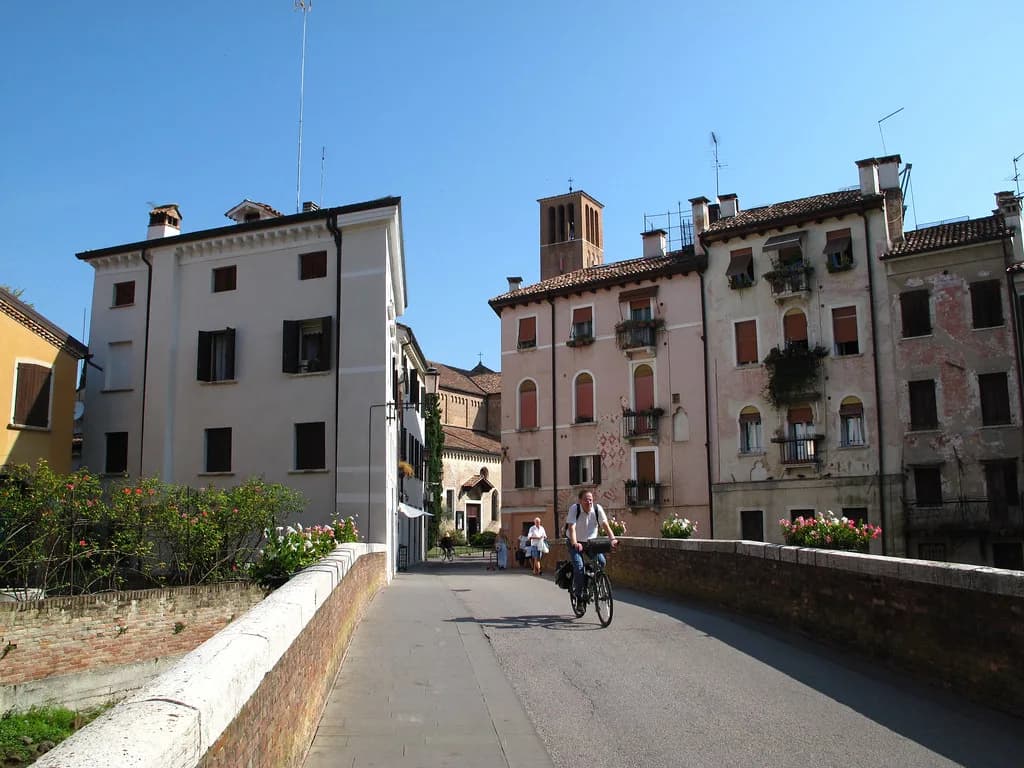
Piazza San Vito backs onto the Buranelli canal, and this is the water stretch to prioritise if your time is short. Wrought-iron bridges, a porticoed alley and the occasional old water wheel make it the most photogenic corner of the centre.
The canal takes its name from the Burano fishermen who once came here to trade, and the streets around it are lined with cafes and restaurants that make a good lunch stop.
Do not expect Venice. Treviso's canals are shallow and run perpendicular to the streets rather than carving the city into islands, and they carry no gondola traffic. What you get instead is green water, plant life and swans, which is a different pleasure entirely.
Stop 6: San Francesco and Its Frescoes
The church of San Francesco, a Romanesque-Gothic building not far from the canal quarter, holds frescoes by Tomaso da Modena and the tombs of sons of Dante and Petrarch. It is one of the stops where the interior, not the facade, repays the detour.
Pair it with the canal stretch rather than treating it as a separate excursion, since the two sit close together on foot. Check access when you arrive, as church hours are not published in the sources used for this route.
Stop 7: Isola della Pescheria and the Cagnan
The fish-market island sits in the middle of the Cagnan river, moved there by the Austrians in the mid-nineteenth century, and it remains a lively, characteristic corner of the city. The nearby Ca' dei Carraresi overlooks the islet and hosts exhibitions.
Market activity is a morning affair, so time this stop accordingly if you want atmosphere rather than empty stalls. Treat the island as a pause on the route, not a destination in itself.
Two Route Lengths: Compact Centre or Walls and Sile
The compact version ends at the fish market after roughly a half day at an unhurried pace, which is our suggestion rather than an official figure. It keeps the fresco interiors optional and leaves room for a proper lunch.
The longer version continues to the Sile riverbanks and the sixteenth-century walls, a tree-lined loop of about five kilometres around the historic centre with three surviving gates. Porta San Tomaso is the most impressive of them, and the walk is flat and easy to follow.
Walking the walls at midday in summer is the common mistake; the exposed tree-lined boulevard offers little shade at the hottest hours. Save this extension for late afternoon, when the light on the brickwork is better anyway.
Where to Pause: Coffee, Sandwiches, Tiramisu and Prosecco
Treviso is a city for small, specific food decisions rather than a single marquee meal. Build a sandwich from the deli counter at a traditional hostaria, take a coffee in a side street, or sit down for bigoli, the thick local pasta, at a trattoria near the centre.
Tiramisu is claimed by Treviso, with a popular account tracing it to Le Beccherie in 1969, though the dessert's origins are genuinely disputed. Treat the story as local lore worth hearing rather than settled history, and order a slice somewhere that takes it seriously.
Prosecco is the local pour, and the wine route towards Conegliano and Valdobbiadene begins from this province, so a glass with lunch is a sensible default. Menus and prices vary by season and venue, so read the board rather than relying on any guide's figures.
Museum Add-Ons: Santa Caterina and Luigi Bailo
If you want frescoes indoors, Museo Santa Caterina holds the cycle of the life of Saint Ursula by Tomaso da Modena alongside paintings by Titian, Longhi and Tiepolo. Museo Luigi Bailo covers the nineteenth and twentieth centuries in a converted monastery setting. Both are separate sites, and both close on Mondays.
Exhibitions rotate through these spaces, so check what is on before deciding which one gets your time. The 2026 programme includes a Tomaso da Modena anniversary strand and a Nino Springolo show, both dated and best confirmed on the museum's own listings.
Common Mistakes to Avoid
Assuming one ticket covers all the civic museums is the most frequent error, and it usually means rushing a collection you paid to see. Choose one site, give it an hour, and walk the rest of the city with your eyes up.
Skipping the fresco interiors entirely is the opposite mistake, especially for San Nicolò and San Francesco, where the painted cycles are the substance of the visit. Balance the two tendencies by planning exactly one indoor stop.
Treating Treviso as a Venice substitute leads to disappointment and missed detail. Come for arcaded streets, green canals, and a slower pace, and leave the gondolas to the lagoon.
Plan Your Visit
Walk this route on a weekday morning to catch the market atmosphere and reach the Buranelli canal before the lunch crowd. Keep Monday out of the plan if the civic museums matter to you, since both main sites are closed.
If the canals are what draw you, read more about the overlooked corners of the city in this guide to hidden gems in Treviso, then choose your indoor fresco stop from the Treviso Attractions hub before you set out.
Frequently Asked Questions
Is there anything to do in Treviso on foot?
Yes. The historic centre is compact and largely pedestrianised, so squares, arcaded shopping streets, canals, bridges and church facades can all be linked without transport. The main museums are separate ticketed stops and both close on Mondays.
How long does a self-guided Treviso walking route take?
A half day covers the compact centre at an unhurried pace, starting at Piazza dei Signori and ending at the fish-market island. Adding the walls and Sile riverbanks extends it further. These are suggestions, not official timings.
Do you need a ticket to see Treviso's frescoed churches?
The streets, squares and church exteriors are free to walk. Church interiors vary, so check at the door or with parish channels on the day. The civic museums are separately ticketed and publish Tuesday to Sunday, 10:00 to 18:00, closed Mondays.
Are Treviso's canals like Venice's?
No. Treviso's canals are shallower, greener and run perpendicular to the streets rather than dividing the city into islands. There is no boat or gondola traffic, and the appeal lies in plant life, bridges and quiet canal-side streets.
Is the Treviso fish market open every day?
Market activity on the Isola della Pescheria is a morning affair and not guaranteed daily. Check locally before making it a priority, and treat the island as a pause on the walk rather than a fixed appointment.
Sources
- What to see in Treviso: 8 must-visit places in the city of canals
- Treviso Travel Guide - Reasons to Visit this City Near Venice | Tuscany Now & More
- Treviso, Italy: A Visitor's Guide For Mindful Travelers - Caffeinated Excursions
- Treviso: what to see and what to do | ViaggiArt
- Piazza dei Signori site features - Goparoo
- Musei Civici Treviso - Sito Ufficiale dei Musei civici di Treviso
Continue exploring
More guides you'll find useful