
Day Trips from Siena: San Gimignano, Monteriggioni and the Val d'Orcia
Compare excursions from Siena to San Gimignano, Monteriggioni and Val d'Orcia towns by bus, car or guided tour, with transport cautions and return-planning.
On this page
Siena works well as a base. Once you have walked the centre, the hill towns around it become the obvious next move, and three directions stand out: San Gimignano to the north-west, Monteriggioni toward Florence, and the Val d'Orcia towns to the south. This guide compares them by transport, day length and season rather than ranking them.
A caveat shapes everything below. The detailed bus and train notes in the DiscoverTuscany day-trip article were last updated in May 2019, so line numbers, frequencies and journey times there are historical examples, not current facts. Use them to understand the shape of each trip, then confirm details with the operator before you travel.
Which Trip Suits Which Traveller
For a single memorable town on public transport, San Gimignano is the fuller day: the DiscoverTuscany article describes a direct bus from Piazza Gramsci and an alternative routing via Poggibonsi. Travellers with little time, or a taste for a short walk, may prefer Monteriggioni, where the same article notes a short ride plus roughly a kilometre uphill to the castle. The Val d'Orcia suits those with a full day and patience, because frequency matters more there than raw distance.
Think in three modes. Public transport keeps costs predictable but ties you to a timetable that thins in the evening, at weekends and outside summer. A car buys flexibility across scattered Val d'Orcia towns and lets you link two places in one loop. A small-group tour removes driving and timetable worries at the cost of following someone else's schedule.
If your stay is short, keep excursions minimal. With only a day in the city, a Siena one day itinerary covering Piazza del Campo and the cathedral will use your time better than a rushed bus out and back. With three days, one excursion plus two city days is a comfortable split, and the Siena three days itinerary shows what you would otherwise trade away.
Getting Oriented From Siena
Siena's compact centre makes excursions manageable: leave in the morning and return to the same streets by evening. The Comune di Siena homepage is a sensible orientation point, linking out to Visit Siena tourism information, the Palio's dedicated pages and city museums, so you can check what is happening before fixing excursion dates.
Outward buses have historically left from Piazza Gramsci in the centre, with some services also departing from the train station outside the walls. The DiscoverTuscany article describes the station as around a two-kilometre walk from the centre, downhill on the way there, with local buses covering the gap. Treat those specifics as how the network was arranged at the time of that article, not as a guarantee for your dates.
Before any excursion, anchor yourself in the city. Our guide to the hidden gems in Siena covers quieter corners such as the Basilica of San Domenico, useful when an excursion ends early or a plan falls through.
San Gimignano: Towers and a Full Day
San Gimignano earns a full day rather than a half. Its tower skyline and streets fill several hours comfortably, and the DiscoverTuscany guide suggests staying into the evening after daytime visitors thin out. It also cautions that services may be less frequent than the headline interval implies, so build slack into the return.
The public-transport version described in that source relies on a bus from Piazza Gramsci, with a fallback route via Poggibonsi that adds time. Because those line numbers and intervals date from 2019, look up the current timetable on the operator's own site the week you travel and note the last reasonable return.
Drivers gain little on the outbound run but more on the return, since they can leave after dinner without chasing a bus. If you are weighing a car for this trip alone, it is rarely necessary; save the rental for a Val d'Orcia day where the flexibility is worth more.
Monteriggioni: A Short Trip With a Walk
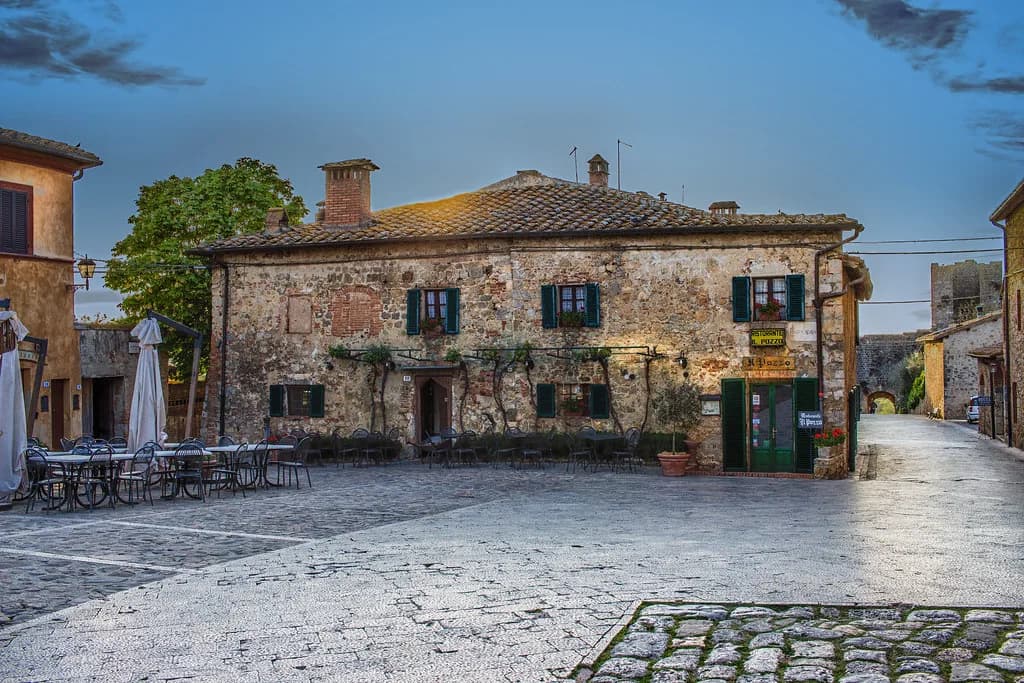
Monteriggioni is the closest thing to a half-day excursion here. The DiscoverTuscany article describes a bus from Piazza Gramsci taking around twenty minutes, then a walk of roughly a kilometre uphill to the castle. That final stretch is the decision point: with luggage, small children or in heat, it changes the trip's character.
Families may find the short ride and the reward of walls and towers easier to manage than a long day in San Gimignano. Our Siena with kids guide is a useful check on how much walking younger travellers handle comfortably before committing to the uphill approach.
Because the visit itself is compact, Monteriggioni pairs naturally with a slow morning in Siena or an afternoon back in the city. Check the return timetable before setting off, since the DiscoverTuscany source notes that this corridor was not always hourly.
Val d'Orcia Towns: Montalcino, Buonconvento, Montepulciano and Pienza
In the Val d'Orcia, frequency is the constraint more than distance. The DiscoverTuscany guide describes Montalcino as served by a bus mainly intended for hospital staff, running more often on weekdays and hardly at all on Sundays, and it advises checking both the outward and return timetable before leaving. That pattern, rather than any single line, is what to verify for your dates.
Buonconvento is the gentlest introduction, described in the same source as a short train ride with the station about five minutes' walk from the historic centre. Montepulciano and Pienza are a longer commitment, and the article cautions that winter return buses may be scarce enough to make a summer visit the safer choice.
This is where a car earns its place. Linking two Val d'Orcia towns in one day, or lingering over a long lunch without watching the clock, is easier on four wheels, though you will need to plan parking outside the historic centres. Tours with wine cellars and a traditional lunch are the third route; a Siena-based operator describes small-group tours limited to around eight participants.
The Public-Transport Reality Check
The most useful lesson from the DiscoverTuscany round-up is structural, not numerical. It reports that connections thin after about seven in the evening, that Saturdays and especially Sundays see fewer services, and that summer schedules are fuller than winter ones. Those patterns are worth testing against current timetables, whatever the line numbers have become.
Build your day around the return, not the departure. Pick the last connection you are confident of catching, work backwards to set your sightseeing limit, and keep a fallback in mind. Ticket validation rules and where to buy tickets should be confirmed locally rather than assumed from an old description.
If a plan collapses, Siena absorbs the change well. A rainy day in Siena has covered alternatives, and our Siena Attractions hub is the place to shortlist sights for the day you stay put.
What Changes When You Drive
A car turns the Val d'Orcia from a timetable puzzle into a loop of your own choosing and makes combining Montalcino with a smaller village realistic in a single day. It also removes the Monteriggioni uphill walk from a bus stop, though parking outside the walls still means walking in. The trade-off is that someone forgoes wine tasting, and historic centres are best left to pedestrians.
For San Gimignano alone, a car is usually the harder choice: you still park outside the walls, while the bus drops you close in. Reserve the rental for the day the scattered geography genuinely helps you.
Half Day or Full Day: Choosing and Cutting
A half day suits Monteriggioni, or a single Val d'Orcia town reached by an early train such as Buonconvento. A full day suits San Gimignano and any two-town Val d'Orcia plan, and the DiscoverTuscany guide's suggestion of leaving in the morning and returning in the late afternoon fits both.
When time is tight, cut the second town rather than the first. Rushing two places produces a blur of stops, and hill towns reward a slower pace. A workable rhythm for a three-day stay is one full-day excursion, one half-day trip and one unhurried city day, which the Siena Three-Day Itinerary builds around.
Guided Alternatives That Solve Transport
When the timetable problem outweighs the cost, a guided day trip is a legitimate answer. The Siena-based operator describes small-group day tours limited to eight participants, with winery visits, farm-to-table lunches and guides handling driving and routing; wine school sessions in the centre are a shorter alternative. Treat this as a commercial option, not an official recommendation.
Compare what you give up: departures are fixed, stops are chosen for you, and you cannot linger. What you gain is a managed return, commentary and often a winery visit that would be awkward to arrange independently without a car.
Towns Worth Knowing Beyond This Guide
Several other towns appear in the DiscoverTuscany round-up but sit outside this comparison's scope. Florence and Pisa are full-day city trips reached by bus or train, Colle di Val d'Elsa is a short ride toward Florence, and Rapolano Terme offers hot springs, which that article places within roughly forty minutes by bus or train.
Asciano, Monteroni d'Arbia and Castellina in Chianti round out the list, the last reached by a Chianti-bound bus whose afternoon services the source describes as sparser. Keep these as ideas for a return visit rather than squeezing them into a short stay.
Plan Your Visit
Choose San Gimignano for a classic full day, Monteriggioni for a short outing with a walk, and the Val d'Orcia for scenery that demands either patience with timetables or the freedom of a car. Whichever you pick, confirm services with the operator for your dates, because the detailed figures in the DiscoverTuscany article date from 2019 and schedules change.
Leave at least one day unplanned for Siena itself. Start with the city's official pages for orientation, then let current timetables rather than wishful thinking set your excursion days.
Frequently Asked Questions
Can you do day trips from Siena without a car?
Yes, for several destinations. Buses and trains connect Siena with towns such as San Gimignano, Monteriggioni, Buonconvento and, with more planning, Montalcino and Montepulciano. The constraint is frequency rather than distance: check the last return before you leave, and expect thinner services at weekends and outside summer.
Is San Gimignano or Monteriggioni the better short trip from Siena?
Monteriggioni suits a half day and, according to the DiscoverTuscany day-trip article, involves a walk of roughly a kilometre uphill from the bus stop to the castle. San Gimignano fills a full day with its towers and streets. Choose Monteriggioni if time is short or walking is manageable; choose San Gimignano if you want one substantial destination.
How many days in Siena is enough if you also want day trips?
Three days gives a comfortable rhythm: one full-day excursion, one half-day trip and one unhurried day in the city. With only one day in Siena, stay in the centre rather than spending it on a bus, and save the hill towns for a longer visit.
Is it better to visit Montalcino or Montepulciano from Siena?
The DiscoverTuscany article describes Montalcino as reachable by a bus that mostly ran on weekdays, with very few Sunday services. It presents Montepulciano as a longer commitment, warning that winter return connections may be scarce. If you want flexibility or want to combine towns, a car or a guided tour removes the timetable problem more reliably than public transport.
Are Val d'Orcia towns reliably reachable without a car year-round?
Not reliably. The DiscoverTuscany account notes sparse winter buses to Montepulciano and Pienza and advises checking timetables in both directions. Verify services with the operator for your travel dates before building a day around them.
Sources
Continue exploring
More guides you'll find useful





