
Ravenna Mosaics Explained: Byzantine and Early Christian Art
Learn why Ravenna holds so many early Christian and Byzantine mosaics, how to read the key images, and what to look for inside each UNESCO monument.
On this page
Ravenna packs an unusual concentration of early Christian and Byzantine mosaics into a walkable historic centre, which is why the city works so well as a short art-focused stop rather than a checklist of churches. The Opera di Religione della Diocesi di Ravenna runs five of the diocesan monuments as a single visiting circuit, and its own planning page suggests roughly three hours to cover the whole tour, with shorter individual visit times for each building. Treat that as the operator's suggestion and not a rule, then build in buffer for looking properly.
The most common mistake is to arrive without knowing what you are looking at, then leave having admired the gold but missed the argument the images are making. A second mistake is to assume all eight UNESCO monuments share one ticket; the diocesan group is ticketed and booked through the Opera, while other sites are handled separately. A few minutes of reading before you go changes what you notice inside.
Why Ravenna Has So Many Mosaics
Ravenna became the capital of the Western Roman Empire in the fifth century and later the seat of the Ostrogothic court under Theodoric, before passing to Byzantine rule in the sixth century. Each regime built and decorated for its own legitimacy, which is why the city holds such a dense sequence of baptisteries, basilicas and chapels from a relatively short span of time. UNESCO inscribed the early Christian monuments of Ravenna as a World Heritage site in 1996, recognising eight locations across the city.
That political sequence matters when you stand in front of a mosaic, because the imagery often carries a message about who held power and which version of Christianity was official. Sant'Apollinare Nuovo, for example, was built by Theodoric as a palatine basilica and later converted to Catholic orthodoxy after the Goths were driven out, a change still visible in the decoration. Knowing this turns a beautiful wall into a document.
How to Read a Ravenna Mosaic
A mosaic is built from tesserae, small cut pieces of stone or glass, set at slightly different angles so that light catches them unevenly and the surface appears to shimmer. Gold areas were typically made with gold leaf sealed behind glass, which is why they read as luminous rather than simply yellow. Once you know this, you start noticing how the makers used tilt and spacing to control reflection rather than relying on painted shading.
Early Christian art moved away from the three-dimensional modelling of Roman painting towards flatter figures, frontal poses and simplified shapes, partly because mosaic as a medium limits subtle modelling. Scale often signals importance rather than distance, so a more significant figure can be larger regardless of where they stand in the scene. When you look at a panel, ask who is biggest, who faces forward, who looks at whom, and what each figure holds.
Narrative order is the other key. Many Ravenna schemes run in bands, with gospel scenes above and processions of saints below, so you read upward and along rather than taking the whole wall in at once. Pick one band, follow it from left to right, and the logic of the composition usually becomes clear within a few panels. If you only have one pass through a building, spend it on a single band rather than trying to absorb everything.
The Diocesan Group in the Historic Centre
The Opera di Religione della Diocesi di Ravenna manages five monuments in the old town: the Mausoleum of Galla Placidia, the Basilica of San Vitale, the Basilica of Sant'Apollinare Nuovo, the Neonian Baptistery, and the Chapel of Sant'Andrea with the Archiepiscopal Museum. They sit within a compact area and can be reached on foot, which is why the operator's suggested three-hour circuit is realistic for a focused visit. Individual visit times differ sharply, from a few minutes in the smallest buildings to around twenty-five minutes in the larger basilicas.
Do not treat the group as a single building. Each monument has its own character and its own admission slot, and the operator advises booking timed entry in advance to avoid queues and crowding. Current prices, opening times and any multi-day ticket conditions belong on the operator's info and prices page, since these are exactly the details that change between seasons. Check that page shortly before your trip rather than relying on older guides.
Mausoleum of Galla Placidia: Stars, Shepherd and Crosses
The Mausoleum of Galla Placidia is small, dim and easy to underestimate from outside, and it is the building most likely to be rushed. Built in the first half of the fifth century as an oratory attached to the Holy Cross church, its interior is organised around the triumph of the cross over death, read from the bottom upward. The central dome carries a cross surrounded by stars, with the four evangelist symbols in the corners beneath it.
Above the entrance door is the Good Shepherd lunette, and on the opposite wall Saint Lawrence carries a cross as he moves toward martyrdom, with a cabinet of the gospels beside him. Between the apostles, doves drink at a vessel, and pairs of deer drink at a pond on the eastern and western lunettes, imagery drawn from the psalm comparing the soul's longing to a deer thirsting for water. Look for those small repeating motifs rather than only the famous blue ceiling.
The building was never the resting place of Galla Placidia herself, who died in Rome in 450 and was buried in the family vault there. It was separated from its church in 1602 and has stood as an independent monument since. Knowing that prevents the most common misreading of the site.
San Vitale and the Imperial Panels
The Basilica of San Vitale is the monument most people have seen photographs of before arriving, and the apse panels of Justinian and Theodora are the reason. Look at what each figure carries and where their hands fall: the emperor's position and the objects held by the retinue carry claims about sacred authority and offering rather than simple portraiture. The mosaic survives in the apse, while other surfaces show later interventions, so read the whole interior rather than only the golden panels.
Nearby stands the Mausoleum of Galla Placidia, which the operator describes as both an ally and a rival of San Vitale: whichever you enter first, the other continues the argument. That proximity is a practical gift, because the two buildings can be paired in a single stop without crossing the city. Give San Vitale the longer share of your time.
Sant'Apollinare Nuovo and Its Processions
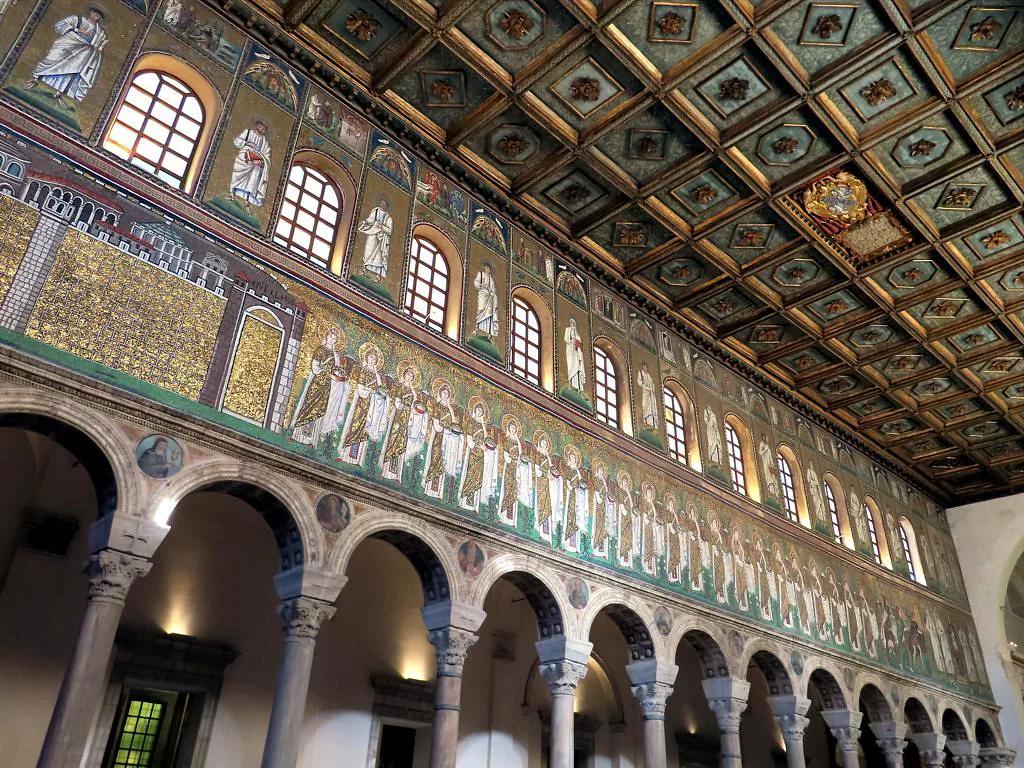
From the street, Sant'Apollinare Nuovo is easy to miss, tucked behind a flowerbed and set back from the road, and its plain exterior gives little away. Inside, the side walls carry the sequence that makes the building famous: rows of male saints on one side and female martyrs and virgins on the other, moving in rhythm toward Christ enthroned and toward the Virgin with the Magi kneeling before her. Their faces lack individual features and their bodies are flattened, an effect of Byzantine isotypy rather than careless work.
The upper band holds scenes from Christ's life, with miracles and parables on one wall and the Passion and its aftermath on the other, each framed by ornamental canopy motifs. The lower band shows the port city of Classis and the palace, and the palace mosaic retains traces of figures that were removed after Theodoric's court fell out of favour. Look for surviving hands and fragments where figures once stood.
The apse mosaics here were lost centuries ago, so do not arrive expecting a golden semi-dome as you would find at Sant'Apollinare in Classe. The nave walls are the reason to come, and they justify the operator's suggestion of around twenty-five minutes in the building. If you read only one band, take the processions.
Beyond the Diocesan Core: Other Mosaic Sites
Ravenna's UNESCO listing covers eight locations, and the remaining three are ticketed separately from the diocesan group: the Arian Baptistery, the Basilica of Sant'Apollinare in Classe, and the Mausoleum of Theodoric. The Arian Baptistery was built under Theodoric for Arian worship and preserves a dome mosaic including a nude figure of Christ with the river god Jordan beside him. Note that the afternoons can be limited at some of these smaller sites, so check the current opening arrangements before planning them later in the day.
Sant'Apollinare in Classe sits outside the historic centre in the Classe district, several kilometres from the old town, which changes how you plan the day. Local tourism information describes reaching the Classis Museum and the basilica via a dedicated cycle path, by bus from the station, or by taxi, and pairs the basilica with the Classis Museum as a single outing. Verify current transport arrangements before relying on any single line.
Timed Entry, Booking and Splitting Your Visit
The operator asks visitors to book timed entry in advance for each diocesan monument, and entry is organised around those slots rather than open arrival. If your schedule is fixed, book before you travel; if it is loose, booking at the start of your stay still gives you flexibility across days. Check the current ticket conditions directly with the operator, because validity and pricing are not fixed facts you should take from a secondary page.
A practical route when arriving by train is to start at Sant'Apollinare Nuovo, a short walk from the station, then continue to the cathedral area for the Neonian Baptistery and the Archiepiscopal Museum, finishing at San Vitale and Galla Placidia. The operator gives this sequence along with walking times of roughly a quarter of an hour between clusters, which is useful for judging whether you can fit the circuit around another commitment. Treat the sequence as a suggestion and adjust for your own pace.
Where the Mosaics Sit in the Rest of the City
Beyond the mosaics, Ravenna rewards slow wandering between visits, and a few sights sit naturally alongside the mosaic circuit without needing their own day. Dante's tomb and the Zone of Silence lie in the centre, near the Basilica of San Francesco, whose flooded crypt is a curious stop between monuments. The Basilica of San Francesco appears among the quieter corners worth adding to a Ravenna itinerary when you have time between timed entries.
If your interests stretch beyond late antiquity, the city's mosaic identity continues into modern work, including contemporary mosaics and workshops, which is why Ravenna reads as a living craft centre rather than a museum city. Balance the UNESCO interiors with an unhurried walk through the streets between them. That contrast is often what people remember.
Mistakes to Avoid
The single most common confusion is between Sant'Apollinare Nuovo in the historic centre and Sant'Apollinare in Classe out in the district of the same name. They are different buildings, different tickets and different journeys, and mixing them up can cost you half a day. Read the full name before booking or setting out.
The second is to treat the smallest buildings as filler. Galla Placidia and the Neonian Baptistery are compact, but the density of imagery inside them is higher than in the large basilicas, and they are the places where rushing costs you most. If you must cut something, cut a second basilica rather than the small monuments.
The third is to assume one ticket covers the full UNESCO list, which it does not. The diocesan group is sold and booked through the Opera, while the Arian Baptistery, Sant'Apollinare in Classe and the Mausoleum of Theodoric sit outside that arrangement, and each site may have its own slot or admission terms. Build your day around that split rather than discovering it at the door.
Plan Your Visit
Ravenna rewards preparation more than most art destinations: a little knowledge about tesserae, symbolic scale and narrative bands turns a room of gold into a legible argument. Choose two or three monuments to study properly rather than racing through all eight, and check current prices, hours and booking conditions with the operator shortly before you go.
Start with Galla Placidia and San Vitale as a pair, add Sant'Apollinare Nuovo for the processions, and treat Classe as a separate excursion if time allows. Leave space between timed entries for the streets in between.
Frequently Asked Questions
Why are there so many Byzantine and early Christian mosaics in Ravenna?
Ravenna was the capital of the Western Roman Empire in the fifth century, then the seat of Theodoric's Ostrogothic court, and later came under Byzantine rule. Each period of power produced churches, baptisteries and chapels decorated with mosaics, and eight of those buildings were inscribed as a UNESCO World Heritage site in 1996, preserving an unusually dense group of works from a short historical window.
How do I read a Ravenna mosaic without an art history background?
Start with composition rather than detail. Ask who is largest, who faces forward, who looks at whom and what each figure holds, since size usually signals importance and frontal poses signal presence rather than realism. Then follow one horizontal band from left to right, such as the gospel scenes in the upper register of Sant'Apollinare Nuovo, instead of trying to absorb the whole wall at once.
What is the difference between Sant'Apollinare Nuovo and Sant'Apollinare in Classe?
Sant'Apollinare Nuovo is in the historic centre and is known for its nave processions of martyrs and virgins with gospel scenes above. Sant'Apollinare in Classe sits in the Classe district several kilometres away and is a separate ticket, usually paired with the Classis Museum. Confusing the two can cost you a long walk or a missed booking.
Can you see all the UNESCO monuments in one day?
It is difficult. Not all eight share a ticket, and Sant'Apollinare in Classe lies outside the centre, so combining everything in one day means a lot of moving around with little time to look. Many visitors do the five diocesan monuments in the centre and treat Classe as a separate half day, verifying current opening arrangements beforehand.
Do the eight UNESCO monuments share a single ticket?
No. The Opera di Religione della Diocesi di Ravenna manages five monuments in the centre, while the Arian Baptistery, Sant'Apollinare in Classe and the Mausoleum of Theodoric are handled separately. Check current ticket scope, prices and multi-day conditions directly with the operator before you commit to a schedule.
How much time should I plan for the diocesan monuments?
The operator's planning page suggests around three hours to cover the whole diocesan tour, with individual buildings ranging from a few minutes to roughly twenty-five minutes each. That figure is a suggestion rather than an official rule. Add extra time for the buildings you find most absorbing, and remember that timed entry slots shape how quickly you can move between them.
When is the best time to see the mosaics?
Mosaic surfaces respond to light, and interiors such as Galla Placidia and San Vitale are dim, so allow your eyes time to adjust and look for the shimmer created by angled tesserae. The operator publishes an evening openings page and a notices page, which is where seasonal evening access and any temporary changes are announced. Check those pages before assuming a particular evening visit is available.
Sources
- Ravenna Mosaici – Opera di Religione della Diocesi di Ravenna
- The Cold Chronicles of Early Christian Art (Ravenna) – IMAGE
- Early Christian Monuments of Ravenna: eight incredible sites that make Ravenna an unmissable city
- Discover Classe - Private Guided Tour of the Basilica of Sant’Apollinare in Classe and the Classis M - Visit Ravenna
- 24h on the ways of Dante in Ravenna | Emilia Romagna Tourism
- Mausoleum of Galla Placidia – Ravenna Mosaici
- Basilica of Saint’Apollinare Nuovo – Ravenna Mosaici
- Plan your visit – Ravenna Mosaici
Continue exploring
More guides you'll find useful





