Parma Rainy Day Guide: Indoor Things to Do and Museums
Plan a rainy day in Parma with the Pilotta complex, free cathedral, ticketed Baptistery and small museums, plus how to check hours and ticket scope first.
On this page
A rainy day in Parma rarely means staying in, because the historic centre packs an unusual number of long indoor visits into a few walkable blocks. The trick is to anchor the day on one site that can absorb two or three wet hours, then fill the gaps with short church stops that cost nothing and demand no booking.
Budget expectations vary sharply between venues: Parma's cathedral is free to enter, while the Baptistery and Diocesan Museum are ticketed, and the Pilotta complex sells one ticket covering several collections inside a single palace. Those scopes are not interchangeable, so treat each site as its own decision rather than assuming a single city pass.
Why Parma suits a wet day better than most small cities
Parma is compact enough that most of the sights below sit within a short walk of Piazza Garibaldi and Piazza Duomo, so you are never stranded far from shelter. That density matters in rain: instead of a cross-city dash, you can step from a palace interior to a church porch to a cafe table without a long exposed stretch.
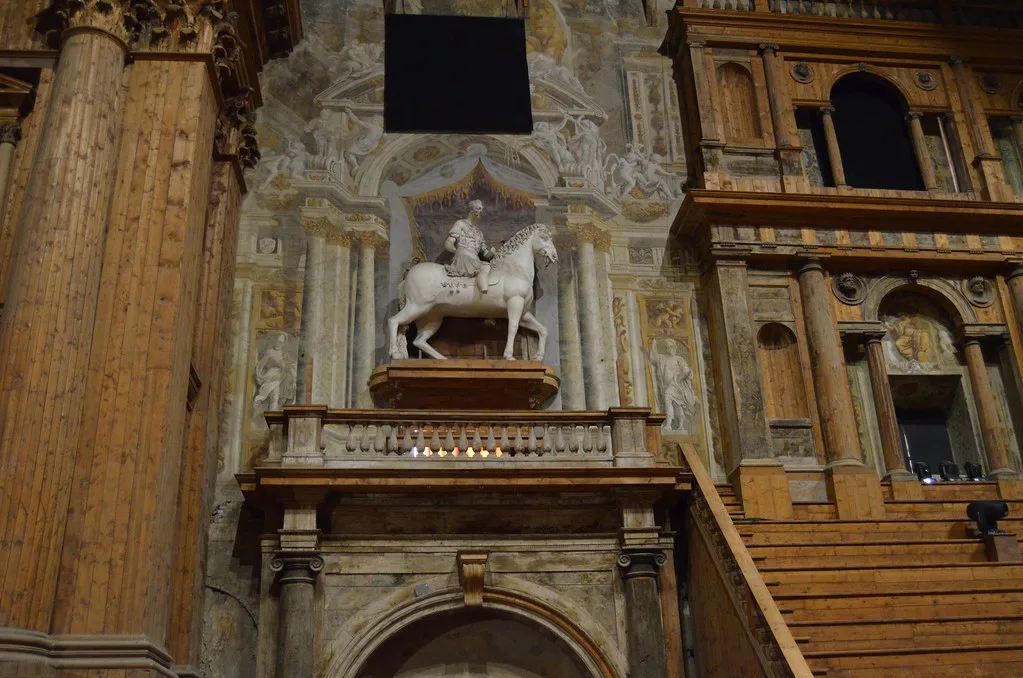
One useful reference point is the Teatro Farnese inside the Pilotta, described as a wooden theatre built for Duke Ranuccio Farnese between 1617 and 1618 and later restored after wartime damage. Whether or not you time a performance, the building is a genuinely indoor set piece that rewards a slow look rather than a quick photo stop.
Rain also changes the rhythm of a short city break: one 2024 guide suggests Parma can be covered as a day trip or stretched over a night or two, and wet weather is a good argument for the slower version. Fewer stops, longer interiors.
Start with the Palazzo della Pilotta
The Pilotta is the obvious first anchor because it holds several collections under one roof in the Farnese palace complex. A recent guide lists the archaeological museum, the Teatro Farnese, the Palatine library, the Galleria Nazionale and the Bodoni printing museum within it, and advises choosing what interests you most because a full visit can run to several hours.
Ticket scope is the detail to pin down before you arrive: that same 2024 guide describes a single admission covering the group of attractions, with a separate reduced rate for visitors aged 18 to 25. Check the palace's own published ticket page on the day you plan to visit rather than relying on any figure quoted in a travel article, including this one.
If you only have one wet afternoon, pick two collections rather than racing through all of them. The theatre and the national gallery make a logical pair, and leaving the library and archaeology for a return visit keeps the day humane.
Choosing inside the Pilotta: gallery, theatre, library or archaeology
The Galleria Nazionale is the art-heavy option, with a collection that a local guide describes as running from medieval religious art through to the twentieth century, housed in airy nineteenth-century rooms. Give it at least an hour if paintings are your priority, and expect to move slowly through the earlier rooms.
The Teatro Farnese is the shortest satisfying stop. One review roundup notes that the all-wood theatre was largely destroyed in a 1944 bombing raid and painstakingly restored to its original design, which explains why it reads as both ancient and immaculate.
The Palatine library and the Bodoni museum suit anyone who prefers books and printing to paintings, and they are quieter spaces to wait out a downpour. Confirm current access arrangements at the ticket desk, since individual rooms within large complexes can be closed for study or conservation without affecting the main ticket.
Piazza Duomo under cover: the free cathedral and the ticketed Baptistery
Parma's cathedral is the rare major Italian church that costs nothing to enter, and a German-language guide notes that admission is free with visits suspended during services. That makes it a dependable shelter stop, but plan around Mass times rather than treating the doors as permanently open.
Inside, Correggio's dome fresco of the Assumption is the reason to linger, and the same guide places its execution in the 1520s to early 1530s, a milestone that anticipated later Baroque ceiling painting. Stand beneath it for a few minutes rather than photographing from the doorway.
The Baptistery beside it is a separate, paid monument: the same source describes a combination ticket for the Baptistery and Diocesan Museum, quoting a regular and a reduced rate at the time of writing. Treat those figures as a dated reference point and confirm the current price and pass options with the Piazza Duomo administration, which publishes opening hours and visiting passes.
The octagonal building of pink Verona marble is worth the ticket on a wet day precisely because its interior rewards close looking at the reliefs and the painted vaults. A reference entry on the Baptistery notes four levels of open loggias and eight turrets around a central dome.
San Giovanni Evangelista: the quieter first Correggio dome
Directly behind the cathedral stands San Giovanni Evangelista, and its dome holds Correggio's earlier treatment of the same upward-spiralling idea he later pushed to its limit at the Duomo. Seeing this one first makes the cathedral dome easier to read, and the church is free to enter with roughly forty minutes suggested for the nave and dome.
The left-aisle chapels carry frescoes by Parmigianino painted when he was very young, which means two major Parma painters sit within a few steps of one another. That concentration makes the church a better rain shelter than its modest exterior suggests.
The cloisters and the historic Spezieria di San Giovanni, a Benedictine pharmacy preserved with its shelving and jars, are managed separately from the church and keep varying hours. Ask inside rather than assuming access, and do not build your route around the pharmacy unless someone on site confirms it is open.
Museo Glauco Lombardi: Napoleon, Maria Luigia and the Palazzo di Riserva
For a change of register, the Museo Glauco Lombardi in Palazzo di Riserva collects art and documents from Parma's eighteenth- and nineteenth-century ducal period, centred on Maria Luigia d'Asburgo, Napoleon's second wife and from 1816 duchess of Parma. The museum's own site introduces this scope and lists current exhibitions and events.
The collection began with the purchases of Glauco Lombardi, a Colorno-born collector who spent decades gathering objects from the Bourbon and Marie-Louise periods, and the museum opened in the Palazzo di Riserva in 1961 before becoming a foundation. Knowing that history explains the intimate, domestic feel of the display.
Highlights include an official 1812 portrait of Marie Louise, a painting of the King of Rome with his mother, the imperial wedding gift basket and the duchess's own fortepiano. Check the museum's contacts and tickets page for current opening days, since small foundations often keep shorter hours than the large civic museums.
Camera di San Paolo and other small indoor stops
The Camera di San Paolo, frescoed for a Benedictine abbess, is sometimes suggested as a rainy-day stop, but access arrangements and any inclusion in a combined ticket should not be assumed. Confirm directly with the site or the city's tourist information before walking over, and keep a backup plan so a closed door does not derail the afternoon.
Beyond the big names, Parma has a scatter of small museums covering music, printing and church history, and a local guide describes the Casa della Musica in Palazzo Cusani as free to enter. Because such details age fastest of all, verify each one on the day rather than trusting a published list.
Food as shelter: long lunches and covered detours
Parma's food culture is itself an indoor activity, and a wet day is a fair excuse for a slow lunch of culatello, Parmigiano Reggiano and torta fritta with Lambrusco. A local guide recommends a cold-cut platter as the natural way to start a meal here, which suits a rainy schedule better than a rushed sandwich.
Covered markets and salumerie also offer dry browsing: the Ghiaia market, which the same guide says began in its square in the nineteenth century and takes place weekly, spreads into the neighbouring streets. Check the current market days before you go, since a wet midweek morning and a wet Saturday are different propositions.
If the rain sets in properly, consider a food or cheese-factory tour as an alternative to walking between churches; several are listed with free cancellation options on booking platforms, and indoor production rooms keep you dry. Morning departures are common, so book a day ahead and read the meeting point carefully.
A wet-day route that limits backtracking
Start at the Pilotta when it opens, spend the morning in the gallery and theatre, then walk to Piazza Duomo for the free cathedral and, if tickets appeal, the Baptistery. This sequence keeps you in the densest part of the centre and leaves the afternoon open for San Giovanni Evangelista, two minutes behind the cathedral.
Finish with the Museo Glauco Lombardi on Strada Garibaldi, which puts you close to Piazza Garibaldi for an aperitivo or an early dinner if the weather has not eased. If you have only half a day, drop the Pilotta's smaller collections and keep the gallery.
Practical notes on hours, riposo and queues
The single biggest risk on a rainy day is arriving at a closed door, because many smaller Italian sites keep reduced hours or close over the middle of the day. Build the day around one confirmed anchor and treat everything else as optional, checking official pages such as the Piazza Duomo site for the cathedral and Baptistery and the individual museum sites for the rest.
For orientation on the ground, Parma's tourist information offices can confirm which sites are open and which passes are currently sold, and they are a sensible first stop if the rain is heavy. Ask specifically whether a pass covers interiors or only exteriors, since that distinction changes what a wet day is worth.
Finally, leave slack in the schedule for queues at the most popular interiors, and keep a short indoor alternative in reserve. A single booked highlight plus two free churches is a more realistic wet-day plan than a checklist of six museums.
Plan Your Visit
A rainy day in Parma works best as one long museum visit, one free church interior and one long lunch, with the ticketed monuments slotted in only if the weather really closes in. Check each venue's own page for current hours and ticket scope before you leave your hotel, because the small separately managed sites change fastest.
Frequently Asked Questions
What can you do in Parma when it rains?
Anchor the day on the Palazzo della Pilotta, which holds several collections under one roof, then add the free cathedral and San Giovanni Evangelista nearby. The Baptistery, Diocesan Museum and Museo Glauco Lombardi are separately ticketed indoor options. Confirm current opening hours with each venue before setting out, since smaller sites may close over lunchtime.
Is the Palazzo della Pilotta a good rainy-day activity?
Yes, because it contains the Galleria Nazionale, the Teatro Farnese, the Palatine library, the archaeological museum and the Bodoni museum in one palace. A recent guide advises choosing what interests you most, as a full visit can take several hours. Check the ticket scope on the palace's own site before you rely on one admission covering everything.
Do you need a ticket for Parma Cathedral?
No, the cathedral is free to enter, though visits are suspended during religious services. That makes it a reliable shelter stop on a wet day, but plan around Mass times rather than assuming the doors are always open. The Baptistery and Diocesan Museum next door are ticketed separately.
Is the Baptistery covered by the same ticket as the cathedral?
No. The cathedral is free, while the Baptistery and Diocesan Museum are sold as a separate ticket, and one published reference quoted a combination price at the time of writing. Treat any figure you read as a dated reference and confirm the current pass options with the Piazza Duomo administration before buying.
How long does San Giovanni Evangelista take to visit?
Allow around forty minutes for the church and its dome, longer if the cloisters and the historic pharmacy are open. Those spaces are managed separately from the church and keep varying hours, so ask inside rather than assuming access. The church is free and sits directly behind the cathedral, making it an easy addition to a wet morning.
What is the Museo Glauco Lombardi about?
It covers Parma's eighteenth- and nineteenth-century ducal period, centred on Maria Luigia d'Asburgo, Napoleon's second wife and later duchess of Parma. The collection grew from Glauco Lombardi's own purchases and opened in the Palazzo di Riserva in 1961. Check the museum's own contacts and tickets page for current opening days.
Can you visit the Camera di San Paolo?
Access arrangements should be confirmed directly with the site or with Parma's tourist information before you walk over. Do not assume it is open or included in any combined ticket. Keep a backup indoor stop in reserve so that a closed door does not disrupt a wet afternoon.
Sources
- Hoạt động tham quan tạiParma | Những hoạt động hấp dẫn nhất tại ở Parma
- An authentic guide to visit Parma like a local in 2026 | Visititaly.eu
- Discover Parma: Top things to do in this charming city
- San Giovanni Evangelista, Parma: Correggio's Other Dome
- Museo Glauco Lombardi – Maria Luigia e Napoleone – Parma tra '700 e '800
- The Glauco Lombardi Museum - napoleon.org
- Piazza Duomo Parma - Cathedral, Baptistery, Bishop's palace
- The Cathedral of Parma: Between Romanesque and Renaissance | Vivere in Italien
- Teatro Farnese - One of the most beautiful wooden theatres in the world | Ita.travel
- Teatro Farnese Reviews | Tripexpert
Continue exploring
More guides you'll find useful