
Lecce in Two Days: Itinerary for the Centre and Beyond
Plan two days in Lecce with a suggested split: Baroque squares and papier-mâché workshops on day one, then a coast or Valle d'Itria excursion if you have a car.
On this page
Lecce rewards a slower approach than its sight count suggests. The historic core is compact and largely pedestrianized, built from warm tan stone, and the pleasure lies in strolling between squares rather than ticking off monuments. Two days is our suggested duration, not an official requirement: it lets you give the centre one unhurried day and still keep part of a second for crafts, a museum or a short excursion into the Salento.
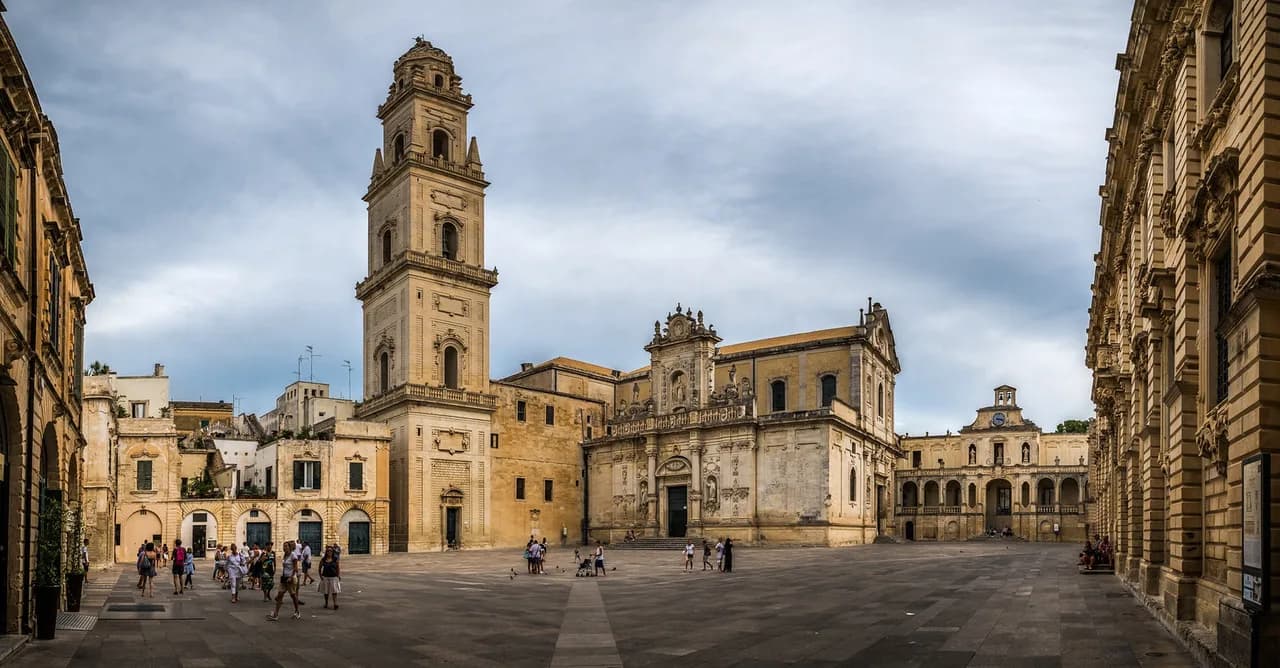
The city sits in the middle of the Salento peninsula, which makes it a practical base as well as a destination. Italia.it frames a weekend here around the white Lecce stone, the historic gates and most of the Baroque churches, and suggests visiting Piazza del Duomo near sunset, when the light softens the stone. Treat that as a good scheduling cue, then build the rest of the day around walking distances rather than transport.
Why Two Days Suits Lecce
Lecce is not a city of blockbuster must-sees. A local guide describes it as somewhere you visit to enjoy rather than to chase the next museum, and notes that the centre was largely restored over the past two decades. That character suits a two-day plan: one dense day of architecture and squares, one flexible day that bends toward crafts, collections or the sea.
The compactness is the real advantage. Porta Rudiae, Piazza del Duomo, the Basilica di Santa Croce, Sant'Irene and Piazza Sant'Oronzo all sit within the historic centre, so a single day on foot covers the Baroque spine without rushing. Save the second day for anything that requires leaving the walls or slowing down further, and use the Lecce Attractions hub to pick which churches repay a closer look.
The Suggested Split: One Day In, One Day Out
Our recommendation is to spend day one entirely inside the centre and to reserve day two for one of three choices: the castle, Roman theatre and craft workshops; a museum that matches a specific interest; or a half-day excursion toward the coast. Trying to combine all three on the same day produces a rushed, car-dependent schedule that undercuts what makes Lecce pleasant.
If your time is tighter than two days, the Lecce in One Day itinerary concentrates on the gates, Duomo, Santa Croce and Sant'Oronzo, and it is worth knowing what you would be cutting. The two-day version adds breathing room for coffee stops, an afternoon rest and an evening aperitivo, which the local guide treats as part of the daily rhythm rather than an indulgence.
Day 1 Morning: Porta Rudiae Into the Baroque Centre
Start at Porta Rudiae, the oldest of the city's historic gates, where busts of the city's founders stand on the columns and a statue of St Oronzo crowns the top. Walking through it puts you inside the old centre within minutes and gives the day a natural narrative arc through the city's fortified past.
From there, head to Piazza del Duomo and look at the cathedral exterior and bell tower before going further. Because the same city guide recommends the square at sunset for the light, loop back in the evening rather than treating it as a single morning pass, and check the cathedral's own notices on site for whether interiors are open when you visit.
Keep the morning loose. The pleasure of this centre is in the side alleys, the balconies and the carved facades that reveal themselves at particular angles. A short pause for coffee in a square is not lost time here; it is the point.
Day 1 Midday: Santa Croce, Sant'Irene and Sant'Oronzo
The Basilica di Santa Croce and the adjoining Convento dei Celestini are the highest expression of Lecce Baroque, with carved rose windows, floral friezes and layered stonework. Italia.it says the convent can only partly be toured and that it now houses the Prefecture, so treat the church and the convent building as two separate things rather than assuming one entrance or one ticket covers both.
Continue to the Church of Sant'Irene dei Teatini, dedicated to the saint who was the city's patron until 1656, then walk on to Piazza Sant'Oronzo. There the Roman amphitheatre and the 29-metre column of Sant'Oronzo anchor the main square, which Italia.it describes as the heart of city life rather than a monument to file past.
If you want context for what you are seeing, a guided walk helps. Baroque effects were designed around specific sightlines and heights, so details hide in plain view until someone points them out. The local guide's suggested tour content covers the main square and amphitheatre, a stretch of the corso, the Duomo, Santa Croce and at least one of the original gates.
Day 1 Afternoon and Evening: Siesta, Aperitivo, Wine
Plan around the afternoon lull rather than fighting it. The local guide notes that between about two and four in the afternoon the city slows, some businesses still close for a few hours, and the heat is at its least forgiving; a rest now buys you energy for the evening. This rhythm is strongest in smaller towns but still shapes how Lecce feels.
In the evening, head toward Porta San Biagio and Piazzetta Santa Chiara, which Italia.it names as popular meeting places with plenty of restaurants, clubs and pubs. For wine without driving, the local guide recommends the enoteca Crianza for its Pugliese selection, with Negroamaro and Primitivo as the best-known grapes and the region's rosés worth seeking out.
Cocktail bars cluster behind the cathedral around Via Paladini and just outside Porta Napoli. If you want one name, Quanto Basta is the one the local guide calls best known, but the cluster matters more than any single address, so pick by atmosphere and walk on if a place is full. Confirm current opening days directly with any venue before building an evening around it.
Day 2 Option A: Castle, Roman Theatre and Cartapesta
Stay in town and start with the Castle of Charles V on Viale XXV Luglio, a sixteenth-century fortress that Italia.it describes as the city's cultural centre, hosting exhibitions and events. Pair it with the Roman theatre, reached on foot from Porta San Biagio and tucked among ordinary buildings, which makes it easy to miss if you are not looking for it.
Then give cartapesta proper time. This is a working craft in Lecce, used for church statues and the ceiling of Santa Chiara as well as for small figurines sold as souvenirs and nativity pieces. The local guide says workshops still operate in the old town, names Cartapesta Riso as a good place to see the work, and notes that searching cartapesta on a maps app will surface about a dozen options.
A gates walk ties the day together without repeating day one. The local guide calls Porta Napoli the most monumental of the three surviving gates, while Porta Rudiae and Porta San Biagio sit in different quarters, so moving between them carries you through some of the prettiest streets. Walking the gates needs no ticket; individual churches and museums along the way may have their own arrangements.
Day 2 Option B: Museums That Match a Specific Interest
The Jewish Museum and the Faggiano Museum often appear in Lecce lists, but the local guide is candid that you would not be missing anything major by skipping both in favour of an aperitivo or gelato. That is useful information: choose them if the subject genuinely interests you, and otherwise spend the time on the streets.
If you do go, treat them as two separate collections with their own visiting terms. None of the sources here establishes shared tickets, opening hours or booking rules for either, so check each one directly rather than planning around an assumption.
Book lovers have a third option worth looking into: the Convitto Palmieri complex, whose courtyard and cloisters also contain the Church of San Francesco della Scarpa, known as the church without a facade, and the Bernardini Library, which Italia.it describes as one of the largest in Apulia. Check access arrangements to the library before counting on it.
Day 2 Option C: A Half-Day on the Salento Coast
Lecce sits centrally on the peninsula, and the local guide estimates about half an hour by car to Otranto on the Adriatic, Gallipoli on the Ionian, or Santa Maria di Leuca where the two coasts meet. For a single half-day, pick one direction rather than circling the whole peninsula. Day Trips from Lecce to Gallipoli and Inland Salento covers the Ionian and inland option.
Beach choice matters more than distance. The same guide describes long sandy stretches with beach clubs on the western coast north of Gallipoli, naming Porto Cesareo, and sands north of Otranto at Torre dell'Orso and Baia dei Turchi. Much of the rest of the coast is rocky, with clear water and fewer people, as at San Foca and Torre Sant'Andrea.
The car-versus-tour trade-off is simple. The SP358 between Otranto and Santa Maria di Leuca is described by the local guide as a cliff-hugging drive of almost 80 kilometres, but it is a drive, so someone must stay sober and focused. Without a car, tour operators run day trips; with one, you choose your own stops but take on parking and winding roads.
Food and Drink Cues for the Two Days
Start a morning with a pasticciotto, the shortcrust pastry filled with custard that the local guide says is always served warm; Italia.it suggests it as a breakfast before day two. For lunch or dinner, look for cucina povera dishes such as fava bean purée with chicory or orecchiette with broccoli rabe, which one traveller's account found at Trattoria alle Due Corti and Le Zie. Treat named restaurants as leads and check opening days yourself.
For more unusual local plates, the guide lists horse meat stewed in tomato sauce, raw shellfish, snails cooked with onion and bay leaf, and roasted lamb organs. These are acquired tastes, so order one to share before committing to a full portion. Our what to eat in Lecce guide covers the local dishes in more detail.
Where Two Days Is Not Enough
Two days covers the centre comfortably but leaves the wider region untouched. Inland, the local guide suggests the Valle d'Itria and its trulli country around Alberobello, Ostuni and Martina Franca as a day trip, and adding more coast time is the other obvious extension. If either appeals, add a night rather than compressing it into the second afternoon.
You will also want to leave room for the city itself. Those who rush Lecce in a day see the sights but miss the evening passeggiata and the early-morning quiet, which the local guide treats as the parts worth remembering. Our hidden gems in Lecce page extends the trip beyond the main squares when you have extra time.
Practical Planning Notes
This guide deliberately does not quote ticket prices, opening hours, closure days or booking requirements for churches, museums or the castle, because the sources used here do not establish them. Check the Comune di Lecce website and each attraction's own page shortly before you travel, and confirm church interiors separately from the squares and public ground outside them.
Getting around the centre is on foot, which is the main reason to stay inside the walls or close to them. For the coast and the SP358, decide in advance between a rental car and an organised tour, and remember that some businesses still observe a midday break, so build a slower lunch into the plan.
Plan Your Visit
Two days in Lecce works best as one day of Baroque stone and squares, followed by a second day that follows your curiosity rather than a checklist. Give the centre its evening light and its morning quiet, take the afternoon lull seriously, and treat the museums and the coast as choices rather than obligations.
Before you go, confirm the practical details that this guide does not state: opening arrangements, ticket terms and transport schedules. If your plans grow beyond two days, the Day Trips from Lecce to Gallipoli and Grecìa Salentina and the hidden gems pages extend the trip naturally without repeating what you have already seen.
Frequently Asked Questions
Is two days enough for Lecce?
Two days is a good suggested duration rather than an official requirement. It gives you a full day for the historic centre, including Porta Rudiae, Piazza del Duomo, Santa Croce, Sant'Irene and Piazza Sant'Oronzo, plus a second day for craft workshops, a museum or a half-day excursion. If you also want the Valle d'Itria or more beach time, add a night.
What should you do on day one in Lecce?
Start at Porta Rudiae and walk into the old centre, look at the cathedral and bell tower in Piazza del Duomo, then continue to the Basilica di Santa Croce, the Church of Sant'Irene dei Teatini and Piazza Sant'Oronzo with its Roman amphitheatre. Keep the afternoon slow, rest during the midday lull, and loop back toward the Duomo in the evening before an aperitivo near Porta San Biagio or Piazzetta Santa Chiara.
Should you use Lecce as a base for the Salento coast?
Yes, if you are comfortable with a short drive or an organised tour. Lecce sits centrally on the peninsula, and a local guide estimates about half an hour by car to Otranto on the Adriatic, Gallipoli on the Ionian, and Santa Maria di Leuca where the coasts meet. For a two-day trip, pick one direction rather than attempting a full circuit.
Are the Jewish and Faggiano museums worth visiting in Lecce?
They are worth it only if their subjects interest you. A local guide states plainly that skipping both in favour of an aperitivo or gelato would not leave you feeling you had missed something major. If you go, treat them as two separate collections and check each one's own opening arrangements and ticket terms before setting out.
Do you need a car for a Lecce two-day trip?
Not for the centre, which is compact and largely pedestrianized. You only need a car, or an organised tour, for the coast and the SP358 drive between Otranto and Santa Maria di Leuca. Without a car, several operators run day trips; with one, you gain flexibility but take on parking and cliffside roads.
What local food should you try in Lecce?
Begin with a warm pasticciotto, then look for cucina povera dishes such as fava bean purée with chicory and orecchiette with broccoli rabe. More adventurous options include horse meat stewed in tomato sauce, raw shellfish and snails cooked with onion and bay leaf. For wine, seek out Negroamaro, Primitivo and the region's rosés.
Sources
Continue exploring
More guides you'll find useful





