
Ferrara Self-Guided Walking Route: Half-Day Historic Centre Plan
Plan a half-day Ferrara walking route linking the castle, cathedral, Via delle Volte, Palazzo dei Diamanti and a wall stretch, with sourced visiting times.
On this page
Ferrara rewards travellers who walk it without a schedule. The historic centre is flat, compact and listed by UNESCO, so a morning or afternoon on foot covers a castle, a cathedral square, two Renaissance palaces and a stretch of the old walls without any transport.
This plan is a suggested order, not an official itinerary. One self-guided audio tour operator measures a comparable route at roughly 3 km and about three hours at an unhurried pace, which is a useful planning figure rather than a verified standard; add time for any interior you enter.
Why Ferrara Suits a Self-Guided Walk
The old centre sits inside nine kilometres of walls that enclose the monuments, and the tourism board presents that circuit as something to walk or ride, which makes orientation simple even on a first visit. Streets are level and the distances between the headline sights are short, so the main planning decision is not how to get around but how many interiors to fit in.
If you want company, the Ferrara Greeters programme pairs visitors with volunteer residents for a free walk of a couple of hours, capped at groups of six. It is a conversation with a local rather than a guided tour, so it works well as an alternative for anyone nervous about navigating alone, but it requires a request in advance rather than a walk-up booking.
Route at a Glance
A workable order runs Porta Paola and the walls, Via delle Volte, Castello Estense, Piazza Trento e Trieste and the cathedral, then Corso Ercole I d'Este to Palazzo dei Diamanti, with Palazzo Schifanoia and Sant'Antonio in Polesine held back as optional additions. Finish by rejoining a wall stretch and curving back toward the station or the centre.
Treat the operator's roughly three-hour, 3 km figure as an estimate for the walking and looking, not for the whole outing. Museum entries, a coffee stop and the monastery detour each add time, so a half day is realistic only if you pick one or two interiors rather than all of them. The same applies to most routes through the centre; the second tour operator listing a one-day historic-centre itinerary treats the full set of stops as a full day rather than a morning.
Start at Porta Paola and the City Walls
Beginning at Porta Paola gives you the medieval walls before the palaces, and several city guides suggest this gate as a natural first stop. Walk a short stretch of the ramparts first: the grassy banks and brickwork explain how the city was defended long before the Este family rebuilt its centre.
The walls are free and open to anyone at any hour, which makes them a low-risk opener if you arrive early or your train is delayed. If a longer traffic-free loop appeals, the city council publishes mobility notices and road changes that can affect approaches to the centre, so check the municipal site when your walk coincides with works or events.
Via delle Volte and the Medieval Lanes
From the walls, drop into Via delle Volte, the arched medieval lane that once linked warehouses to small artisan workshops. The overhead arches and uneven cobbles make it a place to slow down rather than march through; look up as often as ahead, because the details sit above eye level.
This is the part of the route where a self-guided format pays off, since the lane is a thoroughfare rather than a ticketed sight and you can linger without holding up a group. Continue toward the centre when the arches end, and keep the Jewish Ghetto area in mind as an extension if you have extra time.
Castello Estense: Outside Versus Inside
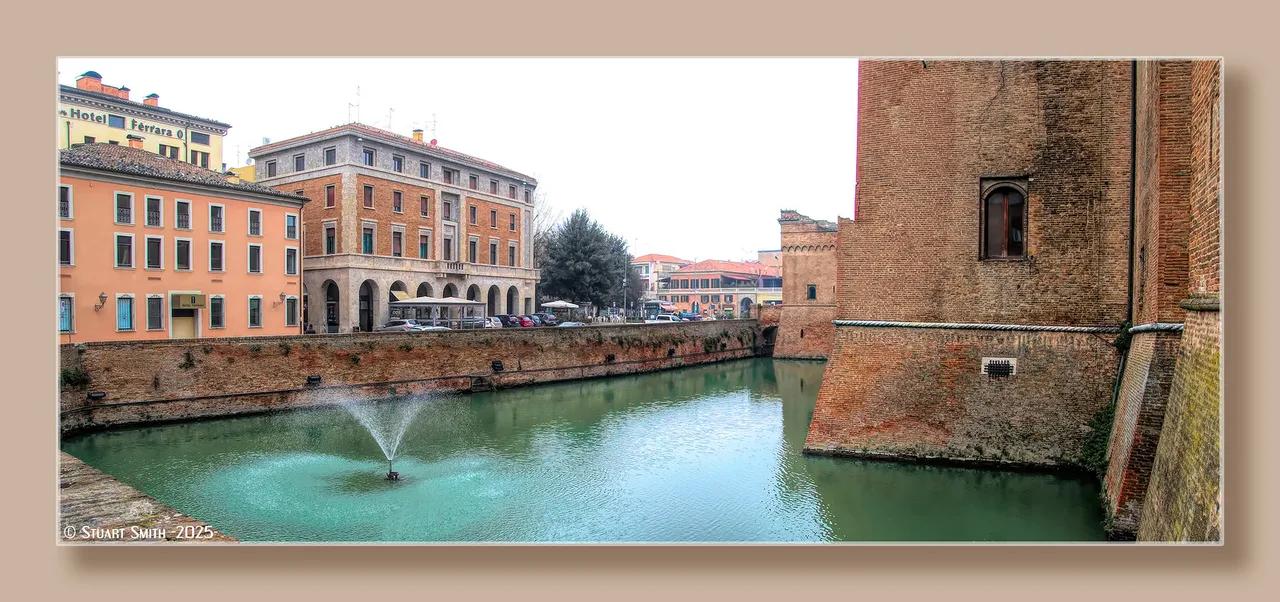
The moated brick castle from 1385 dominates the centre and is free to circle from outside; its courtyards and water ring can be seen without buying anything. That makes it a sensible low-commitment stop on a half-day walk: walk the moat, take in the towers and decide on the spot whether the interiors justify the time.
The castle interiors are separately ticketed with their own hours, and prices and booking arrangements change, so check the official Castello Estense pages on the day rather than relying on older guidebooks. If your half day is tight, the exterior is enough; if you have a full day, going in early keeps the rest of the route relaxed.
Piazza Trento e Trieste and the Cathedral
The cathedral of San Giorgio faces Piazza Trento e Trieste, a wide square shared with market stalls, cafes and the clock tower. The Romanesque facade begun in the twelfth century is the draw from outside, and the square is the obvious place to sit down; treat any cafe here as your coffee stop by choosing one with tables facing the church rather than following a fixed recommendation.
Whether you can go inside depends on restoration work, which has affected the building in recent years, so look at the doors on arrival instead of assuming access. If the interior is closed, the facade, the adjacent municipal palace courtyard and the square itself still fill a pleasant half hour.
Corso Ercole I d'Este and the Addizione Erculea
Corso Ercole I d'Este is the spine of the Addizione Erculea, the deliberate late-fifteenth-century expansion that added broad, straight streets to the medieval core. Walking it north from the centre is the clearest way to understand why Ferrara is studied as an early example of planned urban design: the perspective, the palazzo frontages and the cross streets all belong to one scheme.
Because the street is a working road, the pleasure is in the long view rather than individual doorways. Walk the full length once, then turn into the side streets on the way back if a facade catches your eye.
Palazzo dei Diamanti and the Diamond Facade
Palazzo dei Diamanti closes the Renaissance stretch with a facade of diamond-cut marble blocks, built from 1493 as part of the same planned district. It is a building to look at from the street and the surrounding square first; the effect depends on daylight, so an afternoon arrival gives a different reading from a morning one.
The interiors are a separate decision. The palace hosts temporary exhibitions and the civic gallery, with their own tickets, dates and opening arrangements, so check the palace's own listings before building your day around a show. If nothing on view appeals, keep walking: the facade alone justifies the detour.
Optional Art Stop: Palazzo Schifanoia
Palazzo Schifanoia is the strongest art addition if your half day stretches into a longer one. Its Hall of the Months, painted by the Officina Ferrarese under Borso d'Este, is the reason to pay the entry, and the museum's published hours are Tuesday to Sunday 10:00 to 19:00 with the ticket office closing at 18:00, while tickets are listed at 12 euros full and 9 euros reduced for 18 to 30-year-olds and over-65s. Check those hours again before you go, since museum schedules change.
Budget at least an hour if you want to read the three tiers of the fresco cycle properly rather than file past them. On a genuine half day, the honest trade-off is Schifanoia or the castle interiors, not both.
Optional Quiet Detour: Sant'Antonio in Polesine
Sant'Antonio in Polesine is a working Benedictine monastery, and its appeal is the painted nuns' choir with frescoes from the school of Giotto rather than monument-scale spectacle. Visits run in short windows: the museum service lists Monday to Saturday 9:30 to 11:30 and 15:15 to 16:45, closed Sundays and holidays, while the provincial tourism board lists a Sunday afternoon window of 15:15 to 16:45, so confirm by phone before making the walk.
Entry is by donation, and small groups may need to ring ahead, so treat this as a contemplative stop rather than a box to tick. Dress and behaviour should suit a cloistered community: quiet voices, no wandering beyond the visitor route, and no assumption that every part of the complex is open.
Finishing on a Wall Stretch
From the northern palaces, rejoin the walls for the closing stretch; the tree-lined ramparts are where the city feels emptiest of traffic and you can see how the centre sits inside its green ring. This is also the easiest place to adjust your finish: head back toward the station or loop into the centre depending on your train.
Late afternoon is the kindest light for the walls, but the route works in either direction, so a morning walker can simply reverse it. Carry water, since shade on the ramparts is patchy in summer.
Practical Tips for Pacing the Route
Plan around one paid interior plus the free exteriors if you have around four hours on the ground. Two museums, a monastery visit and a relaxed coffee stop will not fit comfortably, so decide before you set out what you would drop rather than rushing the Hall of the Months or the castle.
Surfaces are a mix of paving, cobbles and grass on the walls, so shoes with some grip help on the arched lane. Beyond that, the walk is level and short, and frequent benches and cafes give you room to shorten it at any point.
For a longer stay or a different mood, explore more hidden gems in Ferrara and treat this loop as the orientation day rather than the whole visit.
Make the Walk Your Own
Ferrara's centre is generous to self-guided walkers: the walls, squares and exteriors are free, and the ticketed interiors can be added one at a time as your energy allows. Use the operator's three-hour figure as a rough guide, verify museum hours on the day, and leave space for a second coffee. For related planning, see Ferrara Attractions: Visitor Guides to 10 Sights. For related planning, see Museo del Duomo Ferrara: Cathedral Museum Guide.
Frequently Asked Questions
How long does a self-guided walking route in Ferrara take?
One self-guided audio tour operator measures a comparable route at roughly three hours and about 3 km, but that is their planning estimate, not an official time. Add an hour or more for any museum or monastery interior, and treat a half day as realistic only if you pick one or two paid stops.
Is the route free, or do I need tickets?
The walls, streets, squares and the castle exterior cost nothing to see, and the monastery is entered by donation. Ticketed interiors such as Palazzo Schifanoia, the Castello Estense and the Palazzo dei Diamanti exhibitions are charged separately, so check each venue's current prices and hours before visiting.
Is Palazzo Schifanoia worth adding to a half-day walk?
If you care about Renaissance fresco cycles, yes: the Hall of the Months is the reason to pay the entry, and it rewards an unhurried hour. On a tight half day, choose it over the castle interiors rather than trying to do both.
Can I walk the route with kids or limited mobility?
The centre is flat and the distances are short, which suits families and slower walkers, and you can cut the route at any square. Surfaces include cobbles and grass on the walls, and access inside individual monuments varies, so check each venue before you commit to a paid visit.
Where should I break for coffee on the route?
Piazza Trento e Trieste is the natural pause, with cafes facing the cathedral, and the lanes around Via delle Volte offer quieter alternatives. Pick a table you like rather than following a fixed recommendation, and factor the stop into your timing.
Do I need to book anything in advance?
Most of the walk needs no booking, but the free Greeter service and monastery group visits require arranging ahead, and temporary exhibitions at Palazzo dei Diamanti may sell out around busy periods. Check the official pages for each site in the days before you travel.
Sources
- Comune di Ferrara | Sito istituzionale
- Ferrara Self-Guided Tour: Castles, Diamonds & More
- Ferrara Greeters: Free walking tour - mini group
- 6 Best Things To Do In Ferrara
- Walking Tour Ferrara – Self-guided audio tour in 1 day
- St. Anthony Polesine - Musei di Ferrara
- Monastery of Sant'Antonio in Polesine - Ferrara Terra e Acqua
- Monastery of Sant'Antonio in Polesine - InFerrara
- Museo Schifanoia - InFerrara
- 24 Hours Sightseeing In Ferrara Italy & Nice Places For Food
- A Week in Ferrara: The Best City You Weren’t Planning to Visit - Travel Guide - Mark Your Landing Spot
- to-be-seen
Continue exploring
More guides you'll find useful





