
Ferrara Three Day Itinerary: A Slow-Paced City Plan
Plan three unhurried days in Ferrara with the city walls, Corso Ercole I d'Este, the old town and ghetto streets, plus realistic pacing advice.
On this page
Ferrara lies in Emilia-Romagna between Bologna and Venice, and one travel account notes that visitors often overlook it despite its well-preserved centre. That makes it a natural fit for a slower trip: the core is walkable, the old walls offer a green loop of roughly nine kilometres, and the food alone justifies an unhurried evening.
A single day in Ferrara usually means a rushed walk from the station to the castle and back. A suggested three-day shape lets you split the centre across two mornings, treat the walls as a flexible half-day rather than a mandatory full loop, and keep the third morning open for a bike ride or a repeat of a favourite quarter. Nothing here is an official schedule; these are suggestions for how to pace the days.
Why Ferrara Rewards Three Days Instead of One
The municipal site presents Ferrara as a city recognised as UNESCO World Heritage, and the centre is compact enough to cross on foot in the course of a morning. The density is the point: rather than travelling between sights, you drift from a Renaissance avenue into a medieval alley within minutes. Three days turn that density into an advantage instead of a blur.
One travel account describes Ferrara as having superb food and plenty of opportunities for cycling or walking, and remarks that it lacks the tourist crowds of Italy's headline cities. Treat any sense of quiet as relative and expect the centre to be busiest around the evening passeggiata.
The trade-off is that Ferrara does not hand you one blockbuster sight that fills a whole day. If you need constant stimulation, two days will be plenty; if you like markets, long lunches and returning to the same piazza twice, the third day is where the trip settles into its rhythm.
Before You Go: Trains, Orientation and What to Confirm
Ferrara's main station sits within walking distance of the historic centre, which makes it an easy rail stop from Bologna or Venice, according to the same day-trip account. Trains are described there as frequent, with the Bologna run taking roughly half an hour to an hour depending on the service type. Check current timetables and fares with the operator before you travel, since schedules change by season.
The municipal site is the place to confirm current civic information, including mobility and traffic notices that can affect streets around the centre. It also links to the official tourist portal and the regional transport operator, which is where you should verify any local transport question rather than relying on a general guide.
Pack for walking and bring a light layer for evenings: the flat streets are forgiving, but the walls and the cobbled medieval core add distance to any day. If you plan to cycle, confirm current rental options and local cycling rules when you arrive, as these are not fixed facts a guide can promise.
Day 1 Morning: Arrive and Take the City Walls Gently
Start with the walls rather than the centre. The day-trip account describes a gravel path lined with tall trees running along the old circuit, with the walls totalling around nine kilometres and forming a circular route. You do not need to complete the loop: pick up the path, walk a section, and step off where a street leads towards the centre.
The walking-versus-cycling decision matters here. On foot, a half-circuit plus the centre is a comfortable morning; by bike, the full loop becomes realistic, and the same source calls Ferrara heaven on earth for bicycle lovers. Either way, leave the walls while you still have energy for the afternoon, since the centre involves its own walking.
Follow the route towards Corso Ercole I d'Este, the avenue that opens the Renaissance part of the city. A ten-stage walking tour of Ferrara is a useful reference for ordering these stages if you prefer a structure to improvising.
Day 1 Afternoon: Corso Ercole I d'Este, Palazzo dei Diamanti and the Castle
Corso Ercole I d'Este begins as a cobbled residential street and becomes progressively grander, with palaces lining the way and the Palazzo dei Diamanti described as the most striking of them. Even without entering, the facade and the street are the sight; budget your time for standing and looking rather than for a ticketed visit.
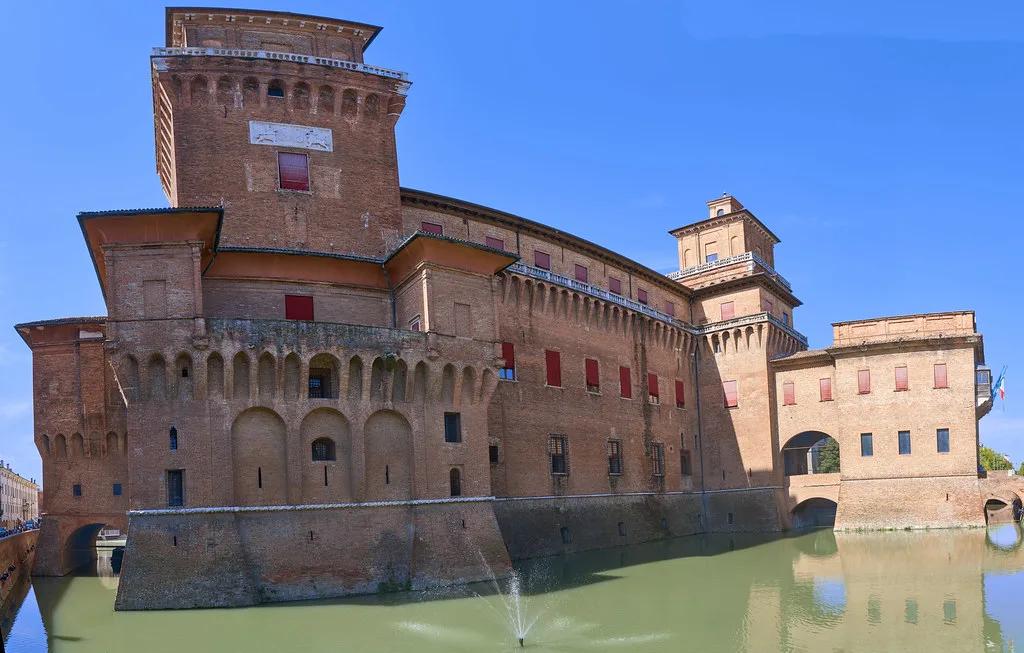
At the end of the avenue the Castello Estense comes into view, almost disproportionately large. The day-trip account notes that wandering the castle courtyards is free, while some indoor sections can be visited for a fee. Do not assume one ticket covers everything: treat courtyards and interiors as separate decisions and confirm current arrangements at the castle itself.
The castle also houses Ferrara's tourist information office, according to the same account, which makes it the obvious stop for brochures on local events and current openings. Ask there about anything time-sensitive rather than trusting a printed guide.
Day 1 Evening: Piazza Cattedrale, the Duomo and a First Dinner
Head to Piazza Cattedrale to see the pink and white Duomo facade, then stay for the evening passeggiata, when locals take their slow stroll around the square. The same account recalls a street market adding to the liveliness of the piazza on the day of that visit; markets vary, so treat it as a bonus rather than a fixture.
For dinner, order cappellacci di zucca, the hat-shaped pasta filled with pumpkin and traditionally served with butter and sage. The day-trip account warns plainly that the sweet-savoury pairing is not for everyone, so if pumpkin pasta sounds odd, choose another Emilian dish and keep the bread, which is notable for its twisted shape, on the table.
One named option in that account is Osteria I Quattro Angeli, chosen for its outside tables with a view of the castle. It is a single recommendation rather than a ranking; book ahead or arrive early in high season, and confirm opening days directly.
Day 2 Morning: A Deeper Walk Through the Centre
Day two is for the centre itself, without the walls as an overture. The ten-stage walking tour on the regional tourism site runs through the Este Castle, the Cathedral of San Giorgio, Piazza Trento Trieste, Via delle Volte and the Palazzo dei Diamanti, which makes a useful spine for a morning. Use it as a sequence of anchors rather than a route you must follow exactly.
The difference between the marked themed routes and unstructured wandering is worth planning around. The routes give you the significant streets and a sense of how the Renaissance additions connect to the medieval core; wandering gives you the courtyards and side alleys that no route lists. Do the marked route first, then abandon it.
If you want a fuller catalogue of what you are passing, the city's attraction guides cover individual sights in detail and help you decide where to spend an indoor hour.
Day 2 Afternoon: The Ghetto Streets and Time to Slow Down
The old medieval town and the ancient Jewish Ghetto are described in the day-trip account as the place to finally put the map away, with the ghetto marked by a blue line on the city's tourist map displayed at points around Ferrara. That is an invitation to wander, not a list of sights: there is no prescribed route, and the pleasure is in the narrow lanes themselves.
Build this block with slack. Two hours of wandering, a coffee, and another hour of wandering is a better use of the afternoon than racing to a third museum. If you have already walked a lot, sit in a square instead; the ghetto rewards attention more than coverage.
Beyond the centre, the wider network of quiet lanes and less-trodden corners is where the city feels least like a tourist stop, and the guide to hidden gems in Ferrara covers those areas in more depth.
Day 2 Evening: A Long Dinner and the Castle After Dark
Keep the evening long and local. Order a plate of contorni, the grilled vegetables and oven-baked potatoes the day-trip account remembers alongside the pasta, and take the house red rather than chasing a wine list. The same account describes its meal as memorable and reasonably priced, a reminder that Ferrara's food reputation rests on everyday cooking rather than ceremony.
After dinner, walk back past the Castello Estense. Outside, the moat and towers are free to see, and the courtyards give a second, quieter look at the same building you saw in daylight. Check the city's events calendar for anything on during your dates, but do not build the evening around a listing you have not confirmed.
Day 3 Morning: Choose One Thread
The third morning is where three days earn their keep, so pick one thing rather than adding a third neighbourhood. The cleanest choice is the full wall circuit by bike, which turns the whole perimeter into a stretch of flat riding. The alternative is a repeat of a favourite quarter at a slower pace, returning to Corso Ercole I d'Este or the ghetto streets when they are emptier.
Walking the entire loop instead of cycling is possible but takes a good part of a morning, and the gravel surface makes it slower than the map suggests. Decide the night before, based on how your legs feel, and hold the plan loosely. Bike rental options should be confirmed locally when you arrive.
If the weather turns, swap the walls for the indoor sections of the Castello Estense or a museum stop, and confirm current opening details at tourist information or on the city's official pages.
Day 3 Afternoon and Evening: Leave Room for a Day Trip
With frequent trains from Bologna and Venice, Ferrara works well as a base for a short excursion, and the day-trip account notes both cities as easy connections in the other direction. If you would rather stay put, use the afternoon for an unhurried museum, a second castle visit with the interiors this time, or simply a long lunch. Verify train times and ticket prices with the operator on the day.
Spend the final evening in the medieval alleys rather than on a farewell checklist. A last pass along Via delle Volte, one of the stages in the regional walking tour, and through the small streets towards the station ends the trip on the same quiet note it began.
If three slow days leave you hungry for a same-length plan in another European city, our Budapest three-day itinerary follows a similar principle of one district at a time.
How to Pace Three Days: What to Cut and When to Swap
If you have to cut, drop the full wall loop rather than the centre. The walls are a pleasant frame for the city, but the streets around Corso Ercole I d'Este, the castle courtyards and the ghetto alleys carry the trip, and a half-circuit gives most of the scenery for a fraction of the effort.
Heat and rain change the plan more than distance does. On hot days, walk the walls early and keep the afternoon indoors; on wet days, use the covered streets and the castle interiors and save the ghetto for a dry evening. Any specific rule about access or cycling should come from the city itself, not from a guide.
Three days is not too long if you treat Ferrara as a place to eat and stroll rather than to collect sights, and it is too long if you need a new headline attraction every few hours. Two full days in the centre plus one flexible morning is the most forgiving structure.
Practical Planning Notes
Use the municipal site for verified civic information and the official tourist portal for current events, and stop at the tourist information office in the castle for brochures and local advice on arrival. Confirm opening days and any charges for the sites you care about before setting out, because none of these are fixed from season to season.
Expect to walk a lot and to eat well: the flat centre is kind to pedestrians and cyclists alike, and the food is the region's strength. Keep one flexible half-day free in any three-day plan, and Ferrara will fill it without any schedule at all.
If you later plan a Prague trip, our Prague three-day itinerary shows the same district-by-district pacing applied elsewhere.
Plan Your Visit
Three days in Ferrara work best as a slow loop: walls first, then the Renaissance avenue and the castle, a whole day for the medieval core and the ghetto, and a final morning left deliberately open. Confirm trains, opening details and any local rules before you go, and let the evenings stay long. For related planning, see Day Trips from Ferrara: City Sights and the Po Delta.
Frequently Asked Questions
Is three days too long for Ferrara?
Three days is comfortable rather than too long, provided you plan for wandering and long meals rather than a new major sight each morning. The compact centre fits into two days, and the third is best used for a full circuit of the old walls by bike, a repeat of a favourite quarter, or a short excursion. If you prefer constant activity, two days will cover the essentials.
Is Ferrara worth visiting?
It is worth visiting for its dense Renaissance and medieval centre, its walkable and cycle-friendly walls, and its food, and one travel account notes that it draws fewer tourists than Italy's headline cities. It suits travellers who enjoy cities on foot rather than checklist sightseeing.
What food is Ferrara known for?
The signature dish is cappellacci di zucca, hat-shaped pasta filled with pumpkin and served with butter and sage. It is a sweet-savoury combination that not every visitor enjoys, so it is worth ordering one plate to share first. Grilled vegetables and baked potatoes are common side dishes, and the local bread has a distinctive twisted shape.
What can you see in Ferrara in one day compared with three?
One day usually covers a section of the walls, Corso Ercole I d'Este, the castle courtyards and the cathedral square, with time for a single meal. Three days add the medieval core and ghetto streets at an unhurried pace, the option of a full wall circuit by bike, and room for a short train excursion.
How do you get to Ferrara from Bologna?
Trains connect Bologna and Ferrara frequently, and the journey is generally described as short, though the exact time depends on the service type. Check current timetables and fares with the operator before travelling, since schedules and prices change. Ferrara's station is within walking distance of the historic centre.
Sources
Continue exploring
More guides you'll find useful





