Cagliari Self-Guided Walk: Castello to Stampace Route
Follow our suggested self-guided walk through Cagliari's Castello, Marina and Stampace quarters, with a sensible sight order and practical stops.
On this page
Cagliari rewards walkers because the historic centre folds four old quarters into a compact area, but it also punishes anyone who ignores the hills: Castello sits on the high ground, while Marina and Stampace spread below. The route below front-loads the climbing, then descends through the lower quarters, so the hardest work happens while your legs are fresh. Treat the timings as editorial suggestions rather than official guidance.
One useful planning rule runs through the whole day: squares, walls, stairways and church exteriors are public ground, while museums, towers, crypts and galleries are separate ticketed interiors and are not covered by a single combined ticket. Build the walk around what you want to see for free, then add paid visits deliberately. Use the Cagliari Attractions hub to check individual sights before committing.
Why Cagliari Suits a Self-Guided Walk
Cagliari stands on seven hills, and the city's own tourism board describes Castello as the high quarter that offers a 360-degree view over the city and the gulf. That vertical layout is the key to planning: rather than zigzagging up and down, choose one ascent, link the sights along the ridge, and descend once. Local guides also point out that the four historic quarters, Castello, Stampace, Marina and Villanova, sit close enough together to be explored on foot in a single urban walk.
A realistic full loop covering Castello, Marina and Stampace, with a couple of short interior visits, takes most of a day at a relaxed pace. A trimmed version that climbs to Castello, descends by the Bastione di Saint Remy and finishes along Via Roma fits comfortably into a half day. Whichever version you choose, walking is the point rather than the transport: the pleasure lies in the alleys, the sudden views and the change of scale between the fortified ridge and the port below.
The main caution is heat and climbing rather than distance. A writer who knows the city well notes that some visitors prefer to avoid the hills, and that public shuttles exist to reach elevated areas such as Castello. Verify current service details with the Comune di Cagliari before relying on them, because local transport arrangements change.
Before You Set Off
Wear shoes that cope with worn stone and steep steps, carry water, and take sun protection even outside high summer, because much of the route is exposed. The city's tourist board recommends comfortable walking shoes, and notes that many areas have shade but the sun can still be strong. A hat and a refillable bottle are small investments that make the Castello climb far more enjoyable.
Decide in advance how you will handle the ascent. The stairs are the traditional approach, but the city has scenic lifts serving elevated areas, including connections toward the Bastione di Saint Remy and Piazza Indipendenza. Lift operating status is not guaranteed, so check on the day rather than planning around them. If stairs are not an option, plan a shorter route and treat any lift you find as a bonus.
Finally, fix your paid-visit priorities before you start walking, because several sights keep their own hours and sell their own tickets. The Roman Amphitheatre's visiting arrangements are a good example: the Cagliari Turismo page states that restoration work limits access to parts of the building. Checking each official page the day before is more reliable than trusting an old guidebook.
Leg 1 – Piazza Yenne and Via Sassari: An Easy Start
Begin at Piazza Yenne, which local walking routes treat as the heart of the modern city and a convenient meeting point. The square takes its old name, Piazza San Carlo, from 1822, when the viceroy placed a milestone marking the start of the Carlo Felice road that would link Cagliari to Porto Torres. The bronze statue of Carlo Felice still dominates the centre, making it an easy landmark to find.
From Piazza Yenne, follow Via Sassari toward Corso Vittorio Emanuele, the elegant street that acts as the city's drawing room. This opening stretch is deliberately gentle: it lets you adjust your pace, notice the shopfronts and palazzi, and keep the climbing for later.
The same route description places Via Roma and Via Sassari close to both the port and the station, which makes this start point practical if you arrive by ship or train. If you are coming from a cruise call, walk into the centre first and begin the loop here rather than trying to start at the top of Castello.
Leg 2 – Climb to Castello Through Porta Cristina
Take the climb steadily, following signs for Castello, the fortified medieval quarter. If you use the classic approach, enter through Porta Cristina and arrive at Piazza Arsenale, where the former Royal Arsenal now houses the Cittadella dei Musei. The gate is named after Maria Cristina of Bourbon, consort of King Carlo Felice of Savoy.
Inside the Cittadella complex you will find the National Archaeological Museum, the National Picture Gallery and other collections, each with its own ticket rather than one pass for everything. The archaeological museum is the headline act, holding finds that span prehistory through the Roman and Byzantine eras, including Nuragic bronzes. Choose one collection rather than trying to see them all, and check the museum's own site or tourist office for current hours and admission.
If museums are not your priority, Piazza Arsenale still works as a free rest stop and a place to look back over the lower city. Use it to decide whether you want to spend an hour indoors or push on to the Castello core while the morning is still cool.
Leg 3 – The Castello Core: Squares, Cathedral and Towers
From Piazza Arsenale, walk into the historic heart of Castello and head for Piazza Palazzo. Along the way you pass the Tower of San Pancrazio, built at the behest of the Pisans in the early 14th century together with its twin, the Tower of the Elephant. Both are landmarks of the Pisan reshaping of the city in the 1200s and 1300s.
In Piazza Palazzo you meet the Palazzo Regio, also known as the Viceregio, and the city's Cathedral of Santa Maria. The cathedral is a working church, and the tourism board notes that visits to the cathedral and crypt are free while the bell tower is subject to a fee. Read that distinction carefully: the free part is the church interior, not the panoramic tower.
The Palazzo Viceregio dates from the 14th century, when it became the official residence of the viceroy, and a large staircase was added in 1730. Today it houses provincial offices but is open to visitors for a small admission fee, and joining a guided visit on site is the usual way to see the decorated rooms. Confirm current visiting arrangements by telephone or email before building your day around it.
Allow time simply to wander the alleys behind the square, where the white limestone catches the light and the crowds thin away from the main route. This is also the moment to notice the quieter corners that a walking route tends to skip: the hidden gems in Cagliari guide collects several of them in one place.
Leg 4 – Descend via the Bastione di Saint Remy
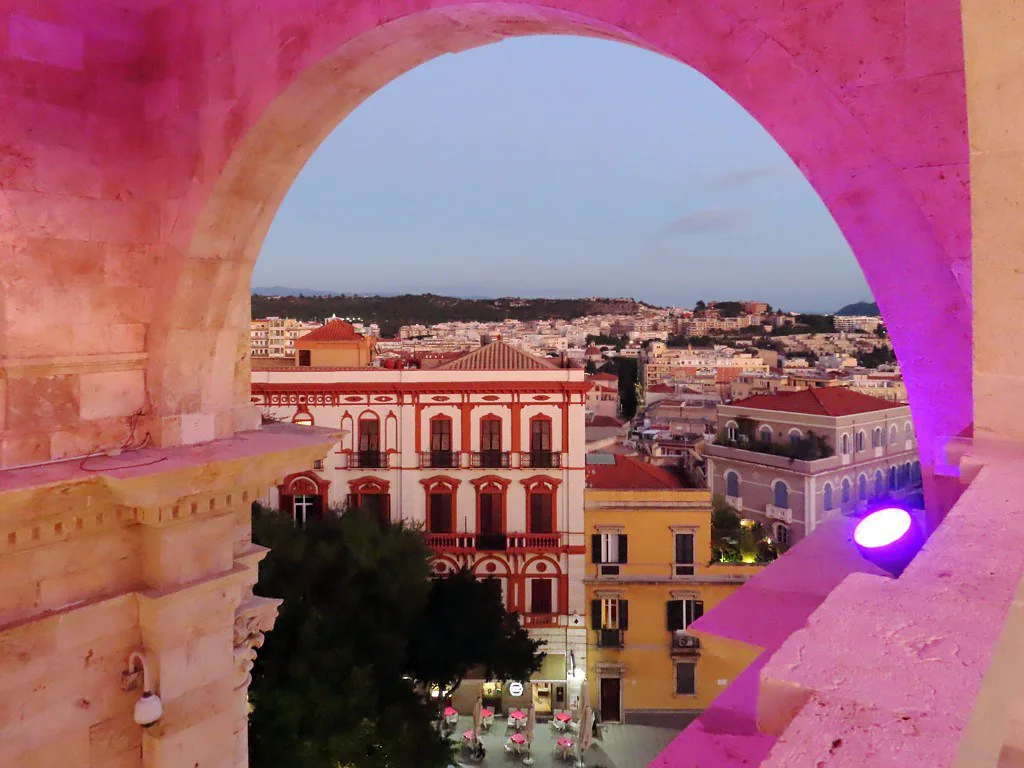
Leave Castello through Via del Fossario and take the steps down to the Bastione di Saint Remy, whose Terrazza Umberto I was built in the early 20th century on the older Spanish bastions. The terrace is one of the city's signature viewpoints, and the descent makes it a natural reward rather than an extra climb.
Inside the thick walls of the bastion, the Passeggiata Coperta is a covered walkway with a separate admission fee. A local writer explains that it was inaugurated in 1902 and served as an infirmary in the First World War and as a shelter during wartime bombing, which makes it a useful wet-weather or hot-weather alternative. Treat it as an optional interior, not part of the free route.
From the terrace, the view runs across the lower quarters and the gulf, so take a few minutes here before continuing. Pause for coffee in the streets below if you like, but check current opening hours at the door rather than planning around an old listing.
Leg 5 – Marina: Porticoes, Archaeology and Shopping Streets
Descend into Marina, the quarter bounded roughly by the castle walls above and Via Roma along the harbour. Walk the porticoes of Via Roma, then duck into the side streets to see the church of Sant'Eulalia, where excavations brought Roman-era remains to light. The city's heritage sites and museum complexes publish their own visiting information, so consult the Sant'Eulalia museum system directly for current access, hours and tickets.
Via Manno and Largo Carlo Felice provide the commercial counterpoint to the archaeology, with shops and historic buildings including the former hospital. This is a good stretch for a mid-walk pause, but it is also the busiest part of the route, so keep valuables close and expectations realistic.
If you are travelling with older companions or simply want a calmer pace, this is the moment to shorten the loop. A writer with local knowledge points out that districts like Marina and Villanova offer level paths while shuttles serve hillier Castello, so the lower quarters make an easy finish on a tiring day.
Leg 6 – Stampace and the Roman Amphitheatre Add-On
Next, cross into Stampace, the quarter known for the festival of Sant'Efisio, which takes place each year on 1 May and involves a procession from Cagliari to Nora and back. The church of Sant'Efisio and the nearby churches of San Michele and Sant'Anna anchor the neighbourhood. This is a place to look at rather than rush through, especially if you have already done the museums.
Two optional add-ons sit here. The Cripta di Santa Restituta, beneath the Santa Restituta church, is a partially natural and partially excavated space once used as a quarry, later as a religious site, and reportedly as a shelter during wartime bombing; it charges a small admission. Just beyond, toward the botanical garden, lie the ruins of Sardinia's largest Roman amphitheatre, built between the first and second centuries AD.
The amphitheatre is carved into the bedrock of the Buoncammino hill, and Cagliari Turismo notes that restoration work limits visits to an 80-metre walkway, with no access to the arena or underground areas. Its published times differ by season: October 1 to April 27 runs 10am to 5pm, while April 28 to September 30 splits into 10am to 1pm and 3pm to 7pm, with the ticket office closing 30 minutes before closing time. Admission is listed as a full price ticket, student and senior reductions, a school rate and free entry for visitors with disabilities and their carers, plus a separate combined ticket valid for a week across several civic sites. Confirm these figures on the official pages before you go, since they may change.
Leg 7 – Villanova and Green Stops
Finish in Villanova, the most recent of the four quarters, known for low houses and small shops. Here you find the church of San Saturnino, described as the oldest church in Cagliari, along with the church of San Giacomo and the former slaughterhouse, now a cultural centre. The quarter is also where the confraternity behind the Holy Week celebrations is based.
Nearby green spaces give the walk a slower ending. Giardini Pubblici, the 19th-century public gardens below Castello, are free to enter and include a gallery with its own small admission fee, while Monte Urpinu is a much larger hill park with ponds, birds and a panoramic road. Both are useful if you are walking in warm weather and want shade rather than another monument.
For a green stop with wildlife, Molentargius park behind the Poetto beach area protects a wetland where pink flamingos nest, and the city's own tourism pages describe the Santa Gilla and Molentargius lagoons as important wetlands. This is an extension rather than part of the core loop, so allow extra time and check park access before setting out.
Optional Extensions Beyond the Centre
If you have a second day, the Tuvixeddu necropolis is one of the most striking additions. It is described as the largest funerary architecture in the Carthaginian world, with vertical well tombs cut into the limestone from around the sixth to third century BC. A local writer notes that it is free to access and open daily from early morning until late evening.
Other quieter stops worth knowing about include the Bonaria cemetery, which a local writer describes as much more like an art gallery than a burial ground, and the ruined Fortino di Sant'Ignazio near Calamosca beach, a free site popular for sunsets. Neither is essential to a first walk, and both involve extra climbing or a bus ride, so add them only if your legs and schedule allow.
The full hidden gems in Cagliari guide pulls these lesser-visited places together with practical notes, which is useful when you want to build a second, quieter day after the main historic-centre loop.
Where to Eat and Pause
The natural lunch stop is in Marina or lower Stampace, where the density of cafes and trattorias is highest and you are close to the port. Rather than chasing a specific address, look for places with a short menu of Sardinian dishes and check the day's offerings at the door. Prices and opening hours vary, so compare on arrival.
For self-catering or a picnic, the San Benedetto market is the classic destination when it is operating normally, with a fish hall on the ground floor and produce above. Note that a local writer reported in early 2025 that the market had closed for renovation and traders had moved to nearby Piazza Nazzari, so check the current situation locally before making a special trip.
Bakeries and small bars are scattered throughout all four quarters, and part of the pleasure of a self-guided walk is stopping when you see something that looks good. Carry water regardless, and treat any specific opening hours you read online as approximate unless the business itself confirms them.
How to Adapt the Route
For a short visit, cut everything except Legs 1 to 4: start at Piazza Yenne, climb to Castello, see the cathedral and towers, then descend by the Bastione. That gives you the essential Cagliari view and the fortified core in a few hours. For a cruise day, begin at Via Roma, walk the porticoes, climb to Castello, and return by the same lower streets rather than attempting Villanova.
For reduced mobility or hot weather, use the lower quarters as the backbone and treat Castello as optional. A writer with local knowledge notes that Cagliari has an efficient public bus system and taxis, and that many key attractions sit close together, which makes it feasible to see Marina and Stampace on foot while reaching Castello by vehicle or lift. Verify current services locally.
In summer, start early and plan to be indoors or in shade during the middle of the day. The amphitheatre's split opening hours, with a long midday break from late April to September, reflect how the city handles heat. Build a siesta into your plan rather than fighting it.
Plan Your Visit
A self-guided walk through Cagliari works best when you accept the city's vertical logic: climb once, follow the ridge, and descend through the lower quarters. Keep the free public ground, the squares, walls and church interiors, separate in your mind from the paid museums, towers and crypts, and check the latter individually rather than assuming a combined ticket.
Before you go, verify the opening times and prices of any interior you care about on the official Cagliari Turismo, SardegnaCultura or museum websites, and confirm local transport if you plan to avoid the stairs. The Comune di Cagliari and the regional tourism site are the most dependable starting points for current visitor information. For related planning, see Roman Amphitheatre of Cagliari: Visitor Guide to the Rock-Cut Ruins.
Frequently Asked Questions
Is Cagliari walkable for a self-guided tour of the historic centre?
Yes. Castello, Marina, Stampace and Villanova sit close together, and the historic centre is compact enough to explore on foot. The main challenge is the climb to Castello rather than distance, so plan the uphill section for the coolest part of the day and consider a lift or bus for the ascent if stairs are difficult.
How long does a self-guided walk through Castello and Stampace take?
A relaxed loop covering Castello, Marina and Stampace with one or two short interior visits takes most of a day. A trimmed version that climbs to Castello, descends by the Bastione di Saint Remy and finishes along Via Roma fits into a half day. These are suggestions rather than official timings.
Do I need tickets to walk around Castello and the Bastione di Saint Remy?
No. The streets, squares, walls, stairways and the terrace of the Bastione are public ground. Paid interiors such as the museums in the Cittadella dei Musei, the cathedral bell tower, the Passeggiata Coperta, the Santa Restituta crypt and the Roman Amphitheatre are separate and are not covered by a single combined ticket.
Can you walk from the Cagliari cruise port into the old town?
The port area along Via Roma is close to the start of the walking route at Piazza Yenne and Via Sassari, so passengers arriving by ship can walk into the historic centre. Begin there, climb to Castello early, and return through Marina rather than trying to start at the top of the hill.
Is the walk to Castello very steep, and are there alternatives to the stairs?
Castello is the high quarter and the climb involves genuine steps and gradients. The city has scenic lifts serving elevated areas, including connections toward the Bastione di Saint Remy, but operating status is not guaranteed. Check on the day and consider a short bus or taxi ride if stairs are not an option.
What should I skip on a self-guided walk if I only have a few hours?
Skip Villanova and the optional extensions such as Tuvixeddu, Molentargius and Monte Urpinu. Focus on the climb from Piazza Yenne to Castello, the cathedral and squares, and the descent via the Bastione di Saint Remy. That gives you the essential views and fortified core within a short visit.
Sources
- Comune di Cagliari
- SardegnaTurismo - Sito ufficiale del turismo della Regione Sardegna
- Urban walking: the best way to discover Cagliari in South Sardinia
- Roman Amphitheatre | Cagliari Turismo
- SardegnaCultura - Cagliari, Roman Amphitheater
- MUTSEU | Mutseu
- The most beautiful museums to visit in Sardinia
- 13 Best Cagliari Hidden Gems: True Local Secrets
- 12 places not to be missed in Cagliari, Sardinia - Italia.it
- The story of the Tuvixeddu Necropolis | Trentaremi
Continue exploring
More guides you'll find useful