Cagliari in One Day: A Castello to Poetto Itinerary
One slow day in Cagliari: a walkable morning in the Castello citadel, lunch and a cave crypt in Stampace, an afternoon at Poetto and a Marina evening.
On this page
A single day in Cagliari works best when you accept that the city is a capital and a working port rather than a resort, and plan around one hilltop district, one beach block and one evening waterfront. The old city stacks upward in terraces, so the order of your stops matters more than the number of them. The suggested timings in this guide are our own planning suggestions, not an official schedule.
The shape is simple. Start high in the walled Castello citadel while the morning is cool and your legs are fresh, descend to Stampace for lunch and a cave-like church crypt, spend the warmest hours at Poetto to the south of the old town, then return to the Marina district and the Bastione San Remy terrace as the light softens. Treat every site as optional and verify status before you commit. A visitor who spent two days in the city still managed only a handful of stops, which is a fair warning against over-packing a single day.
How to Structure a Single Day in Cagliari
Cagliari sits at the southern end of Sardinia as the island's capital, main city and port, a geography that explains why the historic centre and the long city beach pull in different directions. Building the day in one direction — uphill first, seafront last — saves you from retracing steep lanes in the heat. Our own suggested blocks are roughly 9:00 to 12:30 in Castello, 12:30 to 15:00 in Stampace, 15:00 to 18:30 at Poetto and 18:30 onward in Marina.
Castello first is a practical choice: the citadel is enclosed by massive walls with several towers and gates, and its interior streets, cathedral square and university buildings were noticeably quiet when one visitor described them. That same visitor suggests giving the city itself one to two days and saving the rest of Sardinia for elsewhere, which is an honest way to frame the trade-off. If you want a fuller picture before deciding what to cut, browse the Cagliari Attractions guides and mark the two or three sites that matter most to you.
Check practical notices before you go. The city publishes service updates, mobility information and tourism pages on its institutional site, and the regional tourism board maintains an events calendar that is worth a glance for anything that might crowd the centre on your date. Neither source promises that a given monument interior will be open, so confirm with the site itself the day before.
Morning in Castello: Walls, Cathedral Square and Quiet Lanes
Enter Castello on foot and let the climb set your pace, because the citadel rewards slow wandering between gates rather than a checklist. The walls are the main event from outside, and the interior opens into small squares with the Cathedral of Santa Maria, whose square bell tower the visiting blogger dates to the 13th century, though the building has been reworked across the centuries. Give the cathedral a look from the piazza even if you do not go inside.
That same visit found the only underground room of the cathedral open to the public to be the Sanctuary of the Martyrs, where relics of 179 martyrs are kept, and reported that the other underground rooms were closed at the time. Treat this as one traveller's report to verify rather than a rule, and ask at the cathedral what is accessible on your day. If the answer is nothing, you have lost a staircase, not your morning.
Just outside the citadel, the Roman amphitheatre from the 2nd century AD is worth a look from the exterior; the visitor found it closed for restoration work during their stay. Do not build the morning around going inside it, and do not assume the intervention has ended. Passing by on the way up or down costs you a few minutes and still gives you the scale of the structure against the hillside.
Carry water and wear shoes with grip. The citadel lanes are steep and paved in stone, and the combination of climbing, standing in a piazza and descending again is more tiring than the short distances suggest. If you are travelling with someone who struggles on gradients, trim Castello to the cathedral square and one viewpoint instead of a full circuit.
Midday in Stampace: Lunch Logic and a Cave Crypt
Stampace is the practical lunch district because it sits below Castello on the walk down toward the waterfront, so you eat without adding a detour. Choose by what looks busy and suits your budget rather than by a name in an article; the sources here describe no specific venues, menus or prices, and those details change faster than any guide can track. Keep lunch to about an hour so the afternoon beach block still fits.
The Cripta Santa Restituta is the reason to linger. The church above looks unassuming, but the crypt below is a natural limestone cavern with a history stretching back roughly 3,500 years to an era of pagan worship; it is named for Restituta, a martyr who lived in the cavern in the 5th century. Inside you can see faded 13th-century frescoes and graffiti left when local residents used the space as an air-raid shelter during the Second World War.
The crypt is the right midday stop for two reasons: it is cool, and it is compact. Confirm current visiting arrangements locally before you rely on it, since a church interior can close for services or restoration without notice on a travel blog. If it is shut, swap in a slow lap of the Stampace streets and start Poetto earlier.
Optional Swap: The Tuvixeddu Necropolis
If an underground church space does not appeal, the Tuvixeddu necropolis is the alternative, and it is a different kind of visit altogether. The field holds about 1,000 tombs, originally cut in the 6th to 3rd centuries BC by the Carthaginians and reused in Roman times, with burial chambers carved into the hillside cliffs. The visitor found no entry fee and paths shared with people walking dogs, with informational panels faded and hard to read.
That combination — free, open-air, lightly visited and poorly signed — makes it a poor match for anyone who wants interpretation on site and a good one for travellers who have read up first. The same visitor noted that barriers and signage clearly discourage entering the tombs themselves, so plan to look from the paths. For more overlooked corners beyond the main circuit, this guide to hidden gems in Cagliari helps you weigh quieter stops against headline sights.
Choose one of the two: the crypt or the necropolis. Doing both squeezes the afternoon and leaves you rushing Poetto. The crypt suits a short, cool, interior stop with frescoes and wartime traces; the Tuvixeddu necropolis suits a longer walk outdoors among rock-cut tombs, with the understanding that you are largely on your own for context.
Afternoon at Poetto: A Contained Beach Block
Poetto lies just to the south of Cagliari's old town, and the visitor who skipped it in favour of city sights still described it as lovely from a distance. Your version: treat it as a swim-and-stroll block rather than a full beach day. Two to three hours is enough for a walk along the sand, a dip if the season suits and a coffee before heading back.
Getting there is a decision point, not a detail. The sources cited here give no bus or train numbers, routes or journey times, so check current local transport information on the day rather than trusting a line number from an old post. If the return journey looks slow, cut the beach short — the evening in Marina is the part of the day you would regret losing.
Set a hard cut-off time before you leave the centre, and keep it. Beaches have a way of extending themselves, and the distance back to the historic districts means the last hour of daylight is better spent on a terrace than in transit. If the weather turns, drop Poetto entirely and give the time to Castello's lanes or the Marina instead.
Evening in Marina and the Bastione San Remy Terrace
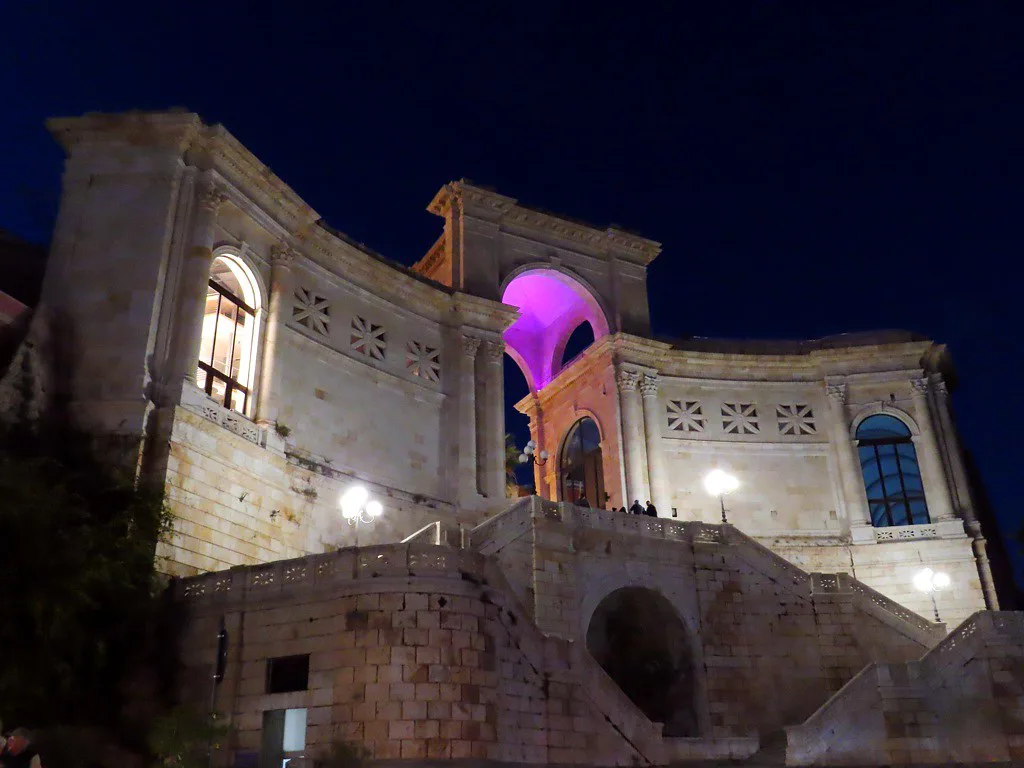
Finish on the waterfront. The Bastione San Remy, which the visiting blogger describes as a 19th-century structure, is one of the city's signature spots: from its terrace you get a sweeping view over Cagliari and the shoreline, and there are restaurants in the streets below it. The same visitor recommends this lower area for an evening wander as the sun sets, which is exactly how to use it — as a dusk viewpoint, not a midday detour.
The Marina district gives you the natural closing loop: waterfront wandering, a look back up at the lit walls of Castello and dinner without a further climb. Keep the evening unscheduled. After a morning of stairs and an afternoon outdoors, the best plan is one that ends when you are tired rather than at a fixed hour.
Logistics: Walking, Footwear and Protecting the Plan
This itinerary is built on walking, with the citadel climb as the only genuinely strenuous part. Wear shoes that handle smooth stone and uneven steps, carry more water than you think you need, and plan shade breaks in the middle of the day. A light layer helps on the terrace after sunset even when the afternoon was warm.
Protect the plan by verifying before you commit. The city website carries service notices and tourism information, and the regional tourism site lists events across the island that can affect transport and crowding. Check the specific monument's own page or ask locally for opening arrangements; nothing in this itinerary asserts that a site is currently open or closed.
Decide in advance what you will drop. If time runs short, the Roman amphitheatre exterior and the second viewpoint go first, then the necropolis. Castello's cathedral square, one descent through Stampace and a short Poetto stop are the core. That order keeps the day coherent even when something closes or a queue runs long.
If You Have More Than One Day
With a second day, the obvious additions lie outside the city. The visitor lists the ancient Su Nuraxi di Barumini, the Roman settlement of Nora west of Cagliari and the resort area of Villasimius to the southeast with its many beaches as worthwhile day trips. Each is a half-day or full-day commitment, so pick one rather than attempting two.
At the scale of the whole island, the regional tourism board is the better planning tool than any single blog, since it organises Sardinia by area and season and maintains the events calendar. Use it to check whether a festival, rally or walking event overlaps your dates before you lock accommodation. The island's quieter corners are also where the Tuvixeddu necropolis style of visit pays off most.
Plan Your Visit
One day in Cagliari is enough for a citadel morning, a Stampace lunch with a cave crypt, a contained Poetto afternoon and a Marina evening — provided you accept the trade-offs and verify what is open before you set out. The itinerary works because each block points downhill or seaward, so you are never undoing a climb at the wrong hour.
Check the city's institutional pages and the regional tourism events calendar in the days before you travel, confirm monument interiors locally, and keep the amphitheatre and the necropolis as flexible extras rather than fixed appointments. Then let the day run slightly loose; Cagliari rewards the traveller who stops on a terrace when the light is good. For related planning, see Cagliari Local Food Guide: What to Eat and Where to Find It.
Frequently Asked Questions
How should I split one day between Castello, Stampace and Poetto in Cagliari?
Use the morning for the walled Castello citadel while it is cool, descend to Stampace for lunch and a short crypt visit at midday, then give the afternoon to Poetto south of the old town. Return to the Marina district and the Bastione San Remy terrace at dusk. The timings are suggestions from this guide, not an official schedule.
Is the Tuvixeddu Necropolis free to visit?
A visitor reported no entry fee and paths used by people walking their dogs. Because that report is not from the site operator and may be out of date, confirm current access and any charges locally before making the trip, and plan to view the rock-cut tombs from the paths rather than entering them.
Is the Cripta Santa Restituta worth including in a one-day itinerary?
It is a compact, cool midday stop with genuine depth: a natural limestone cavern used since pagan times, with faded 13th-century frescoes and wartime graffiti. Confirm current visiting arrangements before you go, since church interiors can close for services or restoration without notice.
Can I walk from Cagliari's old town to Poetto Beach?
Poetto lies south of the old town, but this guide gives no distance or journey time and the sources provide no bus or train details. Check current local transport options on the day, or walk if you are comfortable with a longer stretch in the sun, and set a return time before you leave.
What should I skip in Cagliari if I only have one day?
Drop the Roman amphitheatre interior and the second Castello viewpoint first, then the Tuvixeddu necropolis. Keep the cathedral square, one descent through Stampace and a short Poetto stop as the core. Choose either the crypt or the necropolis rather than trying to fit both.
Is Cagliari worth visiting for a single day?
Yes, if you treat it as a city rather than a beach resort. A visitor suggested giving Cagliari itself one to two days and saving the rest of Sardinia for elsewhere. One focused day covers the citadel, a historic neighbourhood and the seafront; add a second day for trips to Nora, Villasimius or Su Nuraxi di Barumini.
Sources
Continue exploring
More guides you'll find useful